
The Jute Weaver
By Farihah Ahmed

Soumiya Lakshmi Krishnaswamy, drawing, six by six inch series (2010-ongoing). Ink on paper.
Image description: Grey wash for the abstract sky on the upper half and aqua spiral marks as waves in the abstract sea on the lower half.
I entered the forest through the island’s north end, where the fishermen had said there were many types of wood.
I was not sure which variety might best fashion a reed flute, but my belief in this instrument’s sound as the cure for Tameen’s sudden illness took me further amidst the trees. In my bag was water, a small knife, and a larger knife.
A distance into the forest, I fell over the gnarled roots of a tree. At this disturbance, a flash of grey hurtled past—a slender macaque, hoisting itself up. It climbed to a bird’s nest full of spotted eggs. The trees cast long, swaying shadows in the soil. I was watching closely, but did not see that one shadow was the silhouette of an approaching man.
Forgetting the knives at my disposal, I leapt to the ground when I heard him. Before I could move again, he was already apologizing from behind.
The man spoke a strange Burmese, like that of our capital. He was no Rohingya or Bengali mainlander. I was surprised to find—but quite certain then, too—that this man was the first Buddhist I was encountering on the island. Despite my fear, I stood to face him.
He was carrying his own sack of belongings. Coarse threads of jute from his bag trailed behind him. I looked up at the trees, where the macaque had now gone but the bird eggs remained, and I admitted to this strange man that I was looking for wood. He retreated wordlessly at this, turning his back, but I felt that neither he nor I had been affronted.
I resumed my own wandering, but in my periphery observed that he trailed a short distance away, appearing to also search for something. Seeing that he did not intend harm for the time being, I tried to forget him and continued on.
*

Soumiya Lakshmi Krishnaswamy, drawing, six by six inch series (2010-ongoing). Ink on paper.
Image description: Small red spiral marks arranged in a sprawling amoeboid shape in the center of a pale solid ground.
I rinsed my fingertips in a clear pool in the hollow of some tree roots. Rubbed my lower legs to encourage them forward.
Tameen’s own legs had wasted somewhat, the skin shining and loosened over her feet since the mysterious illness had taken hold. It was difficult to think of how she was well just the month before, when she had been no one to me. At that time, all I had noticed was that she stood quite tall next to the doctor while assisting him. I noticed little of their faces during my exam. That had been the wretched first night, when I had arrived with a boatful of other Rohingya on the island.
I dried my hands on some leaves. Began walking again. Shortly thereafter, I found what might be a suitable tree and took the small knife to its arm. The man whom I had not forgotten—though he was now out of sight—called out from somewhere nearby.
Leaves rustled underfoot as he approached again. I gripped the knife against the young tree with force; the pads of my fingers burned. The man’s voice, now, was clear beside me. He was asking if I needed assistance.
I watched him produce a smaller knife from his own bag, one with a curved blade. I then told him what I intended with the wood.
“Oh no,” he said, somewhat aghast. “You need cane plant to make the reed flute. Giant cane. There is none here.”
“Will wood not work?”
“No,” he said firmly.
My disappointment must have been plain to see, as he quickly offered his consolation: “A type of bamboo might suffice,” he said.
He promptly took both our knives in one hand and began walking deeper into the forest. My eyes did not move from his back as I followed. My fear now was that I would lose sight of him.
We arrived finally at a cluster of tall bamboo, a crop resembling that which I had seen the midwife use to sever newborn cords.
“This is what you’ll need for a reed flute,” the man announced.
He was a jute weaver, he said, but knew about reed flutes anyway.
“How do you know about reed flutes?” I asked.
When he didn’t answer—perhaps he had not heard me—I asked his name.
“I have a couple names, but I’m thinking of getting a new one.” He laid a hand flat against the bamboo, feeling for irregularities. “You know, child, for many centuries, mercenaries kept a war name. Sometimes they kept many such names.”
“I see,” I said, mirroring his slow voice. Although I did not quite understand him, I felt myself relaxing in his presence.
“I want to take a new name when I leave this place. But maybe I need to take the new name first, in order to leave?”
I nodded yes, although I was not sure if that was the proper order of things.
“Alright, I will tell you how I know about the reed flute,” he announced, handing me the bamboo he had cut.
He opened his bag and withdrew strips of jute. Underneath this, a thick, old cloth concealed something inside. When he unwrapped the cloth, I saw a head.
The head was pushed closer for my inspection. It was painted white like a doll’s face, although it was unfinished. A straight black line for a mouth and two black arches for brows. The head was surprisingly light in my hand.
“Before our Burma was free, it belonged to the British and Japanese, as you know,” he said. “But even before that, centuries before, we had our own traditions. String puppetry for royal courts and operas. A similar puppetry exists in Japan, do you know about it?”
“I think so,” I said, although we both knew I did not.
The jute weaver abruptly sat, settling into the dirt of the forest floor beside me. He began to shape the bamboo—chiseling out a fleshy column, something like a spine—and when he spoke again, that strange man told me of even stranger events, the likes of which I never heard again from another.
As he spoke, I palmed the painted head which he had secured in my hold, felt the texture of its lacquered sheen.
*
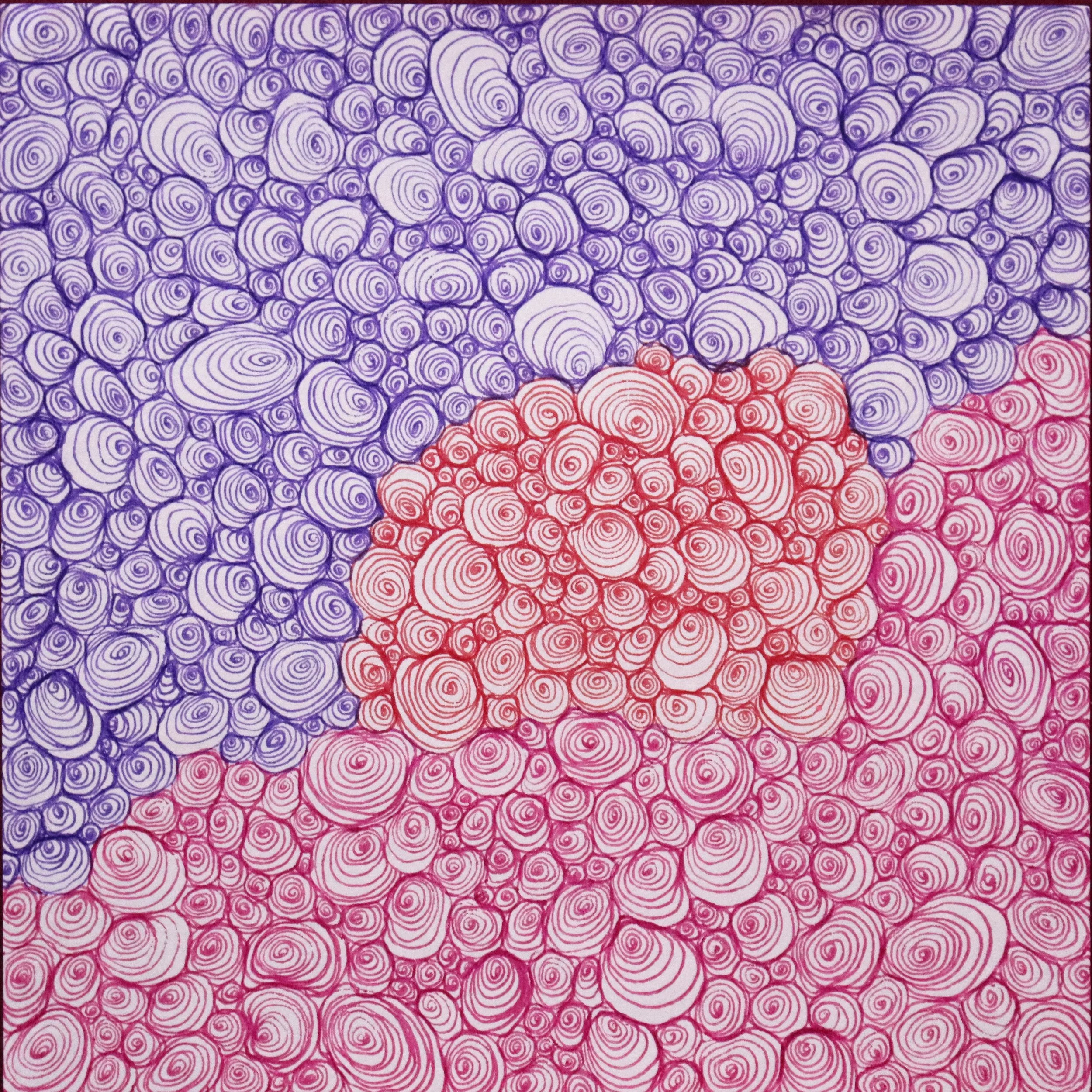
Soumiya Lakshmi Krishnaswamy, drawing, six by six inch series (2010-ongoing). Ink on paper.
Image description: Small spiral marks against a pale solid ground divided in half diagonally: purple marks across the top, red marks across the bottom.
Before our Burma was free, the jute weaver was a student who studied weaving in Japan.
On the side, to make some money, he worked at a puppet theater in Osaka. He swept the theater floor, fetched and cleared tobacco trays, and brought ingredients to the chanter’s apprentice so he could replenish his master’s tea when his voice tired from chanting dialogue. Egg yolk and ground ginger were regularly supplied to the chanter’s apprentice, and in this way, the jute weaver became a sort of apprentice’s apprentice. This was when he learned, also, the importance of quality and the impossibility of its substitution.
Outside of the theater, he progressed quickly in his own weaving studies. One of the younger Japanese men at the theater began to take notice of how well he handled fabrics, so much so that he entrusted the jute weaver with the puppet wigs and clothing. After a year, the jute weaver was promoted again. This time, he was appointed to polish the case of the shamisen player who delivered the musical accompaniment for each show. This was how the jute weaver learned to handle koto, kokyu, and even reed flutes.
But the more time he spent in the theater, the more consuming was his desire to handle the puppets themselves. Puppeteering, of course, was impossible for someone like him. Even if his lineage would have allowed him the honor, the expertise to command just one part of the puppet took nearly a decade to develop.
From behind the stage, he could only hear music and dialogue. But after the shows, when everyone else went home and to bed, the jute weaver began to study the puppets up close.
Some were small, as small as children, and others were so large they nearly engulfed the men—up to three in number—tasked with commandeering them. He studied how bamboo hoops made the hips of men, how feet were missing on women to bestow an elegant, uninterrupted kimono hem. Spools of string attached to flexible whalebone strips for movement.
It was only years later, in another land, that the jute weaver would attempt making his own puppets. He continued to work on the reed flute as he told me this, rounding the cylinder thinned from the raw bamboo. As he worked, I asked why he was in the forest. My understanding was that jute weavers readily found their jute in the fields.
Only after I asked him that question, in the brief silence that followed, did I become fearful again. My smallest finger, poised over the painted eyebrow on the puppet head, softly pressed against the grain there.
“I’m here for wood too,” he said, reaching to take back the head from my hands. He carefully wrapped it up again and deposited it in the bag. “These puppets are made from wood. I use jute strings to attach their parts. But for now, I’m perfecting the heads.”
He then wiped his hands on his longyi and placed the carved bamboo into his bag.
“Do you know how to make your way home from this part of the forest?” he asked. Somehow, I felt that I did.
“You’ll be able to find your way back then. Come tomorrow, same time. We will continue work on your reed flute. Care must be taken with an instrument like that, to honor its sound.”
*
When I arrived the next day, the jute weaver was already there. His bag of jute and painted heads was on the ground next to him. In his hand was a ball of wood which he was sanding.
When he saw me, he put aside the primordial head and we whittled the bamboo from the day prior with a dry branch. Fine, white specks flew from it. As I held the branch, I tried to disguise the tremble in my fingers which had appeared overnight. The man seemed to notice and asked if I was feeling unwell.
“I was sick before, but not anymore,” I said.
“But you do seem burdened.”
“My friend is not feeling well. The situation worsens by the day.”
“Sickness is not always an awful thing. But it’s not malaria, is it?”
“The doctor at the health post said it’s not. And my friend is barely bit by mosquitoes here.”
“Malaria can be a tricky thing. Everyone who knows me thinks I died from malaria. Well, what they think is I died from malaria in Thailand. It’s fine for me to say this to you here, isn’t it?”
Hearing this, I wanted to leave the forest and the strange man behind. I sensed some sort of expectation behind his casual demeanor. It weighed upon me. But I remembered Tameen, how she lay pale and sleeping that morning, and I knew I would not be able to finish the reed flute on my own.
The jute weaver picked up the bamboo and closed one eye. Using his knife, he cut small diagonals at the top of the flute. He called this the tongue of the reed, a place for the player’s mouth.
“Alright, I will tell you how I died in Thailand,” he announced, although I had said nothing. “We can speak of our burdens to one another, can’t we?”
*
During that time when he was weaving and polishing flutes in Japan, the jute weaver went on a holiday to Yokohama. At a pagoda in the port city, he met a group of young people who had recently arrived from Burma.
These three said they were part of a larger group. They had been students in Burma but were now part of a secret operation. This they confessed neither conspiratorially nor elegantly, but with a young person’s naked conviviality when they discovered another who might be of similar age or temperament.
The students revealed themselves as having been expelled from university in Rangoon for their politics. They were infected with that dangerous strain— restlessness for their country’s freedom. Originally, they looked to China for aid, but instead—fate’s swift hand at the curtain—they encountered a Japanese military group along the way who offered to help them instead.
For the jute weaver, finding this group of Burmese men in Japan was homecoming. And although he would never come to possess their level of political fanaticism, their rallying cause became an exhilarating rupture. For a while, the theater in Osaka was forgotten as he prepared with his comrades to undergo military training. He imagined forgoing the weaving, the puppets, the animated dark of the stage, and dreamed of instead returning home as a countryman of importance —flag-bearing, nation-forging— oh, how his mother would embrace him!
The jute weaver, last to join, was also anointed with a war name. In the end, there were thirty comrades in total.
Shortly before they were due for training in Hainan, however, the jute weaver fell sick. During this sickness, he had difficulty distinguishing night from day, real from imagined. This heaviness inhabited his mind as much as his limbs. At the end of his sickness, when he finally felt his familiar self emerging, he could not go on to Hainan. Something, a premonition of sorts, forbade him. It could have been that like Buddha, he had been cleansed after this suffering and finally afforded the truth of his existence.
“Might Muslims believe in something like that?” he asked me.
The jute weaver was right in his instinct. Many fellow comrades would go on to be arrested, killed, or kill themselves in the coming years as Burma’s landscape changed. For those who continued, independence came at a steep price.
“As for me,” the jute weaver said, “I went underground in Thailand. Never returned to Burma. Never used my war name again. Even my mother thought I passed.”
“That is sad,” I offered.
“Except, this is how I returned to my puppets, you see. Everything and everyone else—myself, even—had fallen away. But do you believe it is possible, for anything to fall away without a trace?”
“I don’t understand.”
“Water, after enough time, leaves its mark in the emptied vessel.”
“Yes, uncle.”
“On their way down to free Burma, the rest of them, my comrades whom I left behind, gathered in Bangkok. They drew their own blood. They poured that blood into a silver bowl and drank, you understand this?”
“Yes,” I said, feeling a little afraid.
What I knew was that the comrades drank to pledge allegiance to their upcoming mission. The nation’s true birth. But because we knew their ending, that horrible denouement, I understood now that they also drank to their death in that house in Bangkok.
The jute weaver steadied me by pressing one end of the flute against my palm.
“I was right to disappear when I did,” he said. “Becoming a dead man saved my life. So, you see, sickness is not always an awful thing.”
After flattening the top of the tongue of the reed, he asked for a flame. I produced a lighter and remembered Tameen’s faint, purplish bottom lip. The jute weaver touched the heat to the reed tongue, smoothing away the edges of the cut.
*

Soumiya Lakshmi Krishnaswamy, drawing, six by six inch series (2010-ongoing). Ink on paper.
Image description: Small red marks shaped as the outlines of lips, some filled-in solid red, in an all-over composition, floating against a pale solid ground.
The next day, I arrived at our spot first.
While I waited, I thought of how after he had divulged his story yesterday, it seemed the jute weaver wanted to finish working in silence. Even his narration of those events seemed more for himself than an address to me. And this was a man who had once exchanged words and meals —had been comrades— with the most powerful people in our country’s history. I did not know how it could be possible, that such a man was now helping someone as ordinary as me. As surreal as it was, I felt he had told the truth.
The jute weaver finally arrived after another hour, when I had nearly relinquished hope and thought I might have indeed imagined the entire encounter. Two bags, filled with different colored woods of various shapes and densities, were on his back. He had collected these, he said, while looking for paulownia wood.
“Did you find the paulownia?” I asked him.
“I did not.”
“Will these other woods suffice?”
“Not to worry. Although, I do hope that when I find paulownia, there will be enough to build two bodies.”
“Do both puppets have to be made from paulownia?”
“How else would they recognize each other?” he laughed, fishing our reed flute from his bag.
The two puppets the jute weaver had been building, dismantling, rebuilding, and perfecting for the past three years on the island were for a play about love suicides. He had begun telling me parts of this story in the past two days: initially performed centuries ago in Japanese theaters, the play depicted two lovers who commit suicide because of the burden of their misfortunes. The young man is overcome by his debts; his beloved finds no recourse but to follow her aggrieved lover into the forest. In death they are untroubled, together at last.
The jute weaver revealed to me something else about this play: soon after performances began, they ended. The government halted production because of copycat suicides.
“Copycats?” I asked in disbelief.
I had, until that moment, imagined imitation as something mundane. Children playing. A skittered stone leaving duplicate rings in water.
“Isn’t that quite strange?” the jute weaver said.
Such recklessness, I determined, belonged to others. People who came and went at leisure. The jute weaver had the capacity to be sympathetic to such people. Perhaps he was comprised of the same fiber. He had, after all, come to this island on a whim. To cut wood down, resurrect it in something lifeless.
“A grain of sand separates from the porous shoreline…” he continued, gently squeezing the reed tongue between his fingertips.
The sensation I felt was that he had grasped the tail of my earlier thought somehow, and now the skittered stone lay suspended between us.
“I don’t know, uncle.” Unable to sit any longer, I moved to stand.
“What’s that?”
“I don’t know if I want to hear about this.”
“Why is that, my friend?”
“It seems like bad luck.”
“But do you believe in bad luck? Or do things happen for no reason at all?”
“I don’t understand you,” I said, feeling, to my surprise, a bit of anger.
“At the theater in Osaka,” he spoke hurriedly, straightening to stand beside me. “I was only able to see that play a few times before it was shut down. And it was that play which captivated me most, although I don’t know why.”
“Why?”
“Well now I just said, I don’t know.”
“You had a lover?”
“I did not,” he said, and told me with a wink that the only separation he had suffered was when he killed his past self in Thailand. He laughed heartily, put an arm around me, and I just as quickly felt foolish for my earlier mood. We remained standing like this for a few moments.
“That friend of yours who is sick,” he began again. “Is she your lover?”
“No—although, well, the reed flute is for her.”
“A young man makes flutes instead of playing ball. It’s alright to charm a lady, you know.”
“She’s not my lover,” I said again, wishing the ground would take me in. “Should we return to the flute?”
“The flute is done already,” the jute weaver announced. “I finished it this morning. Put it to your lips and try.”
He showed me how to position the instrument. I tried a few notes, wishing he would look away. A euphonious sound came over us. I felt embarrassed that he had finished it without my knowing.
“A sound which appeals to every heart,” he said, eyes closed. “Even more than the shamisen, I think. But it was only when I traveled to India, after Thailand, that the Muslim mystics were able to tell me why the flute sings to the heart—every heart, regardless which creed or deity it belongs to. As a believer, you know why, don’t you?”
I felt then the same feeling which had guided me days before, from Tameen’s housing to that very forest, to the man before me and the flute that lay in his palm. I shook my head no, so the jute weaver would put into words what I knew but could not describe.
“Alright,” he said. “I will tell you why the reed flute sings.”
*
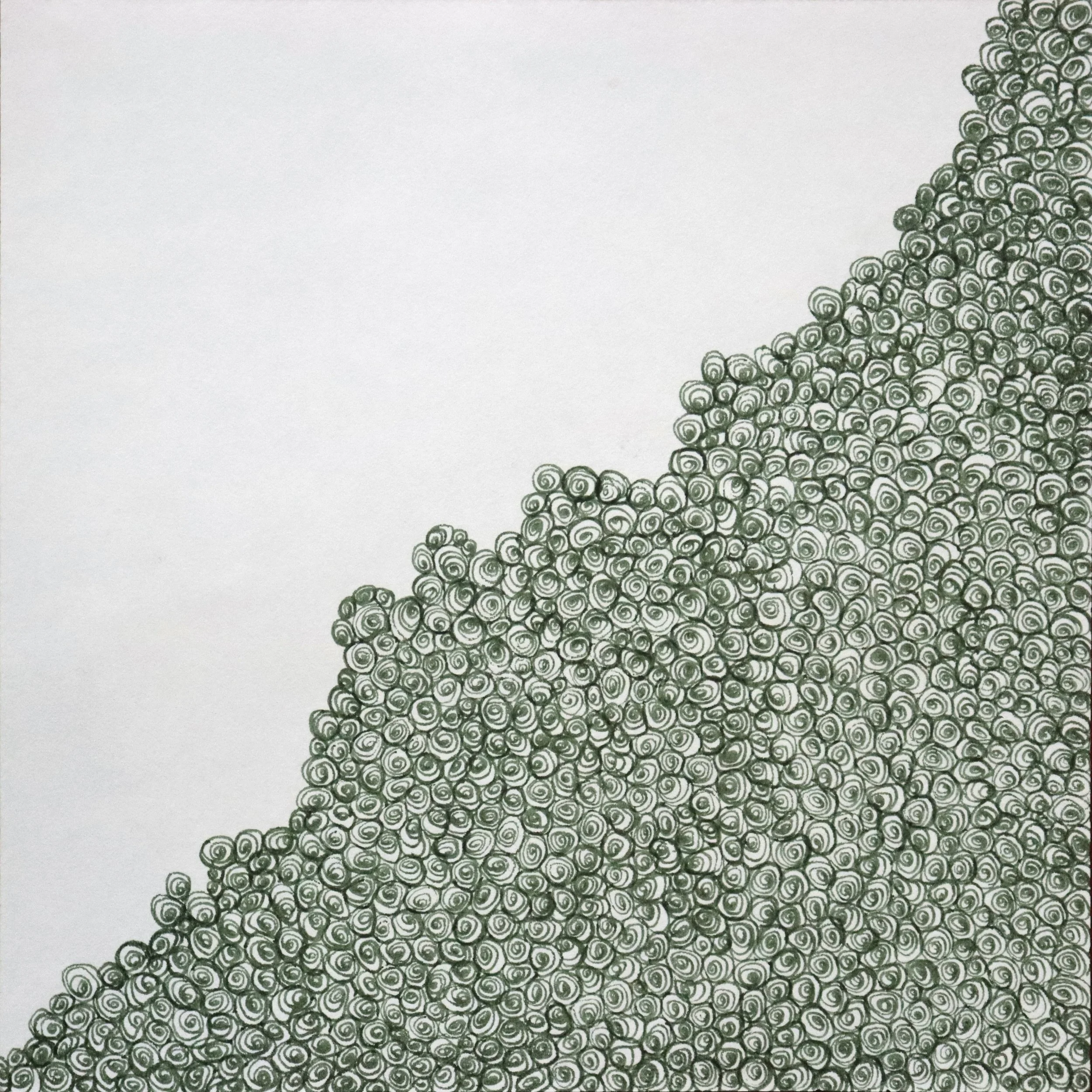
Soumiya Lakshmi Krishnaswamy, drawing, six by six inch series (2010-ongoing). Ink on paper.
Image description: Small dark green spiral marks against a solid pale ground along the lower half, the top half empty, divided diagonally.
In India, the jute weaver encountered Muslims who revered the reed flute as it had been revered for centuries around the world. They recognized the flute as the heart of man, an instrument forged from the suffering of life. The reed flute was God consciousness. That which could only be born from the singular agony of loneliness, the separation of the reed when cut from the reed bed.
“The sound of this flute makes a fitting accompaniment to our story of the lovers then, doesn’t it?” the jute weaver said.
He then asked what he should choose for his next name. In Osaka, his weaving teacher’s son had a name which meant peace, but the boy had a cry so fierce his father worried the boy’s lungs might burst.
“A name should suit a person,” the jute weaver insisted. “When my puppets are finished and I leave this place and put on my play, I’ll need a fitting name. One which can only belong to someone who is free.”
I tried to imagine it, freedom, but I thought of Tameen. The punctuated bone down her long back which branched into fine, webbed nerve. I thought, also, of the boat. The one which I had arrived in. How we had forgotten it in our ecstasy at the shore, but that it was resting, now, ordinary and unperturbed despite being stripped down to its keel by animals.
“A fitting name,” the jute weaver insisted again.
It occurred to me then, that I had warmed to someone whom I ought not to have. Someone who could only know me less and less, the distance stretching between us, the more I learned about him. While he had managed, over the course of the days, to become wholly changed in my view, I remained, to him, transfixed. The very same. He had always been certain of my make, of where to find me amidst the trees.
And as I had become more familiar with him, I saw that the jute weaver was uniquely adapted for the humid, dim forest. His fingers were shaped for discerning wood; his sack of heads slung easily on his back. I knew that if I did not return to the forest, I would not see him again.
It was the only thanks I could offer him, so I thought hard about the name.
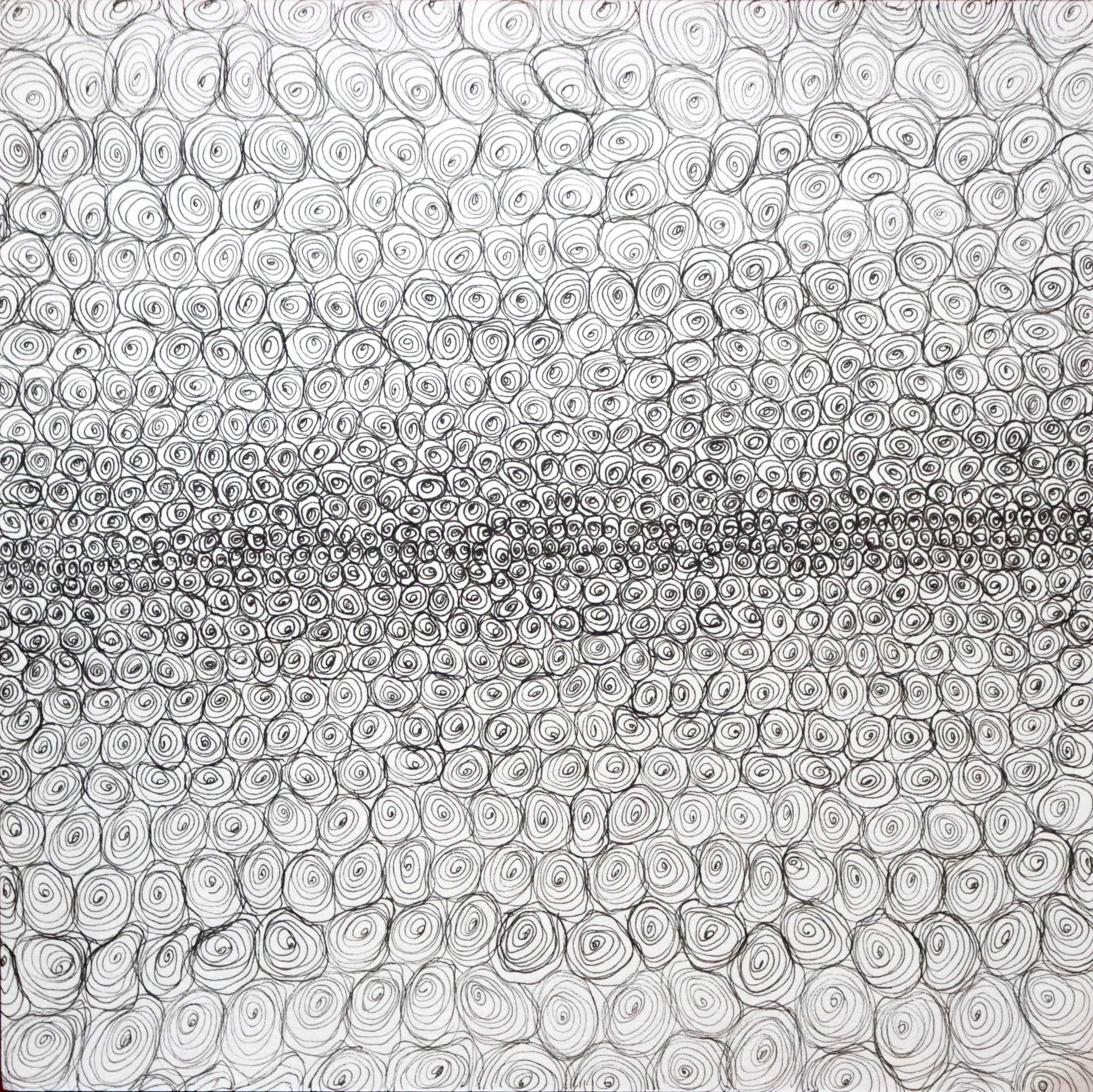
Soumiya Lakshmi Krishnaswamy, drawing, six by six inch series (2010-ongoing). Ink on paper.
Image description: Small black spiral marks against a pale solid ground, disappearing into a central, horizontal, horizon-like line.
Farihah Ahmed is a writer based in New York. She holds an MFA in fiction from Columbia University and a DDS from Columbia University’s College of Dental Medicine. She is the founder and executive director of RoVena, an organization dedicated to educational opportunities for Rohingya refugees. She is presently at work on a novel and can be reached at mail@fjahmed.com.
*
Brooklyn-based artist Soumiya Lakshmi Krishnaswamy was born and raised outside of Boston. A child of Indian immigrants, her work is driven by her perpetual feeling of Otherness. Her drawings and paintings, which have been shown in the US and abroad reference the mark-making languages of early cave and rock paintings, pictographs, and children’s art. She writes of her work: “The colors and textures reference my mother’s clothing and food intermingled with colors I find provocative in their Western associations. The spiral, with its relationship to the human body, is a mark that signifies each of us. My process involves painting, smearing, scraping, removing, adding, covering, revealing and more. It bears my own humanity and errors in a captured moment, like a memory made tangible.”
“Last names come first in Japanese, you racist piece of—” a brawl, a funeral, and a stolen father in a short story by Jay Lindstrom.