
Editor’s Note for Archipelagic Entanglements
By Sharmini Aphrodite
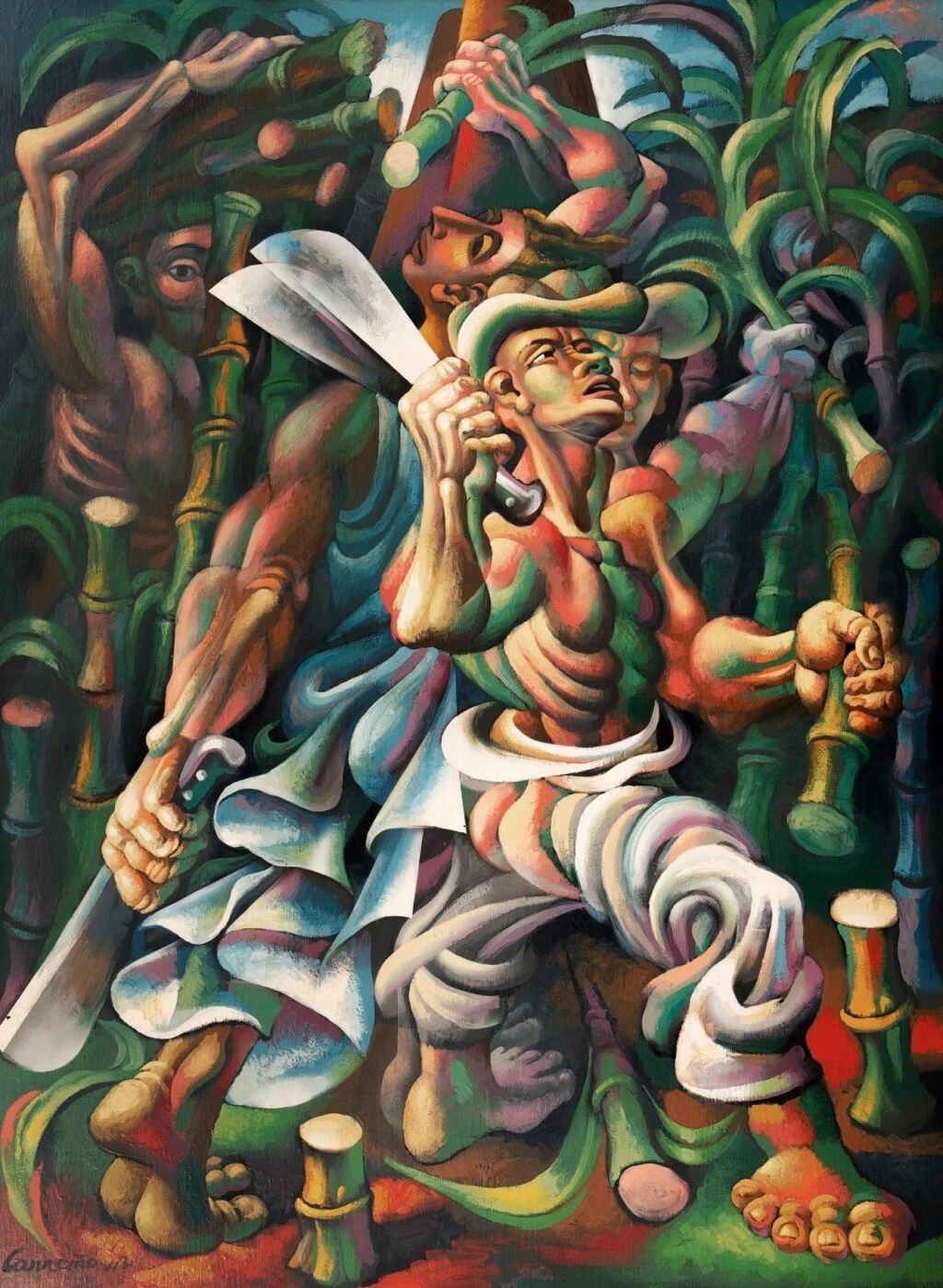
Mario Carreño, Cortadores de Caña (Sugar-cane Cutters), 1943. Duco on wood. 164 x 122 cm. Miami, private collection.
Image description: A vertical canvas of stylised geometrtical figures weilding machetes in a sugarcane field. The composition is jam-packed with fluid action, and a central figure emerges from the green, blue, and orange cane field wearing white flowing trousers, his head lifted, facing to the right while marching onward.
The first time I read about the Caribbean, I was sixteen, and it was in Merle Hodge’s Crick Crack Monkey. In a classroom with raw cement floors on the line of the equator, in the lull of early afternoons, I recognised the eruptive heat of Trinidad, the dialogue of an island rich with the frictions of class, and a history that refused to sit still. Reading Caribbean literature and about the archipelago’s history in the years afterwards, I learnt about dictatorships and cane fields, experienced tropical foliage spreading like a rash, stumbled over a mish-mash of languages, felt the salt sting of the sea and the riot of ritual—and within all this, saw something I recognised. It was this recognition I wanted to unravel with this portfolio.
In some ways, Archipelagic Entanglements is a cousin of the portfolio we published last year, Of the Sea. Whereas last year’s portfolio focused on maritime Southeast Asia, this year we broadened our attention to include the Caribbean archipelago to find significant parallels between the two regions: a history of empire and resistance, the rhythm of the past in the present, a tropical vocabulary. The nature of an archipelago is sculpted by the sea but, strangely, what I find most compelling in the works of this portfolio is the land. The sea is, of course, the womb out of which the archipelago sprawls. In Southeast Asia and the Caribbean, a plethora of faiths, languages, and histories have been brought over oceans, washing up on the shore. But it is on the shore—in the land—where things take root, where they begin to grow.
The original aim of this portfolio was to explore these two archipelagoes through three nodes: plantation, patois, and possibility. The final piece to be published is a dialogue that I had with the writer and researcher Rajiv Mohabir, in which we speak of all three nodes coiling around the land—how it was broken, worked on, exploited, worshipped, nurtured, discarded, and loved. The plantation is a key feature of both archipelagoes; when the European empires—the Portuguese and Spanish first, then the Dutch, British, and French—arrived, it was the plantation that bloomed. Sugarcane and rubber. Slavery and the indentured labour that came after the abolition of slavery. The plantation is a fecund site, yet it remains peripheral. Historian Sahil Bhagat writes that, belied by its marginalisation in anticolonial historiography, the plantation ‘terraformed colonial Southeast Asia’s… landscape’ and ‘serv[ed] as the primary setting for anticolonial resistance movements’.[1] I realised quite quickly after looking through our portfolio’s finalised pieces that the plantation is not merely one of three nodes of the portfolio—it is the central node. It is the setting where the archipelagoes are most entangled, where land, labour, liturgy, and language are broken and reshaped anew.
Make no mistake: the plantation is a ground zero of ecological and social destruction. The monocrop—rubber, palm oil, sugar, coffee, cocoa, or tobacco—destroys natural ecologies on an unfettered scale. In the Caribbean, former plantations are not farmed but abandoned because the land is still traumatised by monocrop planting. In Southeast Asia, Indonesia invaded and still occupies West Papua, while Sabahan and Sarawakian palm oil fuel Malaya’s economy, hollowing out Indigenous lands for profit. Why, then, do we keep returning to such primal scenes of devastation? The easy answer would be: we cannot stop picking at scars. The harder answer to reckon with, however, is that the plantation is not merely a colonial scar. The plantation haunts the present; it is an open wound to this day.
It would have been quite simple to put together a portfolio about the two archipelagoes that limits violence against the land, labourers, and Indigenous Peoples to the colonial period; what is harder to do is to recognise that the postcolonial state has also inherited violence, to recognise that such violence has continued after the Europeans left. It would have been simple to put together a portfolio that is ‘anticolonial’ in a superficial sense—to talk about how all our violence stems from Europe’s exploitation of our archipelagoes.[2] It would have been simple to harken back to an idealised past—a manufactured version of the homeland, what Rajiv describes as the ‘calcity’ of identity (which his conceptualisation of Caribbean ‘coolitude’ works against); to fantasise about ‘golden ages’ such as that of the Malaccan empire or the Malay sultanates; to pretend we shared one culture, one faith, one tongue before the colonisers came, and that if we just go back to that time, everything would be alright. To pretend that if we go back to what we were before the Europeans came, if we could close the wound, there would be no blemish left to mark it.
Here is a truth that is harder to handle. In the Southeast Asian context: the exploitation of Malaya began not with Europeans, but with Malay settlers on the peninsula, who were the first to encroach upon Indigenous Orang Asli lands and enslave the Orang Asli, and whose descendants today appropriate the language of indigeneity to enact violence against communities that have been there as long as, if not longer than, many of them.[3] The departure of the British left thousands of Indian labourers stranded on the Malayan peninsula, at the mercy of the Malay(si)an ethnostate that tore them from the plantation, scattered their communities, provided them with little-to-no economic support, and still derides them as foreigners.[4] In the Caribbean context: ‘the indigenous strand’, peoples whose lands were cleared for plantations and settlement, is still denied in postcolonial nationalist histories.[5] Heirs of the European erasure of the Indigenous record, these histories marginalise the genocide of Indigenous Peoples when their existence continues to be inconvenient in the present, standing in the way of state structures, continued exploitation of their lands for profit, or homogenising cultural ideals.[6]
What is the importance of the plantation in this portfolio? The plantation forces us to look within. Into the hollowed-out land. We cannot pretend it is anything other than a site of violence. It is a place that forces us to be honest with ourselves. Preeta Samarasan’s short story, ‘Apa Lagi’, does this very well by depicting the violence a plantation-descent family faces at the hands of the Malaysian state, delving into a topic that stubbornly remains contemporary. Through its politicisation of Islam, through forced or covert conversions, the Malaysian state continues to prey on the poor and dispossessed.[7]
With equal imagination and precision, the portfolio’s other works reject the sentimentality of nostalgia and the empty praise of precolonial ‘golden ages’. In his poems, Amilcar Peter Sanatan describes the ‘depressed choreography’ of the Jamaican landscape, whereas Christian Emecheta does not shy away from the illicit nature of patois, ‘the child who was never claimed by either parent’, who ‘learned to be shrewd’. C. Aishwarya writes in her poems about the inheritance of unpaid bills in a cold city, describing ‘mouths… shaped’ in ‘fields bright with sugar/ and the quiet obedience of labour’. Olivia Simone’s essay untangles the hierarchy within creolisation. In hers, Samira Hassan discusses the erosion of ritual that ‘changes the texture of things’. In the portfolio’s closing piece, I speak with Rajiv Mohabir about crafting through the rupture of the plantation.
After staring all of this in the face, where do we go? Emecheta provides us with a starting point: ‘The roots do not forgive. They simply grow.’ In his famed 1992 Nobel lecture, the Saint Lucian writer Derek Walcott wrote that, when you break a vase, ‘the love that reassembles the fragments is stronger than that love that took its symmetry for granted when it was whole’. Walcott wasn’t pretending that symmetry existed; he writes after this that the pieces of the Antilles are ‘disparate, ill-fitting’, but that they are ‘care and pain’. Nothing can be reassembled without a precise knowledge of the contours of the broken pieces, without an honesty about the depth and weight of the violence that rent both the Caribbean and Southeast Asian archipelagoes.
This portfolio is a recognition of this burden of history. It is a recognition of hierarchies within and beyond colonial legacies, and it asks us to think how we can move beyond them. It points, too, to new directions at SUSPECT, as we think about how we situate ourselves in the present in our Southeast Asian home base. In the coming months, we aim to centre Indigenous perspectives, writing against the idea that the ‘Malay world’—which is predicated on the sultanates and classical genealogy—has to be our central mode of thinking about our archipelago. Instead, we amplify the voices of the Indigenous Peoples of Malaysia and Indonesia, still fighting for their land and culture today, and disarm the ethnonationalists of their fake cudgels of indigeneity. In the same vein, we aim to centre—fittingly, considering today’s date—the history and present of labour in its myriad forms, remembering that plantation labourers in the Malayan context were not a colonial imposition or afterthought but the drivers of anticolonial resistance.[8]
As we publish each contribution to this portfolio every Friday this May, it is my hope that this portfolio will provide an honest assessment of the violence of history, and how this violence circulates in the present. It is also my hope that it nudges us towards possibilities—towards alternative ways of thinking about and living in these archipelagoes. As we look towards each other’s archipelago and learn from our entangled cacophonies, may we seek a world in which we face uncomfortable truths, celebrate discordance, and—in the words of Édouard Glissant—‘know ourselves as part and as crowd, in an unknown that does not terrify’, to bring ourselves back to a sea in which ‘our boats are open, and we sail them for everyone.’[9] In recognising the other’s suffering within ourselves, it is my hope that we also recognise each other’s liberatory possibilities—in our tragedies and triumphs, our songs and our faiths, and in the small courses of our daily lives.
Notes
[1] Read Sahil’s essay here.
[2] Self-determination and freedoms from colonial powers—represented in the terms ‘decolonisation’, ‘anticolonialism’ and ‘anti-imperialism’—were ultimate necessities for former colonies. It is crucial, however, to understand that these terms also have a history of being appropriated by right-wing nationalists and thus to be wary of how they can be deployed as a means to curb, instead of seek, liberation. See, for instance, Parti Islam se-Malaysia’s appropriation of anticolonial rhetoric and this paper by Wai Weng Hew and Nicholas Chan that discusses marginalisation of ethnic, religious and sexual minorities in Malaysia, justified through the rubric of ‘decolonisation’.
It is also necessary to note that the ‘decolonisation’ process was not evenly carried out within nation-states. The most glaring example of this is Indonesia’s colonisation of West Papua, which was justified by Sukarno under the Greater Malaya/Indonesia (Melayu/Indonesia Raya) project as a form of decolonisation from the Dutch. The Third World anticolonial movement in the 1960s failed to prevent this, as Quito Swan discusses in this paper, which focuses on Bandung’s selective solidarity and West Papuan resistance to Indonesia, in terms of Black and Oceanic liberation. Lydia Walker’s A Counternarrative of Global Decolonization (2024) also shows how sweeping nationalist movements suppressed alternative claims to sovereignty when they challenged the postcolonial nation-state.
[3] This chapter by Kirk Endicott discusses the institutions of slavery in Malaya, where chattel slavery of Orang Asli was characterised by their definition as ‘hamba abdi’ [true slaves]; Orang Asli were taken as ‘true slaves’ because they were non-Muslims—slavery in a maritime Southeast Asian context existed within the rubric of Islamic slavery, in which it was forbidden for Muslims to enslave other Muslims. Raids to capture slaves were planned and deliberate. Malay settlers—such as those from Sumatra, in what is today known as Indonesia—violently encroached into Orang Asli lands in Malaya, displacing them through land grabs and slave raiding.
[4] Andrew C. Wilford’s Cage of Freedom: Tamil Identity and the Ethnic Fetish in Malaysia (2006) and Tamils and the Haunting of Justice: History and Recognition of Malaysia’s Plantations (2014) and Vineetha Sinha’s Temple Tracks: Labour, Piety and Railway Construction in Asia (2023) provide a strong foundation for understanding how Tamil plantation labourers have been deliberately marginalised by the Malaysian state in the postcolonial nation-building process.
This postcolonial marginalisation begins with the displacement of these plantation labourers, who were removed from the plantation and fragmented into an urban proletariat, with many landless today; a starting point to read about this is Miriyam Ilavenil’s research. The descendants of plantation labourers are today painted by Malay-Muslim ethnonationalists as colonial interlopers in Malaya; most recently, with the ‘illegal temples’ discourse, in which these ethnonationalists paint Hindu temples and shrines, many of which are of plantation origin, as taking over the Malayan landscape. They appropriate the language of indigeneity and environmental activism through the dubbing of themselves as ‘land activists’. Read more about this here and here.
[5] This article describes how ‘the reality of small communities [of Cuban Indians] was obscured by the fog of nationalist scholars who predicated a strict Spanish-African origin for the Cuban population’. What is heartening, however, is that these Indigenous communities—in the Caribbean and elsewhere—are not fossilised remnants, as some may think, but culturally active participants resisting marginalisation on their own terms and with their own cultural vocabularies, shaped by land and language, today.
[6] This short essay by Elizabeth Wong is an introductory yet instructive source that goes into further—albeit brief—detail about, as its title dictates, ‘Indigenous Erasure and Resistance in the Caribbean’. It discusses how postcolonialist historiographies, despite their strengths, had often fallen in the trap of perpetuating the idea of an extinguished population in the Caribbean. Particularly appealing to me is the discussion of Édouard Glissant’s idea of entanglements—‘wrestling’ with contesting desires in the patchwork of postcolonialism in a way that reckons honestly with the violence of both the colonial and postcolonial states.
[7] One can look at Kirk Endicott and Robert Knox Dentan’s (‘Into the Mainstream or Into the Backwater: Malaysian Assimilation of Orang Asli,’ in Legislating Modernity, ed. C Duncan [Cornell: Cornell University Press, 2004]) framing of state Islamisation of the Orang Asli as a form of ‘ethnocide’ (see also: this video and this article by Alberto G. Gomes), where Indigenous Peoples in Malaysia are forced to assimilate into Malayness through conversions to Islam. Wan Zawawai Ibrahim explains here that this assimilation is because Orang Asli and Bornean Indigenous Peoples contest Malay claims to indigeneity. Bernard Sta Maria’s The Golden Son of the Kadazan (1978) provides a glance into how this happened in Sabah during the tenure of former Chief Minister Mustapha Harun (see this article for a more contemporary example). Forced conversion of Indigenous children in Sarawak can be read about here while this article looks at the illegal conversion of minors without parental consent throughout Malaysia. Even the dead are not safe; see here and here about how family members have struggled with, and have lost against, Islamic religious councils that laid claim to the bodies of their loved ones.
[8] Sahil’s article discusses his historical research, part of which focuses on plantation resistance movements in Malaya from 1930 to 1947. This period was the beginning of the anticolonial movement in Malaya, which blossomed in plantation strikes—Hindu temples of plantation origin stand as a marker of this plantation history and resistance.
[9] I hope that it is fitting that I close this essay with a note on Glissant, Édouard, Poetics of Relation (trans. Betsy Wing), University of Michigan (1997): 9.
Sharmini Aphrodite was born in Kota Kinabalu, Sabah. Her short stories and writing on literature, art, and history have appeared online and in print. She is the editor-in-chief of SUSPECT, a journal of Asian literature and art. She holds an MA in History from Nanyang Technological University and is currently pursuing a joint PhD in Southeast Asian studies (National University of Singapore) and History (King’s College London). Her current academic project focuses on indigeneity, state-making, and more in twentieth-century Sabah, while her research interests include agricultural histories, orality, and the history of revolutionary Christianity in the Global South. Her short story collection The Unrepentant was published in November 2025 by Gaudy Boy.
*
Mario Carreño (b. 1913, Havana, Cuba; d. Chile, 1999) was a prominent Cuban-Chilean artist and leading figure in modern Latin American art. An early avant-garde artist and part of Cuba’s Vanguardia movement, his figurative works often explored themes of Cuban national identity, post-colonial complexity, and the fusion of popular elements in rural and urban landscapes. His work encompassed an array of mediums, including oil, tempera, inks, and silkscreen. He exhibited frequently at Perls Gallery in New York, and contributed eleven works, including Sugar-cane Cutters, to the landmark exhibition Modern Cuban Painters, organized by Alfred H. Barr, Jr at the Museum of Modern Art in 1944. Carreño received Cuba’s National Award in Painting in 1938, and in 1982 he received Chile’s National Art Award.
“Last names come first in Japanese, you racist piece of—” a brawl, a funeral, and a stolen father in a short story by Jay Lindstrom.