
“Back Pain" and Other Poems
By Satya Dash
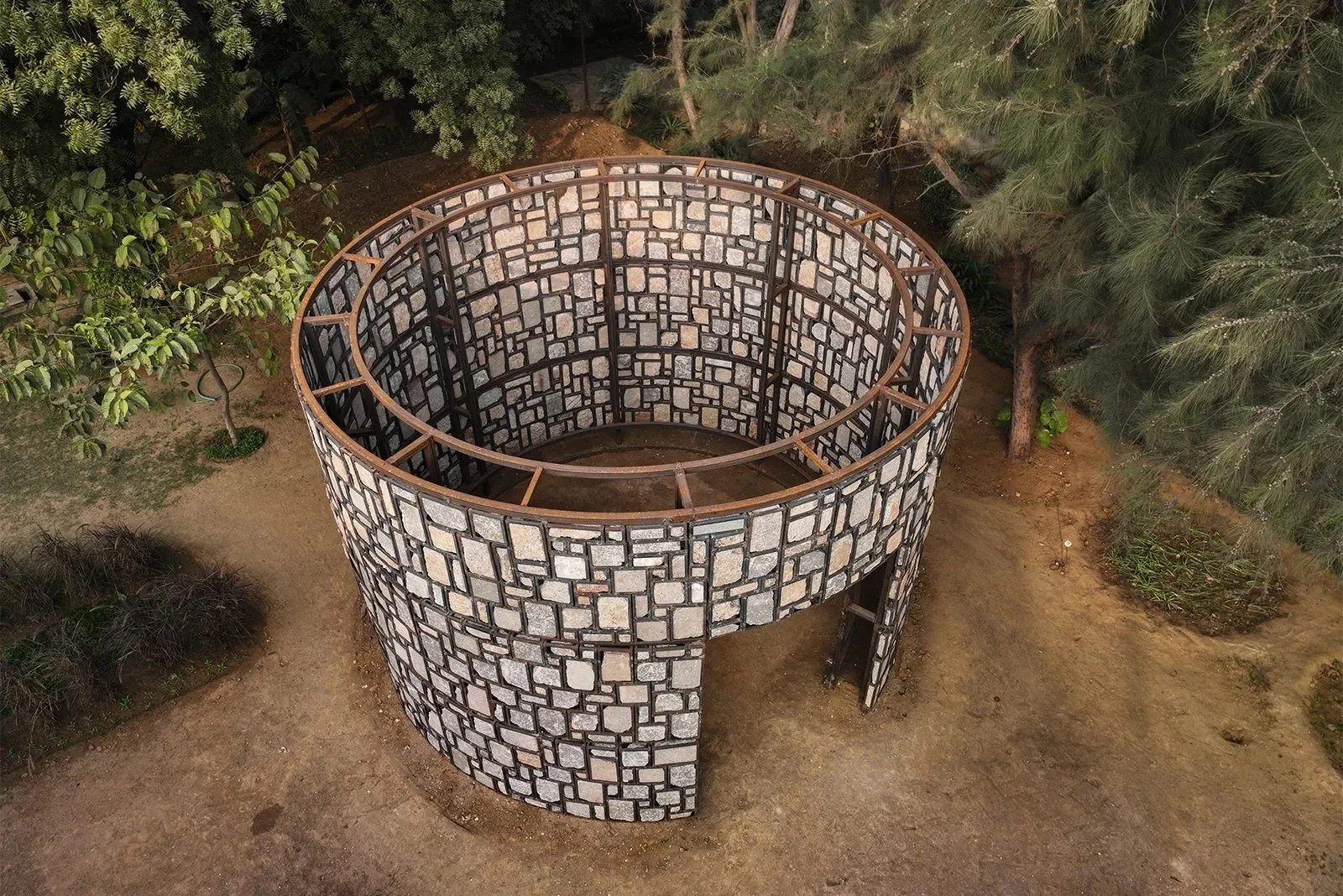
Vibha Galhotra, Future Fables, 2024. Architectonic Sculpture, found rubble, metal 264 x 180 inches, New Delhi
Image description: A monumental cylindrical stone and metal sculture installed on a dirt clearing, seen from above, surrounded by green trees.
After suffering acute back pain in the gym
The air-conditioned sweat
coating my eyelids
is to be credited
for making me want
to listen to you. I want to keep
listening until the conditions
of organic chemistry overcome
my body at death. Fueled
by the rising temperatures, tempers
and prices in the city, stranded
by the overnight disappearance of Uber
drivers from the neighborhood,
ruffled by the murder
of crows flying daily
to the balconies of our apartment, my mind
has stopped listening to the needs of my body
in a classic case of what youngsters these days
are calling a situationship. Do you feel
semantically uncomfortable saying that?
I find things remain
complicated until my mind knows
it has to prioritize. Like the man
who wears a vest saying negotiator
in a hostage situation, I want one
that says prioritizer. I would wear it
to work on Monday mornings,
and to the cemetery on Sunday nights.
There are no failures, only
experiences, says a mastermind
in my dreams. He doesn’t really talk—
there is no audio. It’s just my inference
from the way his lips move.
The mastermind wears a yellow jersey
with 7 on his back. I catch streaks
of white lightning in his beard. His angular
glance towards my knees softens their hubris.
He never asks me to kneel. I step forward
and I’m falling through air,
rapid and wireless. Do I wish I had
taken two steps back before
that fateful step forward? I don’t
know. The one who knows
simply cannot be burdened
by things such as the inflexibility
of the spinal cord or the undemocratic
rule of gravity. I’m not the one.
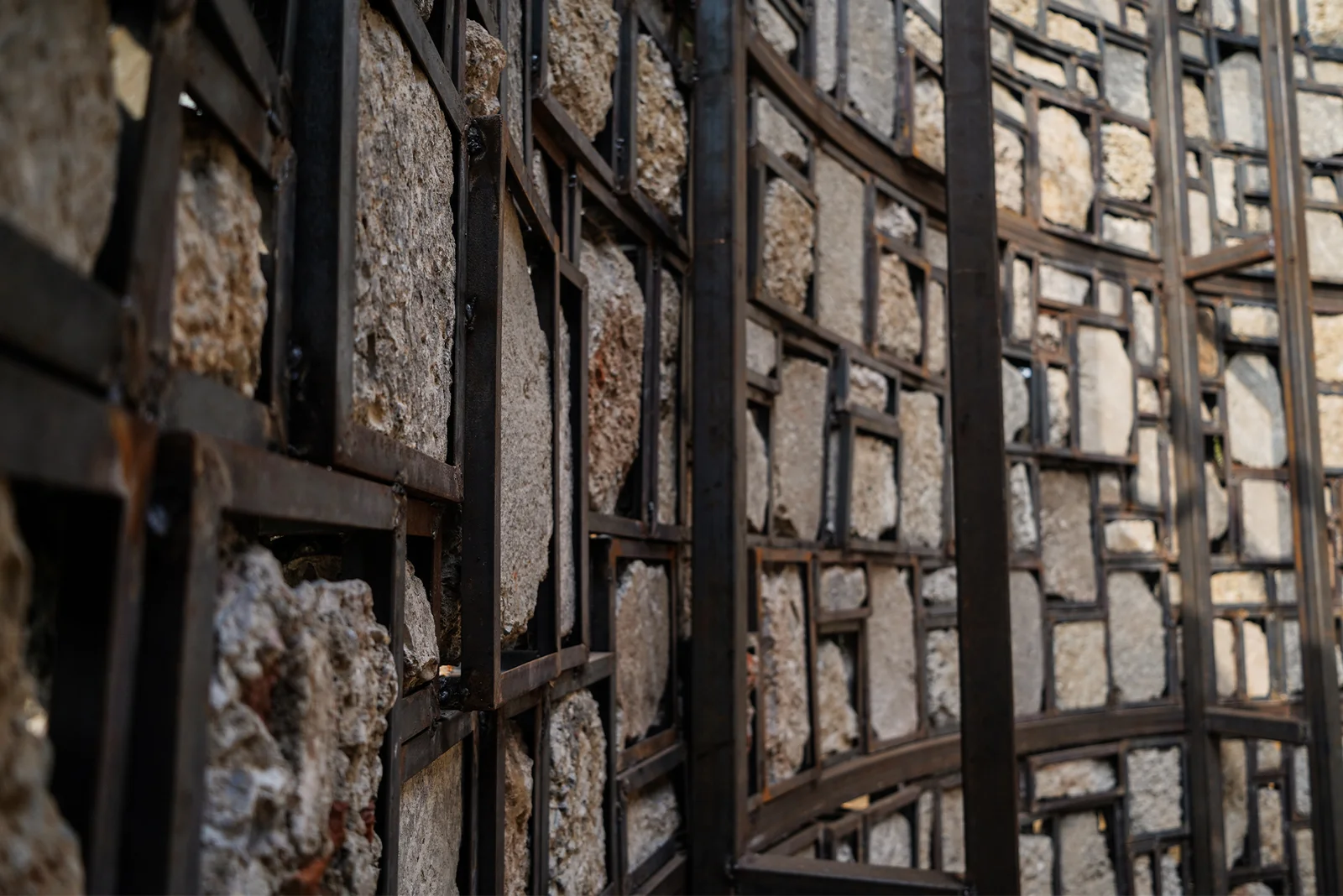
Vibha Galhotra, Future Fables (Detail), 2024. Architectonic Sculpture, found rubble, metal 264 x 180 inches, New Delhi
Image description: View of the curvilinear interior wall: grey cube-like stones encased in a dark metal grid-like framework.
Post-Postmodernism 101
Your friend sends you a poem
stitched by ChatGPT. The rhyme
scheme is neat; it reads like a beloved
parrot’s sermon. You feel an itch
to remove something. You press your
nose to the mirror
to pluck from its surface
an almost invisible strand of hair
with the tips of a scissor.
Miniature craters on your face
repress their violent histories.
One day you realize you have grown
allergic to nuts. But doused in milk,
the walnuts grow
edible to the tongue.
In momentary peace
at the botanical gardens,
you pass out on a picnic mat.
Soon, armies of ants garland
your ankles and wrists. It’s this insufferable
persistence of Catch-22 situations you feel
you are being unfairly subjected to.
Deep inside, you know every human
is out there making
some necessarily stupid living choices to be
on the move. After the pandemic, you start
visiting bars on Friday nights to escape
the ruins of existentialism.
Although once there, it’s only conversations
about existentialism
you’re dying
to strike with anyone vaguely interested.
When a friendly couple requests you to take
a picture of them, you make
sure their background is well
focused: the signboard screaming
in neon-purple— ‘WHO IS YOUR DADDY’.
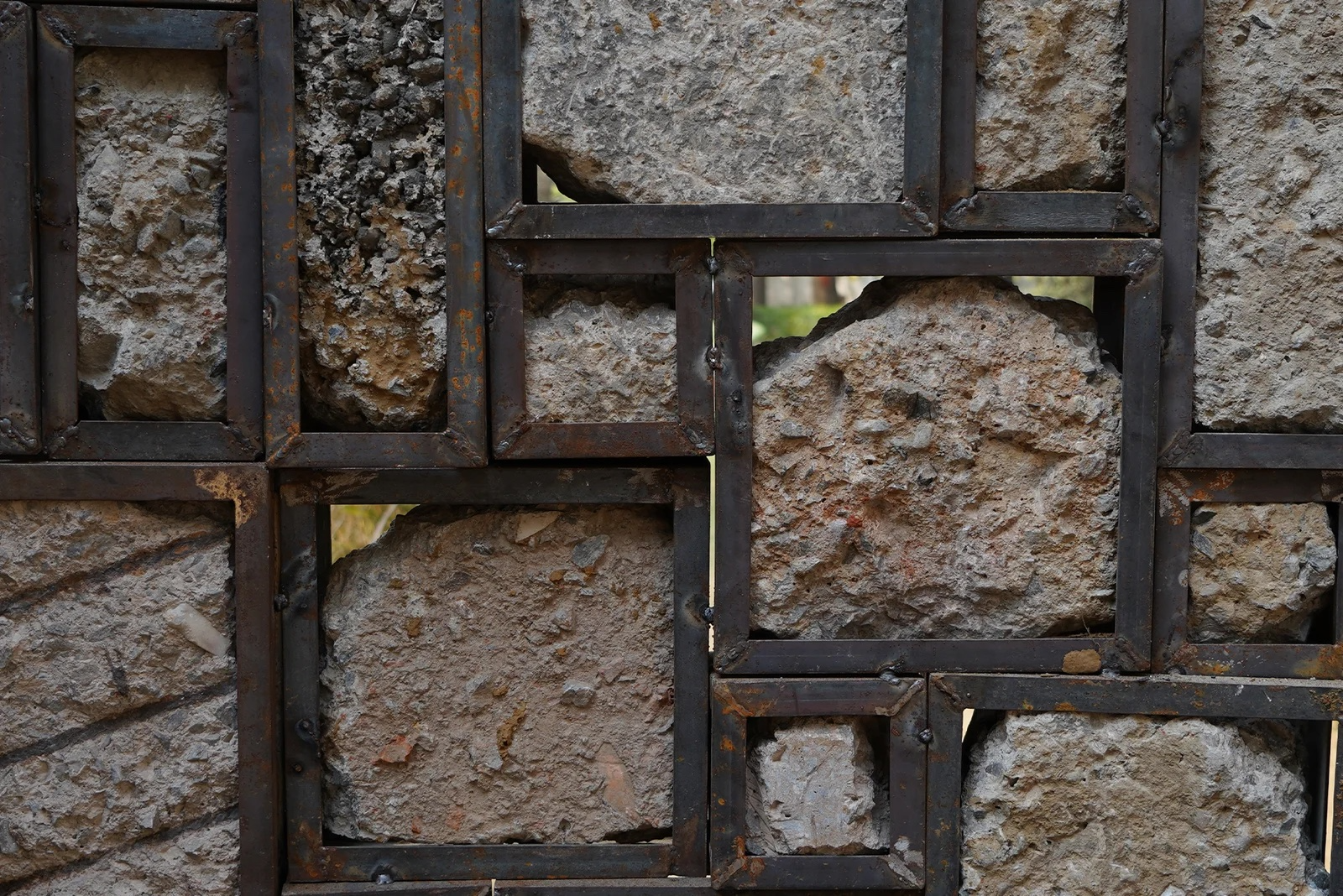
Vibha Galhotra, Future Fables (Detail), 2024. Architectonic Sculpture, found rubble, metal 264 x 180 inches, New Delhi
Image description: Straight-on detailed view of grey stones inside their dark metal frames.
Starting Over
The enriched carbon sat atop the mountain of flesh. Below, a village teemed with ghosts inhabiting little houses whose porch bulbs glowed to signal they were anxious and awake in the hoary hours of the night. The ghosts wanted to hunt down their respective buckets of flesh, but couldn’t penetrate the holy sphere, invisible yet startlingly solid, surrounding the mountain peak. The sphere was supposed to separate the soul and the body. The ghosts were dissatisfied with their forms. If they were true representations of their souls, they felt they deserved to be more permeable, less conspicuous. But alas, the soul had its limitations. It had been a rude awakening to find the soul wasn’t infinite in the ways that popular opinion had propagated it to be. Instead you had to find liberty in the very constraints that had made living such a pain. This made the ghosts sad. At a council meeting, one of them was about to set the agenda for the day, when another voiced the questions everyone had been too embarrassed to ask — without a lifespan, do we still need to be productive? What’s the point of death if we continue to act like the living do? Most of the gathering looked down in shame. Each of them, deep down in the lustrous air of their transparent shapes, was unsure — but sitting down in a circle, they held hands and lit a fire. Praying to the mountain, they resolved to be better at letting go. The keeper of the meeting minutes burnt in the bonfire a fat book of notes. The pages curled into black birds as they went up in flames.
Satya Dash is a recipient of the Vijay Nambisan Poetry Fellowship and the Srinivas Rayaprol Poetry Prize. He has also been a finalist for Platypus Press's Broken River Prize. His poems appear in Ninth Letter, Sixth Finch, Waxwing, Prairie Schooner, and Cincinnati Review, among others. Apart from having a degree in electronics from BITS Pilani-Goa, he has been a cricket commentator. He has been nominated previously for Pushcarts, Nina Riggs Poetry Award, Orison Anthology and Best New Poets. He grew up in Cuttack and now lives in Bangalore, India. He tweets at: @satya043
*
Vibha Galhotra (b. 1978, Kaithal, (Haryana) India; lives and works in Delhi, India) is conceptual artist whose multimedia oeuvre―including sculptures, installations, photographs, videos, site-specific work, and public art interventions―addresses the shifting topography of a world radically transformed by climate change, consumerism, capitalism, and globalization. Propelled by the constant negotiation between human beings and their ecosystem, Galhotra’s practice utilizes intensive research and intuitive imagination to investigate the social, economic, and political implications of human activity on the environment. She draws from varied disciplines, including the fine arts, ecology, economics, science, spirituality, and political activism to inform a poetic visual response to the environmental changes and restructuring of culture, society, and geography occurring in today’s world. The Future Fables project (https://vibhagalhotra.com/future-fables-2) is a pioneering site-specific art installation that synthesizes sculpture, interactive technology, and community involvement to delve into the intricate transformation of modern urban environments while addressing the profound impact of wars and natural disasters.
The winning poems of the 12th SUSPECT Poetry Contest offer quiet intimacies, brilliant honesty, and alluring music.