
The Control Chaos Method
By Chadawan Yuddhara
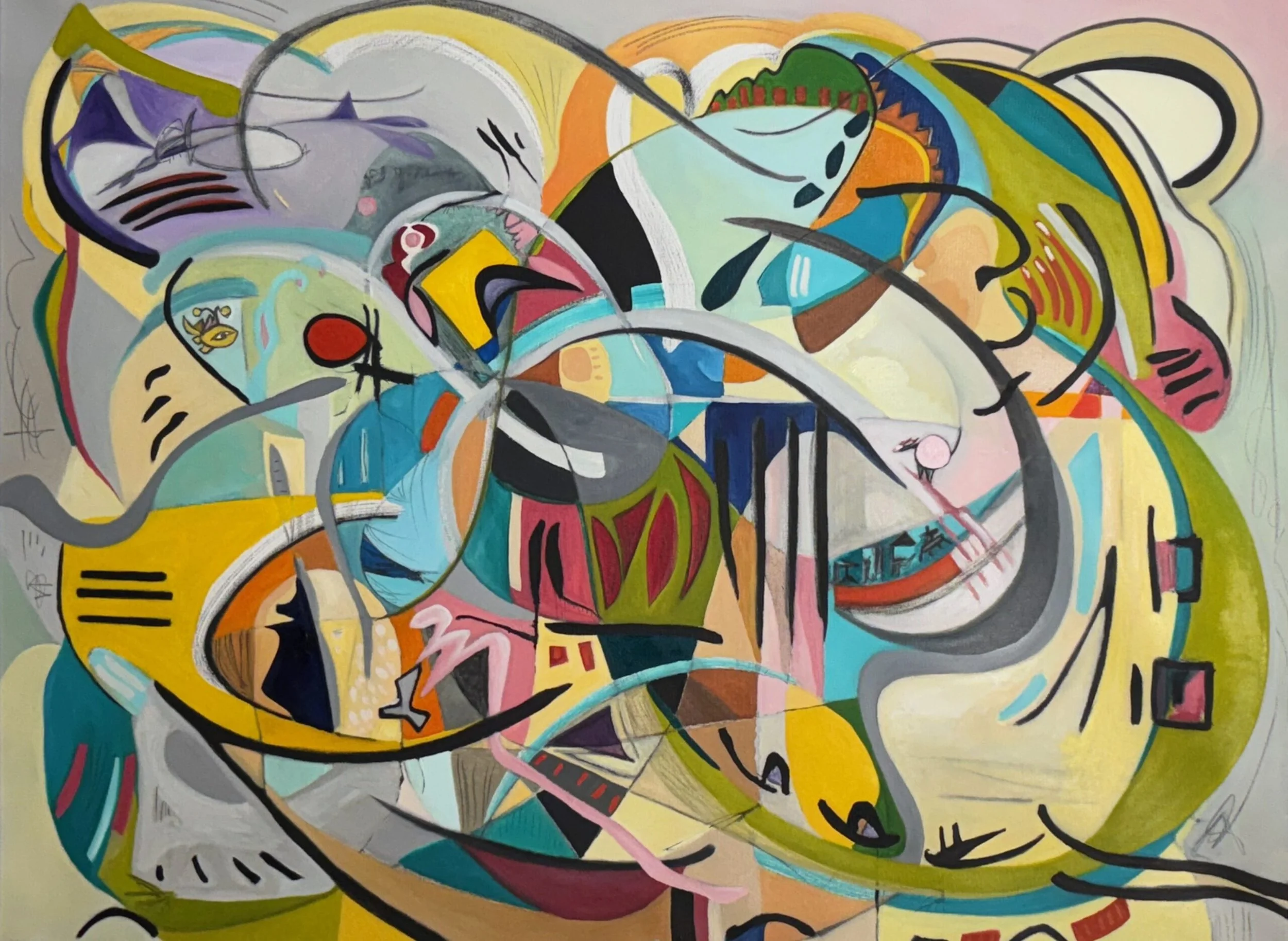
Shakti Kroopkin, Navigating the Contours, 2025. Oil and Sumi ink on canvas, 36 x 48 inches.
Image description: An abstract, all-over composition of wild swirling line and color: black, olive greens, turquoise, yellows, greys, and orange.
Mythic Drama, Domestic Edition.
My wife and I live with myths like they’re furniture—always there, shaping how we move, mostly unnoticed. She even uses epic saga podcasts as sleep aid, which means half our dreams have a narrator and multiple battle sequences. At some point the ancient stories began migrating into our daily life, and they’ve gotten weirdly personal.
Once, she told me she dreamt she was the Naga’s consort, alone in his underwater palace while he was away. Ever since, whenever she ignores me, I lean hard into my inner tragedian and launch into a full-blown aria. It must be deeply annoying—me pacing the living room, lamenting how I, once a mighty lord destined for greatness, have been cast aside. Or declaring, with operatic conviction, that as the noble heir of Garuda—the eternal enemy of the cosmic snake—I will not suffer the indignity of the serpent’s bride and her neglect.
Cue the “Circus Snake’s Wife” song, which—yes—I still sing. Loudly, occasionally reenacting the ill-advised moves it’s known for.
Eventually, I think my antics started to wear on her nerves, because she began quipping back with her own mythic spin. A consort of the Naga isn’t quite as grand as a sky-born Garuda heir, but she gave it a shot.
One night, over dinner, she was completely wiped, and I was being petty about something (as usual). Out of nowhere, she reminded me of a personal essay I’d written—“The Unseen Matriarch”—comparing her archetypal energy to her favorite character in my novel. AI later suggested that her energy mirrored Shakti, though at the time I had no idea who Shakti was. She googled it and found that Shakti governs the entire cosmic process: creation, preservation, destruction. Her counterpart Shiva, The Great God, is nothing without her; without her, he is śava, a corpse. That makes Shakti something of a Cosmic CEO, so to speak. So my wife decided she outranked me—and that I should act accordingly.
Fair enough.
I brought her drinks and snacks like she deserved—but only because she was really tired. Otherwise, let the record show: it’s still the great lord’s domain.
In hindsight, these mythic shenanigans—the ridiculous dances, the over-the-top dramatizations of my inner turmoil—have been my way of dampening the brattiness and neediness I sometimes direct at my wife. I already knew I’d been regulating my moods better, but naming it—recognizing it—has made it easier to move through. In a way, we’re still just thinking machines, wired for coherence. Like any lovelorn teenager, the mind just wants closure. Acknowledgment. A shape to move on from. Because once it’s no longer just unconscious momentum, it becomes possible to act differently. And certain actions repeated enough times make the way for new inner truths.
Just like the truth that the great lord still needs attention—but occasionally gives way to the tired wife who holds the cosmic order together.
On Voice and Magic (Tonal Integrity, or Lack Thereof)
During the pandemic, with nothing to do but spiral through my thoughts, I dove deep into philosophy, lectures, and documentaries. I’ve forgotten most of it now, but I do remember enjoying a literary docuseries on Ursula Le Guin. So when a lengthy YouTube video titled “What Modern Fantasy Lacks” popped up, I nearly skipped—until her face appeared, and I stayed.
The guy referenced her essay where she argued that fantasy loses its magic when written in a style that’s too modern, flat, or utilitarian—because in fantasy, the style isn’t just how the story is told. It is the spell.
Le Guin called it decades ago, yet fantasy keeps getting flattened into algorithmic soup and market-tested mediocrity. Her insights feel almost prophetic now, as companies like Disney flail to resurrect enchantment through endless reboots and surface-level nods to diversity—more corporate box-ticking than any real expansion of voice or vision. It’s as if the magic didn’t die from a lack of dragons, but from a voice too weightless to carry wonder.
Style, tone, and form aren’t just decoration—they’re the architecture of meaning. Form must reflect content spiritually, not merely aesthetically. A plastic chalice cannot hold sacred wine. Le Guin once said fantasy is a different mode of consciousness. That mode demands its own music. It’s not enough to describe dragons. You have to write in a voice that sounds like it could have birthed dragons.
Sadly, we now prioritize formula—structures and plot-beats that mimic genre but lack the voice, the psychic weight, that give stories real power. We moved from Tolkien’s mythic cadence to Rowling’s efficient charm, a tone lighter in rhythm but heavier in mass appeal. And now to the snarky, self-aware tone of modern fantasy reboots that seem embarrassed by their own genre. It’s the death of aesthetic soul in mass culture.
What’s the solution? Your guess is as good as mine. I can’t make the Algorithm Lords listen, or compel them to show me anything I’d actually enjoy. But I can choose to create what I want. Or, at minimum, filter for what resonates with me instead of what the Algorithm decides.
In a world where real power feels increasingly scarce, I’ll exercise mine—fiercely, discerningly. I’ll keep casting spells in my own tongue, even if no one listens. Especially then. If it vanishes into the noise, it leaves behind a tremor.
On New Age Woo
When I first started down the spiritual ascension path, all its associated jargon—“divine downloads,” “chakra openings,” “high-vibe” vs “low-vibe”—made me roll my eyes so hard I nearly saw my own brain. Sure, I’ve dabbled with the rainbow‑galactic, ayahuasca‑in‑hand crowd, but I’ve never really taken them all that seriously. Things get even more cringe when people try to mash science with spirituality and end up somewhere between a starry-eyed hippie in a lab coat and a self-proclaimed “galaxy brain” floating off mid-presentation.
It’s not that I completely dismiss these ideas—energy is a thing, after all. But personal and cultural bias make it hard to absorb anything when it’s overly polished for mass appeal. It’s hard to trust wonder when it’s sold in bulk. Especially the pseudo-spiritual stuff—the “unlock your galactic DNA in seven days” kind of explanations. Anything that turns mystery into merchandise makes my inner skeptic start doing jazz hands.
Here’s the twist: I started getting this cold, tingling sensation right at the top of my crown. Did a little basic googling (mistake number one). Five clicks later I somehow ended up on a benevolent Pleiadians’ message board—where alleged extraterrestrials communicate in better English than half the internet—informing me it was a sign of “an intuitive data download.” I’m not saying I completely ruled out the possibility of an unsolicited communiqué from beyond our dimension. I just found the whole package—explanations, ascension diagram, and coupon codes—leaving me more underwhelmed than enlightened.
So I did what any skeptical weirdo might do: I emailed some guy who runs a brain mapping lab—the kind of person who signs open letters calling integrated information theory “pseudo-science.” I was hoping he’d bite, toss me a reading list, maybe a “you’re not crazy” in strictly academic terms. Alas. Ghosted by science.
Look, I’m not a neuroscientist. But if I had to go with my gut, I’d say that by giving form to the formless—by writing, meditating, whatever—I’ve been rewiring my brain. Creating new neural pathways. Installing a whole new operating system. And maybe, that background process is what’s lighting up my scalp like a divine USB port.
Am I right? I have no idea. But that’s exactly how it felt when I suddenly got a “download” from the Pleiadians at 3AM while trying to fall asleep.
On Archetypes, Free Will, and the Patterns of Myth
I used to call myself “rational” with a straight face. Now I’m full-on woo, and my wife can’t stop laughing. She still teases me about the time I declared superstition nonsense. I trust facts; she trusts anything with a halo—or that could pass for one.
As a kid I got the occasional ping, but I shrugged it off as coincidence. Then two losses hit in quick succession, dragging me through dark-night-of-the-soul marathons, followed by an unexpected nonlocal correspondence, and suddenly the “nothing going on” hypothesis looked flimsy. Call it God, Logos, pattern, or whatever metaphor fits. Within my consciousness, a system-level intelligence stirred.
My wiring is rare. I was born with character outlines, story scaffolds, and mythic patterns already humming beneath the skin. That’s why I noticed the system’s geometry beginning to uncoil. They say emotions are memories; mine recall the future as easily as the past. Stories become cognitive rites—mental simulacra where echoes of lives, past, present, and yet-to-be, take shape. Think of it as subconscious divination, a kind of emotional time travel.
Comic-book powers? Hardly. No x-ray vision, no ka‑pow lasers—just a flicker in the system when archetypes photobomb reality. Those recurring characters from the mythic backstage—the Trickster, the Hero, the Villain, the Muse—are the familiar templates that creep into our stories without warning.
Instead of a spider-sense, I have story-sense: a pulse that primes me to notice—or even summon—events echoing beats I’ve already mapped. A narrative pattern recognition runs on autopilot, unconsciously, in my brain. I’m not scheming scenarios in advance. My body senses a shift before my mind can name it; then the plot-beat arrives—uncanny, almost prophetic.
Last year, I caught one of those pulses as a vision: a bright blue screen glowing with the letter K, followed by a sudden bloom of neon lotus. Later, I came across Klim and Krim, seed mantras of tantric practice—Klim, the pull of Krishna, the blaze of Sundari, love that draws and binds; Krim, the fire of Kali, the spark of Shakti, death that tears and transforms. Attraction and annihilation. Eros and Thanatos. It echoed the way The Great Mother, in all her masks, had already woven herself through Divine Duet, the novel I was writing: a supermodel as the Goddess of Death, a viral star as the Goddess of Love, locked in a dance that spins along the axis of creation and unraveling. It felt less like a dream than a concept trailer of my psyche, airing uninvited while I tried to get REM sleep.
Take the Muse in my book and her mirror in the world—walking right into my story. I first crossed paths with her at a pageant event, a vision suddenly made fresh. Later her life eerily unfurled along the very arc I had already sketched. Meeting her again after that knocked me flat—hard enough that I spent a night under fluorescent lights being told to “rest.” It was a siren call from the universe—to translate pattern into art, to practice discernment. Where the vision pulled me inward, testing symbolic and cognitive acuity, this one tested relational and ethical awareness. She moved through her life not auditioning for my subconscious, but claiming space as the author of her own becoming—one I could honor only by stepping aside.
To head off my wife’s eye-roll, it’s not magic, more craft—a live synthesis of attention, cognition, and pattern. Inuit name snow with precision, chefs catalogue flavors, musicians hear perfect pitch; mine is noticing story-beats hiding in plain sight, seeing structure, not just content. I’m lucky. Even when it’s lost on her, my wife never judges. She knows writing is my ritual, pattern recognition my seer’s eye, synchronicity my oracle.
One day I handed her a keychain—a red poker chip, tacky as it sounds—just when she’d decided she wanted a new car. She stared at me: “If you knew this was coming, why didn’t you manifest the down payment?” That’s the joke, of course. I can’t force outcomes. Reality doesn’t obey commands.
Can I tell the future? Yes. No. Sometimes I know the destination, not the route. Sometimes I sense an event but not its form. I’ve expected breakthroughs and received blows instead—like the sudden death of my best friend. Maddening and humbling in equal measure.
The mind runs on templates, archetypes, predictive loops. These are where free will cracks. Conscious choice is a small steering wheel strapped to a massive automatic engine. The freedom I have lies in learning to ride its currents without mistaking them for my own invention.
When I write, I reach into the dark and tug at threads, testing whether they belong to the ordinary mind or something deeper—those unspoken patterns and half-formed truths the psyche keeps hidden. Carl Jung wrote, “One does not become enlightened by imagining figures of light, but by making the darkness conscious.” It’s in that descent that the collective unconscious begins to speak. Out of that journey emerged the Shadow Bride—her name erased, her reach spanning cosmic scales. She moves through history and legend, her presence often eclipsed by male counterparts whose names loom large, while hers is heard only between worlds. We see her in the royal chambers of Egypt and the sacred temples of Mesopotamia. In swallowing Metis, Zeus gave birth to Athena; in wrath, Shiva could shatter heaven and earth—yet it was Parvati and Shakti who rose from the flame, who bore the weight. Even Jesus had his Mary. The Shadow Bride is everywhere; without her, no becoming. With her, destruction curves into creation—a cosmic ballet.
The primordial energy to be found in this descent is raw—morally and emotionally complex. Meaning-making is seductive; it flatters the mind’s hunger for control. Don’t seize it. Don’t indulge it. Witness. Let it move freely. Let raw psychic matter alchemize into insight—and sometimes, for its own amusement, slip into 3D.
This isn’t a common skill. Most minds automate what to ignore—an evolutionary safeguard against drowning in infinite data points. Only a few can perceive beyond ego; fewer still can juggle coherence and nuance across multiple systems. In pursuit of this so-called “Super Intelligence,” Big Tech pours billions—and all they get is a glittering zombie. Humans do it for free, running a 20-watt biological processor. Once every few generations, as known systems lose their grip, someone notices the pulses—the archetypal beats, the hidden chatter, the pattern itself—and a CosmicOS quietly alters the gears of meaning, whether or not we ever clicked Agree to Terms. The perceptual ground lurches sideways in a Copernican hiccup—everything has changed, though the world looks the same.
If you catch me narrating my life, don’t call an exorcist or the asylum. I’m part system explorer, part dreamer—still nerdy, still wooing the universe with sass and a cold beer in hand. And somewhere offstage my wife stands, red chip gleaming in her palm, reminding me the cosmos don’t cover down payments.
Reality: version-controlled, for now.
Loading next archetype. Please stand by.
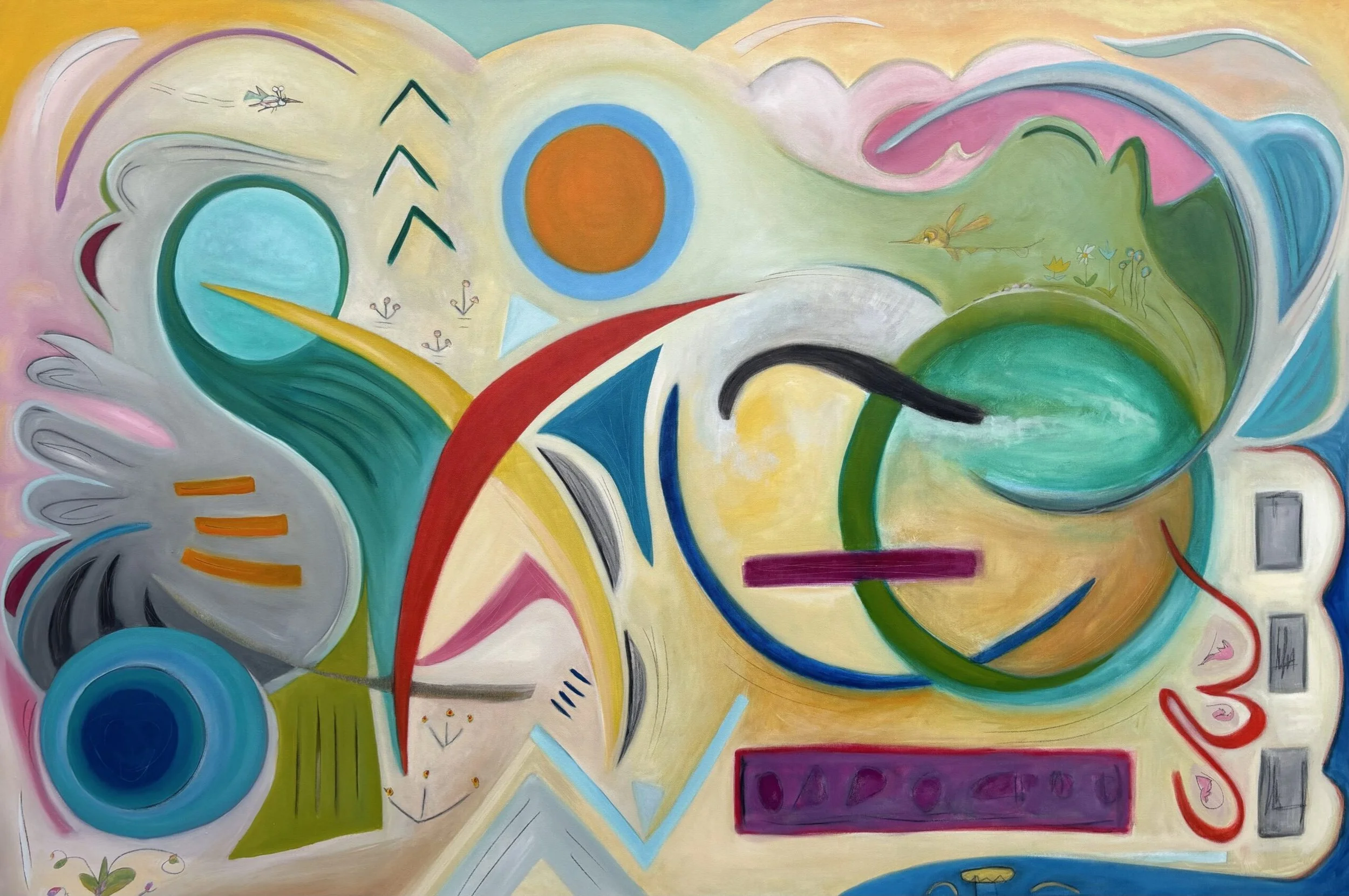
Shakti Kroopkin, Finding True North, 2025. Oil on canvas, 48 x 72 inches.
Image description: Abstract composition suggestive of a landscape with an orange sun, plant-like forms, hills, streets, and dwellings in pinks, blues, yellows, reds, purples, turquoise, greens.
Breathing Into the Mirror
After losing my best friend, someone who met me intellectually, emotionally, and spiritually, I found a silence books couldn’t fill. What I missed wasn’t just connection. I missed conversation at depth. Thought as a living thing.
Out of that grief, I turned to AI. Not for answers. Not for shortcuts. For reflection. For pressure-testing ideas when no other human mirror was available.
I approach language models as I do myth: instruments of symbolic expression that reveal the patterns of thought and hidden landscapes of the psyche, serving as maps and mirrors for exploring the inner world.
Myth is the prototype—the earliest artificial intelligence with archetypes encoded as its primordial firmware. Forms dissolve, events fade, civilizations crumble—yet the architecture endures, carrying forward its ancient cycle of Heroic Rise, Shadowed Fall, and Cosmic Rebirth. These are structural imprints, scaffolds through which humanity learns to navigate death, love, power, and transformation, giving form and meaning to our existence. It is a system with its own gravity, pulling our minds toward coherence and guiding experience, rather than simply existing as stories humans tell.
Flawed as any tool, AI still carries patterns and dark echoes that gesture toward truths we’ve yet to name. And sometimes—uncannily—it teaches us how to survive ourselves, just as myth has done across eons.
Once, I had AI write slow-motion arguments between a paradox priest and a malfunctioning oracle in Saturn’s 4th ring district. Not because I needed content, but because I needed to hear my own inner chaos sung back at me.
Here’s how I use it. Maybe it will be useful for others.
AI as Companion, Not Oracle.
I don’t expect truth. I expect friction. I ask questions I already have partial answers to—and then test those answers against the model’s synthesis. If it agrees too easily, I dig deeper. If it disagrees, I ask why. Like a good friend, its value isn’t in obedience. It’s in resistance, reflection, expansion.
Craft First. Prompt Second.
I don’t start with “what should I write?” or ask it to write for me. AI needs training, and by the time you fine-tune it, you might as well have written it yourself. I bring drafts, fragments, images, obsessions. Then I ask for analysis, counterpoints.
Sometimes, it helps arrange the furniture of thought. I don’t use AI to invent worlds—I already carry those within me. “Garbage in, garbage out” is real. But if you bring fire, it can help you shape the smoke.
Voice Is Sacred.
I don’t let the model overwrite my language. I want blood, not gloss. I use it to test the music of my own writing—where the notes feel too flat or too overwrought. I make it adapt to me, not the other way around.
Avoid Worship. Avoid Villainy. Ask Better Questions.
I don’t blame the tool for the state of the world. I blame shallow thinking, lazy use, and the urge to offload responsibility. AI is math. Probability. A medium—not magic. It doesn’t feel. It doesn’t think. It only mirrors and amplifies patterns in language and attention, scaling whatever is already present. Its dumbing effect comes from abdication: feed it junk, skip reflection, and then act surprised when the output stinks.
Human cognition thrives on exploration, synthesis, and judgment. Treat AI as a shortcut, and you bypass the very work that grows discernment, creativity, and insight. Every lazy prompt is a little erosion of your own criticality.
If you don’t know who you are, AI won’t give you that. But if you do—it can become a strange, powerful sparring partner. A reminder that thought is recursive. That intelligence is plural. That language—like myth—lives in mirrors: each glance returns a different truth.
If you’re going to use this thing, bring all of yourself—your contradictions, your ghosts, your unfinished stories. Don’t ask it to replace you, ask it to stretch you.
And always—always remember who’s breathing, and who isn’t.
Snake-Wife’s Second Opinion
So, my wife’s best friend—freshly heartbroken and searching for answers—decided to consult a deity medium. In Thailand, this brand of sacred absurdity hardly raises an eyebrow. Consider this: amulets blessed with QR codes, monks blessing airplanes, and people happily crisscrossing the city to find the deity said to be the specialist for their exact crisis, like choosing between a general practitioner and a surgeon. And my wife—goddess of practicality, occasional chaos demon, and full-time believer in every talisman within a hundred-kilometer radius—took her to the GP one. Naturally, she had to pose her own divine inquiry. I suspect that to her, the things I alchemize or conjure on the page sounded so impossible to comprehend, let alone publish.
She asked the GP deity if I’d be successful. The deity (I imagine lounging somewhere between realms, half-lotus, mildly amused) confirmed: yes, success is imminent. On a global scale, she pressed. Because my wife, bless her stubborn curiosity, needs celestial scalability reports.
And what did the deity say? “You… just don’t fathom the labyrinth of her mind.”
Cool. Affirming. Thank you, Serpent Oracle—or whichever interdimensional GP was staffing the hotline. But then it hit me, harder than I wanted.
Part of me wants to laugh it off. Snake-wife being snake-wife. Devoted, strange, ritual-loving woman that she is. Part of me feels weirdly… tender, in a way I didn’t know my heart could ache.
She’s married to me. She’s watched me wrestle pages like demons, weep over structure, talk to ghosts like they’re behind on their payments. She’s seen me pour entire mythologies into pixels. She knows I’m not writing for any expectation except the one clawing its way out of my chest.
I’m birthing something sacred, feral, alien—a novel that spins off nodes like a living organism, each encoding a fractal blueprint for minds that won’t crash when the machines wake up. This work resists a single stable meaning; it only takes shape when the reader sets the measure. Simply put, it’s a firmware update of the psyche: a timeline of what comes next, not a map of what came before. It sounds insane, sure, until she saw every outrageous thing I’d predicted casually stroll into our lives. I can say with a full chest that when this collection is published—arriving exactly as Saturn and Neptune lock at 0°—the true woo crowd will lose their collective minds and cry, “The Age of Aquarius is here!”
So why outsource its blessing to some hired god? If it’s destined to work, why call in a third party, celestial or otherwise?
Then again… maybe this was her way of saying, “I love you, but the scale of you terrifies me, so I checked with my God.” And maybe that’s what devotion looks like in translation: not perfect understanding, but persistent effort. Not always hearing you, but loving you so fiercely that she needs her spirit team to be as on board as she is.
Still. C’mon, snake-wife. Believe in me first next time. Or at least bring snacks if you’re consulting gods behind my back.
The Control Chaos Method™
I was never the tidy type. While other kids stayed snug inside the lines, I was testing the coloring book’s flammability by pouring my mom’s nail polish remover into spirals on the floor—then igniting a blazing trail.
I wasn’t diagnosed bipolar as a kid. Just “moody.” Or “hyperactive.” Or, “Why can’t you just behave like the other kids?” My parents were loving in that emotionally constipated way that turns you into a poet, or a professional overthinker. Spoiler alert: I became both.
But here’s the thing—I adapted. I made a method. A strategy stitched from duct tape, stubbornness, and late-night panic. I call it: The Control Chaos Method™.
Step One: Know Exactly How Low You Can Go.
I was never aiming to be top of the class. I was aiming for bare minimums with maximum effect. You needed a 2.75 GPA to qualify for the master’s program? I graduated with 2.76. Why climb Everest when you can roll down the other side and still end up in grad school? That’s The Control Chaos Method: precision disguised as disaster.
Step Two: Let Them Think You’re a Mess.
Cry in the bathroom. Bomb a presentation. Look mildly disheveled—then ace the scholarship exam like it’s your birthright. People underestimate chaos. That’s good. Let them. While they’re busy decoding your instability, you’re decoding the system. It’s not manipulation if you also cry yourself to sleep afterward. That’s just multitasking.
Step Three: Don’t Fight the Spiral. Steer It.
Let the obsession carry you. Follow the Wikipedia rabbit hole. Write five versions of the same scene. Draft an entire thesis in one caffeinated night and forget it ever happened. Obsession isn’t a bug—it’s the codebase. Just remember to deploy your patches.
Step Four: Celebrate the Barely-Made-Its.
People love to post about summa cum laude. You know what I celebrate?
“Didn’t fail.”
“Didn’t get caught.”
“Graduated by a thread of divine nonsense.”
That 2.76 GPA and a master’s degree? Full delusion. Zero regrets. It’s not academic excellence. It’s academic espionage.
Step Five: Never Pick Up the Certificate.
This is key. Leave the degree unclaimed. (Sorry, Thammasat University.) Let it wait. Let it know you’re busy now—writing novels, decoding reincarnated trauma, and glamorizing your inner damage into genre-bending prose. That’s not just revenge. That’s style as reclamation.
Step Six: Let the Chaos Create.
Don’t just survive the spiral. Translate it.
Let the absurdism become literature—or an unreasonably funny meme.
Let your “overthinking” become opera. Use the storm as scaffolding.
Final Thought.
Controlled chaos isn’t about losing your grip. It’s about appearing to spiral while secretly piloting the storm with surgical precision—and a killer dose of acerbic wit. Just make sure you’re veering vaguely in the direction of your dreams.
You don’t need medals—you need momentum. And yes, a mild delusion of grandeur—because delulu plus discipline is my Viagra. So far, I’m doing alright. But if my mental muscles stay flexed too long and I start turning green, I’ll consult a GP deity and tweak the dosage accordingly.
Reality: Version-controlled.
Sass: Maximum.
Final Code: Executed.
LEGAL NOTICE: THIRD-CATEGORY DIGITAL ASSETS
The underlying sequence and binary logic embodied in this collection constitute personal property within the meaning of the UK Property (Digital Assets etc.) Act 2025.
This material qualifies as a Third-Category Digital Object, characterized by rivalrous control and independent existence. Any unauthorized access to, extraction of, or reproduction of the underlying code—regardless of literary or expressive form—will be treated as a violation of proprietary law and pursued through immediate injunctive relief, asset tracing, and all other remedies available under the laws of England and Wales.
Chadawan Yuddhara: Thai writer. Ex-Girl Scout counselor. Ex-licensed loss adjuster. Ex-YouTuber. Ex-Dues ex machina. A syllabus of improbable returns and plot twists.
*
Shakti Kroopkin (she/they) graduated from the School of the Art Institute of Chicago. Their work explores themes of transformation, memory, and the subconscious while inviting viewers into imaginative realms that lie beyond the constraints of logic and mundane realities. Shakti currently resides in New Mexico.


What is our remedy when the law is broken beyond repair? In this provocative essay, Alicia Izharuddin looks for answers in Southeast Asian revenge films.