
As The Han Flows
By Max J. Nam
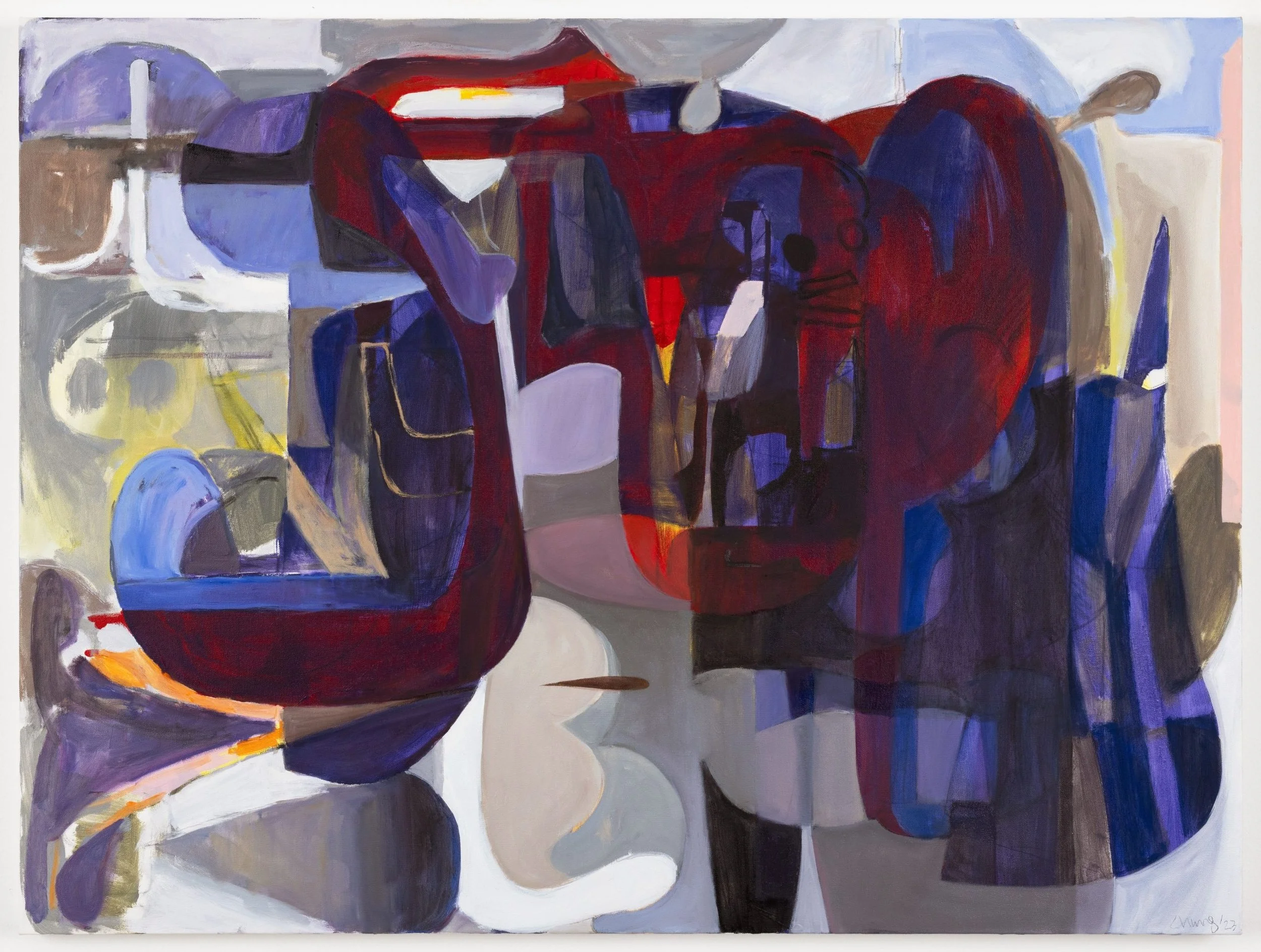
Helen Chung, Untitled (Shut Up! You're Not Interesting!), 2023. Oil on canvas, 38 x 48 inches.
Image description: An all-over composition of abstract, overlaid, and interconnected shapes in a palette dominated by pale greys, deep violets, blues, and reds.
In the second to last winter of my childhood, I went for a walk. It was early January, and the snow had come down that day like an epiphany. Andy called me up to go explore the riverside. We weren’t very close at the time, although we had been classmates for years, but he asked me anyway knowing I was the only other person who would be excited by snow. I agreed to meet, and, shortly after sunset, the two of us ventured down to the bank of the Han.
There, the fog had gathered so thickly that, despite the dwindling snowfall, we could barely see a few feet ahead of us. The streetlamps along the path revealed nothing but darkness. Everything we came across was disfigured and unrecognizable: familiar hills gave way to treacherous cliffs, stone steps morphed into strange jagged monoliths, and a great steel bridge, whose underside we spent ten minutes staring at in awe, offered a glimpse into an alien world, like one of those industrial dystopias in popular sci-fi movies. When we reached the water, the city lights across the river had been swallowed up, so that there was nothing left to remind us that we were in Seoul, and everything to suggest that we were now standing between the realms of the living and the dead. All around us, a hush gradually settled like a curtain blocking out the noise of the universe—penetrated only by the occasional faint voice which, when followed, gave way to empty mist, as if it was the whisper of spirits beckoning us forth.
Naturally, the more ominous our surroundings became, the happier and more reckless we grew. We sprinted wildly along the pavement, leaped off dangerous-looking ridges, and clambered over forbidden railings. At one point, we tried going down an icy slope that led right into the river. My shoes had the better grip, so I stayed above as an anchor while Andy held my hand and inched forward—and in that manner, we gradually edged our way to the bottom, dressed like two penguins and stumbling every two steps as the spirits urged us on. Finally, Andy decided that we should walk across the frozen water.
“Only if you go first,” I dared him. Andy pondered the ice for a moment.
“Deal,” he replied, striding out with total confidence.
That was the time Andy fell into the river.
After that night, as if Andy’s unplanned baptism had somehow bound us to the Han, Andy and I would often go walking by the riverbank. We began to bring Eugene, another friend in the neighborhood, along with us as well, and soon it was ritual for the three of us to meet on any night that the mood struck. We walked in every kind of weather except rain: on snowy nights that whisked us back to the world of that first walk, on temperate nights under the maternal gaze of the moon, and even at times when the sky was so muffled by pollution that all you could see was the dust glimmering over the city—but which were made up for by other occasions, when the air was clear enough that, despite being in the middle of Seoul, you might actually glimpse a star or two. It was a rare freedom from the weight of growing up, a respite from the usual activities prescribed to boys our age (studying, worrying, and more studying). We were faced with just one choice on each walk—east or west?
For us, to turn west would mean an adventure, whereas to head east would mean a journey. The adventure promised a trail of endless discoveries, with parks and promenades and paths to little islands constantly popping up out of nowhere along the riverbank, ensuring that, no matter how many times we had walked westward, there was always something new to entertain us. The journey, by contrast, consisted of a rather predictable series of sights: a small outdoor gym, a grassy field, and then bridges, bridges, bridges. Yet it was this second, plainer option that offered us a true sense of the epic—a feeling that we were on some cosmic trek down an infinite road, traveling at the very edge of existence and moved by the same breeze that pushed the clouds through the night. We felt that, by walking eastward, we were participating in something far greater than ourselves, something which can't quite be expressed in words, but which we understood in the gentle lapping of the water and the little nudge of the wind.
What made us feel such things in those moments? I think perhaps, somewhere in that water and that wind, in the rubble of that pavement and in the shadows under those numberless bridges, we sensed life itself, more real than any of the future-rending crises casually occurring each day in the long quest toward college admissions, or of the plastic ideals fed to us from infancy by adults and the mass media. Besides, there was something very satisfying about seeing a huge bridge loom over us and realizing that, forty minutes ago, it had been just a short vague line scribbled above the horizon. There was something about walking that gave us a tangible sense of progress, as if it were proof that we were actually moving forward—even if to go nowhere at all.
Thus it was during this period that I, like many of my friends (all of us for some reason at the exact same time), suddenly began to take advantage of the fact that I live in the world. In April of the following year, I took my new buddy Hana down to the river, to show her all the wonderful things I had discovered there. Walking right to the edge of the bank, we stood among the rows of young flowers blooming by the water—I can still see Hana’s eyes sparkling like a character out of Studio Ghibli when she spun round and exclaimed, “It’s so pretty!” The sky that day was such a bright burst of blue that, every time we looked up, we were filled with an insatiable urge to fly. So we raised our arms and reached up high, and as we strolled along we saw two birds teasing the clouds and felt that we were them, lofty and free and careless of the fields of grass awakening beneath our feet.
But soon summer came, catching us by surprise and driving us off into the corner for shade. And still the river rolled on, past the fields, past the green hills, under the white of that blinding sun whose light would wash over me as I sat waiting for the train, while the shrill cry of cicadas seeped into the humid air and soaked my skin. Then the train would arrive, and I would ride and stare out the window at the trees and power lines streaking by—until we crossed a bridge over the Han, and then the view would flush open to reveal the boundless sky above the shimmering water, and I would do everything I could to capture the scene (using my eyes, words, photos, anything), trying my hardest to absorb it all as I gazed into the dream-blue.
For, just as quickly as it had come, summer would slip away. And when autumn emerged, I would not be there to greet it. My childhood was transitioning into something else, like the leaves of trees changing their colors. I would depart at the end of July to start college in Ithaca, and, although I didn’t know it then, my parents too would move to America just a few months after me, taking with them my final ties to Seoul. It was the last summer of my childhood, but I did not stay to see it off. By the time the first leaf fell, I was already gone.
*
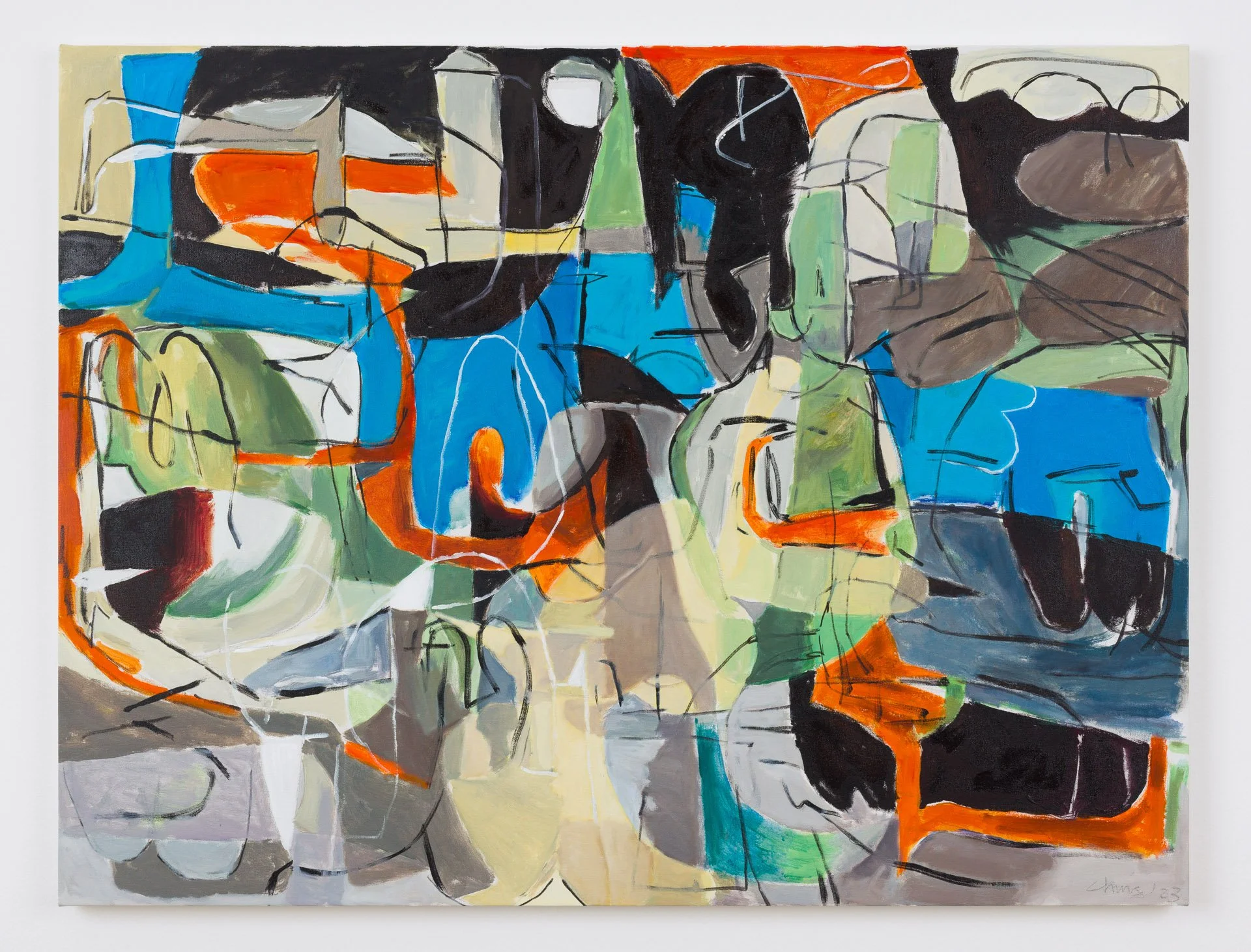
Helen Chung, Untitled (Maybe Had I Known I'd..), 2023. Acrylic and oil on canvas,36x50 inches.
Image description: An all-over composition of abstract, overlaid, and interconnected shapes in a palette dominated by pale greys and yellow, black,orange, cerulean blue, and bright orange.
Sometimes in Brooklyn, the rain comes down and buries the buildings across the river. Whenever that happens, it seems to me that the world beyond the window transforms—New York becomes Seoul, the East River becomes the Han. I’m back at home on a gray Saturday afternoon, stressing about my schoolwork and being melancholy about the passage of time that will inevitably lead me to Monday (not knowing what manner of happiness secretly lies in that stress and melancholy).
From a different side of my parents’ apartment, the windows overlook the crowds of houses crammed throughout the borough. The rain rubs away the details on the buildings, erasing their lines of context, so that, under this muted view, I can imagine that these are the neighborhoods not of Brooklyn but of Yongsan. After all, I ask myself, if two places appear exactly alike from a certain angle, what’s to say they aren’t actually one place? Maybe there is no Brooklyn that is truly distinguishable from Yongsan; maybe there are no real places, only perspectives. And so I whisper to the rain that I am still home, that there is no such thing as America, and that everything before me is the same old picture, just taken by a new camera.
In Ithaca, similar thoughts emerge as I first look around my dorm. I find my room from Seoul strangely recreated, with familiar books and plushies lining the shelves, familiar coats hanging in the closet and clothes folded in the drawers. And yet the original has not been fully restored; the version I’m sitting in is shrunk and diluted, missing many of its usual details, like a photo one finds of one’s parents from their adolescence. The rest of my old room, the remaining toys and books and picture frames, is currently being packed up in Korea, to be reassembled in Brooklyn where, in three months, I’ll see it for the first time. But still, somehow, lying here on my new bed, I feel that I’m in the same room that I’ve always known. These posters on the wall, these childhood albums, these cherished trinkets on my desk—all come together to form my own little asylum, sheltering me from the storms of change. It’s as if my room is one of those migratory English words whose spelling varies by country, like ‘neighbour’ or ‘aeon’ or ‘center’: a word arranged differently in different regions (in Seoul, in Ithaca, in Brooklyn), but always with that single unalterable meaning at its core.
The only difference, which I can’t escape in Brooklyn nor in Ithaca, is the sky. I gaze up at it from the windowsill, and try hard to summon those old feelings again. But try as I might, I fail. No matter how I look at it, the sky just isn’t as pretty as it used to be.
*
It’s evening in Ithaca. Alone at my desk, I pause from writing and look out at the dark water basin of a sky, as deep in color as it is in depth (a blueness somehow deeper than black, like the ocean surface where it hides an undersea abyss). And there it is, that new tugging at my heart. I lean back and prepare my dose of that drug called nostalgia, perfectly aware of what pain it will bring, but with no other remedy for the hollowness in my soul. My poison, my medicine. Beyond all else, I’m afraid of forgetting—or worse, of ceasing to care about—those memories that I currently cherish most. And if doing that is what it means to grow up—well, then, I would rather stay in this incorporeality forever. So I plunge the needle full into my flesh, plunge my flesh into the pain, just to prove to myself that the pain is still there.
I sink into the sky. Beside my journal, my phone lights up on the desk. Friends are calling me, friends newly made, inviting me to join them. But ah well, I let myself sink deeper…
Yes, the worst thing would be to lose this feeling, this yearning which is my only connection to the past. As long as I keep yearning like this without end, that past remains mine. What more could I possibly need?
Something else is calling now. This time it isn’t coming from the phone. Out of the quiet of my memory, an image rises like the tide. It swells up from unknown depths to recall me to a certain place, a place that ever pulls at my body, begging for it to follow, although my body is unable. It is a place to which the body cannot go—only the heart.
Max J. Nam is a Korean-American-Australian writer and student. He was born in Tokyo and raised in Seoul and London before moving to the U.S. for college. He is pursuing a bachelor’s degree in English Literature at Cornell University, with minors in Comparative Literature and East Asian Studies. After graduating, he hopes to continue his learning wherever he can.
*
Helen Chung (BA Fashion Institute of Technology, NY; BA ArtCenter College of Design, Pasadena) was born in South Korea and currently lives and works in Los Angeles. After graduating, she worked briefly as a shoe designer. Her work spans painting, sculpture, and photography in both narrative figurative genres and conceptually-driven abstract work. For more info visit: https://helenchungstudio.com and https://www.instagram.com/heleninorbit

What is our remedy when the law is broken beyond repair? In this provocative essay, Alicia Izharuddin looks for answers in Southeast Asian revenge films.