
Too Much Silt
By Yap Hao Yang
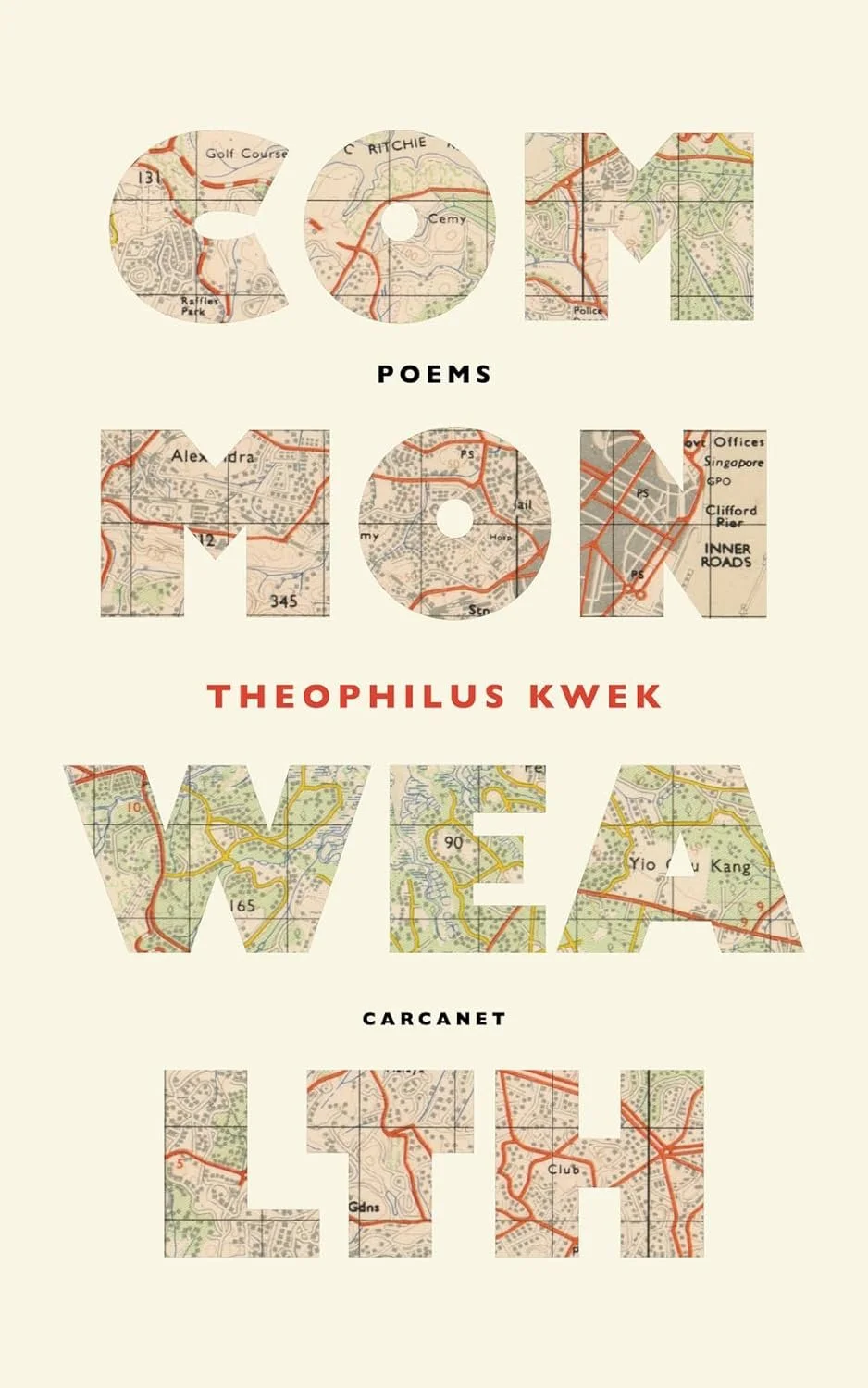
Commonwealth, the fifth full-length collection of poetry by Singaporean poet, Theophilus Kwek, investigates our relationship with land in Singapore. In a city where 75% of the population lives in apartments on a 99-year lease, land is unreliable—it moves, and it keeps changing hands. Consequently, residents alternate between states of rootedness and rootlessness, possessing only a transient connection to places they call home. Already at the start of the collection, the opening poem, ‘Closing Time’, confronts us with the relocation of long-time residents from Tanglin Halt estate, which was slated for demolition by 2024. Yet, this is merely another instance of dislocation in the restless history of Singapore.
Throughout Commonwealth, Kwek chronicles the series of displacements in Singapore across the colonial era, the post-war period, and the 21st century. These changes are often seen in our built environment. In ‘Clearances’, for instance, Kwek narrates the historical reshuffling of land ownership, where he describes the “bitter trade” between the British and the Sultanate and the turnover of Napier’s house in Tanglin. Centuries later, the turnover of housing spaces would be repeated on a larger scale with the relocation of residents from kampongs into modern apartments (‘Relocations’, ‘Chap Lau Chu’), and then again out of these apartments (‘Closing Time’, ‘Pearl Bank’). Under such conditions of repeated uprooting, how can anyone feel a sense of belonging, or, as Kwek asks in ‘Jalan Besar’, “claim [their] lawful turf”? Kwek, in that poem, recalls scenes of a grass turf from yesteryear (“their young gather[ed] here/ to mourn and dance [...]”) and asks, “Who walks it now?” Echoing the sentiment at the heart of Southern Tang Emperor Li Yu’s Yu Mei Ren (“Jade steps and carved railings may still as ever be there/ Though changed are the faces fair”), the poem searches for the things that remain constant despite change.
Often, our sense of belonging to a place is mediated by objects. In ‘Closing Time’, Kwek draws our attention to everyday items like “cups”, “benches”, and “LED signs” and draws out each tidying action “‘sweep”, “scrape”, “strip out”; the process of relocation is dragged out, a sentence stretched from the poem’s beginning to its end. In so doing, Kwek gives space to the emotional weight of relocation, revealing the sentimentality we attach even to the most trivial of items used in our everyday life. We see this reprised again in ‘Pearl Bank’, where Kwek personifies inanimate parts of the eponymous building like “pillars [that] regret” and “columns […] full of outcry”—they betray the emotions we invest in them. And when the “staircases weep”, one is reminded of Virgil’s pithy formulation: Lacrimae rerum—there are tears of things. But while notes of lament are sounded, woe is not the collection's overall tone.
Despite cycling through dislocations and relocations, Commonwealth is remarkably stoic. There is a recognition that—as cliche as it sounds—change is the only constant. After all, the collection opens with an ending in ‘Closing Time’; later, in ‘Chap Lau Chu’, a poem that revisits the moment residents moved into the first HDB flats in Singapore’s Commonwealth neighbourhood, Kwek fast-forwards to the foregone conclusion at the start: “One day we’ll take them down again.” The same pessimism colours the description of a “leaf vacating/ an old rain tree/ [that] still stops the gaze, though the ending/ is forgone” in the poem ‘From A Field’. One might say Kwek is cynical. But in a city where one would indeed be “lucky if the roof you put up outlasts/ the kids you raise”, Kwek’s attitude is more than reasonable. In fact, there is something comforting about the inevitable cycles of change, which Kwek repeatedly points out in Commonwealth. The ending of ‘Pearl Bank’, for instance, asserts (almost mantra-like) that “There will be rain again, and rain over/ the earth, till another grain/ sleeps, wakes, becomes a pearl.” A play on the name of the iconic Modernist apartment building, this line expresses a persistent hope in spite of change beyond control. There is comfort in the cyclical rhythm of history—a building is demolished, another rises.
There is comfort too in the eventual return to—and of—nature. Many poems in Commonwealth (especially those written during the COVID-19 pandemic) imagine the world in the absence of human beings. After our departure, we “turn the benches over to the birds” (‘Closing Time’) and “ferns run amok along the walls’ crevasses [and] a wasp dares to clamour” (‘Relocations’). In an age of catastrophic biodiversity loss, these poems bring together the human and non-human experiences of dislocation and relocation; at the same time, they offer some hope for a more harmonious coexistence in the future. In asking whom this land belongs to, these non-anthropocentric poems suggest a common trans-species claim to the earth—our commonwealth.
Where Commonwealth shines is in its occasional instances of precise, imaginative, and surprising language. The ending of its titular poem, ‘Commonwealth’, best represents this:
[…] light industry, a city on its heels,
so quick even the grownups are caught
by surprise. The same grownups tiptoeing
now for all that’s still unseen, caught here
in a blink of a lens. Yes, an industry of light.
Kwek cleverly flips the formulation “light industry” (using ‘light’ as an adjective to describe the rapidity of development) into “an industry of light”, which not only offers a pithy description of photography, but also of the electricity-reliant industry of modernity. “An industry of light”—a phrase as snappy as a camera’s click. The pandemic poems are also strikingly imaginative, delighting readers with such fanciful images as “bougainvilleas [letting] their long hair down” (‘Psalm for a Pandemic’) and “roads roam[ing] with ghosts, making the trees quiver” in a description of heatwaves (‘Report from a City Under Lockdown’). Unfortunately, this is where my complaints begin.
For every metaphor that succeeds, multiple do not. Some of the especially awkward ones include: “an island is a door/ through which a sea is strung” (‘Quarantine’); “aunty Hasmah [...]/ her kerosene lamp a lighthouse above/ our heads” (‘Relocations’); and “to weave between the waking and the dead/ a line sinuous as earth, the water/ making way” (‘The Swimmers’). The images here are either absurd (a lighthouse above one’s head) or ambiguous (water being compared to ‘earth’, only to return to ‘water making way’). Yet none can compare with the abject abstractness of ‘Flyover’:
When was it I learned that two
roads, one going this, one the other way
could meet here, for a time run parallel
to the sky, and reaching down (as if both
were to lean on one shoulder) rest their palms
against the earth, their single steadying
shadow like a handstand, or a prayer?
It is difficult to imagine this sequence of asphalt gymnastics. The onslaught of clauses heaps confusion upon confusion. One finds in this excerpt an instance of the rambling syntax found elsewhere in the collection such as the one-stanza poem ‘Moving In’. In contrast, the sentence-long ‘Closing Time’ succeeds with a more natural and restrained sequence of images and sentiment. Often, however, syntactical choices reflect the poet’s voice—a formalistic poet might choose a metrical syntax for instance. In Commonwealth, voice might be Kwek’s greatest fault.
Generally, the voice of Commonwealth is overtly poetical to the point of being faux poetic. This voice is heard from time to time: “the princes and the poets, who are prophets/ too of a most fantastical kind” (‘Funan: A Traveller’s Guide’); “love by any other/ name is flight” (‘Parable of Feet and Wings’). Is it not a cliche to refer to poets as fantastical prophets? Is it not too Shakespearesque to refer to love “by any other name”? Besides sounding ‘poetic’, there is little substance in these lines. However, the most unfortunate occurrences of such faux-poetic writing are when they undermine comprehension. Consider the following lines from ‘Parable of Feet and Wings’:
[...] How
fraught and, unburdened by metaphor
how free: each whip of a tail, each graceful
taking to the air; which ones each season
leave earth behind, and yet are there.
Like the gecko, this sentence gets off to a decent start. However, once in the air, meaning becomes uncertain, secondary to the elegance of form. Helpless, the poem defaults to a poetical cadence (“and yet are there”). The gecko lands and brushes the faux pas off.
When the writing does not strive too hard to be poetic, it is far too prosaic—descriptive and colloquial without the imaginative precision of poetry. Too many of the poems in Commonwealth read like reportage with little artistic intervention. For example, ‘Clearances’ and ‘Nila’ relate segments of Singapore’s history in the chronological and conventional manner of a National Education lesson. Even when the focus is not on national history but social history, the poems generally offer a dry retelling of facts. For that reason, the plainly descriptive ‘Relocations’ (“My father ran the provisions shop”) and ‘Commonwealth’ (“a girl/ who can’t be older than eleven or twelve/ dressed for the occasion in a white frock/ and socks to match, hoicked high, black”) lose the reader’s attention easily.
Moreover, its reliance on oral history leads Commonwealth to reproduce the monotonous, matter-of-fact format of reported speech: “He announced that the fire was/ very serious, and after he said this [...] The next day [...]” (‘Relocations’); “Oh, Kenny must have cleared it/ says Big Aunt, still watching the TV” (‘The Chariot’). In addition, Kwek’s use of found text is rather injudicious, particularly in the poems ‘De Paradiso’ and ‘Morning at the Raffles Hotel’. In the former, he groups phrases from PropertyGuru into rhyming couplets to no particularly delightful outcome, producing instead an awkward rhyme between “connectivity” and “century”. As for the latter, lines are wasted not just on replicating a colonial newspaper clipping but also—yes—a URL.
When Kwek turns to the local colloquial register and reproduces Singlish in verse, the result is often uninspired. It is as though the ‘Singaporean voice’ is all he intended to capture, with reported speech like “Last time after six you see all the children/ go down to the tracks hold their lantern/ not like the kind you see today got light/ got battery last time is use cellophane”. There is nothing here that invites imagination—it is pure documentation. In comparison, when Kwek writes in his own voice (marked by formal tendencies, literary references, and the use of standard English), we find lines like those in ‘Report’: “This then/ is how a city ends, not with a bang/ but six lanes braiding in a roundabout”. Such lines engage meaningfully with the possibilities of language, the quintessential preserve of poetry.
With all that said, Commonwealth remains a commendable effort at engaging with the pertinent topics of land and belonging in Singapore and around the world. As a writer who has long reckoned with the implications of colonialism, modernisation, and globalisation, Kwek is also wise in turning his gaze to local and native histories to understand our place in the world. It is only a pity that the collection is not as conceptually focused as it could have been. A book that opens with a map of a district in Singapore, after all, anticipates site-specific poetry—a micro-history of Commonwealth or, if not, then a macro-history of the British Commonwealth. Unfortunately, this collection lies somewhere in between and digresses into several irrelevant anecdotal poems like the personal but prosaic recount ‘The Two Bravest Humans’.
Throughout the collection, Kwek compares the course of history to that of a river. Its flow evokes change, such as the morphing of the names of Funan “through older tongues:/ Phnom. Phù Nam. Fúnán. Funan” (‘Funan: A Traveller’s Guide’). At the same time, change is often gradual, and bits of the past are carried into the present—a river “full of history’s silt” (‘Jalan Besar’). Commonwealth, in swimming in the river of history, however, might have ended up carrying too much silt back to shore. Ultimately, poetry is in the refining, the swirling of a pan to filter tin or gold.
Yap Hao Yang (he/him) is a writer based in Singapore.

‘A snapshot of our planet, filled with souls dead and living, crying out that they matter, that their stories must be told.’—this September, Ng Yi-Sheng reviews writers exploring their own pasts.