
The Darkness About Us: Seventeen Stories of Hybrid Otherworldliness
By Marie La Viña
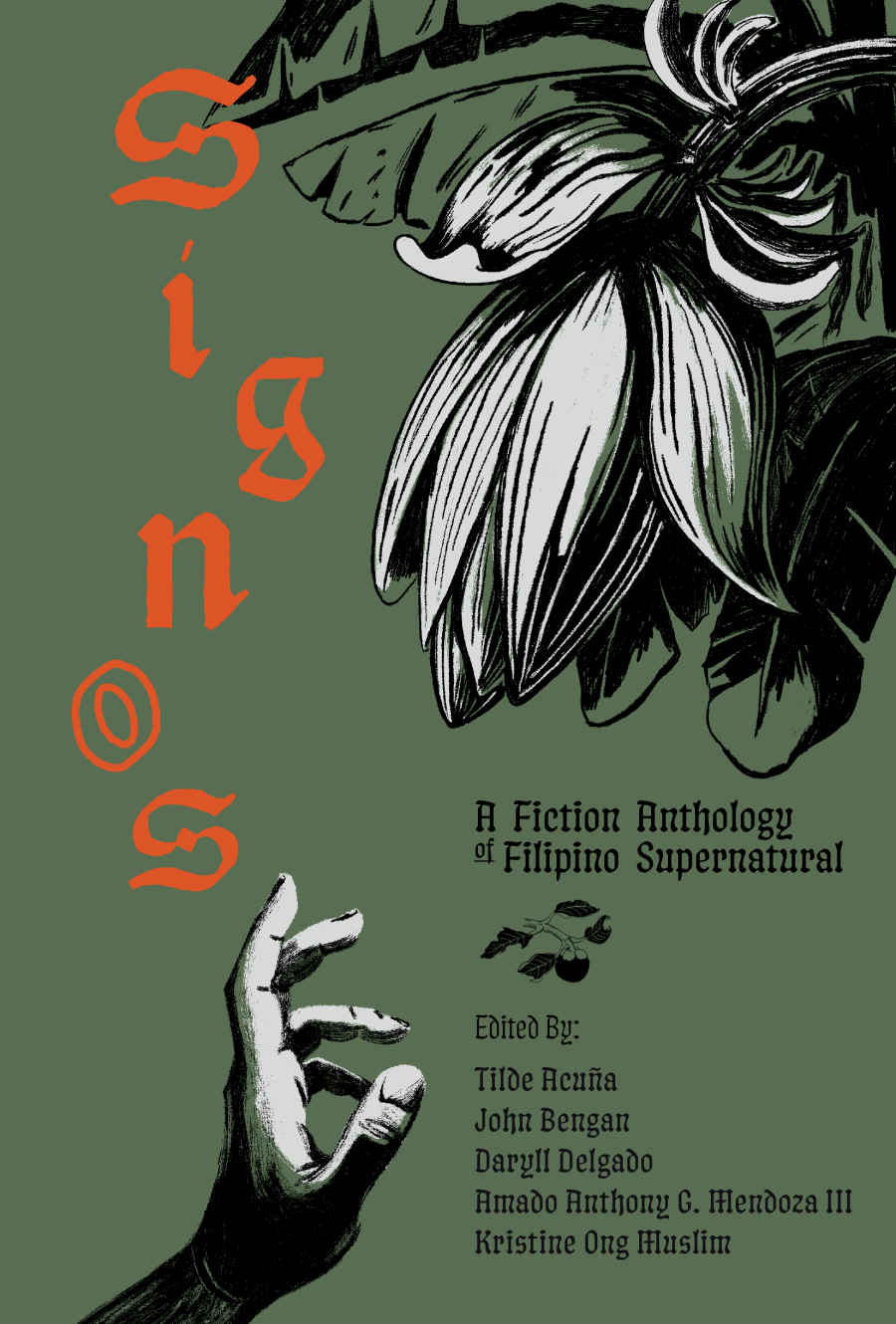
Threading the primordial and the numinous through the everyday, the stories in Signos make radiant the seams between worlds. Weaving dark lore and precolonial myth, invoking ancestral spirits and older gods, the collection unfolds a partial record of signs, symbols, and figures from the Philippines’ supernatural landscape, overlapping otherworlds in various tenses of time, including our own. In this new anthology from Brooklyn-based independent publisher Radix, editors Tilde Acuña, John Bengan, Daryll Delgado, Amado Anthony G. Mendoza III, and Kristine Ong Muslim gather seventeen stories from the immense, diverse, multilingual, and largely untranslated body of Filipino supernatural literature. Within its pages, workers, bureaucrats, and landlords exist alongside chimeras, crones, and mountain nymphs. Bored gods throw down a drop of sky to crush a newborn. A cockfighter, restrained by his wife, begins to squawk, crow, and grow a crown on his head. In the aftermath of a massacre, flowering vines erupt from blood-drenched soil, stretching their tendrils toward a murderer’s towering house.
In these stories, the editors identify an expansive “hybrid otherworldliness” through which older faiths, indigenous beliefs, and ancestral practices endure the centuries-long predominance of Catholicism, a hybridity which animates the contradictions and ruptures precipitated by past conquests and current injustices in the Philippines. Moreover, the presence of the supernatural within worldly realms—the coexistence of the normative and the magical within these stories— reveals the manifold overlapping worlds that constitute life in a nation of such numerous and varied people, languages, histories, and epistemologies. Such complexity and multiplicity have always been threatening to agents of colonization, who exercise various forms of violence to absorb the indigenous populations into their way of life. The stories in Signos not only reflect the myriad ways in which Filipinos have been refusing such suppression over the centuries, but are themselves a method of further refusal and resistance.
“[T]he mythical elements and folkloric designs in our stories represent evolving points and counterpoints in our country’s struggles,” write the editors in their introduction. Supernatural fiction troubles what troubles our archipelagic people: colonial violence, economic precarity, labor exploitation, social stratification, capitalist overconsumption, and ecological crisis. Fantasy as a genre, in its ability to engage with the mysterious, the occult, and the uncanny, facilitates “a deliberate departure from the dominant Western, realist, naturalist, or modernist modes of storytelling.” Its devotion to speculation and imagination can recover what has previously been demonized and suppressed. The collection challenges hegemonic narrative modes not only through genre, but through language. Four of the stories—“Sigbin” by Chuckberry J. Pascual, “Pikpik” by Elizabeth Joy S. Quijano, and “Kamote” and “From Even If Humans Are Chameleons” by Janssen Cunanan—appear in this volume for the first time in English, translated from Filipino and Cebuano. As the editors note, the linguistic diversity of the Philippines includes more than 180 languages. Translation thus becomes a way of glimpsing the vast archive of lore contained within different indigenous oral traditions and spiritualities. The four recently translated stories in the collection represent the beginning of a process to convey Filipino supernatural literature to wider audiences at home and in the diaspora. No doubt the inclusion of additional translated stories from multiple languages, perhaps in future editions, would expand readers’ ability to access experiences from other parts of the Philippines.
Rich in otherworlds and forged in equatorial heat, the distinct and growing archive of the Filipino supernatural, of which Signos offers a glimpse, defiantly contends with the Spanish colonial legacy and continued pervasiveness of American imperialism throughout the archipelago. These two realities so thoroughly permeate contemporary life in the Philippines as to bring to mind an epiphyte, such as the storied balete, a strangler fig whose branches once loomed in thick canopies over an eponymous thoroughfare in Manila, notorious for spectral white lady sightings. Indeed, trees have long evoked for us mysterious, elemental powers. Flora appears throughout the collection to assert their own forms of agency in relation to human actors. In “All These Unforgiving Plants,” the second installment in Reil Benedict Obinque’s quintet “All These,” vegetation features as a retributive force. After a massacre, vines burst forth from the earth in search of the perpetrator, spreading across the land, traveling toward him as he sleeps. Here, the natural world unleashes its enchantments to punish despots and avenge those who have been silenced. Here, we have fantasy as memory and witness against tyranny and forgetting, and magic as subversion, sown among myths of metamorphosis. For instance, in Obinque’s “All These Guava Seeds,” a boy ignores repeated warnings to avoid swallowing the seeds of the fruit, and finds his mistake irreversible. The transformation that follows destabilizes the boundary between human and nonhuman bodies, revealing an unruly form of life capable of overwhelming unsuspecting people. In these stories, plants are imbued with resilience, physical power, and an intelligence all of their own, and our inability to fully understand the source and nature of these qualities elicits awe and unease.
Likewise, Francezca Kwe’s “Lovelore” speaks to the potential for trees to inspire terror and reverence. It opens with the capture of Fray Domingo, a friar “of pure Castilian stock.” This abusive cura from the diocese of Jaro, Iloilo, is taken by “an undetermined number of burly figures” and released “into the forest’s arms” at the base of Mt. Napulak for a “night of retribution” within the wilderness, resulting in his madness. It's an astonishing story, rife with heathen remedies, vengeful spirits and bizarre deaths, yet the most potent magic it describes is contained in a look between two children. In a disarming direct address, it moves across centuries into the present, not without humor, rancor, and sorrow. One of the most compelling aspects of this story is the obscurity around the events it retells: “How long they traveled, no one knows. Some say they exploited the cover of darkness, trying to outrun the dawn […] and some have them creeping cautiously for days around the fringes of towns”; “Nobody too can remember his full name now.” By emphasizing the half-known aspects of the friar’s punishment and the orality of the stories about him—from the very opening of "The exact date is lost, but they say it was a November night when Fray Domingo awoke to the sound of the wind wailing outside his window like a grief-stricken woman”—Kwe reminds us that our foundational tales are inherited, mutable, performed, with parts often lost, obscured, or forgotten. “No one knows exactly what happened in the forest.” The mystery she constructs around the physical environment points to the ways in which the land ultimately exceeds the understanding, and thus control, of colonizing forces. In such a landscape, fertile with possibilities and unseen allies, precolonial wisdom and indigenous ways of life can survive, and in doing so, resist the colonial status quo.
Signos also takes on more modern power differentials. Challenging contemporary realities of social stratification and economic precarity are key concerns in several stories. In “The Haunting of Martina Luzuriaga” by Vicente Garcia Groyon, class and otherworldly divides are bridged in an unlikely friendship between an older, never-married woman and the ghost of a young man who perished in a fire that razed an informal settlement on her family’s property. Although he could never set foot in the house while alive, he becomes her companion, an advisor of sorts from the afterlife. In Chuckberry J. Pascual’s “Sigbin,” the legendary aswang is literally a predatory landlord who seduces and manipulates a property manager and feeds on his tenants. In these stories, supernatural figures call attention to the rigidity of existing strata and power dynamics, imbuing them with a sense of strangeness to question their bleak persistence in daily life. In their relationships with their respective supernatural beings, the human characters must reassess their places within certain socio-economic contracts. This happens as well in “Motif” by DC Mostrales, a triptych, employing myth, hearsay, and rumor. In each of its three parts the men hold land, material wealth, and high social status, whereas the women they coerce into unequal marriages possess something else, passed down through generations: stories, games incomprehensible to men, talismanic black pearls, and robes of starlight. In each case, magic as defiance, encoded in tales.
At times, the horrors Signos depicts are more bureaucratic than otherworldly: the graveyard shift, the credit union, colleagues on higher rungs wielding their authority, citing “the exigency of the service” workers must perform. Maryanne Moll’s "Flowers for the Dead” recounts a string of mysterious employee deaths in a government-controlled agency. Blame is attributed to the ghosts allegedly haunting the building, and yet the highly-surveilled maze of cubicles and broken elevators, and the repeated denial of sick leave, render exploitative labor practices more sinister than the prospect of a spectral sighting. Moll’s focus on the brutalist space and hierarchical dynamics of the workplace, and her light touch with the story’s supernatural elements, successfully direct our attention to the true sources of horror in this world.
The presence of supernatural creatures in Signos also keenly reflects the concerns of a nation attentive to the ecological crisis and to issues of overconsumption and the degradation of natural resources. The collection opens with one of its most elegiacal stories, “The Last of the Sama-sellang” by Sigrid Marianne Gayangos, which imagines the final moments of a human-whale chimera hunted for its gem-like scales. In the final section of Obinque’s "All These,” river mermaids disappear as a restaurant chain introduces suspicious off-menu delicacies. Both stories employ the supernatural to explore biodiversity loss and consider patterns of disruptive human activity, such as overfishing, that result in the destruction of various forms of life, a phenomenon through which real and imagined creatures cease to exist.
The stories in this collection work as harbingers, portals, transmissions. Invitations into otherworlds within our own. Transformations abound within these pages—acts of shape-shifting, endless fluidity. From such figurations, we might intuit that to survive, one must adapt or change. A wise ghost reinvigorates Martina Luzuriaga in the last chapter of her life, while change is still possible. In Arby Medina’s story “Skyface,” bored gods throw down a drop of sky to crush a newborn. But she simply learns to live with the sky for a face—she signs to speak, and beams with light. Just as “Lovelore” evokes the brightness of a beloved’s face by what surrounds it darkly, Signos collects and examines the kinds of darkness through which we might see a part of ourselves illuminated. These stories are ominous, oracular, wise, and absurd. There is something of the tropical gothic in them, as coined and exemplified by Nick Joaquin, whose celebrated oeuvre is alive with rituals and mirrors, anachronism and fantasy, whose folk Catholicism and bourgeois splendor belie a postcolonial anguish. The stories in Signos reckon too with these legacies across our fragmented islands, in the aftermath of war and occupation, and the question of how people and cultures survive the violence of empire. They reveal glimpses of a vast entirety being carried over and folded into a new language. The most enchanting of them suggest a longing for what is lost or irretrievable from the past even as they reimagine what is yet possible.
Marie La Viña is a Filipina American writer. She holds an MFA from Columbia University, and her work has appeared in Prelude and MoMA Magazine. Her honors include a fellowship from Kundiman and prizes from the Palanca Awards and the Poetry Society of America.

‘A snapshot of our planet, filled with souls dead and living, crying out that they matter, that their stories must be told.’—this September, Ng Yi-Sheng reviews writers exploring their own pasts.