
A language of our own: Patois in Désirée Reynolds’ Seduce (2013)
By Olivia Simone

Nathaniel Télémaque, photograph from the series, Kings Hill, Dominica, ver. 1.1, 2024.
Image description: Landscape under a hazy sky, blue sea with a palm tree and houses in the distance; lush green vegetation, a house, and large central palm in the foreground.
“We did not learn our own trees, we did not learn our own vegetation, we did not learn the names of our own landscapes. We were taught half-heartedly the culture of the ‘mother country’, so that when we came into literature, we were in fact singing falsely their songs and repeating falsely their rhythms” (Brathwaite, 1991).
The first time that I heard Kamau Brathwaite speak was when I watched his interview with Professor Edward Baugh at the University of West Indies while painting my ‘twice diasporized’ (Hall, 1995, p. 6) imagining of St. Lucia. I’ve rewatched this video a few times since then, and the above excerpt has continued to follow me around like a lucid shadow. Growing up with English family who’ve often romanticised bilingualism, compared with bilingual Caribbean family who’ve often described their mother tongue as “broken,” language, its politics, and its place in society has always felt important to me. Hearing Dominican and St. Lucian Creole at the homes of my grandparents and great aunties yet being discouraged by them to learn their languages suggested to me that Creole and Patois were nonreal, were without meaning, were fractured ‘partial forms of their European language origins’ (Davidson & Schwartz, 1994, p. 48). This belief nestled somewhere into the back of my mind until I was much older, much wiser, exploring Caribbean culture on my own terms and through writers including Audre Lorde, Sam Selvon, Edwidge Danticat, Dionne Brand, Derek Walcott, and so forth. It was then that I began to understand much more about the familiar-familial languages that continued to elude my tongue.
Creole and Patois, in a Caribbean context, are used to refer to ‘the vernacular form of language which has developed in the colonies and become the ‘native tongue’ of the majority of its inhabitants’ (Hall, 2015, p. 13). In linguistic terms, a pidgin emerges from two (or more) different language communities coming together—voluntarily or involuntarily—and forming a shared language from which they can communicate. Patois and Creole are pidgins that have been universally standardised in terms of grammar, syntax and vocabulary, and became the first language of a new generation (Davidson & Schwartz, 1994; Jourdan, 1991). Caribbean Creoles and Patois, similarly to the archipelago’s cultures and ways of being, metamorphosed from multiple originating locations violently forced together under colonialism. The languages of Indigenous Arawak-speaking peoples, enslaved Africans, European colonisers, and later, Indentured Indians, are the patches that form the quilt of the islands’ Creoles and Patois (Alleyne, 2003; Davidson & Schwartz, 1994). I write these groups of people equally and with equal space on the page, but it is crucial to highlight, as Hall states, that the process of ‘creolization always entails inequality, hierarchization, issues of domination and subalternity, mastery and servitude, control and resistance’ (2015, p. 16). It is therefore unsurprising that, despite Creole and Patois’ dominance in everyday Caribbean society, languages brought to the archipelago by colonisers remain, for the majority of islands, the official languages (Brathwaite, 1984; Carrington, 1999). While the Creoles of Haiti, Aruba, and Curaçao do share official status with their European counterparts (French, Dutch and English), in the majority of Caribbean islands such status has not been granted.
In spite of this, when movements for independence were popularised within the Caribbean consciousness, resistance in the form of language and art was significant (Nettleford, 1978). Artists began incorporating Creole and Patois into their work to rewrite colonial rhetoric concerning the claimed illegitimacy of these languages (George, 1991; McLaren, 2009). One of the first books to be published in a Caribbean Patois was Claude McKay’s collection of poems, Songs of Jamaica, in 1912. Since then, writers including Louise Bennett-Coverley, Linton Kwesi Johnson, Patrick Chamoiseau, Frankétienne, Sam Selvon, and Raphaël Confiant have continued to advocate for the recognition of their Nation Languages (Brathwaite, 1984). By pioneering the use of Patois and Creole in their work in the 20th century, these writers established a tradition of linguistic resistance that continues to influence writers today. Désirée Reynolds’ Seduce (2013) can be read within this lineage; as a novel that employs Patois to explore senses of (un)belonging, identity, and history.
Divided into five movements, Seduce depicts the lives of twelve people—eleven alive and one deceased—over the course of the eponymous character’s funeral. While the novel is set on a mythical island in the Caribbean, the Patois of Church Island mirrors Jamaican Patois and so my analysis relates to Jamaican Patois for its sociopolitical context in the real world. From the beginning of Seduce, it is clear that Patois plays a pivotal role in shaping the protagonist’s sense of identity. From Seduce’s first person narration in the opening movement, Reynolds writes, ‘Me cyant move til what me have to tell is told, till what me have to do is done, like di sun haffi bow before di moon each day and lissen to the stars being dash out, one by one’ (2013, p. 39). Here, Reynolds immediately offers readers a sense of Seduce—that this is her story, that it must be told, and that she must be the one to tell it. The plosive consonants, which create a harsh, staccato effect, further draw our attention to this sentiment. By writing in Patois—a language that holds profound emotions and closeness (Winford, 1974)—Reynolds resists the colonial teaching that a poor, dark-skinned, African-Caribbean female sex-worker speaking Patois does not have the authority to narrate her own reality. This is especially prevalent when understood through a sociolinguistic lens which suggests that the experiences of one’s life are integral to the construction of one’s identity, and that the language with which one chooses to narrate one’s life is a marker of one’s identity (Searle, 1972; Summerfield, 2007). Where would Seduce’s identity be if not articulated in her mother tongue?
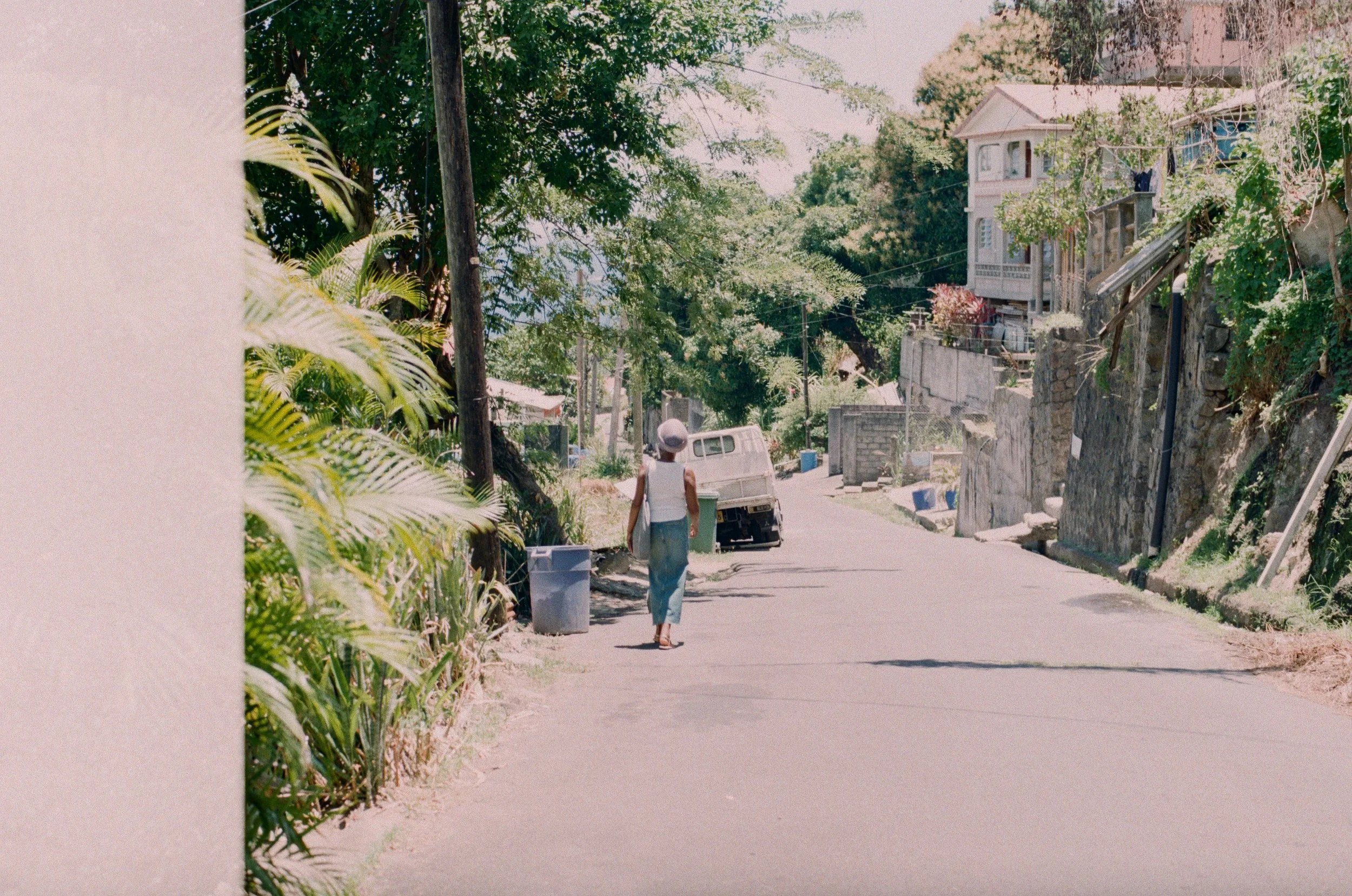
Nathaniel Télémaque, photograph from the series, Kings Hill, Dominica, ver. 1.1, 2024.
Image description: A small residential street framed by lush green vegetation, a parked white truck and a bin, with fencing and a white house on the right, green palm fronds in the sunlight on the left in the foreground, and the figure of a woman in a long, blue jean skirt walking away from the viewer along the street.
In Chris Searle’s 1972 book, The Forsaken Lover: White Words and Black People, he reiterates the specific importance of language in shaping Black identities, and its role in providing a space for self-definition. Searle highlights that Black communities must find their own language separate from that of white colonisers. In this sense, Patois is crucial in African-Caribbean people’s understanding and development of their own Black identities (Maylor, 1995; Warner, 1977). Therefore, the necessity for Patois in expressing Seduce’s identity becomes even more explicit. The novel centres on her life story, unravelling the beliefs and ideas that she held about herself, her family, and her island—all of which can only be truthfully portrayed in the language that speaks to her Black Caribbean identity. This linguistic choice certainly works to legitimise Patois in the face of delegitimising colonial legacies. By empowering the eponymous protagonist with the authority to tell her own story in her own language, Reynolds opens Seduce by reimagining pejorative colonial discourse surrounding Patois and therefore also concerning African-Caribbean identities.
Patois in Seduce is further important when considering how the characters’ identities are entwined with African-Caribbean spiritual belief systems. Seduce’s granddaughter, Loo, is especially significant because she is entirely subsumed in the ‘old ways’, residing predominantly in the bush. In the second movement, we see Loo retreat further into nature as she flees from police sent to break up a political rally. As she traverses through the forest, she feels the presence of the ancestors pouring into her senses. She narrates:
‘We know the callin. It feel like an old blanket dat smell of we people, dat we use to cover us […] we close our eyes an close out the light and hear the noise dat still fill every space in us […] And in di flow of the time of the great ships, of feeding sharks wid our flesh, of rough white fingers pushed into us, white babies at our black breast, of ropes around our necks, of pain and anger dat is as big an wide as di sea we travelled on.’ (Reynolds, 2013, p. 61)
This deeply poignant moment is only made more effective by Reynolds’ use of Patois. Its rhythm and syncopated beat convey the intensity and urgency with which Loo narrates the horrifically unimaginable experiences of her enslaved ancestors. While many non-fiction books describing enslavement in the Caribbean are written factually and in European languages (James, 1938; Torres-Saillant, 2006; Williams, 1944), Reynolds uses Patois in Loo’s monologue to emotively illustrate the devastating impact of slavery on African-Caribbean people. Given that Patois is part of the legacy of West African presence in the Caribbean, Reynolds situates the language as one that connects African-Caribbeans to their African ancestors and thus writes about the transatlantic slave trade from within the African-Caribbean perspective. Supporting Derek Walcott’s statement that we are finally beginning to witness ‘islands not written about but writing themselves’ (1993, p. 22). Indeed, Reynolds’ use of the plural pronoun, ‘we’—which Patois grammatically accommodates for—not only captures the sense of oneness between Loo and her ancestral spirits, but speaks to both contemporary Caribbean readers like myself and those across many generations. This invites us to reconnect with forms of ancestral communication that colonisation attempted to eradicate, incorporating us into the ‘we’.
This passage concludes the second movement, and when I read it, I had to pause and allow the weight of Loo’s words to settle into my skin. They made me sink fully into myself, feel everything that has been lost, every person—named and unnamed by the writers of history—whose life was violently discarded. Every story or belief or way of being, across the world, that has been pummelled into insignificance. I thought of my own ancestors, my own elders schooled pre-independence, under colonial legislation, who believed that their son and thus their granddaughters should not speak their languages. I thought of my own education in London; Kunta Kinte in the television programme, Roots, plastered across the projector after completing a worksheet on the “pros and cons” of the British Empire. Every day, as I write, I commit myself to a perpetual admittance that words are forever limited in their ability to capture the intangibility of life, but what they can do is affect us. That is what Désirée Reynolds does with Patois here. She makes it so that we cannot escape the pain of what has been lost, while simultaneously managing to construct a novel that offers us hope from its existence alone.
By writing Seduce in Patois with a chorus of complex Black Caribbean characters, practicing and engaging with African-Caribbean spirituality and ancestral worship, Reynolds is equally able to depict what Caribbean people fought to sustain and what resisted iterative attempts of colonial erasure. Thus, her realisation of the novel portrays both the atrocities endured by African-Caribbean peoples, and the archipelago’s preservation of culture shaped by West African traditions. We see this not only in Loo’s connection with the spirits, but consistently throughout the novel. From the point of view of Glory, Seduce’s daughter, Reynolds writes, ‘Di duppy dem dat live in dis house use to be me only company. Me only friend inna di worl’ (2013, p. 26). ‘Duppy’ is Patois for ghost or spirit and directly originates from West Africa; originating from the Ga people (Leach, 1961). Using Patois here is highly important because the language holds a connection to West Africa in a way that the official languages of the Caribbean do not. The English words ‘ghost’ and ‘spirit’ fail to encompass the entirety of the African-Caribbean people on Church Island; whose spiritual identities are inseparable from West African belief systems—including Ga, Ashanti, and Bantu folklore—that shaped them (Leach, 1961; Stewart, 2005). This proves that Patois is necessary in Seduce; it is the only language that encapsulates how African-Caribbean peoples maintain a connection to their West African history and therefore ensure that their ancestors’ presence survives.

Nathaniel Télémaque, photograph from the series, Kings Hill, Dominica, ver. 1.1, 2024.
Image description: Two houses, one white, one pale blue, standing at the curve in the street at the foot of a hill, surrounded by thick green vegetation including banana trees. A parked car, a rusted pick-up truck, white gel buckets holding small palm trees, and a lone grey bin stand in a row along a low stone retaining wall.
The documentation and platforming of African-Caribbean spirituality is furthered by Reynolds’ exploration of Rastafarianism in the novel. During the first movement, Mikey, Seduce’s lover, says to the funeral guests ‘Unaccustom as I and I is to talking out in public, I want fi say jus a few tings as Jah watches over all a we. I and I soon to tek me leave’ (Reynolds, 2013, p. 19). The term ‘Jah’, meaning God, and ‘I and I’ explicitly distinguish Mikey’s Rasta identity. The foundational pronoun ‘I and I’ is a highly important feature of Dread Talk and is a core part of Rastafarian culture (Dolin, 2001). Dread Talk is an expansion of Jamaican Patois and was formed by Rastafarians to ‘express their heightened consciousness and profound awareness of the true nature and power of the spoken word’ (Savishinsky, 1994, p. 21). Specifically, ‘I and I’ speaks to a broader tenet of Rastafarianism, which states that a person should have both a strong sense of individualism and an autonomy that allows for ‘radical freedom’, as well as a profound sense of themselves within the collective body (Barnett, 2002, p. 54). It captures Rastafarians’ belief in the duality of the self—there is both the ‘I’ of the individual and the ‘I’ of the divine realm (Dolin, 2001). By worshipping their connection with ancestral spirits and venerating liberty of the self within the community, Rastafarianism rejects the materialistic, self-serving individualism of contemporary capitalism and pushes back against the West’s withdrawal from the natural world (Barnett, 2002; Chevannes, 1977). Rastafarians’ repudiation of such ideas is inextricably linked with language (Barnett, 2002; Savishinsky, 1994). Rastafarianism perceives Patois to be a ‘direct inversion of the perception of the vulgar, spoken language from a Western, colonial perspective’ (Dolin, 2001, p. 61). Therefore, to write Seduce in an official language of the Caribbean—a European language—would be to deny Rastas their voice. It would deny Rastas the words that capture the fundamental core of their spiritual identity.
Reynolds’ writing of Patois is not only meaningful in terms of when she employs it, but also when she chooses to abandon it and use English instead. Seduce opens and ends with an omniscient narrator—described as ‘Souls’—who narrates in English. Reynolds (2013) begins the first and final chapter, ‘The day opens her legs to let the night in. It moves from a dark lilac to bottomless purple. Waiting for a moment to adjust your eyes, against your skin in a smooth coolness’ (p. 9, 189). By choosing to write the omniscient narrator in English, whose all-seeing characteristic carries a certain level of authority, one could claim that Reynolds perpetuates existing hierarchies between Patois and English, suggesting that Patois can be employed as a tool for self-definition at the local level, but not at the level of wisdom reserved for the likes of an omniscient narrator. I disagree, however, arguing that by writing the majority of Seduce’s narrators in Patois and using the language beyond its archetypal constraints, Reynolds does not use the omniscient narrator to affirm colonial discourse that English is of a higher status and instead disentangles the colonial idea that languages, identities, and belief systems must be hierarchical. The sense of autonomy and empowerment woven into the chorus of characters means that readers do not encounter the omniscient narrator as greater than or more informed, nor does their use of English feel superior. In fact, when interviewed, Derek Walcott explains that he does not perceive English to be the language of the colonisers nor does he view it to be theirs alone (Sjöberg, 1996). Walcott regards ‘language to be [his] birthright’ and advocates that language itself ‘is the property of the imagination’ (Sjöberg, 1996, p. 82; Hirsch, 1988, p. 279). Therefore, within the context of Reynolds’ novel—which upends colonial hierarchies within language—English is not solely employed as a means of oppression but is instead reclaimed and thus its ownership redistributed to the imagination of anyone who wishes to speak it.
This is further realised in the character, Honey Rock, a Garveyite-coded politician rallying for independence. When outside the courthouse, he speaks to the Church Islanders gathered, shouting:
‘Time to cut loose. They step out of their country, they tief and pillage, rape the land an destroy the people […] When slavery done, they got paid compensation for our bodies; we got nothing for the work they stole from us […] Now their lackies sell us out for their own comfortable ends, to furnish their backsides and line their pockets’ (Reynolds, 2013, p. 57).
Honey Rock’s voice straddles both Patois and English and, similarly with the omniscient narrator, Reynolds does not write English into his character to affirm colonial ideas of language. Indeed, her repetition of the third-person plural pronouns, ‘they’ and ‘their’, separates Rock and the Church Island community from the colonialists while the first-person plural pronoun, ‘we’, conveys Rock’s sense of African-Caribbean solidarity. In this context, Reynolds’ use of English is not exclusionary or inextricably linked to the colonisers, but instead, as Walcott argues, feels to be an indisputable part of Rock’s birthright.
However, like much of the themes addressed in Seduce, Reynolds refuses to explore English with a one-dimensional approach. While, in the context of Honey Rock and Souls, English feels born anew from a point of resistance, characters like Son and Marshall certainly complicate the presence of English in the novel. The second movement opens from the point of view of Church Island’s head of police, Marshall. He states ‘Goddamn these people, these godforsaken people, what the woman who looked after me would call “dutty, lazy neagah” people. What do they want now?’ (Reynolds, 2013, p. 53). Marshall’s pejorative language—accompanied by the term, ‘them’ and phrase, ‘these people’—immediately portrays his feelings of superiority in relation to the rest of Church Island. Quoting his nanny’s Patois also suggests that it is a language within his linguistic repertoire, but that he actively chooses not to speak it. Consequently, Reynolds’ use of English here cannot be seen as everyone’s equal ‘birthright’. Through Marshall, she demonstrates how colonisers hierarchised language, placing European languages above not just Patois and Creoles, but the Arawak and African languages present before and during colonisation. In this instance, Reynolds employs English within its colonial framework to challenge suppressive ideologies surrounding Patois and its speakers. While Marshall adheres to colonialist beliefs that African-Caribbean identities are dirty and indolent, and that Patois is therefore lower status (Alleyne, 2003; George, 1991; Warner, 1977), he is offensive, unappealing, and deeply pitiful.
Readers may pity Marshall because of the way that he has internalised harmful colonial rhetoric. Describing his encounters with Seduce, Marshall explains, ‘when I was younger I wanted [Seduce] to love me. Don’t know if I loved her, but I wanted her to love me. Instead she needed me. Not the same thing. She was beneath me—too Black’ (Reynolds, 2013, p. 54). By explicitly depicting Marshall’s colourism, Reynolds emphasises his subscription to colonialist beliefs that Blackness/darkness equates to inferiority (Hind, 1984). The fact that he himself is also Black allows Reynolds to speak to the phenomenon of internalised anti-Blackness present in African-Caribbean society, existing as a devastating legacy of colonialism. As Maylor states in her 1995 autobiographical essay, ‘in common with many African Caribbeans [her] father denied his African heritage’; he had a ‘pathological acceptance of things European, of placing European culture at the centre of civilisation [which] enabled [him] to reject his heritage and become a subjected individual’ (p. 45). Like Maylor’s father, Marshall denies his Blackness—his African heritage—and becomes a tortured person, inflicting hatred upon his community and consequently himself. Reynolds therefore writes him in English to highlight his estrangement and misplaced sense of identity on a linguistic level, which contrasts with the strength of Patois-speaking characters. In turn, continuing to legitimise African-Caribbean peoples’ use of Patois as a language of their own and of empowerment (Maylor, 1995). Even though the omniscient narrator corroborates Walcott’s propositions concerning language and English, Reynolds also contradicts this idea with characters like Marshall.
In fact, Reynolds further entangles Walcott’s notion with her characterisation of Son, Seduce’s grandson. As a child, Son was sent to school on ‘di mainlan’ (Reynolds, 2013, p. 73). The mainland is referred to throughout Seduce and depicts a larger island—to which Church Island is its ward, like Tobago is to Trinidad—that accommodates white colonial settlers and Christian missionaries. Returning to Church Island for his grandmother’s funeral, Son recounts how ‘I took whatever was between my legs and ran to the mainland to be lost in the sea of desperate black faces, the memory of home hanging over me’ (Reynolds, 2013, p. 181). ‘Lost’ as a passive verb accompanied by the poignant adjective, ‘desperate’, immediately captures Son’s sense of displacement and the despair experienced by Black people on the mainland, implying the disempowering nature of living under a colonialist gaze and speaking, as it is framed in this context, the coloniser’s language. Reynolds further portrays the dislocation of Son’s identity when the Lampis—the name given to the sex-workers on Church Island—take Seduce’s body to the bush to perform a ceremony. In the fifth and final movement, Son explains, ‘I don’t want to understand this ceremony. I don’t want it to have anything to do with me, but… I feel the need to do something, be a part of it all’ (2013, p. 180). While Reynolds depicts Son’s desire to unhook himself from practices that maintain a connection with West Africa, he still experiences a deep tie to the ceremony. This melancholic longing Son feels towards the ‘old ways’, and to the self-assuredness of his family, is exacerbated by Reynolds’ writing of him in English. Like Marshall, English in the context of Son is entrenched in the history of its use by British colonial structures, highlighting Son’s plight of separateness through language and contrasting this with the collective empowerment of Patios.

Nathaniel Télémaque, photograph from the series, Kings Hill, Dominica, ver. 1.1, 2024.
Image description: Landscape under a hazy sky, blue sea in the distance, with a dense residential promontory packed with lush green vegetations amidst colorful houses and roofs, a small parked car, and a telephone pole.
At the same time, Reynolds’ depiction of Patois-speaking characters also precludes simplification. Despite Seduce’s disdain for the mainland, she still sent Son there. Explaining that it was ‘fi you heducation, fi di bettament of di family, so you [could] be a churchman, you nuh see it? So dat you can change tings’. Seduce hoped that Son would return to Church Island as a priest with a respected education so that he could ultimately ‘corrupt’ the church and use his authority to reignite mass engagement with the ‘old ways’. However, through his mainland schooling, Son realised that ‘the church rotten to the core, it invent by white people to keep us enslaved’. When he explains that ‘I’m not going to say sorry. I do not want to be a priest, a pastor, a monk or any type of churchman’, Seduce grows angry, saying ‘talk like weh you come fram. You haughty-toughty ways not to use pon you own people’ (Reynolds, 2013, p. 143.) Reynolds shows that despite Seduce’s belief in Patois and the old ways, she still held onto the idea that educating Son through means shaped by colonialism would better their situation—which captures the complexity of language in the Caribbean. Here, we witness the double consciousness experienced by speakers of a resistant language (DuBois, 1903). On the one hand, Patois is empowering and affirms African-Caribbean connection with West Africa, but on the other hand Patois speakers are aware of its perception as a language of ‘underachievement’ (Maylor, 1995, p. 45). They are conscious of the perception that English, when framed as the colonisers’ language, is a marker of success and rising social mobility (Mbugua, 1997). Nevertheless, by failing Seduce’s plans for Son, I believe Reynolds works to deconstruct the idea that colonial methods for power and stratification are the ways that will liberate the subaltern (Carrington, 1999; Lorde, 1984). Son’s understanding that he cannot change a church system made to enslave, also allows Reynolds to redeem him from being an entirely lost colonised mind, like Marshall. It is clear then that Reynolds consistently supports and obfuscates Walcott’s notion that the English language is owned by the imagination throughout Seduce. While this is attested to in her use of English in characterising Souls and Honey Rock, when she chooses English for Marshall and Son, Reynolds grounds their language within its sociopolitical context and its colonial standing in Caribbean linguistic history. Thus, Seduce neither denies the relationship between language, power, and identity, which exists very tangibly in Caribbean society, nor refuses the notion that languages intended to oppress can be reclaimed through how we imagine them. While Reynolds does not offer us a simplistic agreement or negation of Walcott’s hypothesis, she demonstrates how these seemingly paradoxical approaches to language can be true at the same time.
It is clear that by writing Seduce in Patois, Reynolds ensures African-Caribbean readers feel reflected in literature, feel that their words and their voices are worthy of publication. She certainly allows the Caribbean to be further independent, sprouting autonomously from the shadow of colonialism—stepping away from hijacked narratives that write African-Caribbean people as slovenly, uneducated, speaking the “broken” language of a “broken” people—and into our own. As I conclude this essay, I ask myself: what does ‘our own’ mean to me, a queer diaspora child? In some ways, my answer lies in my work—my writing of queer Caribbean fiction that embraces English, Creole, and Patois, and which tears open institutional and familial archives to recover histories, spiritual practices, lives and loves suppressed by colonialism—and includes internalising my foremothers’ languages, spending more time on the islands where they grew up. In other ways, I don’t yet have a definitive answer and I’m not certain that I ever will. Both can be true; live simultaneously side by side.
Bibliography
Alleyne, M. (2003). Language in Jamaican Culture. In R. Harris & B. Rampton (Eds.),
The Language, Ethnicity and Race Reader (pp. 54-68). Routledge.
Barnett, M. (2002). The Epistemological Individualism and Conectivism of Rastafari.
Caribbean Quarterly, 48(4), 54-61.
Brathwaite, E. K. (1984). Nation Language. In E. K. Brathwaite (Ed.), History of the
Voice: The Development of Nation Language in Anglophone Caribbean Poetry (pp. 309-313). New Beacon.
Carrington, L. D. (1999). The Status of Creole in the Caribbean. Caribbean Quarterly,
45(2-3), 41-51.
Chevannes, B. (1977). The Literature of Rastafari. Social and Economic Studies, 26(2),
239-262.
Davidson, C. & Schwartz, R. G. (1994) Semantic Boundaries in the Lexicon: Examples
from Jamaican Patois. Linguistics And Education, 7, 47-64.
Dolin, K. Q. (2001). Words, sounds, and power in Jamaican Rastafari. MACLAS Latin
American Essays, 1, 55-69.
DuBois, W. E. B. (1903) The Souls of Black Folk: The Unabridged Classic. A. C.
McClurg & Co.
George, V. (1991). Some survival techniques in Jamaican communities – an overview.
Community Development Journal, 26(3), 178-189.
Hall, S. (1995). Negotiating Caribbean Identities. New Left Review, 209, 3-14.
Hall, S. (2015). Creolité and the Process of Creolization. In E. G. Rodríquez & S. A.
Tate (Eds.), Creolizing Europe: Legacies and Transformations (pp. 12-25). Liverpool University Press.
Hind, R. J. (1984). The Internal Colonial Concept. Comparative Studies in Society and
History, 26(3), 543-568.
Hirsch, E. (1988). An Interview with Derek Walcott, 1985. In G. Plimpton (Ed.), Writers at
Work: The Paris Review Interviews, Eighth Series (pp. 265-98). Penguin Books.
James, C. L. R. (1938). The Black Jacobins: Toussaint L’Ouverture and the San
Domingo Revolution. Secker & Warburg Ltd.
Jourdan, C. (1991). Pidgins and Creoles: The Blurring of Categories. Annual Review of
Anthropology, 20, 187-209.
Leach, M. (1961). Jamaican Duppy Lore. The Journal of American Folklore, 74(293),
207-215.
Lorde, A. (1984). Sister Outsider. Crossing Press
Maylor, U. (1995.) Identity, migration and education. In M. Blair, J. Holland, & S.
Sheldon (Eds.), Identity and Diversity: Gender and the Experience of Education (pp. 39-50). Multilingual Matters Ltd.
Mbugua, N. J. (1997). African Languages can no longer be thought inferior. Sunday
Nation, 10, 12.
McLaren, J. (2009). African Diaspora Vernacular Traditions and the Dilemma of
Identity. Research in African Literatures, 40(1), 97-111.
McKay, C. (1912). Songs of Jamaica. A.W. Gardner & Co.
Nettleford, R. M. (1978). Caribbean Cultural Identity: The Case of Jamaica. Institute
of Jamaica.
Reynolds, D. (2013). Seduce. Peepal Tress Press.
Savishinsky, N. J. (1994). Rastafari in the Promised Land: the Spread of a Jamaican
Socioreligious Movement Among the Youth of West Africa. African Studies Review, 37(3), 19-50.
Searle, C. (1972). The Forsaken Lover: White Words and Black People. Penguin.
Sjöberg, L. (1996). Interview with Derek Walcott. In W. Baer (Ed.), Conversations
with Derek Walcott (pp. 79-85). University Press of Mississippi.
Stewart, D. M. (2005). Three Eyes for the Journey: African Dimensions of the Jamaican
Religious Experience. Oxford University Press.
Summerfield, G. (2007). Introduction. In G. Summerfield (Eds.), Patois and Linguistic
Pastiche in Modern Literature (pp. vi-xxi). Cambridge Scholars Publishing.
thepostarchive (2020, November 12). Kamau Brathwaite – Caribbean Writers and
Their Art: History, the Caribbean and the Imagination 1991 [Video]. YouTube. https://www.youtube.com/watch?v=f-IJE4luDQU
Torres-Saillant, S. (2006). An Intellectual History of the Caribbean. Palgrave
Macmillan.
Walcott, D. (1993). The Antilles: Fragments of Epic Memory. Faber and Faber.
Warner, K. Q. (1977). Creole languages and national identity in the Caribbean. CLA
Journal, 20(3), 319-332.
Williams, E. (1944). Capitalism & Slavery. University of North Carolina Press.
Winford, D. (1974). Aspects of Social Differentiation of Language in Trinidad.
Caribbean Issues, 1(3), 1-16.
Olivia Simone (b. 1999) is a Caribbean-British writer and artist from East London. She is the founder and editor of Breadfruit—a creative writing magazine that showcases the work of women and non-binary people who identify as part of the global majority. Currently, Olivia is working on her debut novel and completing a funded PhD in Creative Writing Research at King’s College London, where she is exploring Indigenous spiritualities in magical realist fiction by African-Caribbean diaspora women writers. She is represented by Rachel Goldblatt at Curtis Brown Literary Agency.
*
Nathaniel Télémaque, aka St. Peso [https://pesovisuals.com], is a visual artist, writer, and researcher born and raised in North West London. He completed his PhD in Practice-related Geography at University College London in 2023, and currently works as a Lecturer in Geography and Social Justice at King’s College London University. St. Peso photographs, films, records, and writes about "everyday things" in various urban and natural settings, bearing witness to mad cities, poetic caribbean landscapes, and maverick livelihoods in his audio-visual practices while focusing on the experiences of young Black adults, creative peers, and the ordinary moments that make up our day-to-day lives. Photographs in this series, Kings Hill Dominica, Ver. 1.1, serve to visually document Dominica’s natural landscape in the locale of Kings Hill. More information: https://pesovisuals.com/KINGS-HILL-DOMINICA-VER-1-1

What is our remedy when the law is broken beyond repair? In this provocative essay, Alicia Izharuddin looks for answers in Southeast Asian revenge films.