
“Tree" and Other Poems
By C. Aishwarya
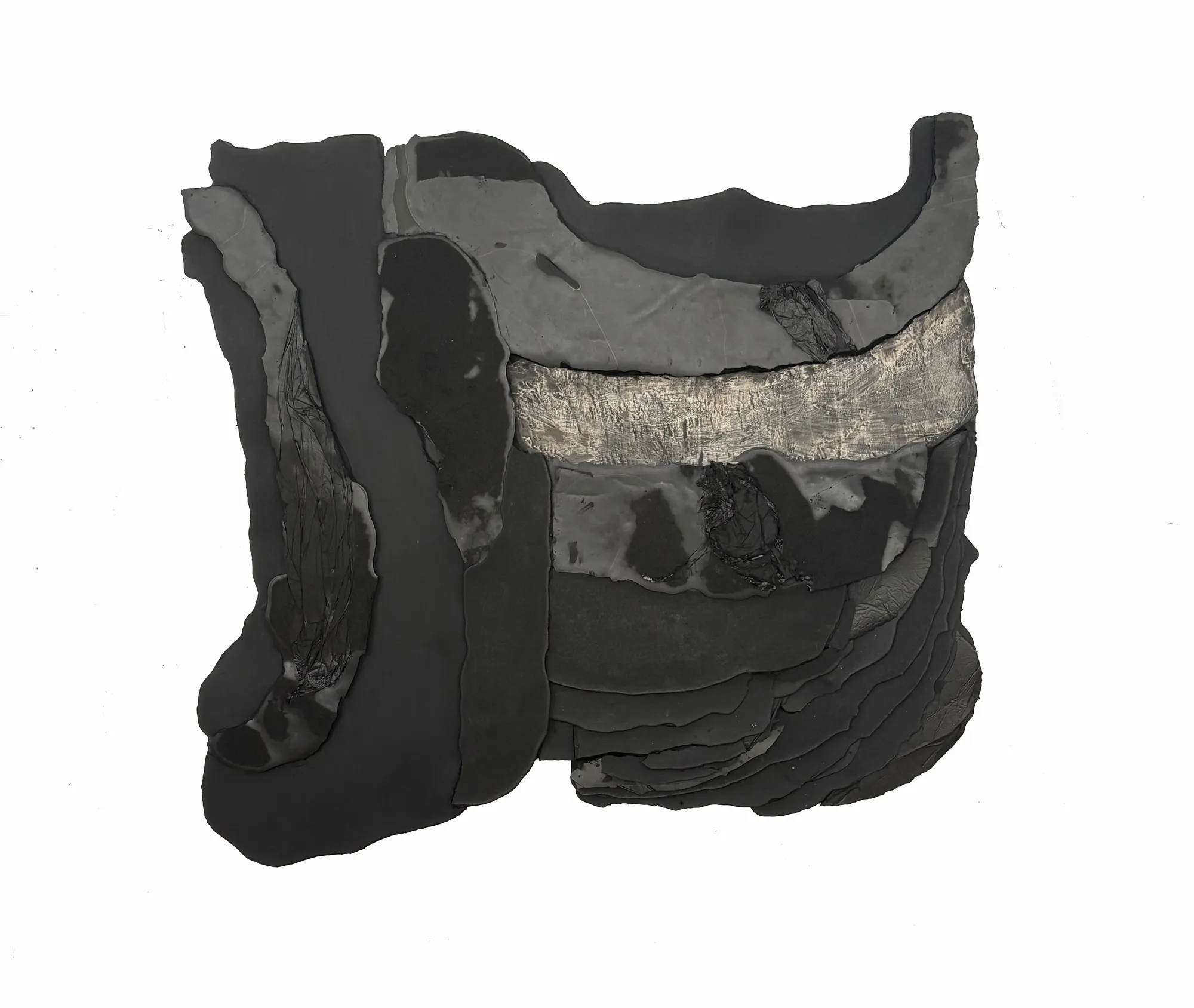
Mahalakshmi Kannappan, After Pressure 02, 2026. Charcoal, lime plaster on wood, 120 x 130 x 10 cm.
Image description: Horizontal composition in high relief, in various shades of black.
Tree
They tell me I sound like them
when I say three.
Tree.
The th does not dissolve in my mouth.
It settles there, firm and certain,
as if it has crossed too many waters
to surrender now.
I did not learn this hardness by accident.
In classrooms where English was pressed smooth
as starched linen,
in a port city where ships came and went
without asking who remained behind,
my tongue was taught to hold itself steady.
Elsewhere, in fields bright with sugar
and the quiet obedience of labour,
other mouths were shaped by the same distant hand.
Somewhere between a strait and a shoreline,
the consonant gathered weight.
Not broken.
Not lost.
Only made to endure.
I say the word again here,
in this city that shivers under winter light.
Tree.
You are close enough to hear the grain of it.
Your smile begins slowly,
as though something in you has recognised
its own reflection in my voice.
The space between us warms.
Not loudly.
But undeniably.
We stand there,
two island bodies
weathering a foreign cold,
and for a moment
sound is enough.
“Where you from?” you ask,
and the question does not bruise.
It rests between us, curious,
like a hand hovering at the small of a back
waiting to see if it will be welcomed.
I let the silence bloom.
Then I answer.
I watch the geography pass through your eyes,
the small astonishment,
the recalibration,
as if the map you were handed
never prepared you for an island like mine.
Still, you do not step away.
Later, in a kitchen heavy with steam,
turmeric staining the air gold,
thyme and allspice rising together,
we stand over separate pots
and breathe the same heat.
Our shoulders nearly touch.
Our laughter folds easily into itself.
Different seas have named us.
Different histories have marked our skin.
Yet salt settles on the tongue in one language,
and hunger answers hunger
without translation.
Before the snow claims the street again,
before we return to the careful work of categories,
I belong to the sound between us,
and it belongs, briefly,
to me.
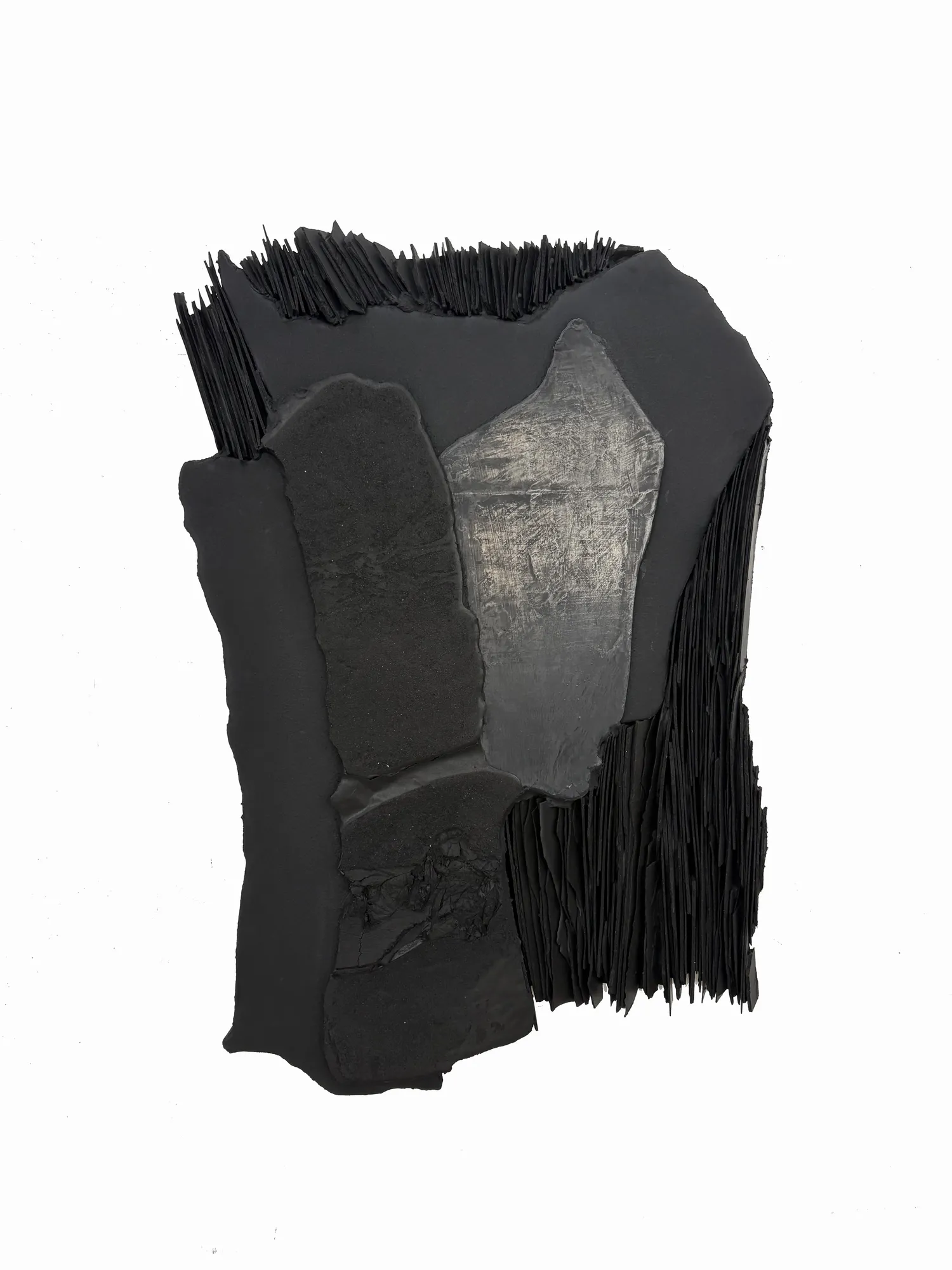
Mahalakshmi Kannappan, After Pressure 05, 2026 Charcoal, lime plaster on wood, 70 x 100 x 10 cm.
Image description: Vertical composition in high relief, in various shades of black.
Lefferts in Winter
The blizzard does not belong to us.
Snow erases the street signs,
settles over Lefferts Boulevard
like a language we never agreed to learn.
Inside, heat remembers.
Cans of Milo stacked behind the counter,
green tin, gold lettering,
the same chocolate malt
that raised me oceans ago.
Here it is again,
whisked into milk by hands
the colour of the drink itself.
We laugh at that.
How malt finds malt.
Shelves heavy with long beans,
okra, pavakkai,
bundles of thyme tied tight as prayer.
The vegetables look like home
but surrender differently to oil.
Curry leaf crackles beside Scotch bonnet.
Cumin meets allspice without argument.
Shrimp sink into tomato,
thick as memory,
then disappear into aloo pie
split open and steaming,
chutney staining the paper bag,
tamarind sharp enough to wake the blood.
Island people, all of us.
Raised on humidity.
On salt carried inland by wind.
Now forced to shoulder
this American winter,
breath visible,
fingers stiff,
hearts beating harder than they should.
We gather around steam.
Around broth.
Around the small mercies of spice
that refuse to forget the sun.
Our skin the shade of malt chocolate.
Our blood warmed the same way,
peppered, simmered,
slow-cooked against erasure.
Outside, the snow insists on silence.
Inside, oil hisses.
And that is the sound
of something living.
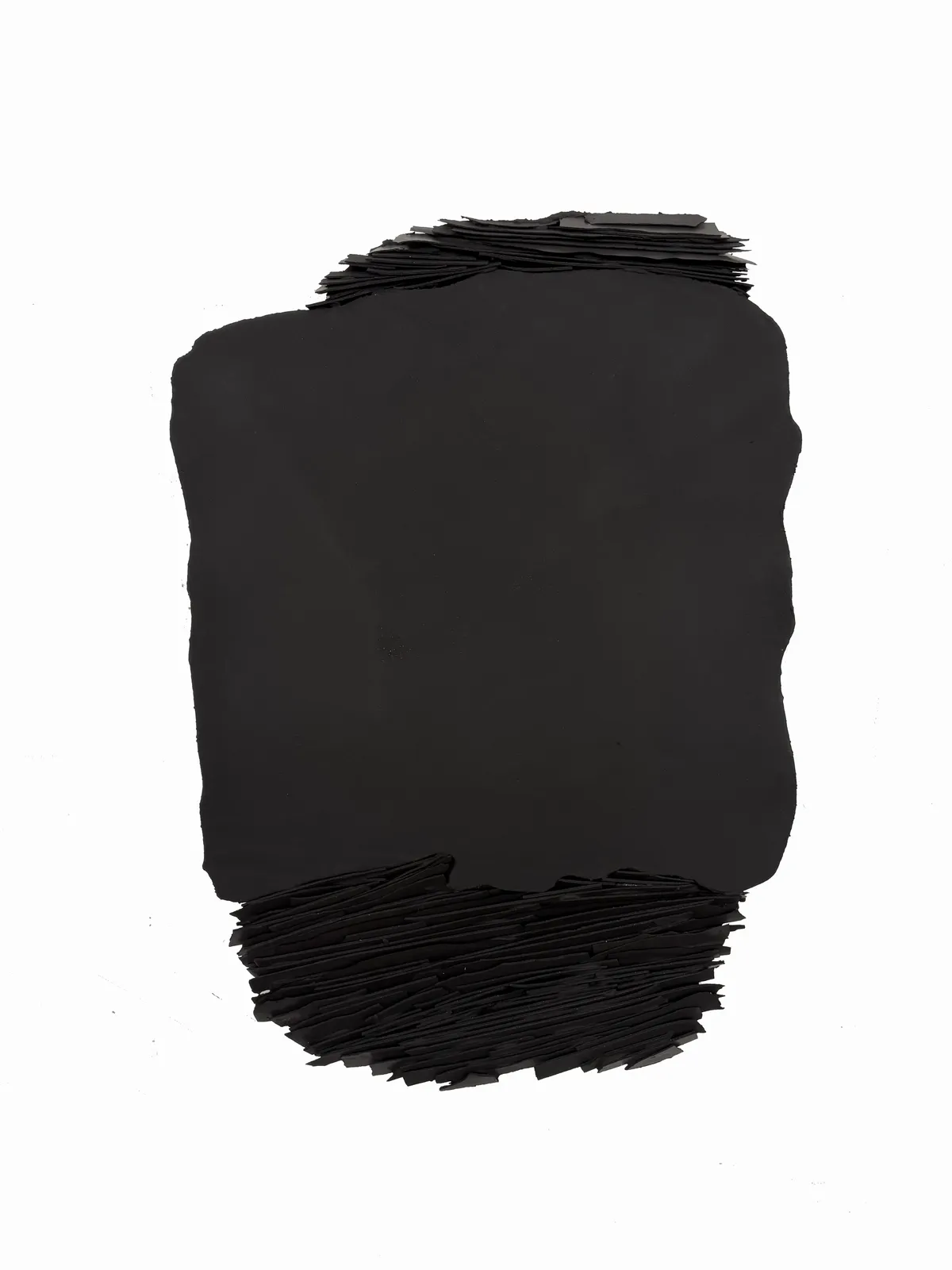
Mahalakshmi Kannappan, After Pressure 04, 2026 Charcoal on wood, 70 x 100 x 10 cm.
Image description: Vertical composition in high relief, in various shades of black.
Rain in South Richmond Hill
The cold is so sharp
my fingers hesitate above the page,
as if words themselves might shiver.
Buses pass below the window
with fogged glass,
their passengers reduced to shadows.
I wipe a small circle clear
with the side of my palm
and watch the world outside
blur into silver.
Rain turns everything tender.
Even the city seems quieter today.
Then the lights disappear.
No warning.
Just darkness falling through the apartment
like a curtain finally released.
Someone strikes a match.
Candles bloom one by one
along the kitchen counter.
Adults lean close to the children
and offer soft explanations,
stories meant to guard sleep.
The truth sits quietly at the table.
The bill was not paid.
Food took precedence.
The flame trembles
but refuses to bow to the draft.
The Tamil girl thinks then
of another island.
Of sunlight
spilling across pavements
like molten gold.
Of afternoons so warm
the air itself felt generous.
There was no winter there.
No darkness that arrived
carrying the smell of unpaid things.
For a moment
she lets the memory rest in her hands
like something fragile.
And yet
she does not mistake this life
for loss.
There is a strange and sacred beauty
in choosing the road
that does not promise ease.
Outside, the rain continues its patient work.
The cold presses its face against the glass.
Inside, the candle flickers,
a small, stubborn sun.
She watches it carefully.
Even if the flame is snuffed out,
she knows this much:
the wind will not be the one
to take it from her.
If darkness returns,
it will be because she has chosen sleep,
because she has leaned forward
and blown gently.
Morning will still arrive.
And when it does,
the day,
like the rain,
like this stubborn neighbourhood
of faraway islands,
will go on.
C. Aishwarya is a Tamil Singaporean writer based in New York. Her work traces the entanglements of language, memory, and migration. She is the author of Where My Feet Have Carried Me (2026) a poetry collection on movement and becoming. Through sensory detail and an intimate voice, her writing explores how belonging is made, lost, and found again.
*
Mahalakshmi Kannappan (https://www.mahalakshmikannappan.com) is a Singapore-based artist originally from India. Her work, primarily in reconstituted charcoal and plaster, involves constructing surfaces through processes of building, fracturing, and reassembly, holding tension between fragmentation, containment, and the behaviour of material over time. Mahalakshmi has exhibited in Singapore, India, Indonesia, the Philippines, and Paris, and has participated in major art fairs including ArtSG, Art Jakarta, SEA Focus, India Art Fair (Delhi and Mumbai), and Art Paris with Cuturi Gallery. She is represented by Gajah Gallery (Singapore/Jakarta) and Srishti Gallery (India).
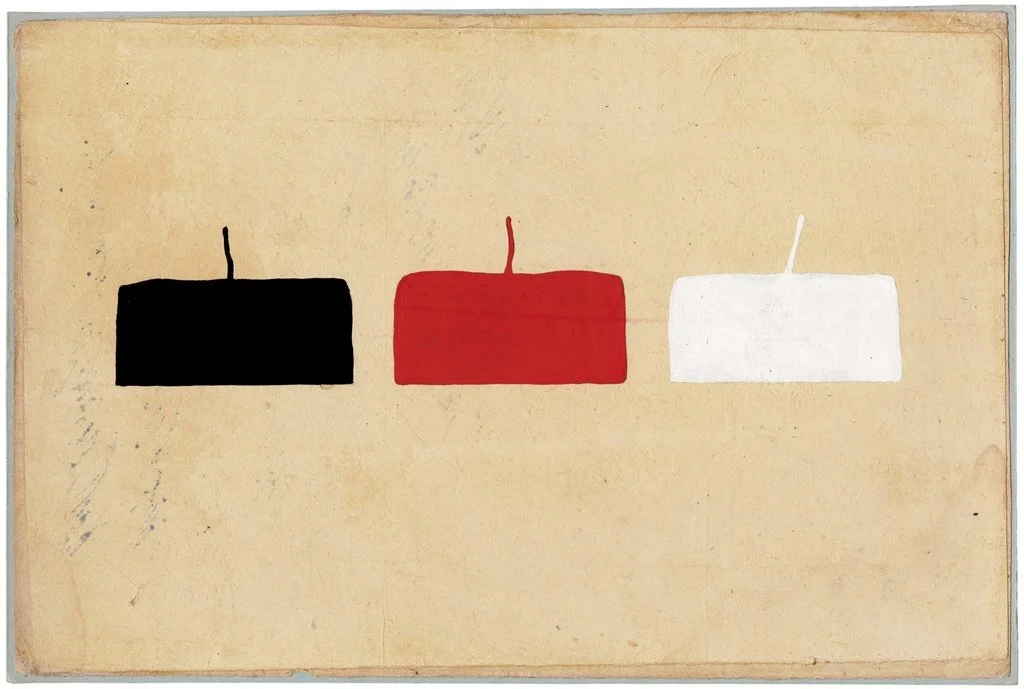
The winning poems of the 12th SUSPECT Poetry Contest offer quiet intimacies, brilliant honesty, and alluring music.