
The Living Pulse of Time
By Sabahat Fida
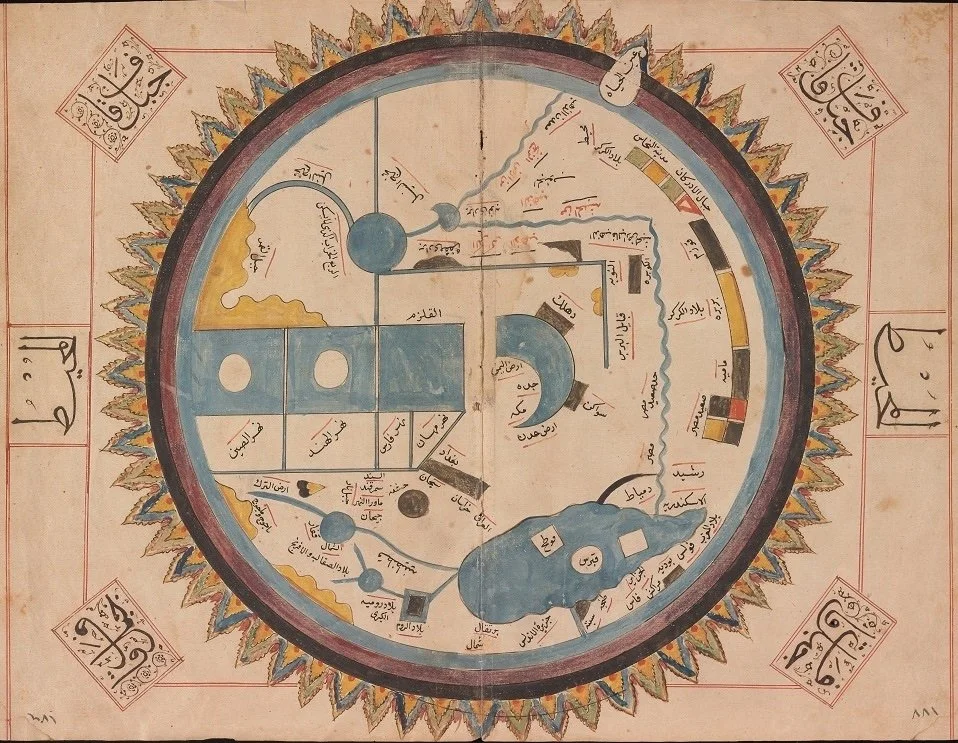
Zakariya Ibn Muhammad al-Qazwini (1203-1283), Map of the World [15—?]. Tempera and ink. Removed from the bound volume, ’Aj’ib al-makhluquat (The Marvels of Created Things).
Image description: The circular map is neat, clear, and detailed. The blue crescent-shaped body of water in the center of the map is Mecca; the ocean on either side forms the outer edge of the sheet, the pillars of the earth in the four corners. Africa and the Nile are the focus, but other places of interest include a Wasteland where nobody lives; Mountains of the Moon; Land of the Slavs and Franks; Gog and Magog; Land of the Turks (Central Asia); Red Sea (rectangular water mass); and the Source of life. Calligraphic flourishes are relegated to the corners.
Modern conceptions of time often follow a single trajectory: a line extending from past to future, punctuated by discrete moments and measured in seconds, minutes, and years. This view, rooted in Newtonian physics and reinforced by industrial clocks, treats time as a uniform backdrop against which events unfold.
But Shia metaphysics rejects this mechanistic view. So does the philosophy of 20th century French intellectual Henri Bergson. For both, disparate traditions though they may seem initially, time is rich in texture, not quantitative or divisible into measurable units. It flows, folds, reveals, and animates. Bergson locates real time in subjective consciousness, while time is based on ontological hierarchy in the case of Shia philosophy.
Time, in Twelver Shia philosophical mysticism, consists of multiple registers—Zamān, Dahr, and Sarmad—each corresponding to a different stratum of reality. This stratified, more reticulated mode of existence enables the emergence of different worlds, events, and beings. Zamān is the most familiar: it’s the time we live by. Days, years, appointments, aging. This is the realm of sequence and change, consequences of personal choice and systemic conditions. Where we’re born, where we grow, where we die.
Dahr is different. It is not chronological, but archetypal—it holds the essential, immaterial realities of things outside the flow of sequential time. In Shia philosophical theology, or hikmah, Dahr is the realm where souls exist, where angels, jinn, and devils dwell, and where the realities of things persist beyond their appearance in the material world. It is not simply a realm “before” history, but one that transcends the history unfolding inside Zamān, embracing both pre-existence and post-death. Realities in Dahr are not subject to the passage of time as we experience it in Zamān. Instead, they exist in a more essential mode, shaped by divine knowledge and will. For Mir Baqir Damad, the Safavid-era philosopher revered as ‘The Third Teacher’, Dahr is the atemporal bridge between the changing physical world—Zamān—and the unchanging divine Sarmad.
Sarmad is the deepest stratum of time, a state of pure timelessness. It is the absolute eternity where “before” and “after” no longer apply. It is the realm of Divine Presence, where all things are present in a single, undivided “now.” This quality unique to the Divine is beautifully expressed by the First Shia Imam Alī ibn Abi Tālib (AS) in the first of his sermons compiled in Nahj al-Balāgha, when he describes God as “the First, without any before being before Him, and the Last, without any after being after Him.”[1] Likewise, Du’a Iftitah, which is attributed to the Last Imam In Twelver Shiism, Imam Mahdi (AS), affirms that God existed even before the concept of nothingness itself: “You are the First , for there was nothing before you. You are the Last, for there is nothing after you.” In this view, Sarmad is not part of the created order at all, it is the eternal now of the Divine.[2]
Once time is no longer viewed as a mechanical flow but as a sacred stratification—where Zamān unfolds under the canopy of Dahr, and all is upheld in the stillness of Sarmad—we find that reality unfolds in layers, accounting for what today is often called a "multiverse", or within Shia intellectual circles as alam al mumkinat, the realm of possibilities. One can say that multiple worlds—or multiple dimensions of this world—coexist, intersecting across veils of time. Zamān, Dahr, and Sarmad are distinct but connected temporal registers, each encompassing realms like Barzakh, the angelic world, and divine presence.
Bergson’s philosophy of time also fundamentally challenges the mechanistic, spatialized view of time as a sequence of discrete, measurable units. Bergson proposes duration, or durée, as the authentic nature of time: a living, continuous and qualitative flow in which past, present and future interpenetrate rather than remain separate. For Bergson, time is not a line but a layered accumulation wherein the past survives within the present not as memory alone but as a living weight that shapes perception, decision and becoming. For Bergson, pure memory (mémoire pure) is the total, virtual preservation of the entire past where every moment lived, stored completely and simultaneously, is thus ontologically preserved. He insists that the past is not destroyed but is preserved in its entirety, invisibly.[3]
If time is a living structure—layered, rhythmic, multidimensional—then existence itself is not self-sustaining. It requires witness, coherence, and guidance. Just as gravity governs the motion of bodies in space, might there be an invisible force that governs the unfolding of time?
For Bergson, this force is the élan vital, a vital impulse or current that moves unseen within every living form, driving evolution forward from within. It is a creative, immaterial impulse within reality that resists and critiques the closed circuit of mechanized time, what he calls the “cinematographical” illusion of a universe composed of static instants. This force is not mechanical but spiritual, not predictable but creative. In Shia thought, this force is the Imam—a guardian who has never submitted to mechanization.
In Shiism, Imams are the divinely appointed successors of the Prophet Muhammad (PBUH). In Twelver Shiism, there are twelve Imams, the first of whom is the Prophet’s son-in-law, cousin, and companion Imam Ali (AS). The Twelfth, Imam Mahdi (AS), also known as Imam al-Zamān, went into occultation—hidden by the will of Allah SWT—in 260AH/874CE. A promised eschatological saviour, his reappearance in the world will mark the end of injustice and the beginning of an ideal society. The Imam—and this is true of each of the Twelve Imams—is not merely a historical leader or ethical exemplar. He is also the metaphysical axis of the universe. By serving as the intermediary between creation and God, he is able to channel divine grace, or fayd, into each moment of Zamān. In this way, he holds the world together and sustains existence itself.
The Imam exists outside the fluctuations of Zamān, measured time, because guidance cannot be subject to the same temporality it governs. He is rooted in Dahr whilst linked to Sarmad so that his governance is not reactive, but visionary. From this position, he sees all events of past, present, and future as a single, coherent whole. Surah Ya-Sin in the Quran tells us: “And We have encompassed everything in a Clear Imam” (36:12). Unlike the Sunni interpretation of Imam e-Mubin—Clear Imam—as something textual, a book or tablet, Shia hadith and their esoteric commentaries identify the Clear Imam as not only a person, but the living manifest Imam of the time. For example, “When Abu Bakr (RA) and Umar (RA) asked the Prophet (PBUH) if Imam e-Mubin meant the Torah, Gospel, or Quran, the Prophet replied ‘No’ to each. Pointing to Alī ibn Alī Tālib (AS), he said: ‘Indeed, this is the Imam in whom Allah has deposited the knowledge of everything.’”[4]
With this knowledge, the Imam orchestrates time and thereby maintains the created order. By serving as the living interface between the temporal world and divine will, he provides both historical and cosmic coherence to the universe. This is why in Shia supplications we call the Imam “the one by whom the earth and time are sustained.” Through him, divine grace continues to descend upon creation: the rains fall because of his presence; the earth remains fertile; time itself continues its unfolding. Were God to withdraw him, the world would dissolve into chaos. Even Imam al-Zamān’s concealment does not equate to an absence, but a mode of metaphysical presence—a hidden impulse, like Bergson’s élan vital, that animates spiritual and cosmic progression. The most famous articulation of this grace, which continues even when hidden, can be found in Bihar al-Anwar, which records the Imam al-Zamān saying, “My benefit [to my people] during my occultation is similar to that of the sun when it disappears from sight behind the clouds.”[5] His body is hidden, but his wilayah—his spiritual authority and influence—is not; fayd continues to flow through him as light flows from a sun behind a cloud. This description also explains the necessity of the Imam as an intermediary in the first place. The cloud does not stop the light. It diffuses it, softens it, makes it bearable to feel on one’s skin, to look with one’s eyes. This is needed because God’s grace is unlimited, all-consuming, and creation has a limited capacity to receive it without being overwhelmed. But with the Imam as the receiver and distributor of this grace, reality, across and within each of the three registers of time, can unfold in alignment with God’s will.
Recognizing that time itself is not empty but inhabited, guided, is to understand that we are not adrift in meaningless chronology. And in a time besieged by crisis, ecological collapse, war, economic disparity, ideological extremism, loneliness, and despair; when we are surrounded by the machinery of governance but starved of guidance; when it is all too easy to surrender hope and believe the world destined for doom—the awareness that we are being drawn, quietly but surely, by a presence that knows us is perhaps exactly what we as a society need.
Technology has grown; wisdom has withered. Institutions proliferate, yet they seem powerless to prevent the world’s unravelling. The more modern we become, the more fragmented we feel. If all systems fail, if our collective future seems increasingly uncertain, might it be time to return to the question of sacred guidance—not as fantasy or reprieve, but as an ontological necessity? To the search for a saviour? Not merely a political reformer or a technological innovator, but someone who transcends the logic of systems that have failed us. Such questions are no longer theological—they are existential. The Austrian philosopher and psychiatrist Viktor Frankl argues that the primary human drive is not pleasure or power; it is the search for meaning.[6] In a moment when every worldly institution crumbles under the weight of its own failures, resulting in the appearances of “meaning vacuums”, it is not irrational but deeply human to seek guidance from beyond. Not to escape the world, but to heal it from a place untouched by its delusions. Not to wait passively, but to live actively—knowing that history, however dark, bends toward the light of a hidden axis.
The Imam al-Zamān is not waiting to appear. He is waiting to be recognized.
In Shia theology, recognition, or ma’rifah, is not only to believe he exists, but to love him, long for him, to grieve his continued occultation. But his concealment is not wilful absence—it is mercy. If the Imam al-Zamān rose today, justice would be swift and terrible. The oppressors would be destroyed, but that justice too would also consume the unprepared. Every day the Imam waits to appear is another day for repentance, for growth, for one more person to come into the fold. As Musa’s (AS) ascent to Tur created a necessary absence to test the Israelites’ faith, so too does the Imam’s occultation test ours. They built a calf; so, do we—power, wealth, despair, false saviours. But there is hope. When Musa returned, the calf was burned, repentance accepted.
What we are facing is not just political or ecological collapse—it is metaphysical disorientation, an intellectual and spiritual crisis regarding why one exists and what is truly real. And in such a time, the presence of a being who exists beyond linear time, who holds the memory of the world and its becoming, who mediates between divine justice and earthly unfolding, offers the possibility of reorientation.
The Imam is the Answer the world has already begun to whisper, even before it dares to ask the Question.
Notes
[1] Nahj al-Balāgha is the famous collection of sermons, letters and sayings attributed to Imam Ali. Compiled by Sharif al-Radi, a prominent Iraqi scholar over 300 years after Imam Ali’s death.
[2] Another Dua that affirms this divine quality is Du’a Kumayl by Imam Alī.
[3] Bergson explored and elaborated these ideas in Matière et Mémoire (1896) and L’Évolution Créatrice (1907).
[4] Sayyid Hāshim al-Baḥrānī, al-Burhān fī Tafsīr al-Qurʾān, under Q. 36:12 .
[5] Bihar al-Anwar, vol. 52, ch. 20, pp. 92–93 (Allama Muhammad Baqir al-Majlisi). The same traditions also appear in Kamal al-Din wa Tamam al-Ni’ma by Shaykh al-Saduq (Ibn Babawayh al-Qummi), which is one of the first and most thoroughly researched books on the occultation of Imam Mahdi, covering narrations from the Prophet and Imams about the occultation.
[6] Frankl, V. E. (1959/2006). Man's Search for Meaning; Frankl, V. E. (1969/2014). The Will to Meaning; Frankl, V. E. (1978).
Sabahat Fida is an educator based in Kashmir with Masters in the fields of Zoology and Philosophy. She writes at the crossroads of science, metaphysics, spirituality, and philosophy aiming to find common grounds for human insight and flourishing. Her research work on Shia eschatology and quantum consciousness is scheduled for publication in a Taylor & Francis journal later this year. Her work has appeared in The Wire, The Hindu, The Swaddle, Metapsychosis, Daily Philosophy and more.
*
Zakariya Ibn Muhammad al-Qazwini (c. 1203-1283), sometimes called the Moslem Pliny, was a Persian scholar and encyclopedist whose works blended factual information with mythical and religious elements to document our mystical and material universes. The influence of his cosmography, Kitab ‘aja’ib al-makhluqat wa-ghara’ib al-mawjudat (Marvels of things created and miraculous aspects of things existing), on later geographical writers was considerable. Print technologies did not emerge in the Ottoman Empire until the nineteenth century, hence the many surviving versions of this popular book were copied and illustrated by hand in endless variation over the centuries. Originally composed in Arabic, it was translated to Persian in the 18th century. This edition of ʻAjāʾib al-makhlūqāt resides in the Beinecke Rare Book and Manuscript Library (Persian MSS +28, https://collections.library.yale.edu/catalog/32261876).

'Yet a declaration had been made on my behalf, and I did not know how to take it back.'—deconstructing desire in an essay by Amanda Juico Dela Cruz.