
“The Inventory of Sweetness” and Other Poems
By Christian Emecheta
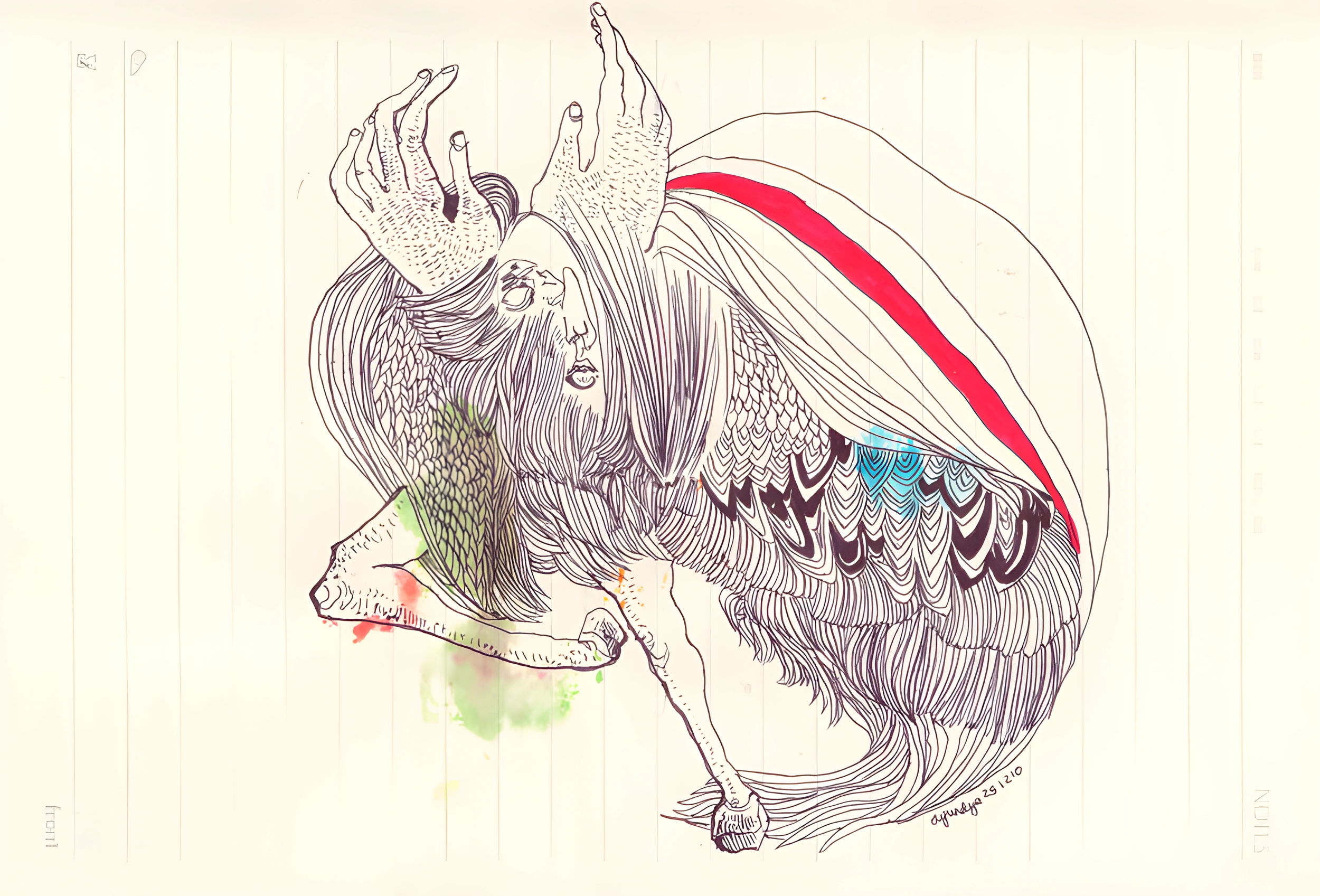
Rega Ayundya Putri, Untitled, 2010. Watercolor and ballpoint on notebook paper.
Image description: Fine-line black ink drawing of a chimerical being, part horse, part bird, part man, with aqua, green, orange washes and a bold red stripe on pale, vertically lined paper.
The Inventory of Sweetness
I
Begin with the journal. Begin with the way
a name was entered beside a tonnage of sugar,
the way a body was measured not in breath
but in yield. The estate books of Caroni
read like scripture written by the merciless:
so many hogsheads, so many hands.
In Penang the rubber trees stood in rows
so orderly they mocked the jungle they replaced.
Each morning a Tamil woman scored the bark
with a curve blade, and the white sap wept
into coconut shells, and she collected it
the way one collect stories of a long crime.
II
What the plantation taught was measurable:
the grid over the green, the straight line
imposed on every meandering thing.
Furrow, row, canal, boundary fence.
Even the seasons were made rectangular,
crop time and dead time, grinding and repose.
The archipelago learned its first foreign language
in the field. Not Dutch, not English, not Spanish,
but the tongue of farming: cut, haul, process, ship.
Every island a factory floor. Every strait
a conveyor belt between hunger and empire.
III
And yet. The body associate what the journal cannot hold.
My father pressed coconut oil into his hair
with the same palms that once stripped cane.
he hummed something tuneless and enormous
while the rain came sideways through the jalousies,
and in that humming was a country
the estate they never documented.
In Johor, a kampung elder still taps rubber at dawn,
but now the latex is his, and the forest
has begun its slow, exquisite return
between the trunks, reclaiming
what monoculture swore was dead forever.
The roots do not forgive. They simply grow.
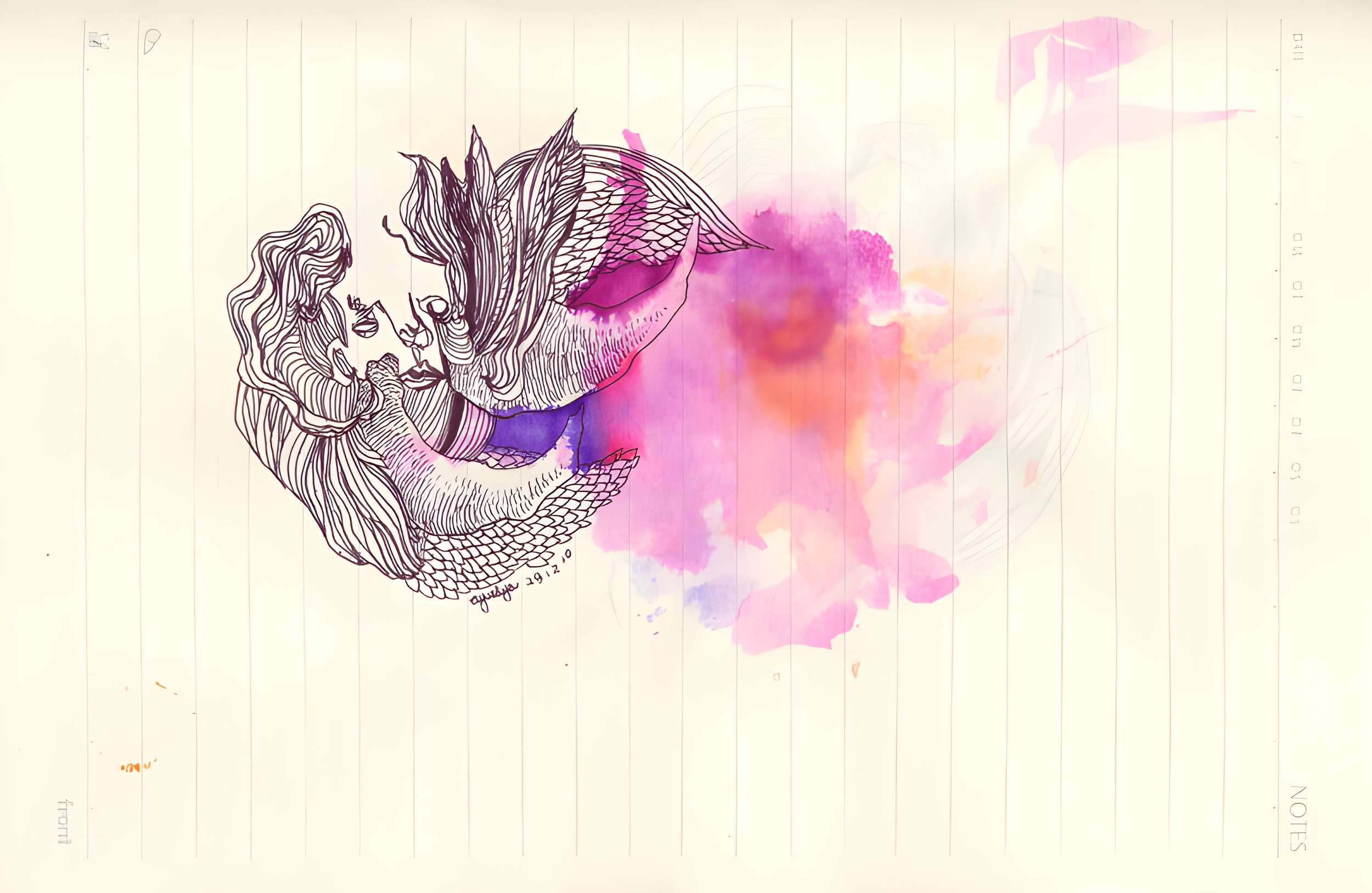
Rega Ayundya Putri, Untitled, 2010. Watercolor and ballpoint on notebook paper.
Image description: Fine-line black ink drawing of a fantastical face framed by wing-like shapes emerging from bright pink, purple, and orange washes on pale, vertically lined paper.
Every Tongue a Raft
The dictionary arrives by gunboat.
It is leather-bound, authoritative, complete.
It has no entry for the sound my mother makes
when she means come here but also I forgive you
but also the rain will stop soon.
In the marketplaces of Kingston and Kota Bharu
a woman sells rambutan and calls out prices
in a language that belongs to no institution,
a river tongue that has swallowed the stones
of Portuguese, Hokkien, Yoruba, Tamil,
and polished them smooth against its own current.
Patois is the child who was never claimed
by either parent, who raised itself
in the yard between two houses.
It learned to be shrewd. It learned to carry
double meanings in a single syllable,
to say one thing to the overseer
and another to the ear it trusted.
In Manado they speak Bahasa pasar,
the language of the market, as though
commerce were its only country.
But listen to the lullabies. Listen
to the prayers spoken just before sleep
when the grammar softens and the syntax
reaches for something older than trade.
I write this in English, which is also a kind of patois,
a tongue bent by every mouth that speaks it.
The words I choose were carried here by conquest,
yes, but also by stubbornness,
also by a grandmother who said
learn their language so well they cannot ignore you.
And now the archipelago speaks back
in frequencies the empire never tuned to:
calypso, pantun, dub, ghazal,
the staccato of dancehall bass
shaking a zinc fence in Trench Town,
the whispered sajak of a Javanese poet
writing by kerosene light.
Every tongue a raft. Every sentence
a passage between the named and the nameless,
between the island we were given
and the one we are still inventing.
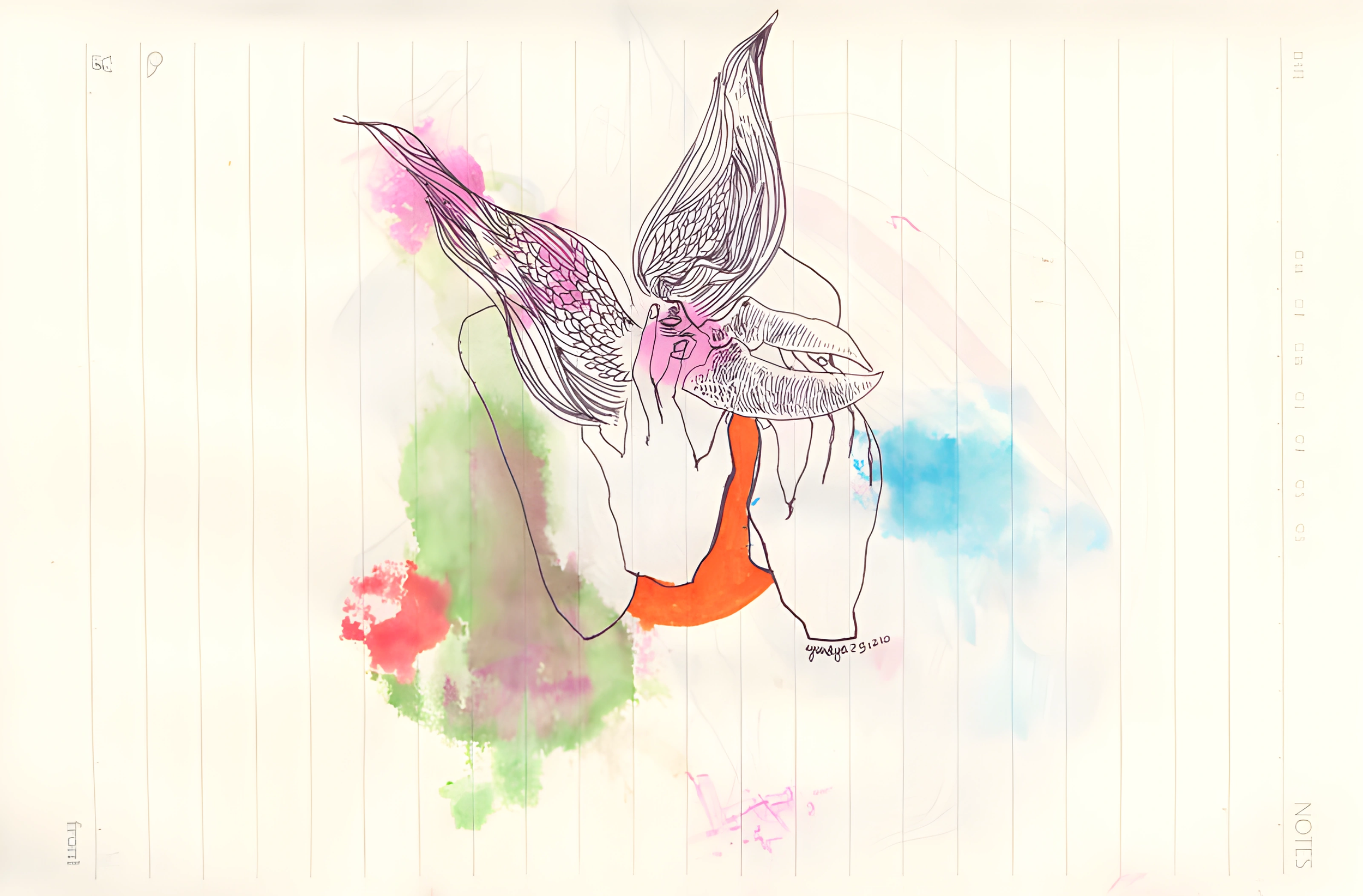
Rega Ayundya Putri, Untitled, 2010. Watercolor and ballpoint on notebook paper.
Image description: Fine-line black ink drawing of hands, a lobster claw, and wing-like shapes, framed by turquoise, green, pink, and orange washes on pale, vertically lined paper.
Tales of the Fortunate Isles
Suppose the future is not a straight road
but an archipelago: discontinuous, scattered,
each island a hypothesis of how to live.
Suppose the sea between them is not emptiness
but the very thing that makes relation possible,
the way silence between notes makes music.
The child in Cebu assembles her model city
from driftwood and circuit boards.
The boy in Tobago studies the reef
with a drone he built from discarded phones.
Neither asks permission from the old masters.
They are busy drawing new ones.
What if the mangrove is an argument
for a different economics:
roots that hold the shore, leaves that feed the fish,
branches that break the storm's first fury?
No export crop. No quarterly report.
Only the slow accumulation of resilience,
which is another name for care.
In Mindanao a woman cultivates rice
varieties older than the nation state,
each grain a library of adaptation.
In Barbuda the frigate birds return
to the same lagoon they have chosen for centuries,
and the fishermen read their arrival
the way a scholar reads a prophecy.
I do not mean to romanticize the sea.
It rises. The coral bleaches. The typhoon
speaks louder each year in a voice
that sounds like compound interest come due.
These are the facts of the archipelago now:
beauty and emergency, twin currents
pulling the same fragile hull.
And yet the possibility persists
the way a coconut floats a thousand miles
and germinates on a shore it has never known.
We are not finished. The atlas has blank pages
and the creator’s hand is ours.
Let the islands speak to each other
across the water they share.
Let the plantation become the garden,
the patois become the literature,
the scattered stones become
a constellation someone, someday,
will navigate home by.
Christian Emecheta is a Nigerian writer with personal ties to Indonesia. He is a 2025 Obsidian Foundation Fellow. His fiction and poetry appear in Arts Lounge Magazine, Step Away Magazine, The Decolonial Passage, Cranked Anvil Press, Walden's Poetry and Reviews, and Mocking Owl Roost, among others. He finds inspiration through reading, film, and the quiet workings of his imagination. Instagram: @emechetachristian
*
Rega Ayundya Putri’s work (http://cargocollective.com/ayundya), rooted in drawing and speculative storytelling, has evolved to encompass animation, installation, sound, and collaborative performance while constructing alternate realities that blur fact and fiction to question the absurdities of the modern world. Influenced by sci-fi manga, film, and anime, Rega’s work often serves to process existential anxieties while exploring speculative futures. Currently based in Bandung, Indonesia, she balances teaching art at local universities, developing new animations, and taking care of her cats. Her work can also be found here: http://instagram.com/_ayundya
The winning poems of the 12th SUSPECT Poetry Contest offer quiet intimacies, brilliant honesty, and alluring music.