
Liturgy, Language, Liberation: A Dialogue with Rajiv Mohabir
By Sharmini Aphrodite
I first learned of Rajiv Mohabir’s work through the Coolitude Project a few years ago when I delved into Caribbean literature. What struck me immediately were the parallels between our regions, intersecting in the figure of the ‘coolie’, what we know in Malaya as the plantation labourer. These were indentured labourers from South Asia, brought to work in colonial plantations and on the railway in Southeast Asia and the Caribbean. Over Zoom I spoke with Rajiv about landscape, labour, liturgy—and their legacies—in the plantations of the Malayan peninsula and Caribbean Guyana.
This dialogue has been edited for clarity and context.
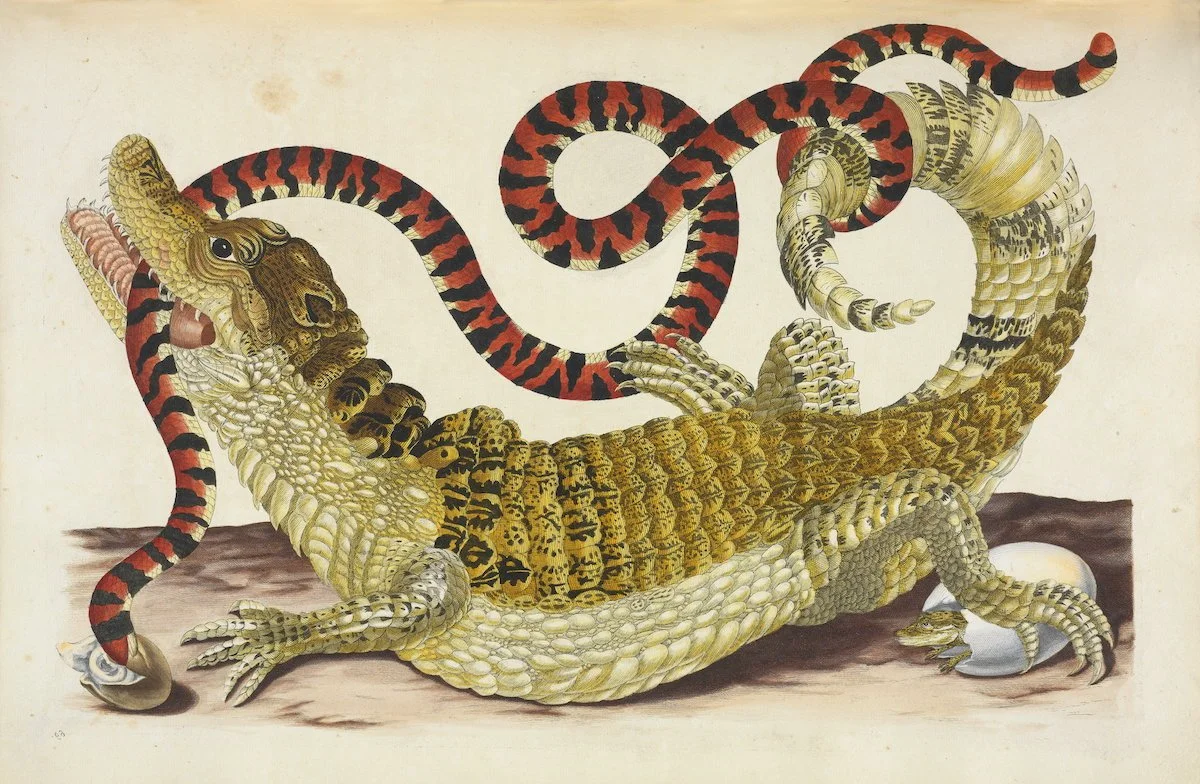
Maria Sybilla Merian, Surinam Caiman biting South American False Coral Snake, 1719. Watercolor and gouache on vellum.
Image description: An olive-green caiman (crocodile) wrestling a large red and black striped snake, which has hatched from an egg at its front feet, while behind its back foot a baby caiman emerges from another egg.
Rajiv Mohabir: I was born in London to Guyanese parents. My dad’s family are all immigrants from the north of India; my mum’s mum’s family were from Madras. I never lived in Guyana, although I lived in India for a couple years. My research has been about finding a sense of home; the ‘coolie’ as a figure is something I’m interested in. I’m also interested in how brown folks represent a settler state and what it means for us to be based in the Caribbean and North America. My main work is that of a poet and a writer. Situating myself in a North American readership has led me to take on a cultural studies praxis: the ‘mesearch’ of the history of the colonisation of the Caribbean and specifically Guyana.
Sharmini Aphrodite: I’m interested in the exploration of your practice through a cultural lens—how that works as an act of tracing. To begin with that, where did you live in India and how long were you there? How does your work trace your roots in South Asia to the Caribbean?
Rajiv: I was in Varanasi for a year, then Jaipur for a year. Living in Varanasi was really important and formative for me because it was in the Bhojpuri belt. The language they spoke there was very similar to the language that my paternal grandmother–my aji–spoke. I’m assuming that my nana and nani–my maternal grandparents–also spoke and understood Bhojpuri because they were fluent in Guyanese Hindustani, a plantation-derived language, forged in South America on the plantation, from the North Indian languages of the indentured servants.
There’s a process called koineization [that occurred], or the language is koiné, the French way of saying it. Surendra Gambhir wrote his dissertation on the East Indian speech community in Guyana [1]; he happened to be doing research where my dad’s village was. It was really interesting to see the language variety and learn a little bit about how Guyanese Hindustani, specifically how that of my dad’s family, was cultivated.
In Varanasi they speak something so similar and the foods are similar, there are all these cultural touchstones suddenly available to me because a lot of the times, coming from this tradition in the Caribbean, being so displaced for over a hundred years, our culture is unrecognisable to more recent immigrants from India who are Punjabi and Gujarati. Being there, people [also] eat phulowri; that was a really cool thing to see… so that was in Varanasi, and I studied folk singing there because I was interested in folk music.
In Jaipur, I worked on my literary Hindi skills and moved into what it could be like to be a literary translator of written Hindi but that was not where my heart was. My heart was in folk music from Bhojpuri and Hindustani. I then started to take this up seriously as a translator.
Now let’s talk about settler-colonialism. In the United States, there’s a tendency to talk about what Eve Tuck and K. Wayne Yang describe as a settler move towards innocence. About how if we can claim a certain amount of oppression, then it would absolve us of being the colonial face of the state. I see that in Guyana, where my ancestors were promised return back to India after labouring on these colonial plantations. They were never meant to be settled until the Empire saw that it was too expensive to do that. We were brought without much real agency, but the ghost of agency danced before us. So people stayed and indigenous land was parcelled out [for them].
With that came the idea, of British thinking—injected into my great-grandparents—to ‘clean’ the land of the bush, to build their settlements there. So what that looked like was not listening to indigenous lifeways of the Amazon basin and forging a kind of stand-in village that wasn’t very similar to where they’d come from in India but more similar to the structural make-up of neolocal resident establishments where people aren’t living in multi-generational houses but houses built on stilts. This layout was echoic of empire even though you could say that there were chulhe or mud-built firesides at the bottom of every house, even though there was lipay, the daubing of the floor with gobar (cow-dung). The layout was a colonial scar.
“Situating myself in a North American readership has led me to take on a cultural studies praxis: the ‘mesearch’ of the history of the colonisation of the Caribbean and specifically Guyana.”
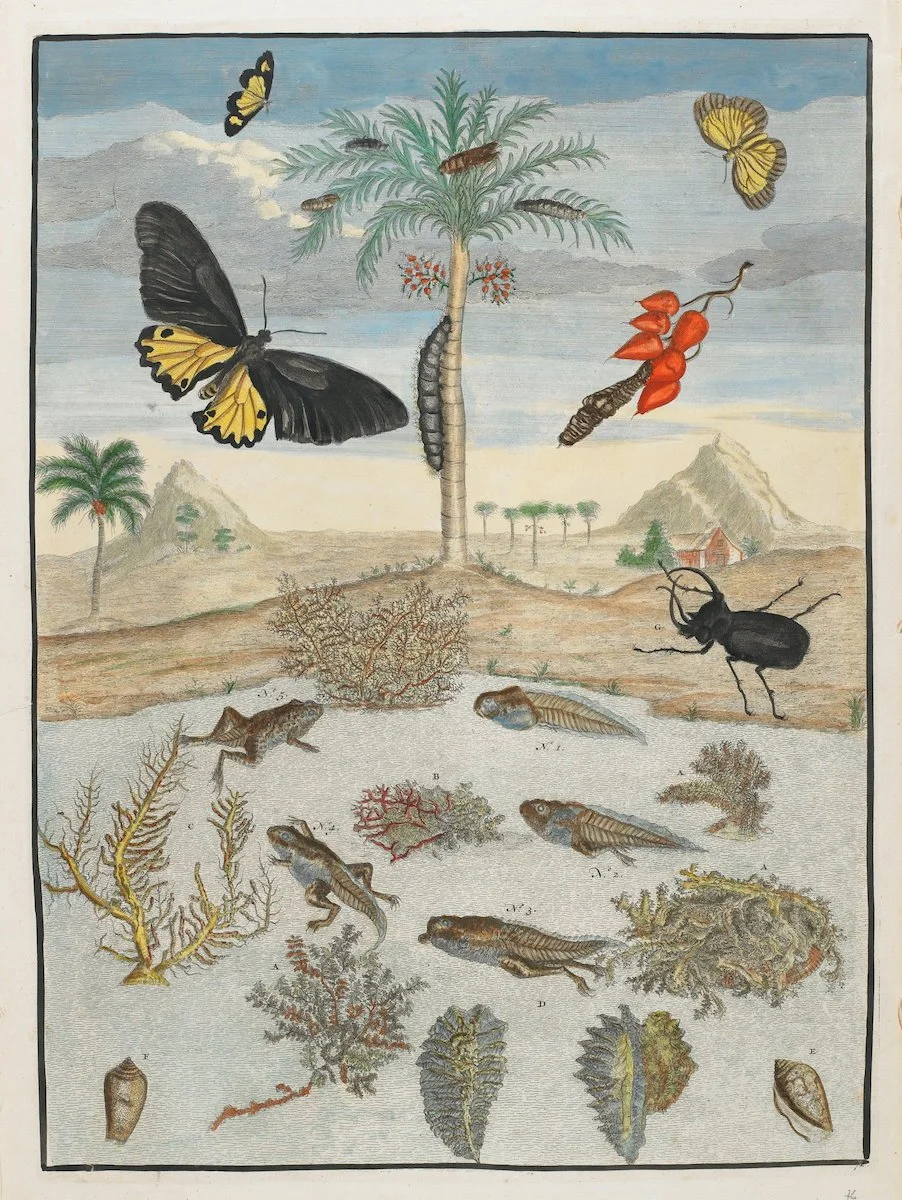
Maria Sybilla Merian, Insects and Fish with Island Background, c. 1719. Watercolor and gouache on vellum.
Image description: Pastoral landscape of Surinam with clouds floating in a blue sky over hills with palms; the composition is divided vertically by a central date palm, which stands in the middle distance surrounded by out-sized butterflies and other insects, while in the foreground the earth gives way to water, revealing marine flora and fauna, such as frogs and tadpoles, seaweeds, snails, and conches.
Sharmini: For the Tamil plantation labourers in Malaya, there’s a parallel history. So in Malaya, there are the Orang Asli, the indigenous inhabitants of the land who were originally spread throughout the Malayan peninsula but have over centuries been pushed further inland to escape slavery by or violent encroachment on their land by the Malay settler class.[2] Then there were the British, who the Malay elite collaborated with during the colonial administration. It is here that the British bring in the Tamil labourers to work on rubber plantations, to build the railway, and it is here that our histories diverge a little. What came after the Second World War was the Malayan Emergency, where these diverse communities—including the Chinese—were working to get the British out of Malaya. They worked together at times, and at others there were frictions between them.
To focus on the Tamil labourers, they were not settlers in a Malayan context but very much also an estate people, historically primarily an indentured class. And how they articulated resistance was through the plantation because that was the fount of their labour, it was where their [Hindu] temples were, where they practised their rituals, their oral traditions: all of that fused into their language of resistance. Moving from this, I’ve been interested in how major Hindu gods in Malaysia are not the ones most popular in mainland India. These include Murugan and other gods considered to be on a lower level of the pantheon. Here, they were considered ‘workers’ gods’ and shrines to them dot the railway line that go up the spine of Malaya, which was built mostly by Tamil labourers.[3]
Quite recently, a big issue in Malaysia is about these temples and shrines. It revolves around the fact that a lot of these temples were built during British colonisation so the labourers of course might not [have] possess[ed] official permits for them. Many from the Malay community are using this as a way to assert their own supremacy by alienating the Tamils and erasing plantation history, saying that these temples are ‘illegal’—on ‘Malay’ land—and wanting to smash them up.[4] It’s interesting to see how these histories parallel and diverge from each other.
Rajiv: I love the idea of colonised peoples banding together to take out the British but that didn’t happen here. In Guyana there was a real struggle for political power between descendants of African slaves and the coolie diaspora indentured folks. The jockeying for power was between the landowning coolies and the people who were able to ascend the ranks of government, Black folks. During decolonisation, the CIA got involved because they didn’t want a socialist or communist government, which Guyanese people were agitating for from both sides of the divide. What happened then was that the ethnic tensions were fanned not just by the British but by the threat that whoever achieved power would oppress the other. We still see that in elections in Guyana, where the violence between the two groups is eruptive and devastating. The types of racism pervasive in Guyana and mainstream media from the United States all interact.
When it comes to an indigenous presence in Guyana, though, the really cool thing is that Guyana has been lauded as one of the places that’s doing the best job at revitalising indigenous languages. They’re learning them in schools; it’s coming from indigenous communities themselves, they’re spearheading this and making amazing, tremendous strides.[5]
As far as Hinduism is concerned, it was always seen as a backward practice of the coolies, vilified by the British. That was one of the lynchpins of the oppressive vocabulary used by people who weren’t Indian of origin against the ‘uneducated person’. So what would happen early in the plantation, to gain political and social power, people would convert to Christianity.
Now, the people in charge of the Indians abroad, the British Immigration department, which was founded in 1840 to oversee the immigration of Indians into the colonies, saw this as a kind of community fracturing. In the 1910s, they encouraged a movement for the Arya Samaj, a tiny sect from India, to go to Guyana and proselytise: in Guyana, they [would] say there was no such thing as caste, to forget the deities and gods and worship only the elements. This infused a new South Asian religiosity and spirituality that fit the plantation society. Which is not to say that Islam or Sanathan Dharma (the kind of Hinduism that is most recognisable with its pantheon of gods) [went] away. But the Arya Samaj did give people a new option if they wanted to escape the oppression of caste, which still existed despite the relative ‘breakdown’ of caste. It’s still very much present.
The people in Guyana we’d call the Madrasis—a wrong colonial term, by the way—the Tamil diaspora—still worship gods such as Mariamman, Ayappa, Murugan. They were also seen as lower in the pantheon. This dynamic also has to do with caste and skin colour, with who belongs to which community. Tamil, Bhojpuri, and Hindustani are not languages often spoken in Guyana any more. And because this linguistic identity is [getting] lost, we’re looking for new ways to connect to one another. To connect this to Malaya, you wrote a short story for the Asian American Writers’ Workshop, where you referenced an article about Tamil songs on the plantation.
Sharmini: Yes, that article by Logewary Arumugam and Kingston Pal Thamburaj discussed how these plantation histories were embedded in folk songs. A line that sticks with me is [rubber] tree—it is a suitable gallow. That sect that came over—the Arya Samaj—who infused their spirituality into their landscape and had the landscape infused into their spirituality, could you talk about that and how that emerged in folk practice, such as ritual or music?
Rajiv: Temples and exact replication of the hierarchical religious structures were not able to be transported into diaspora due to caste. In Guyana you didn’t really have pujari Brahmins with connections to ancestral temples, like you’d have in India, where one family might have maintained and curated a temple for 19 generations. That wasn’t [possible] in Guyana, where people were coming into a landscape that was brand new. They came into a crisis in which their traditions were truncated, things were different, conditions that couldn’t be reversed when people started to settle in the 1910s to 1930s in the landscape. So they sought a spirituality that would make sense to their daily lives.
I’m not that sure about Arya Samaj practices but the focus of their religious rituals in general would be only on a simple Havan, the fire ceremony. This calls in all the elements; there’s no need to remember the different deities with their different pujas that you’d have to do. The people who could be religious experts were the common person. They didn’t rely on the caste structures where you had to have someone more in touch with the mantras in Sanskrit. The practice became more vernacular. They had gurus and everything like that—my dad’s uncle, my grandfather’s brother—started an Arya Samaj church, or mandir, in Crabwood Creek, where they were from, while [also] maintain[ing] his Sanathan Dharma identity. People would go back and forth [between faiths and practices]. There was no real sense of conversion in that way.
Sharmini: It was more about the embedment of faith in the everyday, its embodiment.
Rajiv: Yeah, although you’d still have people with particular attachments. One of the big things in the Caribbean is the Ramayana, one of the major Hindu texts. Because one of the places of India where our ancestors were from was the Ramayana belt. While the Mahabharata and the worship of Krishna were important, were still important in my family and community, the veneration of Ram, Sita, Lakshmana, Hanuman—this was where we saw ourselves in terms of religious identity and practice because it was North-Indian dominated.
There were also a lot of Tamilian folks who also practiced Kali worship. To worship the goddess, Mariamman Kali, meant to practice a certain kind of sacrifice. In Sanathan Dharma, these sacrifices were abhorrent. Such as the sacrifice of goats… blood was a sacred offering to the goddess. But then you have Lord Vishnu requiring everyone to feast or fast as a vegetarian for the five days of Divali. The people in Guyana, who believed in the goddess, believed in ritual possession, drinking alcohol, in a magic that could perform closeness with the goddess. You’d have these North Indian Muslims coming up to South Indian practices of Sanathan Dharma and the lack of mutual recognition, what it probably evoked… this is the space of poetry. My imaginative research.
Sharmini: The inclination towards the ritualistic, trances, possessions… I’ve heard that there’s more of an emphasis on these in Malaysian and Singaporean Hinduism as opposed to other places. We had Thaipusam recently, a festival to commemorate Murugan’s victory, and you’d have people walking in sacred sites—Batu Caves in Malaya is a big one—they’d put on their kavadis, pierce themselves, get possessed. This is very much a folk practice; more orthodox or reformed folks do not like this. It’s interesting then to think about why these practices would be bigger in these plantation environments.
Rajiv: I have a hypothesis. These practices rely on the personal connection with the spirit, the deity, and the moving of the spirit and of the divine through the body that is very corporeal, based on personal affect and experience. Versus an externalised Veda that nobody has access to because these Vedas are in Sanskrit and Hindi, because of caste. This form of worship thus functions outside of that. It feels more liberatory; it has more liberatory possibilities.
“These practices [of trances and possessions] rely on the personal connection with the spirit, the deity, and the moving of the spirit and of the divine through the body that is very corporeal, based on personal affect and experience.”
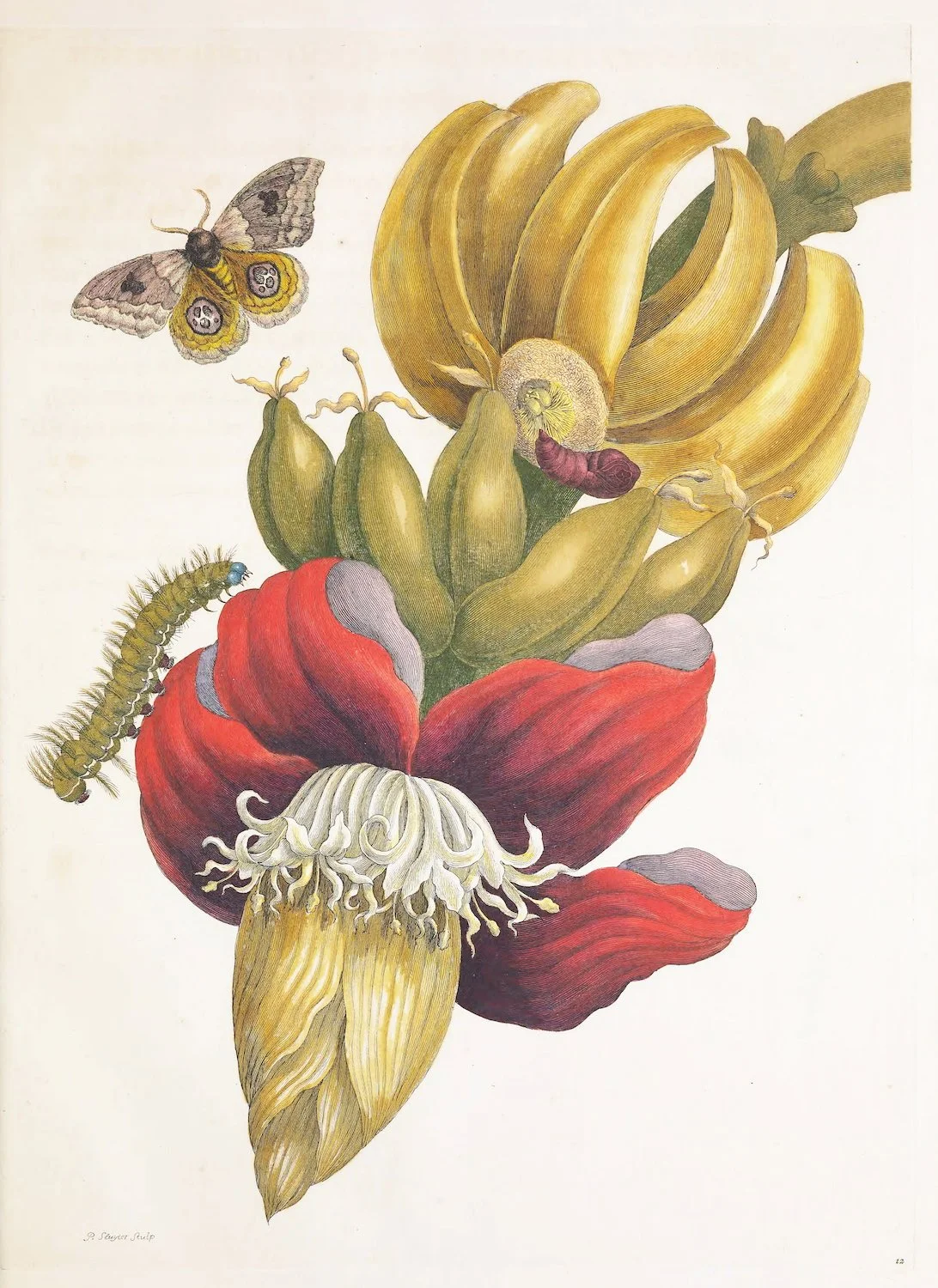
Maria Sybilla Merian, Branch of Banana with Bullseye Moth, 1705. Watercolor and gouache on vellum.
Image description: The composition is dominated by a diagonal branch bearing a large bunch of yellow bananas and an enormous red and white banana flower, with a pupa, caterpillar and full-grown moth.
Sharmini: It’s a much more emancipatory reading of Hinduism than what is common in the imagination regarding the religion, which is that it is a caste-based, rigid practice. Here, instead, Hinduism is rooted in landscape and labour, personal but also tied to being a ‘coolie’, wanting to see a deity that reflects your own struggle. Could you tell me more about more deities like Murugan, that were popular in this Caribbean blend of Hinduism? There was Ayappa…
Rajiv: I don’t know much about Ayappa, aside from a story of him riding a tiger. I really love that iconography, it reminds me of Durga, the goddess who is also riding a tiger. Ayappa was abandoned by his family and he was suckled at the teat of a tigress, who thus became his kin. A wonderful story about wildness and magic. Mariamman is also one of those deities like Ayappa who is worshipped in the Caribbean that carries with her mystery and magic.
There’s also a really cool goddess, a Trinidadian goddess: Supari Mai. She is a Hindu deity but also a Christian one. A lot of people will go to worship her from many religions; there’s this interesting nexus. What a great metaphor for diaspora and [the] changeability of coolieness and how we can look at a mountain and think okay, Mount Kailash—a mountain sacred to Hindus—but also look at it and say, from the stone of this mountain, the indigenous people trace their lineages.
Sharmini: That sense of flux in religion in the Caribbean has always struck me because of its parallel with Southeast Asia. It’s interesting that you mentioned Supari Mai as a Trinidadian goddess, not just a universal Christian or Hindu deity but something new and emergent from Trinidad itself. There’s something similar in Sabah, where I come from, where Christianity’s introduction was separate from the colonial overture; it came with the Catholic Mill Hill missionaries who were instrumental in helping indigenous peoples advocate for land rights against the colonial administration. There was also the infusion of ancestral practices. For instance, there was the use of the name Kinoingan—the ancestral Creator—to refer to the Father, or the celebration of the Kaamtan [Harvest Festival] mass. This embedment of indigeneity in Christianity led to the emergence of Christianity as a form of indigenous resistance to the Malaysian state: its own particular and liberatory practice.
With that said, we should probably start tying all these discussions to your poetry! How do these threads of faith and history, the plantation and the coolie, find their way into your work?
Rajiv: There’s a plantation language element here. I came to poetry not only by reading poets but rather through translating my grandmother’s folk songs. I started collecting all these folk songs when I was 20 for this project as an undergraduate, where I was looking at the Ramayana text and the ways in which it’s kept within families. After I recorded my grandmother, I was trying to do this translation but it wasn’t really working out because I was basing my work on western-standard Hindi, modern Hindi, which is not the language of the plantation. So I had to ask my grandmother, my aji, to explain these nuances of language to me.
In Creolese, my aji would tell me the gist… slowly, I started to learn Hindustani—her language—through the study of Hindi, western-standard Hindi, and Creolese. I was starting to listen to all our cultural productions more, like Babla and Kanchan, they’re this duo… but also looking at folk songs and translating them, and I’d realise that my grandmother—who could neither read nor write in any of these languages—was saying something. She had this vast knowledge of the sacred stories and ritual life; the profane life, also.
I didn’t realise that I was writing poems all this time. I then started to read poetry for real and I started with American poetry. There were a lot of indigenous poets that I gravitated to because of the ways in which they tell stories from oral culture and brought them to the page. I thought of this as a paradigm for me to use to understand the ways my cultural production could exist as American poetry.
There were no templates here. The templates we had were people who studied in Britain, people who were writing poems that might have been a little colonised. But this reflects the history of literacy of the East Indian community in Guyana, in which the people who were writing these poems were educated in the 1930s, when the first books were published. They were doing a lot of mimicry in form, with the British romantic poets. There’s a large conversation between British romanticism and the colonies across the world. You know—what the hell is a daffodil in the Caribbean?
Sharmini: Nothing that either of us have seen while writing about it!
Rajiv: Exactly! There’s this kind of cultural imagination we were disallowed. That was my cultural baggage. My family was also not super literate anyway. We had several books at home but it was never reading for leisure; it was reading to take a test, to pass your math exam. Poetry was a way for me to find my way back into my cultural identity through my alienation now in America. I was allowed to be a stranger in language; a stranger not suspect for my difference. My parents wanted us to be as American as we could be and not to recognise ourselves in brownness. A lot of that search for cultural identity was through that writing of poems. The poetic practice was rooted in the folk music of my family and to understand it I had to do even more deep research into the language we were from.
With that, came my study of the plantation language. It was Caribbean Hindustani, the variety of Hindustani that my aji spoke and because I did know her, we did have conversations, I did learn her language and was eventually able to speak with her. I would fill in holes in the language with Indian poetry and Hindi, western-standard Hindi.
When it came to filling these holes? For domestic spheres, words were easy: [I’d use] Hindustani. But when it came to things that were more technical then it would be also Hindi or Bhojpuri from India that I’d use, or I’d look to Suriname, which was across the river for what they use in their Hindustani, which is way more awake and alive than Guyanese Hindustani. I think this was because the Dutch as colonisers were different; there wasn’t as much pressure for those folks to abandon their lifeways to serve empire. People were able to maintain a practice of their language or a lived embodiment of their language that they weren’t [able to] in the British colonies.
“Poetry was a way for me to find my way back into my cultural identity through my alienation now in America. I was allowed to be a stranger in language; a stranger not suspect for my difference.”
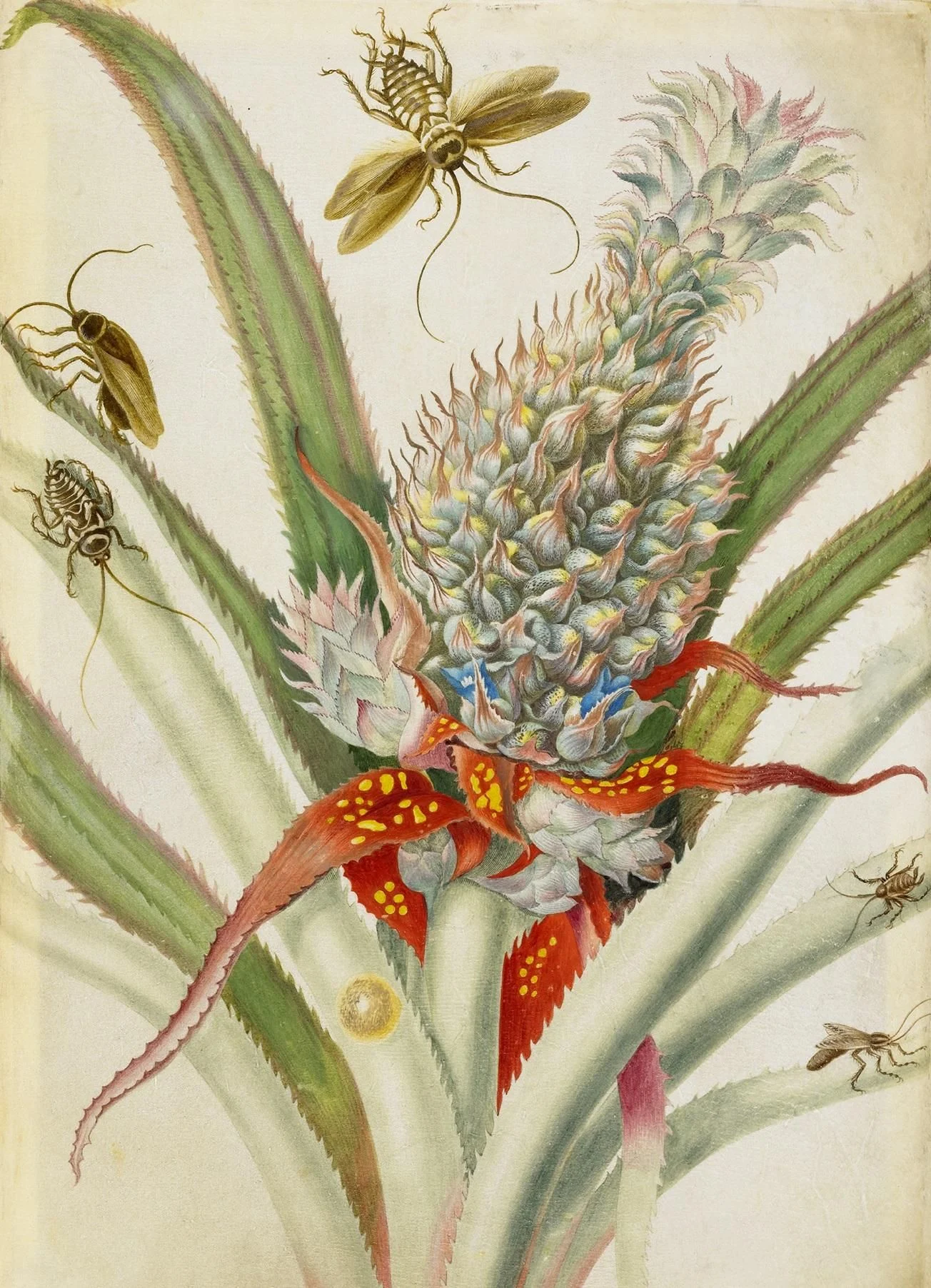
Maria Sybilla Merian, A pineapple surrounded by cockroaches, c. 1701–5. Watercolor and gouache on vellum.
Image description: A pineapple plant bearing a large bloom in shades of pale blue with red sepals fills the composition, while cockroaches frolic amidst its green serrated leaves.
Sharmini: I really like the idea of poetry stemming not from canonical texts but oral practices. Especially emerging from the genealogy of labour, having literacy would be something recent; two or three generations at the minimum. Which means that histories would have to have been transmitted through oral traditions.
I’m also interested in the construction of these plantation-derived languages: I’m curious as to what is the nature of the vocabulary that is retained from original languages, and the nature of the vocabulary that comes from this new landscape. You’d categorised domestic words, for instance, in this sphere where the mother tongue is retained? And what about plantation vocabulary, about what language is used to refer to tools, trees… what is the context in which this vocabulary is shaped and pieced together?
Rajiv: The language that was the last to leave, that still exists in common parlance, are words for foodways—spices, fruits, vegetables—and in the older generations, the language of relationships—uncles, aunts…
Sharmini: An intimate language.
Rajiv: In the domestic sphere. Vocabulary that came from the outside would be more English, imperial…
Sharmini: And this is why we have ‘cutlass’ transmitted from English.
Rajiv: That would be the word. People wouldn’t say ‘churi’. They might, that might be the technical word in Hindustani…
Sharmini: But that’s not the language of the plantation. The English would have used the word ‘cutlass’.
Rajiv: Totally. The English put the cutlass in our hands and said ‘this is the cutlass’. So we used the cutlass for the cane fields, for which we also use the English [language to describe]—that’s [how it] enters into the language.
My grandmother, as a first-generation Creolese speaker, to refer to a child, she wouldn’t say ‘bacha’, she would say the word ‘pickni’, the Creolese word for child. To say ‘children’ in Hindustani you’d say ‘pickni’ or ‘beta’, ‘betan’, ‘beti’. ‘Beta’ means son, ‘beti’ means daughter. It would be a little bit more specific. Hamar betiya, my daughter; hamar betwa, my son. Hamar sab pickni, all of my children. You wouldn’t say ‘more sab betan’; you could say that but it was older, her parents probably said that.
The formation of the language is really interesting, too, because what happens on the plantation is that when the koineization process happens, people from various speech communities in North and South India come together. To come to a mutually intelligible language of that working class, the indentured class, they would move towards a regularisation grammatically, so that more people would have access to easier and simpler language. We think of it as a pidgin, just not with language coming from dominant power into the language of lower power; rather its people belonging from the lower power all coming together. With the Hindustani that’s spoken, ethnicity was also born, and that was that of the ‘coolie’. The coolie didn’t exist as such in India before the British turned us into coolies. What was cool was that once upon a time, the word ‘coolie’ represented our contractual relationship; [it] wasn’t ethnic.
“The coolie didn’t exist as such in India before the British turned us into coolies. What was cool was that once upon a time, the word ‘coolie’ represented our contractual relationship; [it] wasn’t ethnic.”
Sharmini: It was a rubric of labour, it wasn’t necessarily an ethnicity.
Rajiv: And Hindustani also, once upon a time, had that same velocity. It was a language that worked against caste. It worked towards regularisation. It was a language that was opposed to empire. It was a refusal to have English be the lingua franca. And so with the picking up of Creole, Creolese words like ‘pickni’, an African-derived word (‘pickney’ actually comes from the Portuguese but was a word that was used in Afro-Caribbean vocabulary), [Hindustani] had the potential to [be] amalgamative and changeable and nuanced as a coolie identity could be against empire, in terms of a community across ethnic lines.
But because of the insidious hostility that the British sowed… [pitting] the Indian indentured labour class [against] African descended folks, [stifling] autonomy and economic growth in Guyana, with the very presence of indenture… there was already suspicion and hatred that was sown into ethnic dynamics. That served empire so well. If people don’t come together, how can they protest? The mechanics of it are mind-blowingly, devilishly brilliant.
Sharmini: That’s one thing that the Caribbean has that I feel we’re looking for still. A pidgin that’s really an equal amalgamation. I think of the Malays as a political class in Malaysia who are dominant today. And although the British have long left us, Malay political hegemony still replicates the structures the British left and also imposes its own—through religion, through language, through culture. We still labour under this in Malaysia.
So I’m fascinated by these liberatory possibilities of language, beyond these structures of dominance. Of course, poetry and cultural practice, like what you’re doing, exists as a foundation. I find the first fount of resistance to dominant structures can be found in the home: in the language we speak, the tools that we use, the food that we eat. Because if you look at how Malay supremacy asserts itself, it begins with these things we think of as small: minimising and attempting to erase our presence in the places in which we pray, the gods in which we believe, the food that we eat, the languages we speak. That’s also where our history is embedded and so how we can resist.
Rajiv: I try to write as much as I can in this language that nobody speaks anymore because I refuse to give up the dream of it being a socially just language. Guyana, the Global South, gained independence but what does that mean? Nothing at all, because we inherit these colonial structures. We pay tithes, offerings, to the Global North still. So it’s all farcical but the language can resist—we can resist by revitalising the imagination of a possibility outside of the structures we have inherited. It’s something culturally creative and progressive, rooted in the bodily understanding of the divine—going back to what we were talking about.
Sharmini: You’ve already answered this question in a way, but I wanted to ask: how do you think liberation can emerge from the mental and physical anguish of coolie labour? You’ve talked about this a bit with language, but is there anything else?
Rajiv: The idea of the coolie was anti-identitarian, even before that was a possibility of being. The idea of stasis in identity is such a failed modernist project—well, it’s not actually a failure, it’s a feature. So I love the idea, it’s so incredible to think that our ancestors were on the cutting-edge of an anti-imperialist movement.
Unfortunately for us, what emerged wasn’t that, what we have is a calcity. Where we lament even more a kind of rootlessness—the coolie is not recognised as ‘Indian’ by immigrants from India. But this makes sense because why would we want to be India? The India we were from doesn’t exist. Post-1947 India is not the India of my ancestors.
A calcified identity of ‘coolieness’ or ‘Indianness’ from diaspora is problematic because they think of us as fragmented. But we’re not fragmented; we’ve been resisting all the time. I’ve been looking deeply into the history of revolt and dissent in the plantations of the 1800s in Guyana for a project that I’m working on this semester. It’s cool to think of the imaginative possibilities if we bring [coolieness] into the ways that we exist in wherever parts of the diaspora we’re in—then we can work to think through what decolonisation means. People use the word ‘decolonisation’ to valourise something—and while it should be valourised—what decolonisation actually means is [a] reenvisioning of economic base and infrastructure. God knows, look at everything that’s happening in the United States today—we are due for a revolution. Language and poetry can help us with that.
“People use the word ‘decolonisation’ to valourise something—and while it should be valourised—what decolonisation actually means is [a] reenvisioning of economic base and infrastructure.”
Sharmini: On language, I want to bring us back to the Ramayana, and its resonance in the Caribbean. You’ve mentioned its North Indian roots but it’s also been so resonant in Southeast Asia despite most of the Indian population here being from the South. In fact, the Ramayana’s presence here precedes even the plantations: in Thailand, Indonesia, Malaya, the Ramayana was translated into the vernacular, through the art form of the Wayang Kulit. In the shadowplay and puppetry of Wayang Kulit, this story is embodied and ‘embodiment’ is important here because that’s where resistance and revitalisation begins, in the minute, in gesture.
Rajiv: The story is travellable. The Ramayana is no longer an ‘Indian’ story; it belongs to all of us who practice it, who listen to the story and retell the story, whether we are Hindu, Christian, Muslim, atheist, Buddhist… all of this has space in Ramayan tradition. The idea of fighting [for] what we believe to be just is absolutely travellable. The story has a lot to say about oppression; it has a liberatory potential. Maybe this is because I’m an Aquarius that I’m so optimistic but when we look at how the Ramayana has been used by the conservative hindutva-aligned government and religious institutions in India and its diasporas, the Ramayana is absolutely oppressive. But it doesn’t have to be. What if the dreaming of the person that recites and tells the story could be one that moves towards justice?
Rajiv is working on a collection of translations of Ramayan songs from his aji, coming out in October 2026, called Banbas / Exile: A Ramayan Retelling. It blends translation, poetry, flash essay, and prose together to weave a multivalent queer, Guyanese epic. Keep an eye out for this at Milkweed Editions.
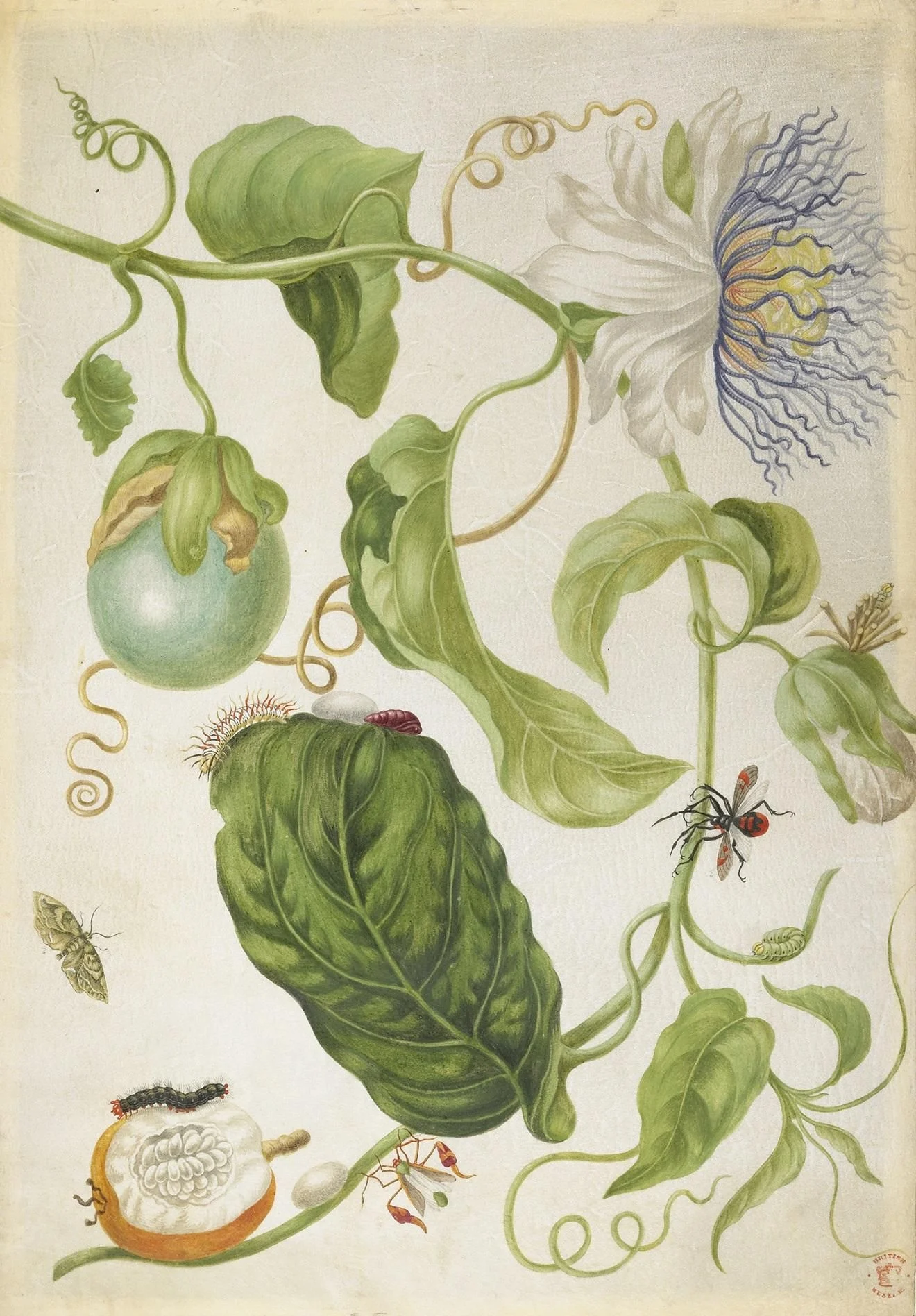
Maria Sybilla Merian, Passionflower, with its fruit, with pupae, caterpillars and two flies. c. 1701–5. Watercolor and gouache on vellum.
Image description: A green Passionfruit tendril bearing leaves, fruit, and flowers, and a few curious insects, sprays across a pale ground.
End Notes
[1] Surendra Kumar Gambhir, ‘The East Indian Speech Community in Guyana: A Sociolinguistic Study with Special Reference to Koine Formation.’ PhD diss., University of Pennsylvania, 1981. Available here.
[2] The establishment of Malay sultanates in the Malayan peninsula (c. 15th century) laid the foundation for the infrastructure of power in which Orang Asli communities in Malaysia continued to be marginalised today. Thought of as ‘infidels’, the Orang Asli were the prime targets of Malay-Muslim slave raiders beginning from this period. The advent of British colonisation gave Malay settlers from other parts of the region the impetus, legal means, and resources to conduct more expansive land-grabs and raids on Orang Asli communities; one such instance is the ‘genocidal war’ known as the Praak Sangkiil in the 19th century. Kirk Endicott and Yogeswaran Subramaniam, ‘Orang Asli Land and Resource Rights in the Malay States’, Journal of the Malaysian Branch of the Royal Asiatic Society 93:317 (2020), 87-114; Robert Knox Dentan, ‘Spotted Doves at War: The Praak Sangkiil’, Asian Folklore Studies 58 (1999), 397-434.
[3] Vineetha Sinha’s Temple Tracks: Labour, Piety and Railway Construction in Asia (free access) uses an ethnohistorical approach to explore how infrastructure and faith intertwine in the construction and maintenance of the Malayan Railway, built mostly by Tamil labourers.
[4] Miriyam Ilavenil’s article on South Asian Avant Garde contextualises the history and development of folk Hinduism demolition of Hindu temples in Malaysia amidst caste extremism and the ethnic and class dynamics of the Malaysian neocolonial project. The article discusses caste struggles within Malaya in further depth. In relation to that, vigilance regarding the Hindu far-right is also essential: this website charts the right-wing Rashtriya Swayamsevak Sangh and its international articulations.
[5] One such example is the village of Kwebana in Barima-Wainini, where the revitalisation of Carib is being spearheaded by community members.
An award-winning writer and translator, Rajiv Mohabir was born in London, England, to Guyanese parents. He grew up in New York City and in the Greater Orlando Area in Florida. Mohabir holds a BA from the University of Florida in religious studies, an MSEd in TESOL from Long Island University, Brooklyn, and an MFA in poetry from Queens College, CUNY. While in New York working as a public school teacher, he also produced the nationally broadcast radio show KAVIhouse on JusPunjabi (2012-2013). He received his PhD in English from the University of Hawai’i and is an assistant professor of poetry in the Department of English at the University of Colorado Boulder. A full list of Mohabir's publications can be found here.
*
Maria Sybilla Merian (1647–1717) was born in Frankfurt to a dynasty of successful print publishers. An entomologist and scientific illustrator, she was one of the earliest European naturalists to document direct observations of insects. In 1699, she travelled to Dutch Guiana (present-day Republic of Suriname) to study and record tropical insects native to the region. In 1705, she published Metamorphosis Insectorum Surinamensium, which became influencial to a range of naturalist illustrators, in which she condemned colonial merchants’ use and treatment of slaves and lamented their resistance to plant or export anything other than sugar. She showcased the many varieties of vegetables and fruits that could be found in Suriname, including the pineapple, and listed plants such as cherries, vanilla, figs, and grapes, which she believed could be usefully cultivated if “the country was inhabited by a more industrious and less selfish population” than the Dutch colonists.

A wide-ranging and stimulating conversation with Xu Xi, author of the story collection Horizon Hong Kong (Gaudy Boy, July 1, 2026).