
Review of Global City Dilemmas and Anglophone Singapore Literature
By Cheryl Narumi Naruse
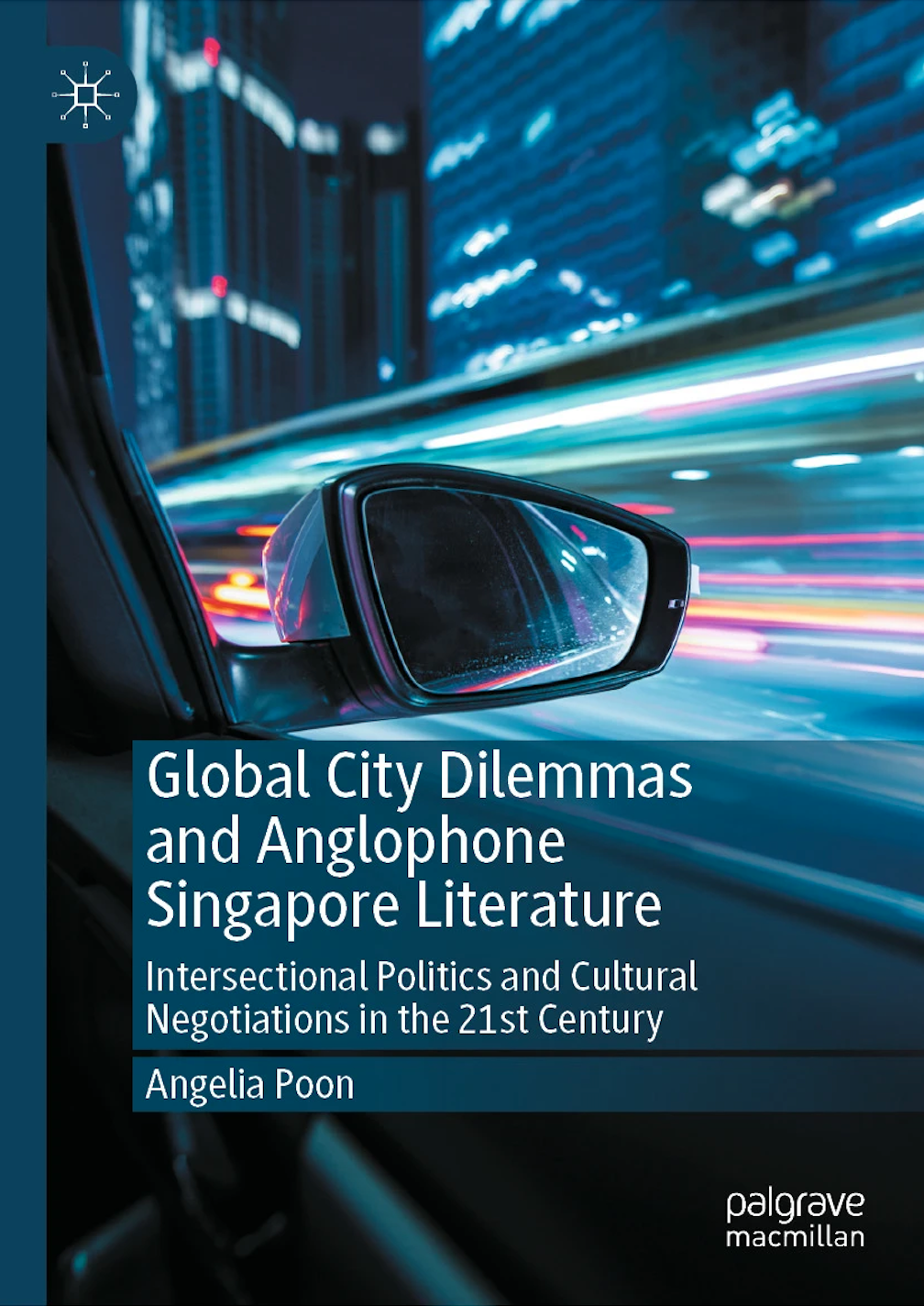
Angelia Poon’s Global City Dilemmas and Anglophone Singapore Literature: Intersectional Politics and Cultural Negotiations in the 21st Century is a monograph that demonstrates admirable, interdisciplinary breadth and deep knowledge about Anglophone Singapore literature. In this book, Poon brings a copious knowledge of the secondary literature available about Singapore literature, culture, and politics to a series of lovely fine-grained close readings.
Poon’s monograph begins with the observation that Singapore’s status of as a “global city” is often depicted as a settled story of triumph. Such storytelling relies on a potted narrative that begins with Singapore as a fishing village (Third World) and peaks as Singapore as something like Marina Bay Sands, or perhaps Jewel Changi Airport (First World). As Poon points out, however, that linear, developmental narrative of twenty-first global city success is one has been historically disproven and theoretically questioned. Framing Singapore in terms of reinvention, she argues, allows for a more complex understanding and investigation into what Singapore is. In other words, the descriptor “global city” is not simply a static category or credential that—ta-da!—Singapore now has. Rather, it is an ongoing process of change that negotiates the specificities of location and the unfolding of history. Indeed, the sheer detail Poon offers about the how administration of the global city has resulted in political, cultural, and social dilemmas in four areas—economic development, education, urban development, and culture—illustrates her point that Singapore is a complex construction.
Poon’s conceptual approach to Singapore through a focus on dilemmas reveals cracks in power, and challenges the assumption that the wealth that attends Singapore’s global city status can always be assumed as a positive development. In this way, Poon’s work resonates with earlier postcolonial thinkers who took up the idea of postcolonial “ambivalence,” a term drawn from psychoanalytic theories aimed at capturing the complex push and pull power dynamics between the colonizer and colonized. Thus Poon’s emphasis on dilemmas moves away from binaristic understandings of the Singaporean context, whether thinking through governance (authoritarian state/resistant subject) or evaluating its unfolding political trajectory (anti-colonial/colonially complicit).
Part of Poon’s ability to unpack those dilemmas come from the literary archive that her objects of study comprise. Though primarily focusing on novels, Poon also takes up poetry, performance, and short stories. She operates with a methodological premise that the complexities of language and forms of storytelling negotiate, reflect, and comment on socio-cultural conditions. This history of English as a colonial language in Singapore, combined with its international reach, makes it a key language for studying Singapore in both local and global contexts.
The second chapter considers the dilemma of housing with respect to the Housing and Development Board (HDB) public housing. The very topic of housing is a rich one for staging the many scales through which the construction of the global city is felt, whether through the intimacies of family, home, community living; the policy levels of urban and thus national development; or the historical changes that come with modernization. Though the chapter purports to primarily focus on Balli Kaur Jaswal’s Inheritance and Sugarbread, Poon spends some amount of time providing a useful literary history (itself briefly contextualized with respect to film history) of what she describes as “national living” (42) established by writings in the late 1990s by authors such as Daren Shiau, Alfian Sa’at, Ann Ang, and Dave Chua.
The third chapter opens with the question of what does “it take to disrupt Singapore’s at best indifferent attitude toward colonialism?” Implicit in this question is another: Is Singapore’s claim to globality simply a reiteration of coloniality? To address these questions, Poon turns draws on a decolonial framework to read Alfian Sa’at and Merdeka, by Alfian and Neo Hai Bin. Alfian is a key writer and thinker for questions of decoloniality, Poon writes, as the person who has “has most sustainedly sought to explore the epistemological and ontological implications of decoloniality and decolonization” (3). Poon’s readings demonstrate how Alfian’s work ultimately calls for a decolonial praxis, one that wrestles with the dilemmas that Singapore’s racial policies create and moves towards a collaborative ethos of Merdeka history. This chapter also includes a useful and thorough discussion of the differences in critical orientations that postcolonial and decolonial paradigms offer.
The fourth chapter takes up state cosmopolitanization. Poon explains how cosmopolitanism is understood by the state as an orientation necessary for a global city, and she discusses immigration policies and political rhetoric as two sites where the dilemmas of a state engineered cosmopolitanism are felt most deeply because they have produced divides between different kinds of inflows of labor (foreign talent vs unskilled labor) and different kinds of Singaporeans (heartlanders vs cosmopolitans). It is in this fraught context that Tham reads the narrative strategies that Claire Tham’s The Inlet and Akshita Nanda’s Nimita’s Place employ in their contrasting positions with respect to Singapore’s cosmopolitanism—the former less optimistic than the latter.
In many ways, the fifth chapter is an extension of the previous chapter, as it continues with the theme of state cosmopolitanization, but with this time with an examination of diasporic Singaporean novels, Kevin Kwan’s Crazy Rich Asians and Kirsten Chen’s Soy Sauce for Beginners, which are aimed at a global literary marketplace rather than the local Singaporean literary scene. What Poon finds is that these novels take advantage of Singapore’s global city status and “seek to commodify a Singaporean expression of cosmopolitanism” (144). Such commodification comes at the expense of engaging the tensions around immigration and social cohesion that have emerged from cosmopolitanization. Moreover, Poon finds that their attempts to be legible to their Westernized readerships favors a Singapore Chinese consciousness. The irony Poon calls attention to is that Singapore’s global city status, which is created literary marketability for Singapore writings, has in fact resulted in depictions that are retrograde in its class and race politics.
The final chapter examines weirdness in Amanda Lee Koe and Ng Yi-Sheng’s short fiction, which Poon frames as a literary and affective response to Singapore’s development into a global city. Weirdness is “unsettling if not disconcerting, producing a suspension of time, judgment, and meaning.” (175). Such affect, in Poon’s argument, reflects a kind of literary experimentation that has emerged from an expanded literary market and professional writing scene, but also one that counters the pragmatist national discourse associated with governance. There is something satisfyingly ironic for Poon to close the book with a critical focus on affective uncertainty—perhaps precisely because there is something that feels so definite to the global city and all its technocratic governance. Or perhaps because it brings us back to the very affect of dilemmas themselves.
Poon’s book is an impressive achievement, one that will be a staple for Singapore literary studies in the years to come. Her literary readings deftly toggle between thinking through local idiosyncrasies and macro developments while also handling an interdisciplinary range of critical works. Ironically, the very conditions that produce Singapore as a global city are the same ones that make it more critically legible in anglophone literary studies. And even as those are conditions we might critique as scholars, research expectations often also demand that we engage a global (academic) book market. How does Singapore as a global city affect knowledge production itself? There is no way, of course, for Poon to answer this question in a single monograph. But this is a question I also wonder about with my own work, as a fellow traveler in Singapore literary and cultural studies, though institutionally situated in North American academia. The critical terms of Poon’s monograph offer an opportunity for us as critics to consider the dilemmas and negotiations we must take on in our own writing and analyses.
Cheryl Narumi Naruse is an associate professor of English at Tulane University in New Orleans. She is the author of Becoming Global Asia: Contemporary Genres of Postcolonial Capitalism in Singapore (2023).

‘A snapshot of our planet, filled with souls dead and living, crying out that they matter, that their stories must be told.’—this September, Ng Yi-Sheng reviews writers exploring their own pasts.