
Watching Pro-Ball with My Mom after Surgery
By Leigh Sugar
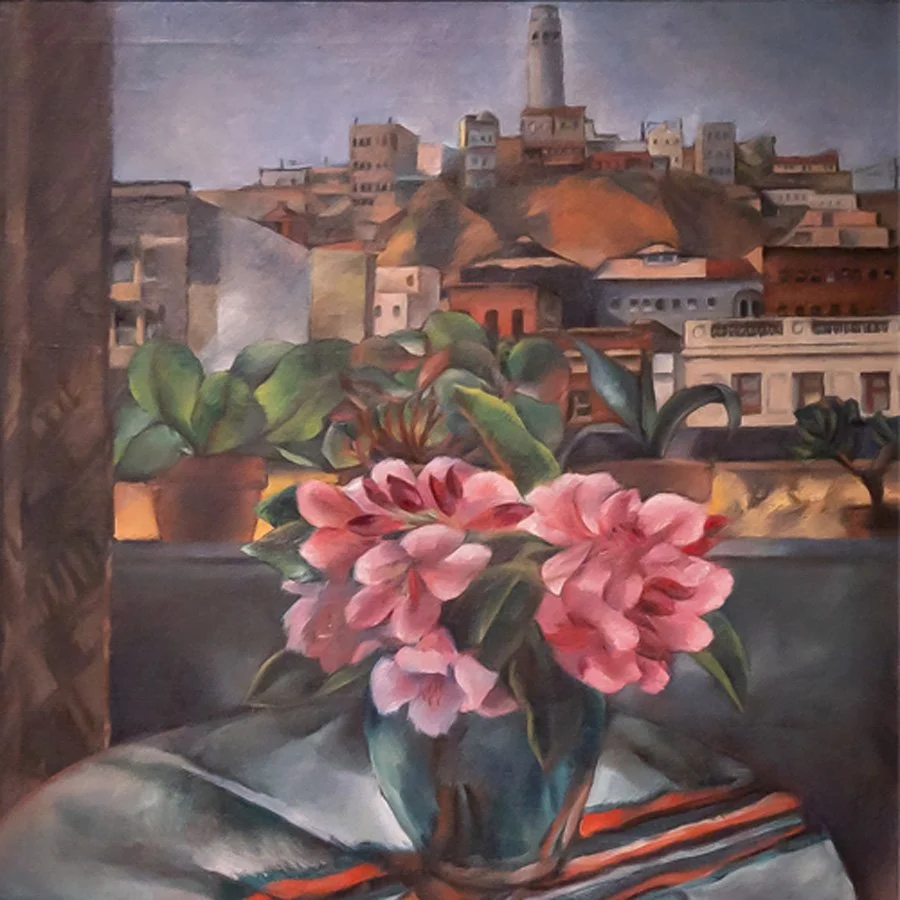
Miki Hayakawa, From My Window, 1935. Oil on canvas, 28 × 28 inches. Collection of Sandra and Bram Dijkstra.
Image description: A still life of a vase of pink flowers before a window that opens onto rooftops of an urban landscape at varied heights. Its painting style and warm vibrant palette are reminiscent of Cézanne, where organic and inorganic objects alike are rendered in semi-geometric, proto-cubist forms.
Failure
I show my newest doctor my oldest MRI, pass him my
phone photo of the best profile cross-section view of
my head-spine, the tissue post-hit. The first of many
scans. He scans the report, photo. I can’t believe your
parents didn’t come out, he repeats, After. I know, I
puerse. To be fair, I didn’t know how bad it was, or
going to get, I forgive. I like to be fair. I don’t forgive; I
understand. I twist to understand. To understand has
required endless twisting. Endlessly twisting
possibilities to explain this perceived filial failure. This
perceived failure – failure, tampered always by the
qualifier perceived. Because I am the perceiver, I’m
not to be believed. Not fully, at least. Doubted, at
least some. I must be doubted because I rendered
myself Fine in the aftermath, despite. Despite the
aftermath, I seem fine. This “seem”: all, and only, my
responsibility. Fault.
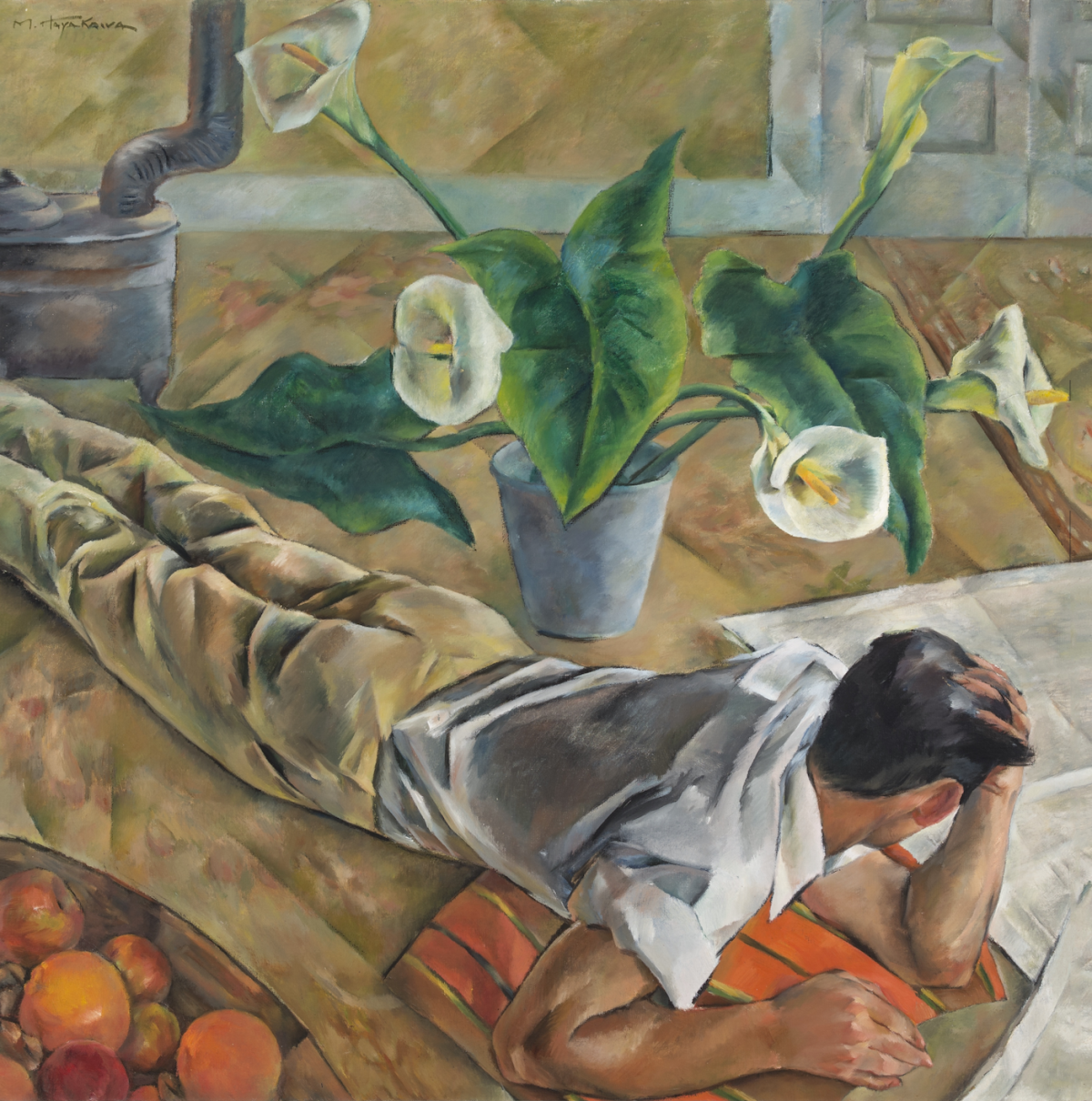
Miki Hayakawa, One Afternoon, ca. 1935. Oil on canvas, 40 x 40 inches. Collection of the New Mexico Museum of Art, Santa Fe.
Image description: Seen from above, a young man in white shirtsleeves and tan trousers lies face down on a carpet to read a newspaper lying open before him on the floor. His back and legs form a strong diagonal that divides the canvas into an upper part dominated by a flowerpot of white calla lilies and the edge of a wood stove, and the lower part where part of a bowl of fruit forms the left corner. The style and warm vibrant palette are reminiscent of Cézanne, where organic and inorganic objects are rendered in semi-geometric, proto-cubist forms.
Watching Pro-Ball with My Mom after Surgery
The back, lumbar. Hers.
L4-5. A neurologist, she
has known what this means,
for decades, scholastically. When
we discover what distance remains
between brain and body
differs. It is rarely a singular
event, this discovery. She knows
better than most how the brain wants
to forget what it wants,
and is good at it. Look
look look look look
she growls. I know
this command is not personal,
would come
regardless of company. Mine,
another’s. Anyone’s. She never
played, not because she peaked
at 5’1”, but because girls
didn’t, couldn’t, when
she was one. Tonight, she
sits in the hard wooden chair,
more supportive than the give
of the cushioned
couch. Oh nice… nice… shit.
The ball shifts hands,
meaning teams. From “hers.”
Shit. She shifts
in the chair. Incredible,
a friend once exclaimed,
how Durant, Bryant, Curry,
and your mom
are all the same species.
Indeed. Indeed
her team is number one
this season. Tied,
this game, though it is early
yet. Pain, today.
Too soon to know
what’s next.
Leigh Sugar (she/her) is a disabled artist based in Michigan. Her debut collection, FREELAND (Alice James Books, 2025), was a finalist for both the Jake Adam York Prize and Alice James Award. She also edited the anthology That's a Pretty Thing to Call It: Prose and poetry by artists teaching in carceral institutions (New Village Press, 2023). She has taught at CUNY's Institute for Justice and Opportunity, NYU, Poetry Foundation, Hugo House, and more. Poems appear or are forthcoming in POETRY, Split This Rock, jubilat, The Rumpus, and more.
*
Miki Hayakawa (1899–1953) was a Japanese-born American modernist painter and leading woman artist within the vibrant multi-ethnic art community in the San Francisco Bay Area. Born in Hokkaido, she moved to Oakland with her mother when she was nine to join her father, a pastor, who had arrived a year earlier. The Chinese Exclusion Act was still in place, restricting entry of Chinese people into the United States, and the expanded Immigration Act of 1917, excluding other people of Asian descent, would pass within a decade of her arrival. In the 1920s, Hayakawa trained at the School of the California Guild of Arts and Crafts in Berkeley and at California School of Fine Arts in San Francisco. During the 20s and 30s, she became a vital part of the artistic community in San Francisco that included Chinese American painter Yun Gee and the artist couple Matsusaburo and Hisako Hibi.
“Despite the aftermath, I seem fine.” Two poems on family and disability by Leigh Sugar for Suspect’s ‘Crip Time’ portfolio.