I place nine offerings at the altar of my halmoni
By Christina Lee
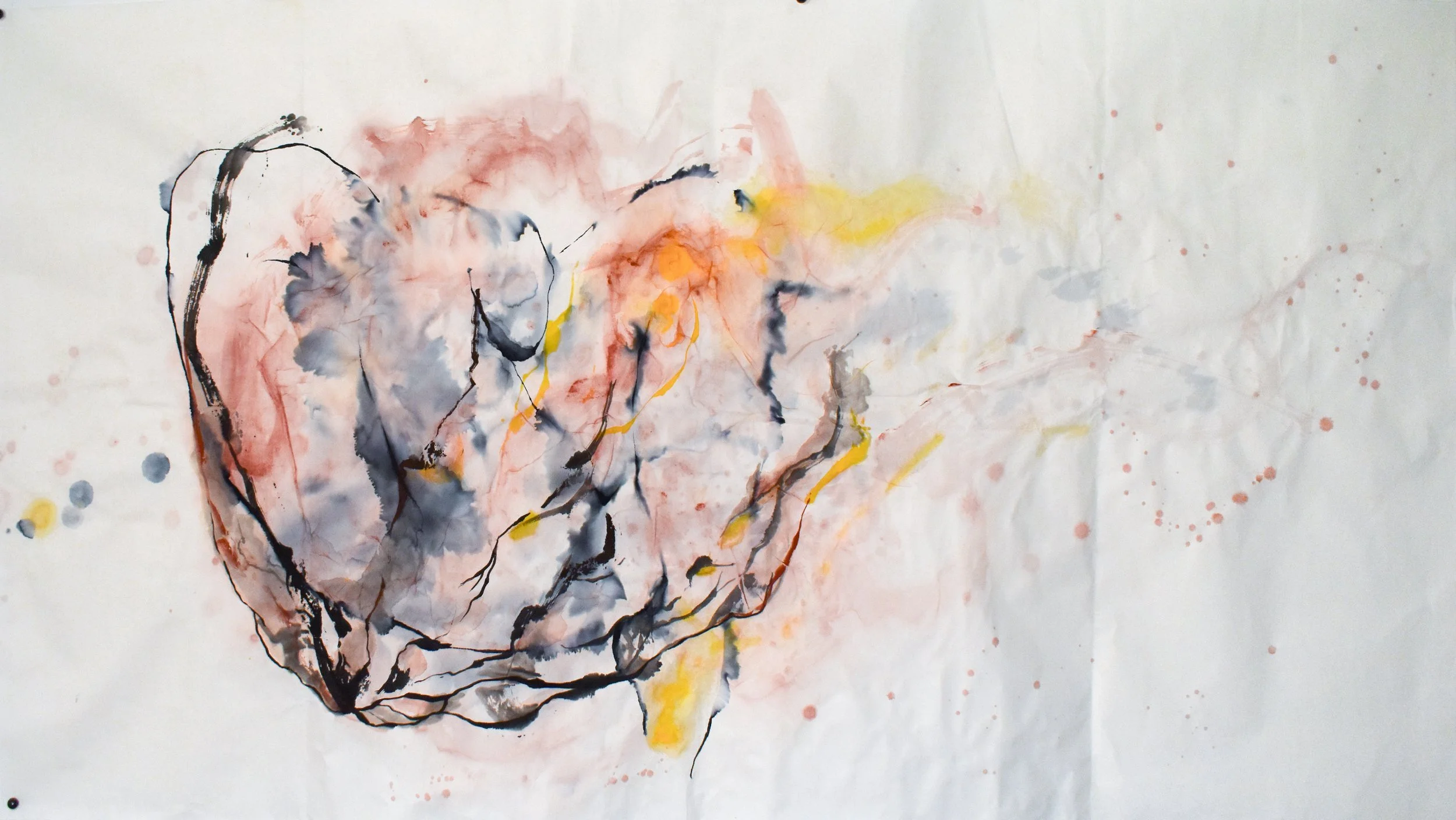
Isabel Lu, from a series of studies in ink, iron oxide, and watercolor on paper.
Image description: Wide composition with complex outlines of what might be a figure rolled into a ball, its limits and borders ambiguous, rendered in fine lines of black, yellow, and sienna, shadowed with washes and splashes of ink and color against a white ground.
1.
She has Alzheimer’s, they tell me one day, and I nod as if I know what that means. But it becomes an integrated reality at once. My halmoni’s, my grandmother’s, symptoms become apparent suddenly, previously gone unrecognized and undiagnosed. I am meant to understand she is different now, with little explanation from my parents, who deliver this news unsparingly. She must have been living with some gradual increase in symptoms for some time before her diagnosis, but my parents, so deeply uncomfortable with acknowledging even their own health, wait until she begins requiring assistance with her daily activities of living. They wait until ignoring the realities of living with a chronic and terminal illness becomes too difficult to hide. Halmoni and I, we visit each other, crossing oceans infrequently but regularly. But the visits have receded steadily in the last few years. To me, that is the only symptom I am aware of.
I later look up Alzheimer’s disease as a teen, attempt to understand this foreign body that eventually renounces me unrecognizable to her, forfeits my identity in her mind. I come to understand that she has a limited amount of time left before she dies in some several years, that the severity of this disease will progress through stages, that perhaps she has already begun to forget. But cruelty lies in the loss of time, the way it seems to pass so quickly.
2.
I watch as I grow the semblance of fine lined webbing across the back of my hands, particularly visible when it is especially cutting and dry in the winter, skin tight around my knuckles, little rips on my cuticles. It reminds me that I am aging, as is everyone around me, that we all are on this earth for a limited amount of time. It is as if these hands are growing into a resemblance of those of my halmoni’s: a ghost of her lives where my skin is now. What I remember of her prominently now are the freckles, stepping stones along the crest of the back of her hand, her webbing a microscopic spread of valleys, skin scrunched around the bone. She reaches for them often, my hands, taking them in-between hers as if to warm them, but she runs cold as the diabetic neuropathy deadens hers, rendering them a stiffened cool.
As numbed as she may have felt in her fingers, she teaches me how to knit when I am in the third grade. Learning by demonstration is easiest for me, I find, after making a confused mess of yarn in my first attempt via the Klutz children’s instructional knitting book (yarn and needles included) whose words are paired with diagrams that feel foreign to me. She demonstrates for me, teaches me, and after she leaves to go back home to Korea, I sit myself on a cushion on the floor, fiddle with my needles, and thread them through the yarn. I recall her hands as a specter of my own, demonstrating poking the head of the needle behind the other, grasping soft acrylic thread, and throwing it around the pointed end. She doesn’t visit often after this, having been diagnosed with Alzheimer’s soon after, and having lost functionality with her new disability. But I feel her absence, and she is the first of my grandparents to have died.
I knit often now, having relearned after decades of disuse, abandoned in place of other things like school and work. I only find it again when I, too, become disabled and chronically ill, my hands also weaker than they were a few years before. When I pick it up again, I am reminded of how the yarn from the knitting kit seemed to have spun fully formed as a scarf, mottled blue, out of her fingertips. Her veins translucent under the skin, matching mine.
When I am too young to have truly known her, we meet on occasion when she crosses the ocean to our home in San Diego no more than once a year from Korea. I sit by her side most often, join her on her walks through the trails near my home. I feel the most kinship with her of my extended family. I know she has diabetes although I don’t feel like I know what that means yet, but I watch as she injects insulin multiple times a day. I sit with her as she cleans her supplies, then her skin, with alcohol that stings my nose as it rises as an evaporation, as she pulls up the end of her shirt, squeezes, and inserts the needle proximal to her belly button, plunging down on the syringe.
It occurs to me today, as I watch a video on how to administer an injectable medication for the first time, that she could’ve shown me how to do it: insert a needle, where and how under my skin. To breathe out to relax the muscles, to feel the pinch of the cold as the liquid enters. For the first time since she has died, I wish she was here. I have missed her, but in acceptance of her death, her absence, I do not wish her back into a world that was unkind to her. I wish her rest and ease beyond this life. Nobody else in my family could show me how to do this, though, I realize, sitting here alone on my couch. Eternally an eldest daughter, I have to be the first in a sense, again. She was the first too.
My halmoni teaches me how to live a disabled life. I watch as she accommodates herself and asks for accommodations. She rests often and purposefully. I watch as she cares for herself diligently: survival. I watch her symptoms manifest and become managed enough, I watch as she goes on her daily walks on the trails near my home, as she takes her medications packed neatly by Korean pharmacies in daily servings in crinkly transparent paper, manage her hypoglycemic episodes that leave her tremulous and in repose on our couch, and importantly, I watch her enjoy life.
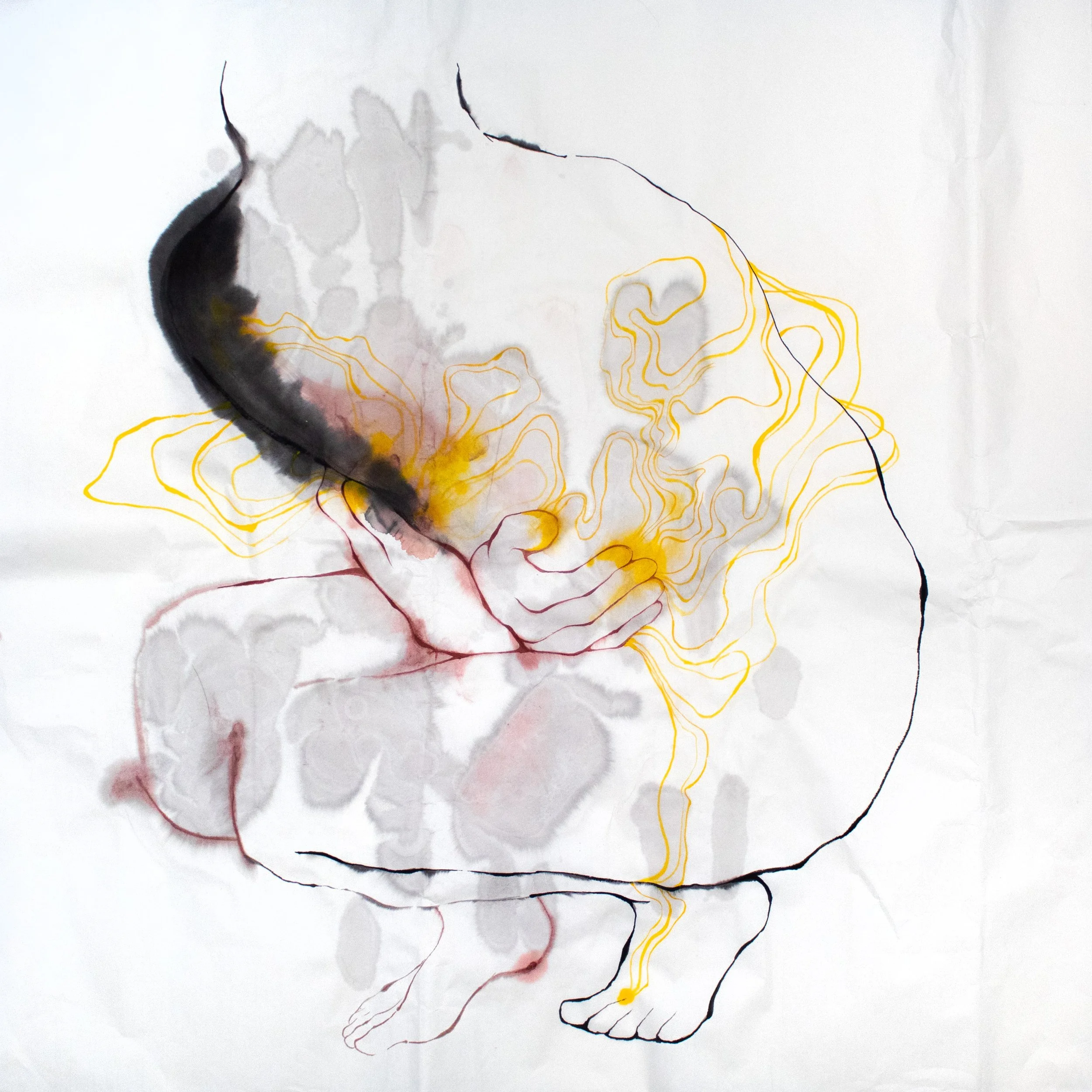
Isabel Lu, from a series of studies in ink, iron oxide, and watercolor on paper.
Image description: The outline of a crouching figure (minus the head) in fine lines of black, yellow, and sienna, shadowed with washes against a white ground.
3.
I also watch as the people around us, her own daughter-in-law, my mother, become increasingly ableist as halmoni accumulates diagnoses. She comments often on my halmoni’s breakfast habits, voice steeped in hatred for her mother-in-law.
How could she eat so much for breakfast? What a pig. You know she has diabetes, it’s because she eats like this. If she didn’t eat this way she would be healthy.
Her judgement that she casts upon my halmoni for eating what now seems to be a perfectly agreeable breakfast through my eyes only seems to expose my halmoni’s will to enjoy life and her autonomy in her choices about her own body and selfhood. My child-self remains unsure at the commentary. My mother decides what is served for breakfast — she selects and washes ripened fruits, buys groceries, drains a cup of water into the coffee maker in the morning and sets it to on. What I see is a plate of two boiled eggs, buttered toast with a puckered, shiny dollop of strawberry jam, coffee, sliced fruit, a halved croissant, my mother’s bilious opinions.
I eat this for breakfast too, and having grown up listening to insults stacked on judgements from my mother, as I played an unwilling and captive audience at the dinner table. She chatters away in her own disordered patterns and ableist means. She loads my plates heavy with force, and despite protest, encouragement to overeat laid bare against her bragging about how thin her body type is, how unhungry she remains, how little she eats. She forges me bigger in her eyes as if to make herself as tiny, as petite as possible. Whale, she shrieks at me, voice bloated with glee, maw open as her words carry deliberately through the air. She punishes me for not finishing a plate all while loading it higher, buys clothing sizes far too big for me to prove that she wears the smallest size. I see now how sick she is too, to pawn her children as her own glorified dysmorphic car show. For years after, I don’t understand portion control or my own hunger cues, for all the time I spent ignoring them at my mother’s command.
It would be better if she died. What she says out loud once my halmoni is diagnosed with Alzheimer’s, reveals cruelty, unsurprisingly. So much of America’s own eugenicist thought is revealed in this statement. How many times have I seen something similar scrolling through Twitter? Useless eaters. How she comes to these conclusions, is not so beyond me when ableism is so deeply ingrained in American thinking — it is the Nazis that took inspiration from American sterilization of women of color, the CDC saying that ‘only the vulnerable’ will die in the face of the ongoing COVID-19 pandemic, the continued experimentation on and exploitation of incarcerated people, the genocides that are fed by the taxes we pay. The many arms of these policies and harm done in the name of research or empire or money are so far reaching still, a hydra with two more insidious heads growing in every place ableism is called to light. You people can’t do anything. I see so much death wished upon those of us who live at any cross axis of violences, of racism and misogyny, of ableism and fatphobia, of axes on axes. When health is framed as an individual responsibility, as it is so impressed upon us here, we moralize something that is really beyond our choosing and our responsibilities — the combination of environmental, historical, genetic factors, which often are beyond our choosing, are not only strong but unpredictable. The only known truth is that the grand majority of us will either age into or experience disability at some point in our lives. It is a matter of when, and not if.
Until recently, disabled people barely were visible to the public eye, with the prevalence of asylums, institutionalization — still present, of course — and Ugly Laws, all three of which have legacies still well-embedded into our culture. People wonder out loud and often boorishly why there are so many visibly disabled people in the community ‘these days,’ when it was illegal to be publicly disabled only so chronologically close as about 50 years ago. That is, it remains in our collective public memory that there is such dire systemic oppression at play, and we are reminded constantly, in the ways that our world is built with the willful lack of investment in elevators, ramps, accessible events, respirators, and audible or visual signage. The push towards Medical Assistance in Dying (MAiD) for conditions lacking in research, treatment, resources, and investment, and the sentiment that disabled people do not exist within society at all seem to afflict the general public. I am also reminded of this every time I scroll past yet another accusation in passing delivered via TikTok comment that medical conditions primarily affecting women are for certain the new hysteria, that surely if there are so many people diagnosed with these conditions that all of them must be faking their symptoms for the sake of an attention-seeking trend. In these moments people fail to recognize that a ‘new’ condition, like mine, is only new to them, that research and diagnoses are becoming more readily available, that the science is only now catching up.
It turns out, however, that sometimes it does not matter if the science is there or not when a person is committed to misunderstanding you. Doctors and strangers alike visually assess a disabled person to determine if they seem “disabled enough” for their liking, and assemble their preconceived notions on disability against the literature, available or not, to manufacture a person who does not want to work or be in community with others, should not have children, should not be accommodated, should not share the streets, should rather be dead than alive. They tell these tales to us burdensome disabled people, tell us we should not dare seek the services that keep us alive, their voices hurled spikes across internet space and time. They suggest MAiD, its services easier and faster to deliver, over real treatment. Meanwhile, we lay in wait for treatment. We enter struggle, fight, for what we know we deserve: from the doctor’s office, the capitol steps, bed. We want to live.
4.
My father and his siblings attend my halmoni’s appointments with her; he flies across the Pacific to meet her and her doctors again and again. I do not blame him for this, but I do not recognize this man, this emphasis on family and support so unfamiliar to me. This is the same man whose absence I measure by his missing body from nearly every one of my birthdays, performances, science fairs, emotions, who leaves me to navigate the college application process on my own despite him being the only one in my family who attends college and graduate school here in the US. I know better than to ask him for anything, yet I watch as he drops everything to be present for his siblings, his mother, his nephews, fulfilling the duty of the eldest son and in doing so, forgoing three of his own daughters.
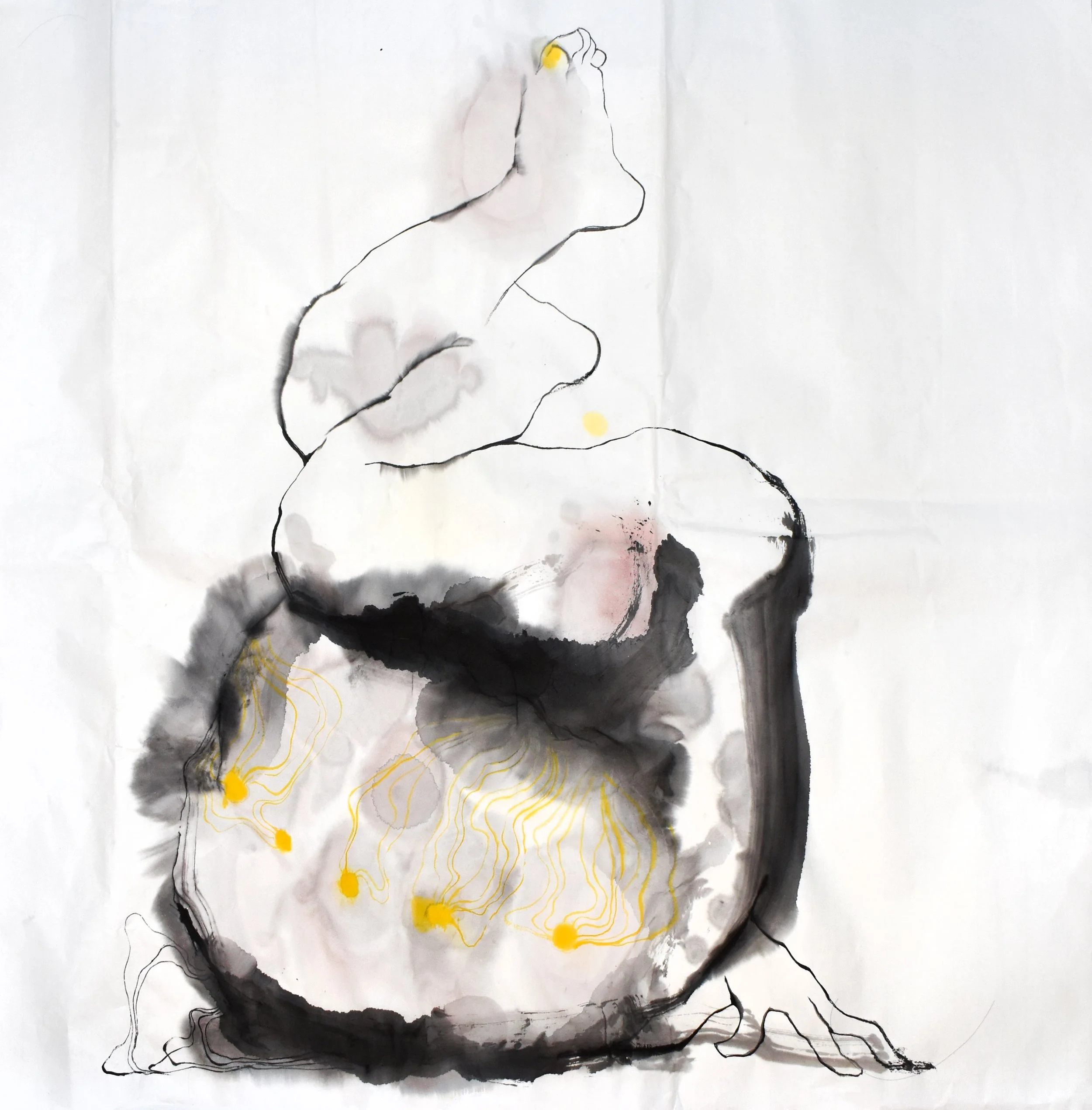
Isabel Lu, from a series of studies in ink, iron oxide, and watercolor on paper.
Image description: The outline of a figure in a semi-headstand, their feet in the air, bolstered by their hands. Drawn in fine black lines with yellow, black and grey washes against a white ground.
5.
When I travel to Korea on my own for the first time, to visit her shortly before she dies, it seems she no longer knows me at all. My natural hair wavier, frizzier, than the sleek, glossy, straight styles often sought after by young Korean women, she exclaims, What is this! Why is your hair messy? She smiles at me blankly, turns to my gomo, my father’s youngest sister, and asks, Who is this? She turns to me and asks, And who are you? 넌누구니?
Her hair, once dyed a spry brown, red in the light, permed on schedule, and rolled into curlers every morning to maintain its shape, now lies in mild waves, undone and frizzy against her head. It gleams white in the light, fluffed, and sits there shining brightly in a poof above her brows. It is so strikingly different from how I have seen her previously. I think little of it then, but the labor it takes to maintain hair, I understand now, having lived through years of my own conditions where I have lacked the energy and coordination to wash or style my hair unassisted for months, if not years, at a time.
We sit at the dining table, where my gomo coaxes her to eat a roasted sweet potato, one of her favorite foods. At the table, a collage of photos and names is placed underneath the clear glass where I see a spillage of smiling faces staring back at me. I trace my finger over the spots I see familiar ones, my father’s, his sisters’. Notably I do not remember seeing my own, or my siblings’.
6.
Memory is a fickle thing. I wonder about forgetting, as there are pieces from my childhood I already do not know, that are hidden from me by my mind, too difficult to remember. And then there are those that return in flashes. Perhaps my halmoni has forgotten her childhood too, as I have, and perhaps they return to her in moments she does not speak of: memories from her childhood where she has seen things so terrifying that articulating them would materialize them back into existence, from when she seeks refuge as a child carrying her own sibling on her back, from the northern region of Korea during the war. Another genocide in reality, where millions of Koreans in the northern region are killed by the US before the arbitrary line is drawn deeming all of us one part evil, one part neocolonial. No one teaches me about this, no one in my family speaks of it, that she is escaping death. Parts of it I piece together myself after an Asian American history class in college reveals the true cost of war.
In some moments of lucidity, we get parts of her current life, though we may never know her past and I am too young to know how to ask. It feels as if a history has been lost.
I don’t have enough contiguous childhood memory for me to write with detail laden dialogue, I realize, when I gently comb through the folds of my brain and find only scraps of the conversations that leave me to piece together what isn’t available. I have few archives that have make it with me to adulthood— the journal that I write in in middle school becomes torn in half in a moment of adrenalized rage by my mother, who discovers that my feelings about her are less than positive. Multiple phones I have as a teen smashed against pavement, also by my mother, who decides that texting my friends about what we’re wearing to school and what we’re watching on TV is a crime worth punishment in isolation. All my photos from high school are deleted by force one night by my mother, who bursts into my room to claim Facebook a waste of time the night before a test while I am studying. These things I do remember, starkly, from my childhood. Her erratic, often tantrum-like rampages end with memories burnt down and the ashes seared into my brain when they land where they may. While the dialogue is lost to me, moments remain.
My memories from childhood reveal myself to me unpredictably in moments of terror, sometimes at night when I go to sleep, sometimes when I am reminded of something my mother does to me, I see her strike me, drag me, rip clothes off my body, leave me outside the locked front door, throw my clothes out with me. I feel the fingerprints still impressed upon my skin where they touch my cheek, my back, my arms. I compartmentalize these moments, I stuff them in vessels too small to repress them in hopes that pressurizing them will keep them from taking over my life. If I sit too long with these memories I fall into the vessels too. I become explosive to the touch.
My father says halmoni recognizes him at times still. He FaceTimes his youngest sister one day, who moves into the building next door to my halmoni’s and is over at her home often, and he says, Mom, it’s me, do you remember me? And his sister responds, that’s my brother. That’s Hakmin, see, Mom? and she giggles. Ah, Hakmin. Halmoni nods as if she is supposed to know.
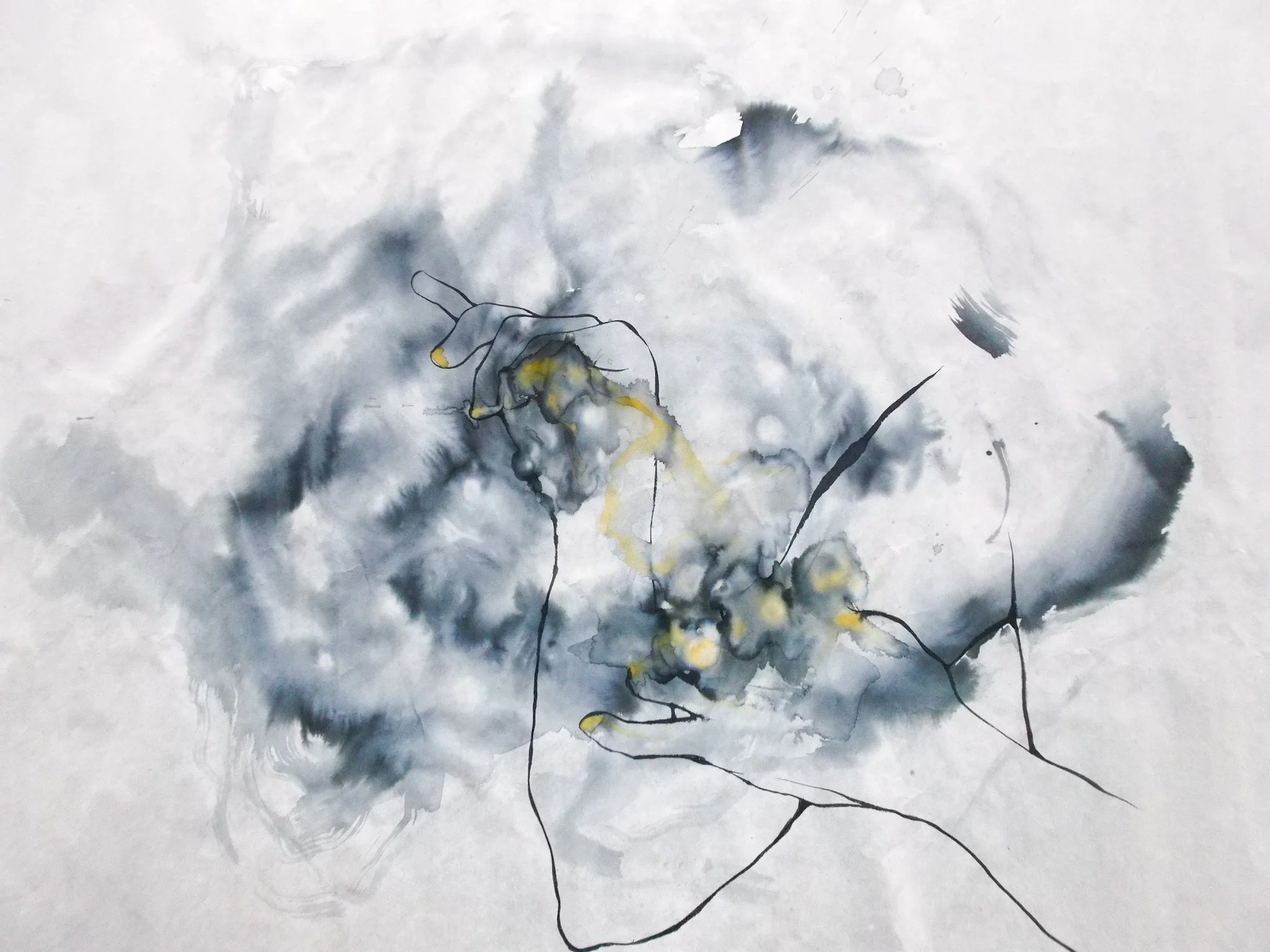
Isabel Lu, from a series of studies in ink, iron oxide, and watercolor on paper.
Image description: Two arms drawn in fine black lines, emerging from a cloud of bluish-gray washes, fingers poised as if in a game of cat’s cradle.
7.
It briefly crosses my mind that maybe it is an attempt at what they believe would conserve my memories of her, that my parents do not let me see my halmoni much when her disability from Alzheimer’s becomes increasingly apparent. But the thought dissolves swiftly. In my lifetime, I have only ever known her as disabled. I don’t meditate on what would be all so different now: disability is a part of our lives and her life is not meant to be lived hidden. Moreover, I do not wish for her to live relegated, as disabled people so often are, to some unseen tower of her home in Seoul. She seems to enjoy visitors years into her diagnosis, after her mood and personality have become altered, so I am not sure that it’s for lack of desire to see me. Rather, my father and his siblings replicate what society has long enacted, that there is something shameful and carceral being done here, in becoming disabled. And yet, I do also meditate on this: my father seems to also want to honor her wish to live her life autonomously but with support, as she previously expressed, in receiving full-time care at home, around her family, despite my mother’s complaints that she should be put up in a ‘home.’ He seems to be able to understand this desire, however, to not ever be institutionalized, but in effect, visitations seem to only ever include himself and his sisters. My interactions with her become rare.
I drive my father to the airport in Los Angeles in late December, where he, responsive to the news that her condition is declining, is set to fly into Incheon. I ask him questions, feel as if I am extracting information out of him, and it reminds me of the people I used to interview about sexual assault for qualitative research, for work. Something in me feels guilty doing this, making him face the harrowing reality and speak it into existence. I learned once in a class that not filling pauses will urge the subject to fill them. I remain silent, let the quiet fill space between us. He tells me, as my captive in the car, that her kidney function is at 25% now, that she is having a hard time swallowing from the Alzheimer’s progressing. I know it is hard to divulge, as his voice becomes punctuated with sighs to keep himself from crying in front of me. More silence then passes between us as I take in the news, that this may be one of the last times that he sees her alive. I wonder for a moment if he never would have told me anything until after she had died.
A few hours after he lands, while still in quarantine from his travel, we learn that she has COVID, caught from her caregiver, who comes to work while sick. My halmoni goes to the emergency room almost immediately due to her fragile state, and is hospitalized. Her condition worsens and she develops pneumonia, then sepsis, and then in mid-January, shuttered away alone and confused in the COVID wing of the hospital, she can only be seen at a distance. Windows and walls between my father and her, she dies. This unravels something in all of us. A few years after her death, I hear Anthony Fauci’s words about COVID still ring in my ears and settle into the grooves of my brain, there to stay: even though you'll find the vulnerable will fall by the wayside, they'll get infected, they'll get hospitalized, and some will die. The vulnerable are precious to me still.
When I learn of her death I am in my kitchen in Brooklyn. I receive a text one night in January. She passed away… is how I come to understand that she has died, and I gasp as I realize the finality of the moment. It snows the next day in Korea, something about the gentle blanket muting the city seems appropriate, quieting, for this moment. I am unable to attend her funeral, partly due to government COVID policies complicating travel logistics to Korea for American citizens like me, and partly due to oversight by my parents. My father seems to forget that we have a meaningful relationship at all, my halmoni and I, though I visit her myself once, traveling to Korea on my own, only years prior to her death, right before COVID comes into global consciousness and takes over our collective lives as we know it. He sends pictures of her funeral display instead, tens of white mums lined up against her portrait, her hair white and combed upwards. Everything is the color of blanched cotton, of mourning. I learn from her urn of her birthday: that she is a Virgo, like me.
My mother is in tears when my halmoni dies; not over the death of her mother-in-law, towards whom she seems to feel only disdain even in death, and not for my father, towards whom she expresses annoyance over his tears, unable to even attempt to understand the depth of his grief. Rather, because she does not want to go to this funeral, she tells me, she comes to me with salt leaking from her eyes, lip trembling, because she is stressed at the prospect of having to wail alongside the other women in the family. In Korea, a funeral is an opportunity, an expectation, for the women of the family to express an exceptional amount of emotion. As a thunderstorm pours from the skies, a great outpouring of intense and passionate sorrow comes forth from the eyes and mouths of these women, fists beaten against chests, as if to welcome this immense pain together. The louder the wails, the stronger the grief for the dead. The wives of eldest sons, like my mother, are particularly expected to carry these tasks and prepare tables full of celebratory food for each holiday ancestors are remembered in. To uphold and labor and mourn for the sake of everyone else, for a person she feels so little towards — to perform — the thought of it must be suffocating to her. But she flies to Korea, too, to be with my father for the funeral. The men stand stoically in their suits, and my father, he will grieve then and for years after, traveling back to his parents’ graves to offer food and drink, ensuring that the dead are looked after even in their absence. Does anyone who has died truly ever leave us?
My mother flies home, to California, after the funeral. My father and his siblings are in Korea without my mother, and without us, to address my halmoni’s belongings, her home, her life. When they are done there is nothing left to remember her by except in the scraps of my memory. He brings back one gold cube, like a gilded pill of acetaminophen, and presents this displayed in a blood red box to me and my siblings, here, this was your grandma’s. Except, this could not have been hers. All of her gold jewelry is transmuted, compressed into a cube, split amongst him and his siblings. Whatever remnants of her had been, are no more. No persimmon tree, no nesting doll collection, no photos, hair curlers, or wool sweaters. She becomes ash. She transforms, disappears, and leaves this plane.
8.
Grief is this ugly thing I see pass by on a freight train when it blares its horn, it appears first when I call my father soon after my halmoni dies, and all I hear are his cries. There are no words passed between us, I let the silence hang in the air again.
The truth is I did not know my halmoni when she was alive; did I love her? This is what I know of her, here. I wonder if her freckled hands ever touched my father’s ruddy cheeks as a child with a gentleness that I know through her hands that taught mine to knit, or if rather those cheeks were met with a fury that seems to peer at me through generations, through my father’s hands that wreck toys and slam doors and accent barked orders. The fury had to come from somewhere too. There is such vast possibility that lies in the lack of knowledge around the person she was. Perhaps she was this unceasingly kind person, perhaps she was not. I am left to speculate on her character, and I might ask my father about her, if not for the fermata, the prolonged silence that hangs between us now. His relationship with me has always remained retroverted, weighted all wrong, and the words between us sparing. Perhaps the silence between us grew too large.
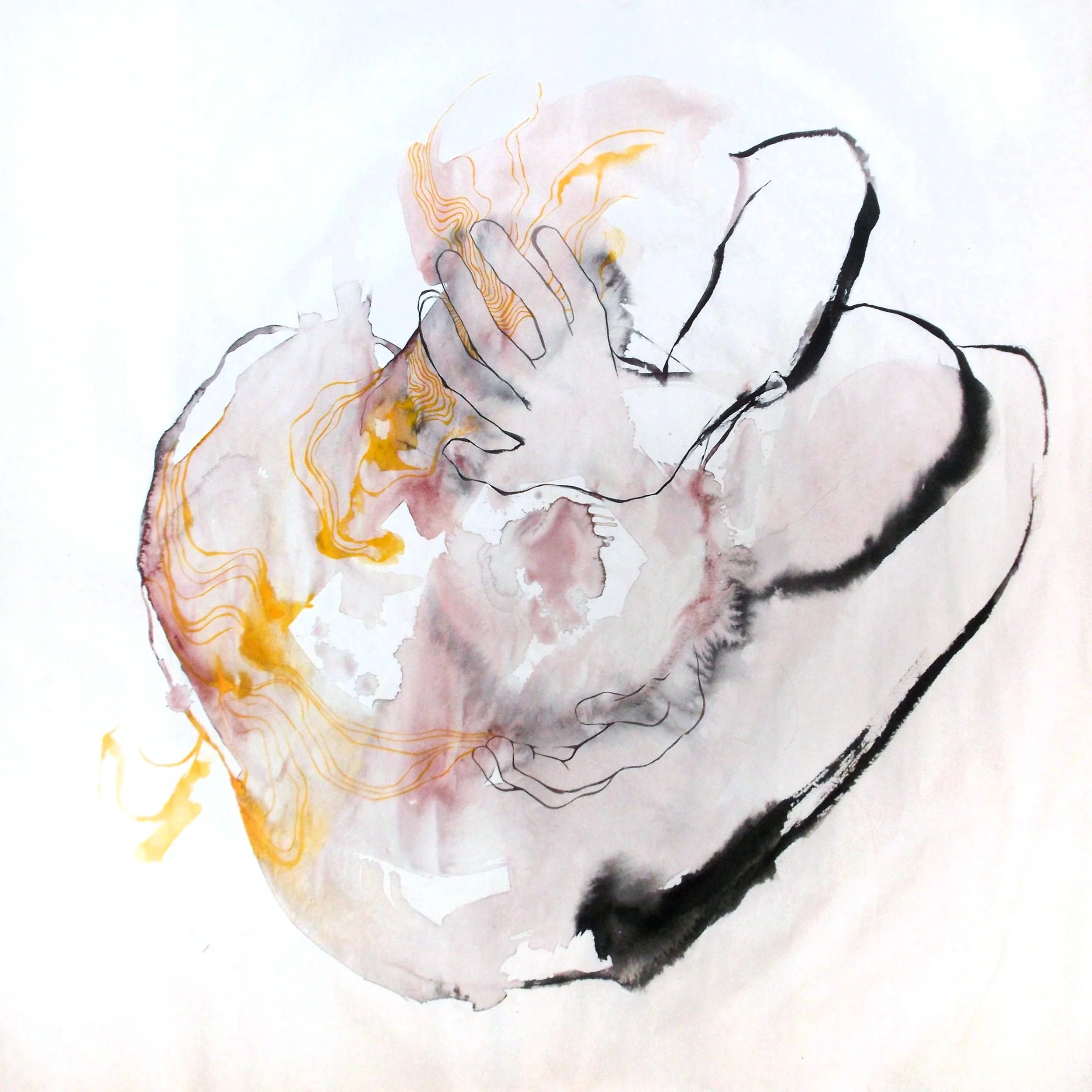
Isabel Lu, from a series of studies in ink, iron oxide, and watercolor on paper.
Image description: The outline of a crouching figure seen from above, with arms and hands encircling their head, rendered in fine lines of black, yellow, and sienna, shadowed with washes against a white ground.
9.
I have yet to visit her grave for my own illnesses make it near impossible to travel. I have yet to set out dduk, fruit, and plates upon plates of other offerings for our holidays, to invite and honor her and other ancestors. Maybe I follow in the footsteps of my parents who never did practice this rite in my childhood home, but rather only when they reentered the borders of Korea, which leaves me feeling clumsy to reach for tradition. As an adult now, though, the choice to relearn falls on me. Parts of me are embarrassed to pluck a tradition from its home, as if I were a tourist to my own life.
I wonder aloud and what returns is stillness, no one is here to answer: what is it to mourn, then? How do I choose to honor ancestors, when I am not certain of the status of our relationship, of our love? What do I make of the grief of not ever truly knowing someone? What is it that I carry forth from here? How do I live the rest of my disabled life? But I lay in a bed of excuses hold me from starting. I wait for the right time and right place, but there are none to be found.
I know the world would have hated my halmoni, the world does hate her, it makes that much clear. The world would have wished her institutionalization, out of sight for their comfort, her death. So I wish her the resources that she would have needed to have felt cared for. I wish her a world that wasn’t hellbent on imperial wars and necropolitics. I wish her abundance, from which she could have drawn upon to have and make generous choices, I wish the world to be endeared to people in her position, now, instead of committing to nihilism as is the easy thing to do when one has been disappointed repeatedly. I wish for renewal, might we always transform and become again, in our relationships. I wish for her survival, I wish for more time. I wish her love, too, and hope more of it might trickle down.
Don’t we all deserve as much?
The time to start is always now.
Christina Lee (she/they) is a disabled and chronically ill Korean writer hibernating on Lenape land (Brooklyn) with her partner and senior rescue dog. She has been awarded generous fellowships by the Unexpected Shape Writing Academy, Abode Press, and VONA, and is an alum of the McCormack Writing Center Workshop. Her work has appeared or is forthcoming in Turning Leaf Journal, 8ball, New Menard Press, and more. Find her editing creative nonfiction with WE THE SOIL or at christinaylee.net.
*
Isabel Lu (http://isabel-lu.com) is an artist whose practice is grounded in experiences of the body, and holds a Masters of Public Health in Dietetics from the UNC Gillings School of Global Public Health, and a Bachelors of Science in Nutritional Science from Cornell University. Drawing on Western and Eastern perspectives and approaches, she grapples with assignments of value, binary categorizations, and diagnoses through painting, herbalism, zine-making, and community engagement, echoing the fluidity of Qi, body, and medicine.
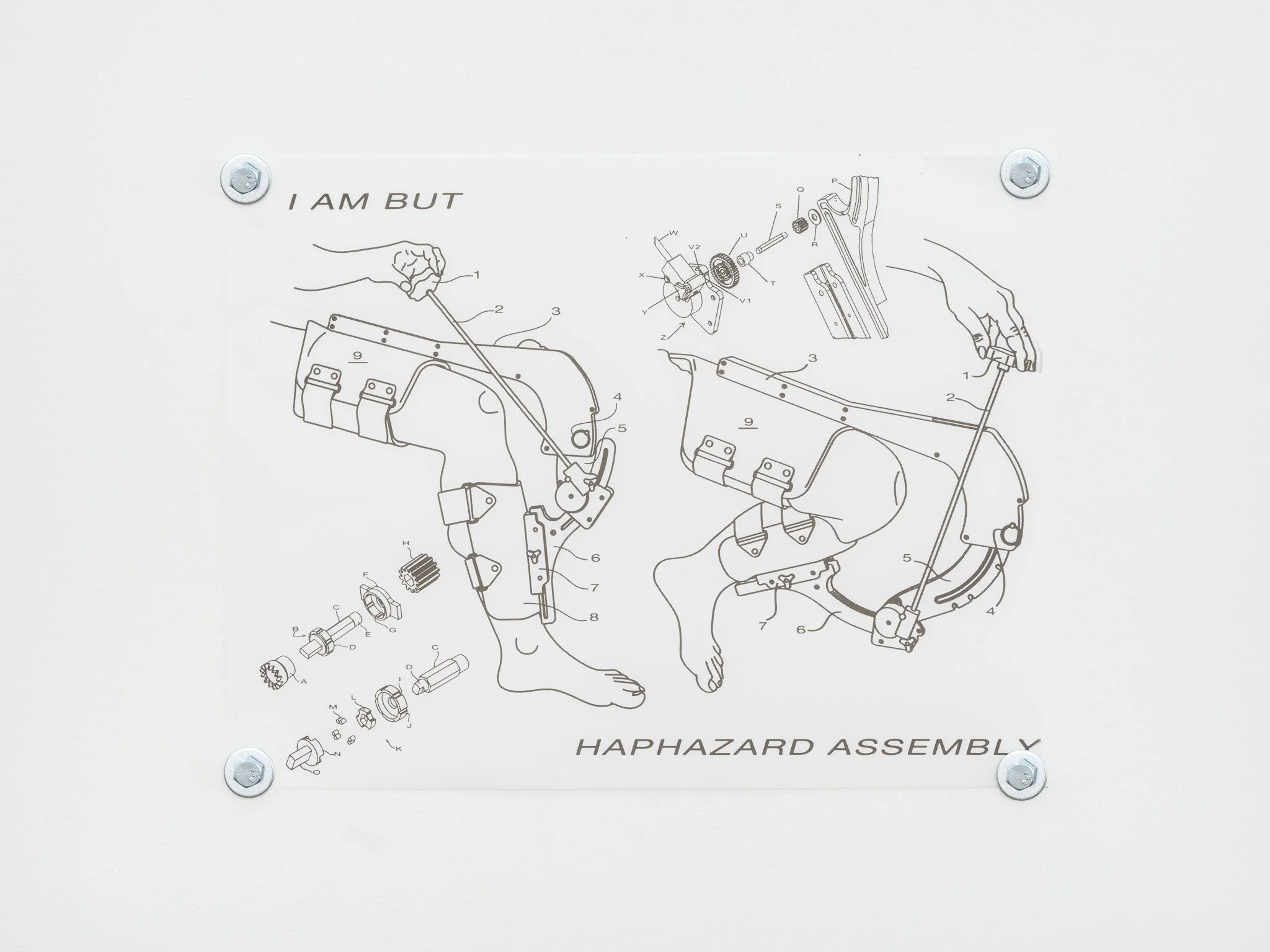
For Crip Time, Christina Lee writes movingly about her late grandmother and the forces which shape disabled lives.