FLARE-UP! AT THE FILM FEST
Respecting pain, rethinking productivity, and reclaiming my crip time
By NH Legaspi
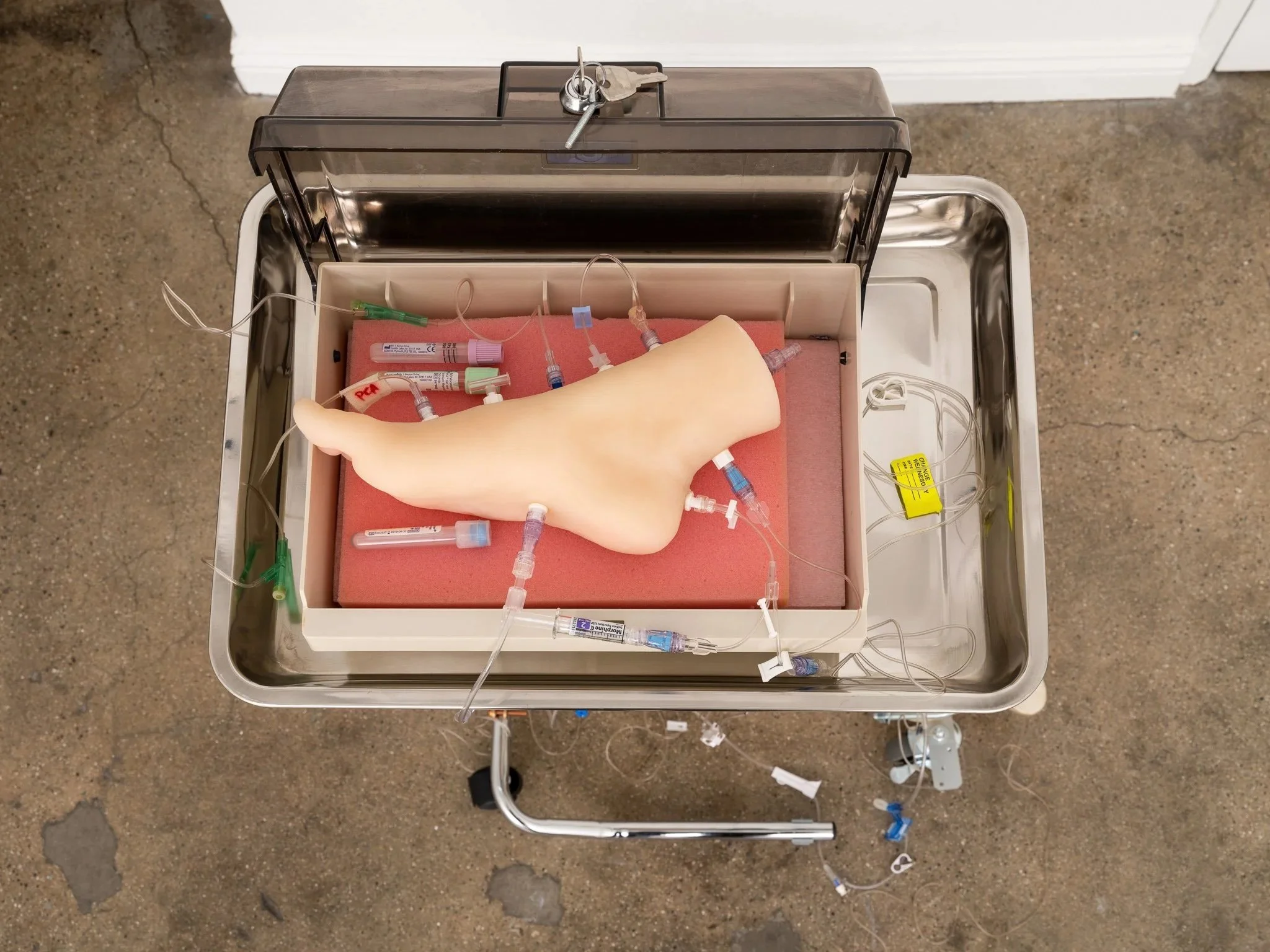
Panteha Abareshi, from This is Not A Body, a solo exhibition of work at Hunter Shaw Fine Art, Los Angeles, Spring 2022. Image courtesy of Ruben Diaz.
Image description: A flesh-toned plastic/rubber foot against pinkish-red packing foam, in an plastic case with its lid open, and placed in a stainless steel tray, seen from above, stuck all over with IV needles and clear plastic tubing.
I feel it again on a scalding Thursday morning in July, drowsy from sleeping past midnight to make another deadline and uncaffeinated to save me the heart palpitations, and I almost can't believe it. In the car heading to a European film festival at a university in my hometown Cagayan de Oro City (CDO), I instinctively cradle my left elbow. I say to my husband, who is driving, that my entire arm feels numb despite taking my nightly gabapentin. That it feels so heavy I think the only way I would ever feel better is if I could pop it out of my shoulder like the arm of a Barbie. It’s been almost ten years since I first felt this kind of nerve pain.
When the big pain returns, I make a mental list of the things that might have triggered it recently. Things I did, things that changed, things to blame for the heightened pain/numbness/tightness/all of the above crawling through the tips of my fingers to the back of my neck, which have received a slew of diagnoses since the pain first developed almost a decade ago: De Quervain's tenosynovitis, arthritis, then carpal tunnel, then repetitive strain injury, until eventually coming to a more accurate diagnosis after a spinal MRI—cervical radiculopathy, a pinched nerve in the spinal column along my neck. Three years ago, when I took on a hybrid job in the Manila office of a UK-based university press which involved traveling by plane between Manila and Cagayan de Oro, I started noticing a stiff pain in my shoulder blades that often felt like splitting wood and just never went away, another diagnosis followed: myofascial pain syndrome, a potential precursor to fibromyalgia.
Together, these two diagnoses dominate my life of chronic pain and somehow also influence my propensity towards pain in other parts of my body, resulting in various other aches and injuries. In the meme-like manner of how I titled this essay after the iconic band (and stuff of my teenage dreams) Panic! At The Disco, other such episodes include: Ankle Injury! At The Airport; Back Pain! At The Italian Restaurant; and a classic, Swollen Knee! At The Cinema.
I was living in Manila when the pain first began in early 2017. As a twenty-three-year-old graduate student of creative writing I was always looking for gigs to jumpstart my dream career in book publishing and sustain my ukay-ukay (secondhand shopping) habit. I took on a high-volume encoding project, confident in my typing skills (since I’ve been a writer all my life) and blissfully unaware of concepts like ergonomics and optical character recognition. I’d always had bad posture even as a child, somehow a byproduct of my being taller than most of my friends and having a particularly sleepy core. When I'm in a hyperfocused state I often forget to take breaks or even check how deeply I've curved my back, and finding out only after emerging from a productive haze that I've been sitting in the same hunched position (that is, to quote Megan J. Kaleita’s essay on being a writer with chronic pain, “like a fucking gargoyle”) for hours.
In retrospect, these factors were the perfect storm to produce the “wear and tear” so often cited by physical and occupational therapists dealing with my case. In one of my earliest doctor's visits I showed up with my upper left body covered in Salonpas and my left arm in a sling because I legitimately thought it was about to fall off, and the doctor thought I had broken it. Then came the different prescriptions, learning once on a very wobbly unassisted walk to the hospital that muscle relaxants were definitely not for me, until I was given a combination of drugs that my body liked enough for me to take daily. Because I was often compensating for what my left hand couldn't do with my right, the pain in my non-dominant hand soon followed. Then I needed to wear wrist splints on both hands. Since then, the splints and meds seem to have kept this very specific pain and the very specific need for an arm sling at bay. Some days, when I'm revisited by the delusion that I might get better, I skip some of my medications thinking that I don't need them anymore; this almost always comes back to bite me with varying degrees of force, but like a martyr I fantasize, I daydream, I hope.
✴✴✴
A flare-up can look different for every person who lives with chronic pain. Repetitive, fine motor movements—such as typing short phrases on a standard keyboard, writing with a pen, extended use of my smartphone, prolonged deskwork, or using a small Allen wrench to assemble flat-pack furniture from Shopee—are the usual suspects behind any pain level that goes beyond my daily two on the scale. Stress, which is bad enough for my chronic pain but even worse for my PMOS (polyendocrine metabolic ovarian syndrome, formerly known as PCOS), is also a usual culprit.
The latest definition of pain by the International Association for the Study of Pain is: “An unpleasant sensory and emotional experience associated with, or resembling that associated with, actual or potential tissue damage.” Chronic pain is often defined as any pain that persists almost daily for more than three to six months. As months turned to years, I still imagined that someday I would recover, that there would be a certain magical day where I would wake up and be able to type my heart out on a keyboard with zero pain. There seemed to be so much shame in admitting that I was indeed someone with a disability, despite all the evidence of it I had accumulated over time.
I would apply for a person with disability (PWD) ID card and the disability benefits that come with it in 2023, the year of my thirtieth birthday. Every city or municipal government in the Philippines has their own process for registering and creating these plastic ID cards for people with disabilities, and their own designs—CDO’s process is relatively more convenient as it can be applied for online, and its design has a stretched image of the city hall as its background—but every ID card says VALID ANYWHERE IN THE PHILIPPINES. With the ID, a person gets priority boarding on planes, priority service in commercial establishments, value-added-tax exemptions, and discounts on hotels, transportation, movies and cultural sites, medical services and treatments, food, groceries, medications, even some spa treatments—the PWD simply has to present it at the cashier. Because of these benefits, producing and using fake PWD ID cards has run rampant in the Philippines; cards that often take weeks to process at local government offices are easily available to purchase online. In response, food and beverage establishments have placards on their checkout counters saying: “No to fake PWD cards. Help us protect the exclusive rights of our real PWDs.”
Because of my hesitance to wear splints outside of work and home, and because without them I pass for abled, I often feel that I'm being sized up and assessed by people when they see me waiting at priority lanes. Once when I was lining up for priority boarding alone at the airport flying out from CDO, an older person behind me pointedly muttered, “Isn’t this line supposed to be for seniors and PWDs only?” In the priority train car for senior citizens, PWDs, and parents traveling with children in Manila, the train patrol guard walked in and saw me (a young woman, alone, with no children), and looked at me from head to foot, as if trying to determine why I was there and looking for a reason to kick me out of the priority car. I had left my card in a different bag and had to find a tidy way to explain why I deserved to be in the priority car, and not the often packed ones for women or the full-to-the-brim ones for the general population. Trying my best to conceal my panic, in defeat I could only tell the guard, May diperensiya po sa kamay—there is something wrong with my hands.
Because of this constant feeling of being watched when lined up without my splints or the occasional walking stick or wheelchair, I often wonder whether I need to perform my disability more, if I need to “look” more disabled in their eyes for me to warrant their compassion and understanding, to look like a “real PWD.” At the height of the crackdown against fake PWD IDs in 2025, I would often see business-owning acquaintances posting their harangue about people who use PWD IDs and the minuscule amount shouldered by the government in comparison to the larger cuts absorbed by restaurants which eat away at their profit, alongside Reddit threads about people with disabilities who are questioned about and refused discounts despite their legitimate cards. I didn't want to constantly prove my disability to get these benefits, but instead of fighting early on I chose to shrink away and just avoid using my PWD ID at restaurants.
At lunch on my thirty-third birthday in Manila with my husband, I presented my ID for the usual discount. The waiter later returned my card and said they couldn’t find me on the Department of Health’s national database for PWDs and that I should just ask kung saan ko pinagawa—wherever I got it made. The rejection stung, and the pressure to “present” as disabled started bubbling up again. If my husband hadn’t been there to reassure me, I truly would have burst into tears. I tried my best not to take it personally; they probably meant to tell me to check with where I got it processed (that is, the local government unit that issued me this card) instead of where I supposedly got it fabricated (that is, implying that I got it illegally).
True enough, despite having this card and availing of its benefits for three years now, my PWD ID number does not yield any results on the DOH database. This may be a result of the inconsistent processes across different local government units across the Philippines, even down to the sequence of numbers that constitute a PWD ID number, which DOH clarified in a report by PhilStar on PWDs not found on the DOH registry should be “RR-PPMM-BBB-NNNNNNN, where the first two digits represent the region code, followed by the provincial code, municipality and barangay codes, and finally the seven-digit sequential code.” My PWD ID does not contain my barangay (loosely, a village or borough) code, and when I tried supplying it on the database, the supposed completed sequence of numbers still did not return any results.
I presented my card the very same night out to dinner at a different restaurant, and they gave me the discount without question.
✴✴✴
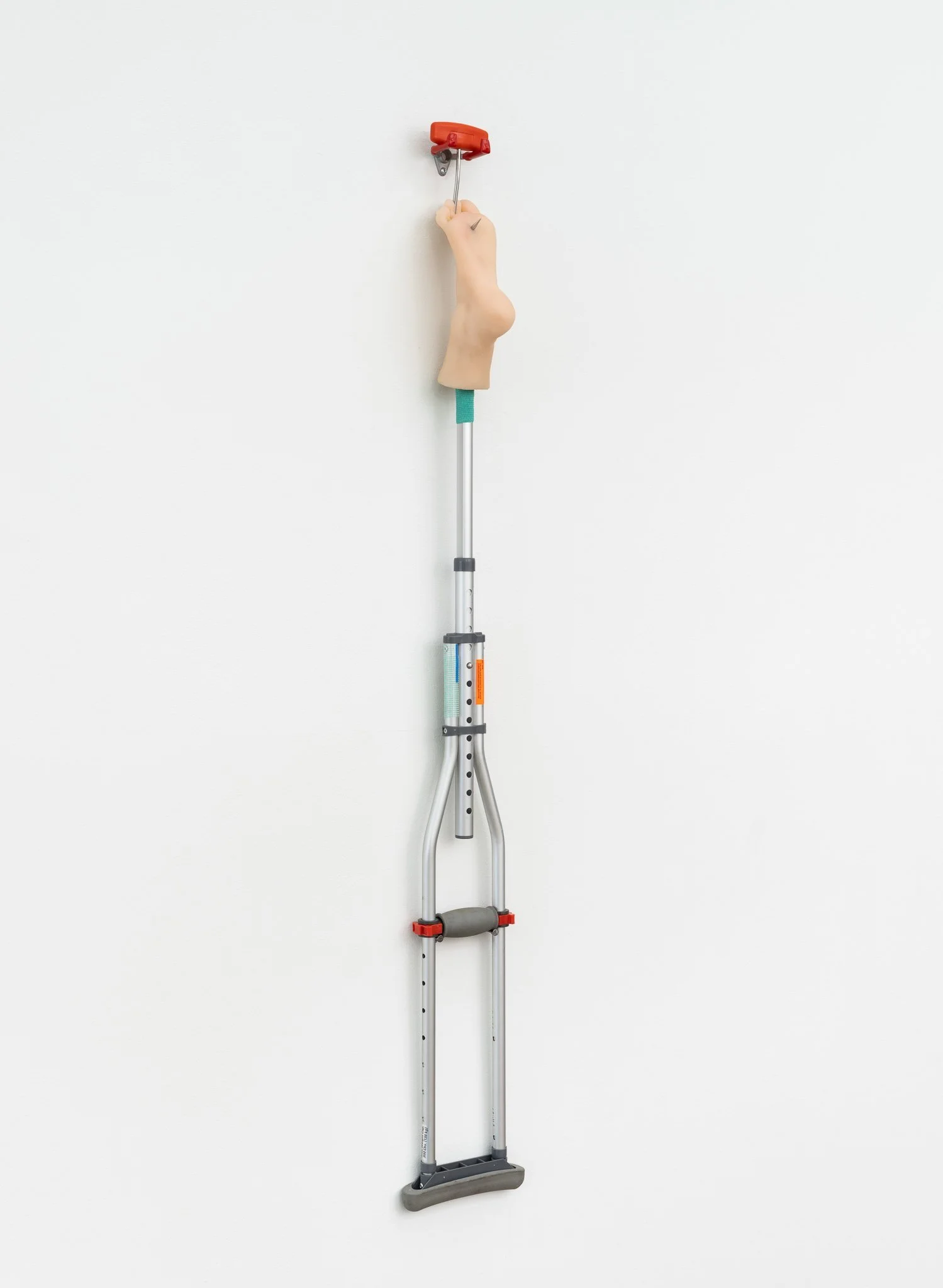
Panteha Abareshi, from This is Not A Body, a solo exhibition of work at Hunter Shaw Fine Art, Los Angeles, Spring 2022. Image courtesy of Ruben Diaz.
Image description: A flesh-toned plastic/rubber foot hung on the wall, suspended from and pierced by a giant fishhook, a metal hospital crutch protruding from the ankle.
The pain from 2017 that returned on the second day of this film festival in 2026 was shockingly yet distantly familiar, like a bout of déjà vu, but the process of self-blame came naturally: it was my own fault because I wasn't sleeping well, I wasn't keeping up with my exercises, I hadn't soaked my hands in months. I had gotten a massage the previous week and was too groggy to tell the masseuse not to press on my wrist and my hands felt numb since then. I'd been eating too much red meat and dairy, which is said to contribute to flare-ups. After months of complaining about my slow and bloated desktop setup, my husband bought me a new laptop and it boosted my productivity because I could work at the dinner table. I used it to finish up (by that I mean cram) a freelance project the night before my flare-up, using my middle and ring fingers to rapidly scroll through the document using the laptop’s trackpad, wary that if I used my middle and fore fingers it would bend my wrist, and this led to another tingling and numb feeling in my wrist. Then came the giant pain the next day. I'd learned since then to cover my trackpad and use it as little as possible, in favor of my ergonomic mouse’s roller or simply using a keyboard shortcut. It's usually not one single thing that causes a flare-up, but it's often more convenient for me to explain to people using a single cause; in this case, I blamed the new laptop.
Except for the splints I wear to sleep and the other pair I wear when I work at home or in office settings, it’s been years since I've needed to wear my splints out in public. Aside from the tropical temperatures (heat index of 42°C on that Thursday) utterly inhospitable for wearing splints that go up to my forearm (to say nothing of the restrictive posture correctors I should be using but cannot stand how sweaty I get wearing), I've never been a fan of explaining to people why I have them on or being stared at for wearing them. Since we were already out of the house and we would miss the festival if we went back home, my husband and I rushed to a nearby drugstore to buy a temporary splint. They didn't have any in stock, so instead we bought elastic bandages that my husband wrapped around my left arm. I briefly considered buying a sling, but I was wrestling with myself about whether I wanted to be stared at by students at the film fest, or worse, have to explain if I ran into an acquaintance. The heat and my insecurity won.
Nothing good ever comes out of explaining why I wear my splints; the truth is far too long-winded and truncated, often rushed explanations feel too trivial. Though sometimes, they can be comical: I don't remember what question I answered from an Indian man who once approached me at a cafe in Manila pointing at my splints, but when I mentioned I was a writer his face lit up and he told he said he was a writer too, and when I thought he asked me, “What do you write?” I rambled on about how I wrote fiction about my hometown that was changing at breakneck speed, and in response he showed me a photo of a motorcycle on his phone. He thought I was a rider.
Most times, people are understanding. Sometimes I don't know what to do with their pitying looks or well-meaning but often repetitive advice, so I end up just assuring them that I will be fine. So as soon as I thought I had recovered enough to not need them when I was just out and about in the world and not working, I did away with them. But that Thursday, as I watched three films with my arm covered in Salonpas and wrapped in an elastic bandage in CDO, I thought about that morning at the doctor's office in Manila looking like I had a broken arm, terrified I had dropped back to square one.
✴✴✴
Through years of procedures and on-and-off physical therapy visits, the messaging has been clear: there is no cure for these kinds of conditions; only management of the pain. This of course means a consistent regimen of medications and supplements, physical therapy sessions and paraffin wax baths three times a week, twice-a-day exercises, daily warm soaks, a low-inflammation diet, and lots of rest.
Rest, which means eliminating my biggest trigger: work.
I’d dreamed of becoming a book worker since the day I saw Sarah Michelle Gellar on the 2007 movie Suburban Girl (an adaptation of two stories from Melissa Bank’s book A Girls’ Guide to Hunting and Fishing) walking through the streets of New York City carrying a coffee cup and pencil in one hand and a manuscript on the other, occasionally scribbling on the papers on the way to her Manhattan office. It was the summer after I finished grade school and pirated DVDs went unchecked in the city, and this was one of the movies my parents had brought home. Knowing then only of jobs related to my father being a doctor and my mother being an accountant, I watched slack-jawed as I discovered that my favorite pastime (reading books) and my favorite activities (word search puzzles and copyediting at local student press contests) could be something I might do for a living. The dream eventually expanded to having a publishing house of my own one day.
I learned from an early age that there was much value and leverage to be gained from my achievements. When I was younger it meant getting prizes from my parents and avoiding getting scolded (getting a scholarship in my private high school for graduating salutatorian in grade school was an added bonus), and in my teens it meant earning their trust to pursue extracurricular work and going out with friends as long as I kept my grades up. In school and after, I learned to handle several projects and assignments at once, and balancing that with extracurricular work and a social life. In the corporate world they would call this the ability to multitask, being a self-starter, and needing minimal supervision to handle work. I was eager to please, a workaholic, a team player, a pleasure to have in class and at work. I wish I could say this kind of background makes me an effective and disciplined worker, but in truth I am a champion procrastinator and would often avoid one project by working on another, spinning as many metaphorical plates as I could before coming back to finish the intended task just as they were all about to fall and shatter on the ground. My excuse for this is that if left to my own devices, if I miraculously didn't have such a massive backlog, if there were no alarms or calendar reminders, I would revert to my ideal state: bedrotting the days away while playing cozy farming sims.
Productivity, and the validation and praise I was given for a job well done, plus my very real passion for becoming a publisher, kept me going. In 2017, I thought very little of that would change when the pain came—or at least, I was determined that very little would change, at the expense of my own wellbeing.
I had to enlist the help of my then-boyfriend (now husband) to complete that encoding project. I just barely made it through my graduate coursework and was gearing up for writing my graduate thesis when I entered a foggy, depression-like state of lethargy and constant questioning about whether I could call myself a writer if I couldn't even physically write. Had this been the age before computer technology I would have had to hire a scribe, but realistically I would never have had the resources for that. It was a great slog to use the speech-to-text software on my computer and have it learn my voice; that software wasn't quite as sophisticated on smartphones back then as it is today, and it’s a struggle even as I write this now.
I've always been able to organize my thoughts better by writing them down, and when the pain was at its peak, I couldn't even put pen to paper. I was always able to figure out what I wanted to write as I was writing it (to badly paraphrase an oft-quoted Joan Didion line), but in speaking, one is always expected to have a fully-formed idea in their mind before they articulate with their mouths—something entirely incompatible with the act of creative writing. The constant stops and starts made it near impossible to enter the flow states that I was so dependent on with my writing. And because the only language I speak that the speech-to-text software at the time could process is English, writing even just words or short phrases in my native language was off the table (I would happily discover in the writing of this essay that Google Docs speech-to-text is getting better at transcribing Cebuano-Binisaya).
This resulted in a hesitation more intense than any kind of writer’s block: a second-guessing of words before they are even formed, before they even get the chance to be written or erased. This, to say nothing of the constant errors and glitches that I encounter in the transcribing of the words that I have rehearsed over and again in my mind, only for them to come out incorrectly due to the limitations of the software in interpreting my borrowed tongue, and the physical toll of speaking, most of the time yelling, into an uncooperative device.
My first attempts at voice-typing short stories were so poor I began avoiding writing completely, opting instead to work full-time as a junior editor for an academic press in Manila. I spent two years of the pandemic alone and realized I was slowly forgetting the city I was writing my stories about, so I decided to put my publishing career on pause to go home to Cagayan de Oro City and finish writing my graduate thesis. Through the support of my family and a combination of voice typing, glide-typing, perusing the suggestion strips on a Google keyboard, and the sheer physical work of it all, I managed to finish writing ten short stories and the accompanying critical introduction in 2023. By July that year I would finish my degree and in November I would find out that my manuscript was accepted for publication. In early 2025, my book was put out in the world. Around the same time the book was released, I established an indie micropress in CDO.
I haven't written anything of substance since.
Just as I watched that last sentence get written after I spoke it, I stopped myself. I take a beat to think about the past few years and realize that I've written and published six flash-fiction pieces, the beginnings of a historical novel I got the idea for while I was writing my thesis, an English translation of one of my husband's novels, and this essay. I have to get better at remembering the things I've done. I have to get better at remembering that I have never once stopped writing, that I will probably keep writing until my throat is raw.
✴✴✴
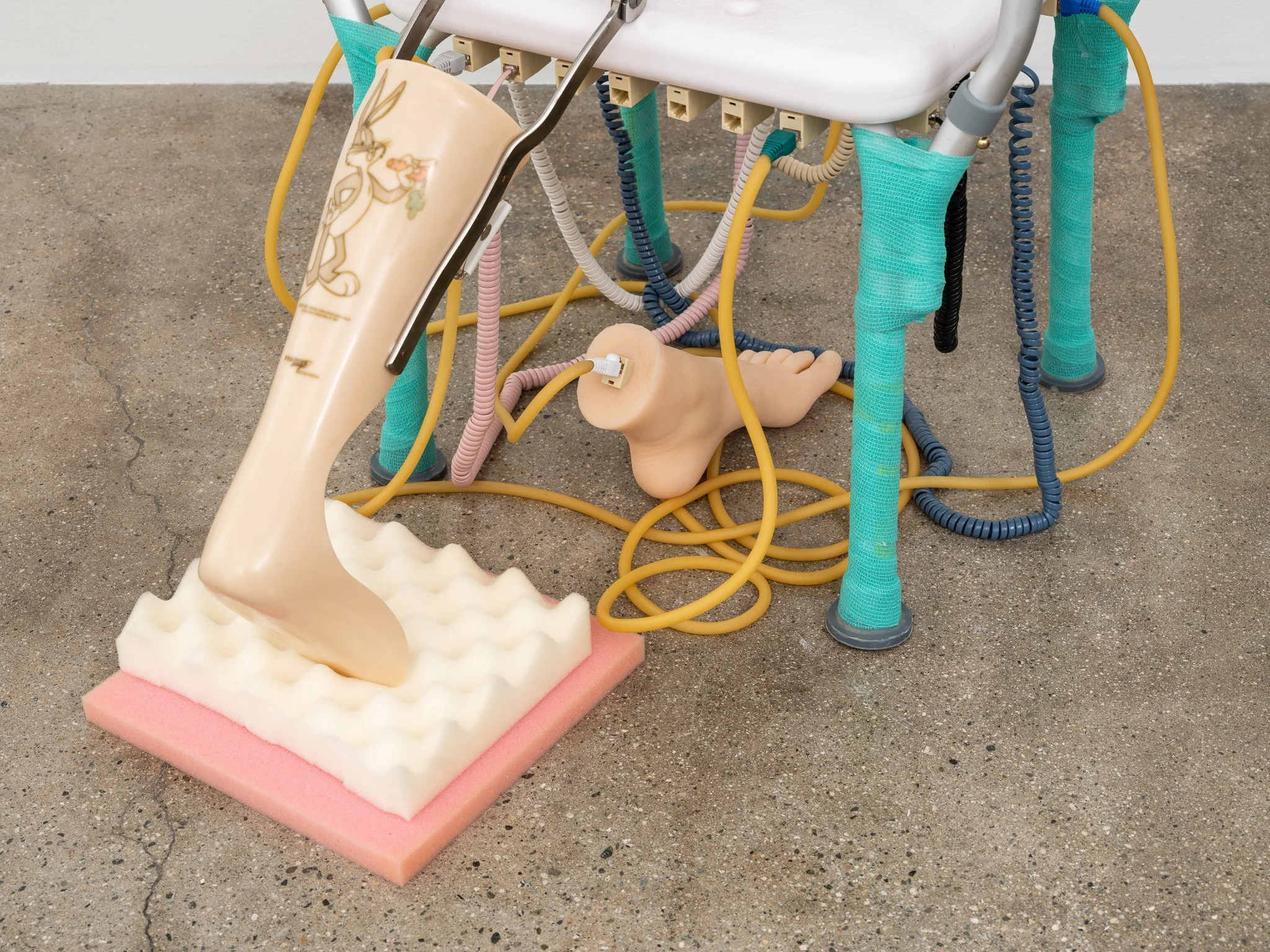
Panteha Abareshi, from This is Not A Body, a solo exhibition of work at Hunter Shaw Fine Art, Los Angeles, Spring 2022. Image courtesy of Ruben Diaz.
Image description: flesh-toned plastic/rubber foot and calf, with a cartoon of Bugs Bunny eating a carrot is drawn on its calf, its toes buried in white and pink packing foam on the floor. The upper calf is bolted on either side with a metal leg brace and connected to a small plastic hospital chair-contraption exuding yellow rubber tubing and grey telephone-cord. The chair legs are bound with green grip tape and another rubber foot connected to the tubing is poised beneath the chair.
Because I have such a short memory, I often hyperfixate and overwork myself on a project, finish it swimmingly, then completely forget about it and move on to the next one. After forcing myself to rest, with profuse apologies for all the projects getting delayed because of it, and just allowing myself to enjoy the films at the festival, it dawned on me that this flare-up came in the wake of an extremely busy halfway mark of 2026: manually producing six different book titles for and participating in six book fairs the across the country, co-organizing a region-wide zine fest in CDO, then in one book fair in my city running on just a single hour of sleep because of issues in the production of a book that I mostly produced, printed, cut and bound by myself, among other speaking engagements I had for the fair and beyond. Namawi akong lawas (my body settled the debt), I tell my friends and the people I owe work to. My body saw the chance to break down and took it.
My friends in our local writers collective in CDO and I have become steady fixtures in the writing community in our city, organizing poetry nights and writing workshops and producing journal issues for over eleven years now. My micropress keeps me busy. I will start teaching again soon. Still and all, I love making things with my hands, and have recently gotten into junk journaling. I quite literally have my hands full, but inspired by the work of Leah Lakshmi Piepzna-Samarasinha and many disability justice organizers as she shares about in her book The Future is Disabled (2022), I can't help but wonder whether such a community exists in Cagayan de Oro City. I’m fully aware that if such a community doesn't yet exist, I must be one of the people to start it. There was a time that I was reticent about embracing my disability, initially thinking that I didn’t want to be defined by the things that I couldn't do, but by the things I could. But what would be so bad about being called a disabled writer? Why do I always seem to find reasons to get in my own way?
In the pivotal essay “The Pain Scale” by Eula Biss, she writes: “Assigning a value to my pain has never ceased to feel like a political act.” Survival and resilience are so embedded in Filipino culture that I often am compelled to think about the pain of people who don't have the privileges I have, and therefore I shouldn't complain or think that I need to change anything because of my condition, because I pass for abled, because I have such a strong support system and I'm ridiculously privileged to have a husband and parents and a family that supports me. But this flare-up shifted something in me that felt long overdue.
I took a week off from freelance projects and making books and watched thirteen lovely films from across Europe. I wore my splints out in the wild. I did nerve gliding exercises again. I scrolled through an ungodly amount of listings on Carousell looking for the perfect toiletry pouch for when I teach again. I began to acknowledge that the very notion of productivity, going business-as-usual and ignoring my pain, and my toxic habit of often even brushing aside my disability when I was feeling relatively well and only taking care of myself when I get a flare-up, was actually my internalized ableism and my fear of losing relevance and validation without my achievements. That I’ve tied too much of my own value to the things I can accomplish, so I lost sight of the fact that I can be appreciated for who I simply am—whoever that is.
My voice is cracking. I need a break.
✴✴✴
When I worked as an associate content editor for a UK-based online education publisher in Manila, I was introduced to the concept of digital accessibility. It would be the first job where I disclosed my disability, and rather than feeling alienated for it as I had feared (hence taking so long to disclose it in my career), I was given accommodations for my condition. It was there I would learn the ropes of creating online learning content with various access needs in mind, and meet many wonderful people and fellow advocates. The strain of traveling between CDO and Manila took its toll on me after two years, but now as an educator myself in my alma mater, I try to champion digital accessibility in all the subjects I teach. I now know that I need to be more forthcoming in disclosing my own disability, so my students will feel empowered in choosing to disclose their own.
As I recovered from my flare-up, I began apologizing less and explaining more. I unabashedly cancelled plans and made more realistic ones. I thought of the people around me who make me feel less alone. I thought about my former colleague G, an AK amputee, when she visited me here in Northern Mindanao and we travelled through Bukidnon together with my husband and laughed through the steep forty-minute habal-habal (single motorcycle) ride through rough terrain to arrive at a majestic mountain peak, and her relief that I brought my walking stick just in case she or I needed it. I think of my friend F who also works in publishing and is starting to get treatment for pain in his wrist, and us both realizing that the real way to not be in so much pain is to just be constantly on vacation. I think of another friend L who partially tore his ACL and had to work from home because his brutalist office building didn't have elevator access, and the conversations we had about just how long the Philippines has to go to achieve accessibility for all. I think of my husband M, a novelist who lives with dyslexia and a middle-ear disorder, and how we build a life together with our different access needs. And most of all I think of C, whom we lost to Crohn’s disease in 2025, and how much more time we could have had together as colleagues-turned-friends, swapping stories of our crip struggles and advocating for each other. And I remember again the student occupational therapist I saw in 2017 who first called my condition cumulative trauma disorder and told me that when the pain comes, one should respect what it has to say.
And so I listened. On a recent family trip to Camiguin, our accommodations had limited cell signal and dodgy Wi-Fi. It was an invitation to use my phone less, and true enough, on vacation there was very little hand pain, no work devices, no fine movements. I took this chance to rest so seriously that it quickly became a project that I toyed with calling Relaxation! At the Villa. My jaw was unclenched, my back relaxed, and my core surprisingly stable from belly laughs and kicking my legs while swimming with a giant sea turtle we immediately named George. Somewhere above the deep blue around Mantigue Island, I realized there is still more work to be done, but there is no rush. I know all I have is time.
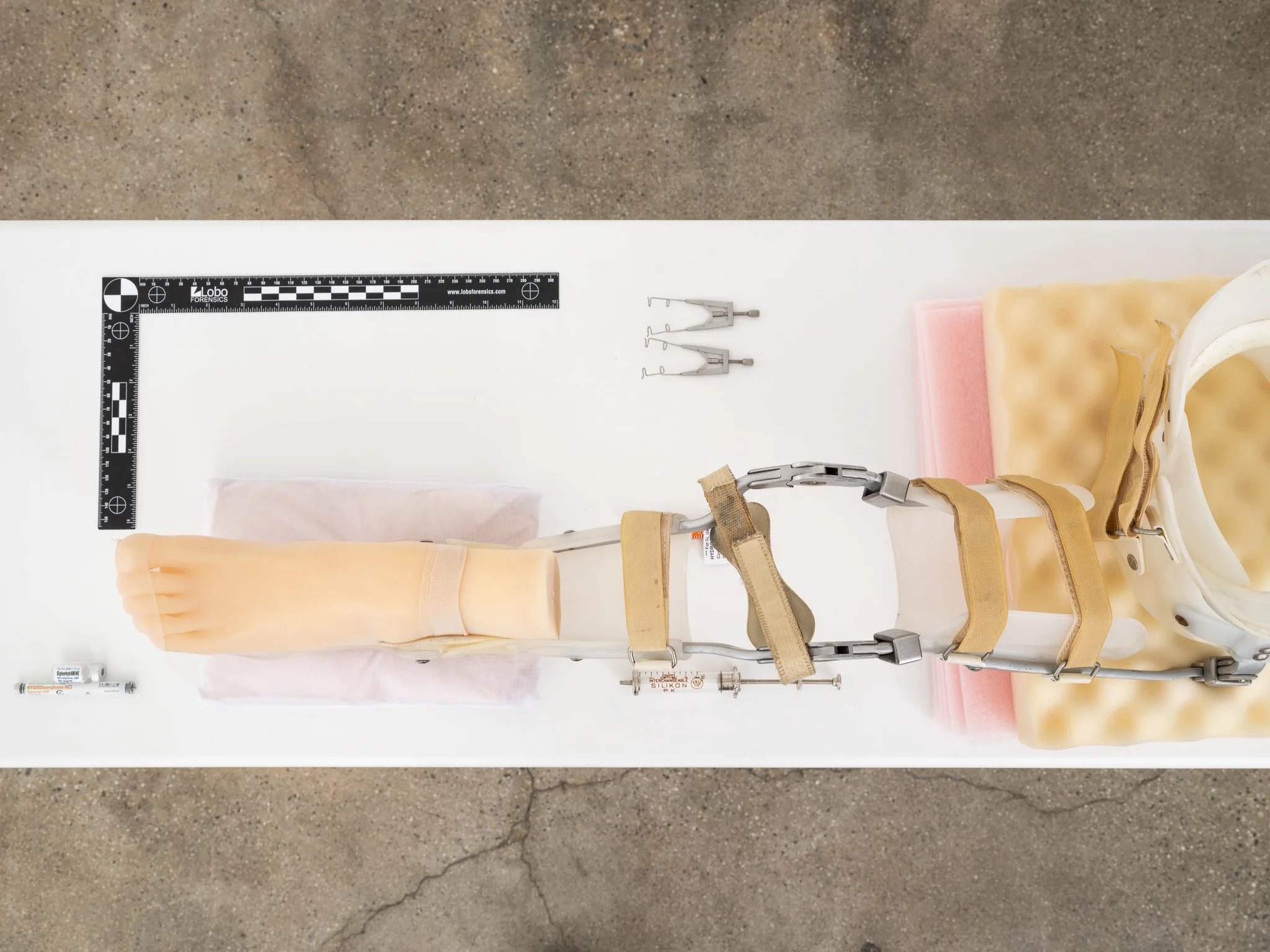
Panteha Abareshi, from This is Not A Body, a solo exhibition of work at Hunter Shaw Fine Art, Los Angeles, Spring 2022. Image courtesy of Ruben Diaz.
Image description: Seen from above, a flesh-toned plastic/rubber foot clad in a sheer sock, is bolted to a metal leg brace on a white rectangle with beige and pink padding and packing foam. A carpenter’s square and small metal calipers are placed along its length.
Works Cited
Biss, Eula. “The Pain Scale.” The Best Creative Nonfiction, vol. 1, no. 32, 2007, pp. 65-84.
Flores, Dominique Nicole. “Is your PWD ID in the DOH registry? Here's what to do.” Philstar Global, https://www.philstar.com/headlines/2025/01/08/2412773/your-pwd-id-doh-registry-heres-what-do.
“PWD National Database.” Department of Health (Philippines), https://pwd.doh.gov.ph/.
“Huladrx.” Instagram, https://www.instagram.com/huladrx/.
Kaleita, Megan J. “Writing with Chronic Pain.” Litreactor, https://litreactor.com/columns/writing-with-chronic-pain/.
Legaspi, NH. The Fireline: Stories from Cagayan de Oro. The University of the Philippines Press, 2024.
“Nagkahiusang Magsusulat sa Cagayan de Oro.” Facebook, https://www.facebook.com/cdopoetrynight.
“Papel-Papel PH.” Papel-Papel PH, https://www.papelpapelph.com/.
Piepzna-Samarasinha, Leah Lakshmi. The Future Is Disabled: Prophecies, Love Notes and Mourning Songs. Arsenal Pulp Press, 2022.
Raja SN, Carr DB, Cohen M, Finnerup NB, Flor H, Gibson S, Keefe FJ, Mogil JS, Ringkamp M, Sluka KA, Song XJ, Stevens B, Sullivan MD, Tutelman PR, Ushida T, Vader K. “The revised International Association for the Study of Pain definition of pain: concepts, challenges, and compromises.” Pain, vol. 161, no. 9, 2020. doi: 10.1097/j.pain.0000000000001939.
NH Legaspi is an author, translator, and publisher from Cagayan de Oro City. She holds a bachelor’s degree in English from Xavier University–Ateneo de Cagayan and a master’s degree in creative writing from the University of the Philippines Diliman. She is the founder of Papel-Papel Publishing OPC, an independent micropress in CDO. Her first book, The Fireline: Stories from Cagayan de Oro, was published by the University of the Philippines Press in 2024 and was a finalist for the 25th Madrigal-Gonzalez Best First Book Award and Best Book of Short Fiction in English at the 43rd National Book Awards.
*
Panteha Abareshi's work is rooted in their existence as a chronically ill and disabled body contending with multiple medical illnesses, at the foundation of which is sickle cell zero beta thalassemia, a progressive genetic blood disorder that causes debilitating pain and bodily deterioration. Abareshi confronts the able-bodied gaze, and questions notions of consent within the dynamics of power, control and objectification between viewer and disabled body as subject to explore the complexities of living within a body that is highly monitored, constantly examined, and made to feel like a specimen. Lately, Abareshi is focusing on the disabled body as fetish object, conducting research into disabled sexuality and its representations within pornography and fetish materials. For more info visit: https://www.panteha.com
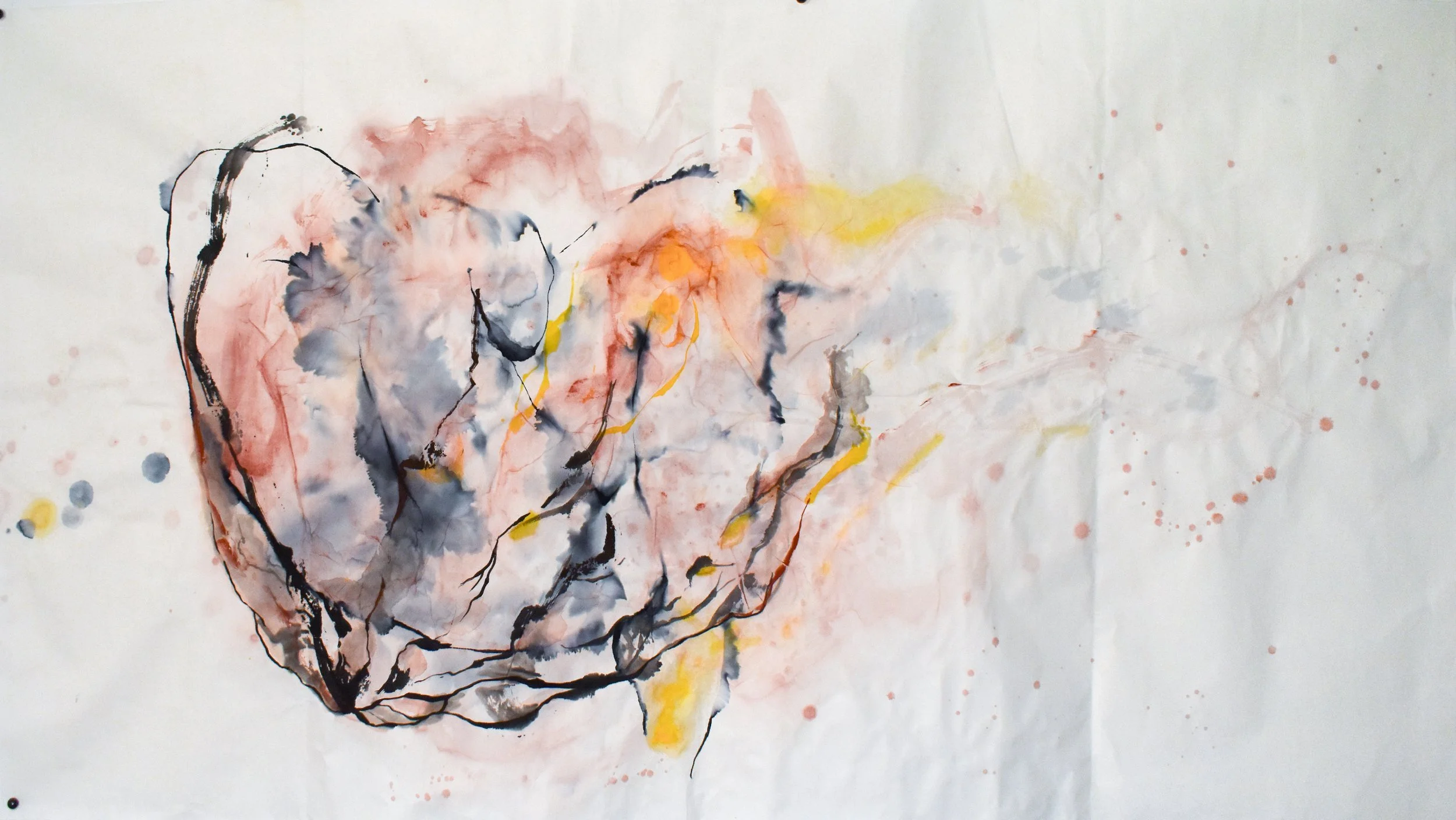
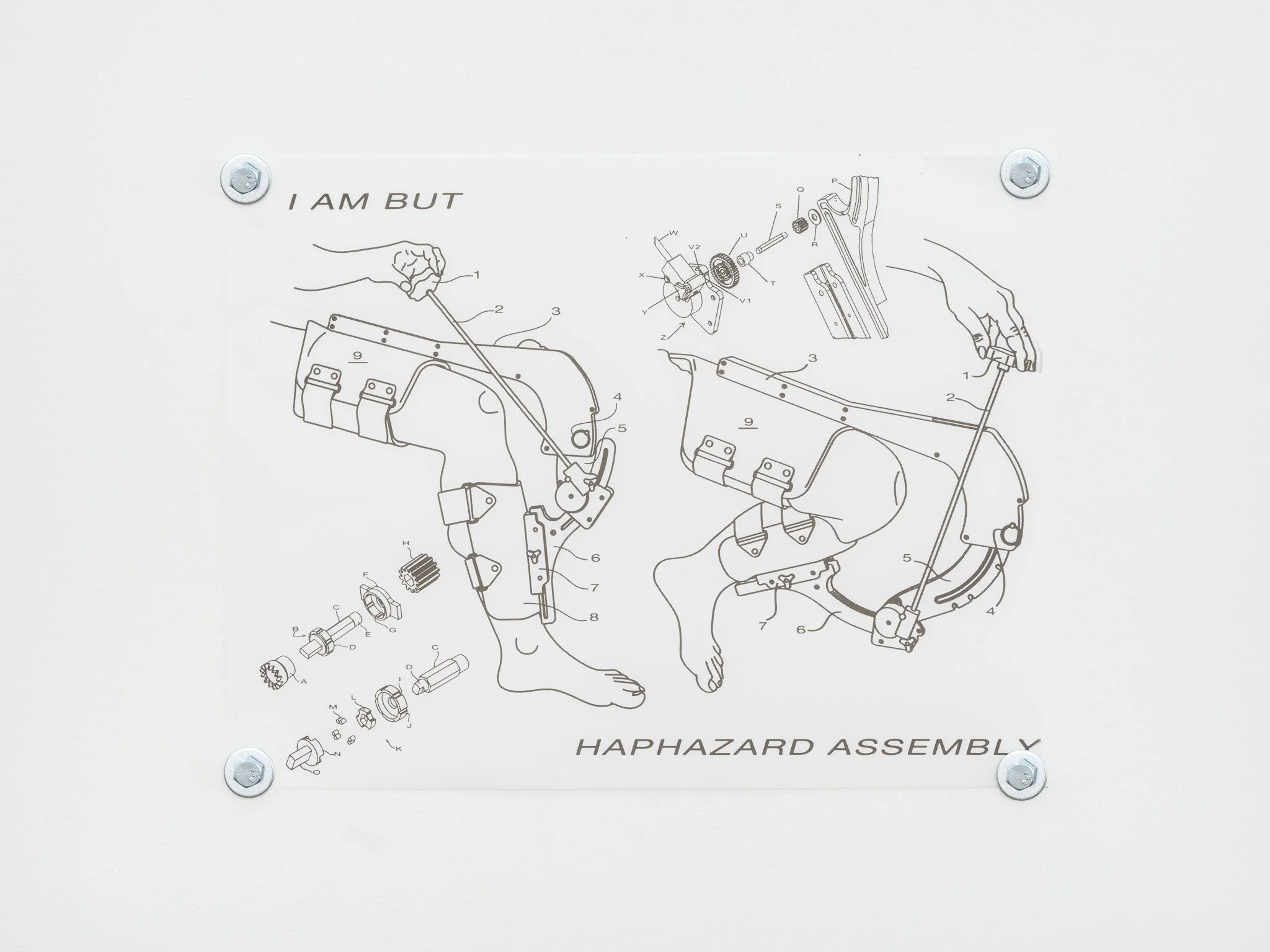
What does chronic pain say, or sing? An essay on adaptation and access by NH Legaspi for SUSPECT journal’s ‘Crip Time.’