
Editor’s Note for Crip Time
By Jack Xi
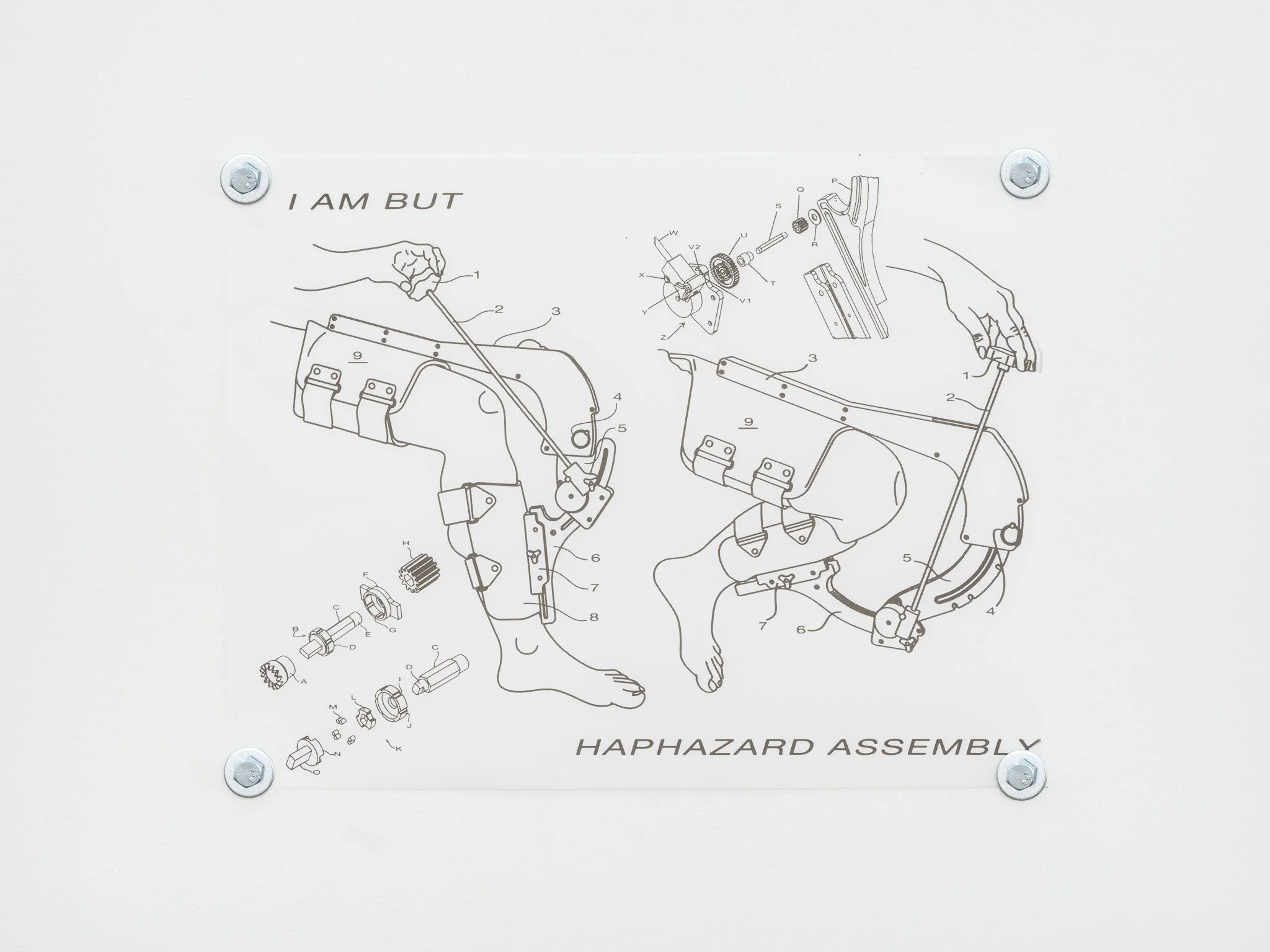
Panteha Abareshi, from This is Not Body, a solo exhibition of work at Hunter Shaw Fine Art, Los Angeles, Spring 2022. Image courtesy of Ruben Diaz.
Image description: Fine-line drawing on transparent vellum bolted to a wall of pale gray, depicting legs and braces, hands, bolts, and washers, ressembling a typical mechanical drawing instruction for assembly; the words I AM BUT HAPHAZARD ASSEMBLY appear in all caps and italics above and below
“Crip time” is a term widely used by disabled theorists and communities, with “crip” as in “cripple”, and “time” as in “I know this is past time for disability pride month in July, but we’re doing this anyway!” With no clear origin, crip time refers to the mismatch in time scales and lived experiences disabled people face compared to abled folks. A need for flexibility, extra time, or living out of step with abled expectations, crip time encompasses how time distends, explodes, freezes for disabled people. I experience this in planning routes around wheelchair access or what distance my body can walk, or in needing to cancel hangouts and stretch deadlines due to chronic pain flares. If you're another kind of disabled, you may experience this as long hospital stays or swaths of medical appointments creating absences and “delayed” milestones abled others cock their heads at. And if you're not disabled, you may experience crip time too – as a caregiver, masked and gloved, or once you age into or abruptly are conscripted into our ranks.
The disjoint between crip and nondisabled time points to wider disjoints in disabled and abled experiences. Where the medical model of disability presents disabled people’s bodies as the source of disability – and medical interventions or ultra-resilient supercrip positivity its sole cure – the social model of disability focuses on disability as arising from how structures around us are not built for us. As a non-ASL speaker can't recite a poem to others underwater, neither can a fish-out-of-water wheelchair user navigate a world of stairs. Crip time and disability aren’t purely located in the body, but are also externally imposed.
In proposing and editing this portfolio, I hoped to invoke the idea of crip time and foreground disabled experiences of time – what shapes that experience, and how different kinds of time can connect or contradict each other. I also hoped to create time for us to be heard, and to have disabling structures named for the breaking. After all, Scholar Alison Kafer describes crip time as not “bend[ing] disabled bodies and minds to meet the clock,” but “[bending] the clock to meet disabled bodies and minds.” (27). Amidst the urgent sense of time running out – for averting further degrees of future global warming, or for halting nuclear and superintelligence-induced doomsday clocks – we are also asked to burn ourselves out for others’ profit, merely to survive. As Jenny Odell points out in Saving Time, there is “a lonely absurdity in the idea of racing against the clock at the end of time.” (xvi). What can crip time teach us about bending time into a less painful shape?
Nisha Patel’s poem “the summer i laid down”, published alongside this essay, hauntingly connects crip time with those of other lives and timescales – how the same forest fire that “cuts the beetles off at the jaw” also “chokes us out,” questioning how institutional approaches to health and safety can fail or vulnerable communities.
Next week, you’ll see Christina Lee and Leigh Sugar’s family-themed works. While Leigh Sugar explores how disability connects and creates distance within a family, both in doctor’s appointments and in front of the TV, Christina Lee weaves between Lee's intergenerational experiences with theirs and their grandmother’s disabilities and the wider family and social power structures surrounding them.
Rob Colgate and NH Legaspi will then cover resilience and institutions; Colgate lyrically and cleanly laying out the pain of “perfecting” the queer, disabled body to another’s standards, Legaspi sharing her journey of acceptance, slowing down, and living with chronic pain – all while an ill-implemented disabled ID system mean trains and even restaurants can become hostile at the drop of a pin.
Closing off the portfolio, Jhani Randhawa’s interview of author and artist Khairani Barokka gives us insight into colonialism, crip time, and “counter-mapping” alternate forms of care as they discuss Barokka’s book Annah, Infinite (Tilted Axis Press, 2025).
Together, I hope these pieces show us how rethinking time, achievement, and standards of what is normal – for individuals, bodies, and business-as-usual – is worthwhile. That disability writing is more than “overcoming” stories, relegating disability to the futures of impossible cures or to uncomfortable, elided pasts. That – much like the curb-cut effect meaning ramps in curbs help people with baby strollers as much as it does wheelchair users – thinking with disabled ideas and timescales can help us address present, pressing questions of climate, labor, control, and care for disabled and nondisabled folks alike. We matter now; you matter now. Join us, late or waiting. You know it’s time.
Cited works
Kafer, Alison. Feminist, Queer, Crip. Indiana University Press, 2013.
Odell, Jenny. Saving Time. Random House Trade Paperbacks, 2024.
Panteha Abareshi's work is rooted in their existence as a chronically ill and disabled body contending with multiple medical illnesses, at the foundation of which is sickle cell zero beta thalassemia, a progressive genetic blood disorder that causes debilitating pain and bodily deterioration. Abareshi confronts the able-bodied gaze, and questions notions of consent within the dynamics of power, control and objectification between viewer and disabled body as subject to explore the complexities of living within a body that is highly monitored, constantly examined, and made to feel like a specimen. Lately, Abareshi is focusing on the disabled body as fetish object, conducting research into disabled sexuality and its representations within pornography and fetish materials. For more info visit: https://www.panteha.com
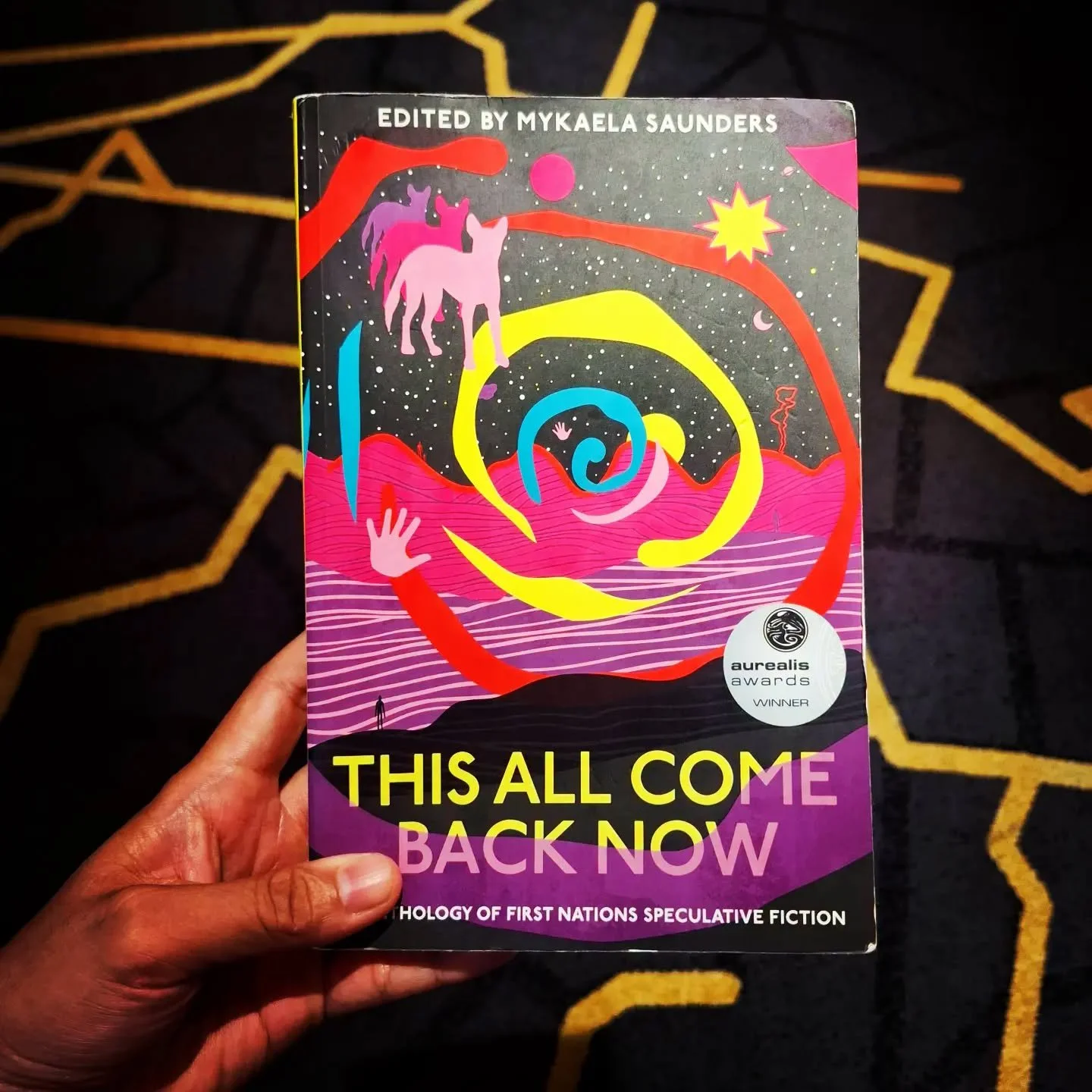
“a forest on fire cuts the beetles off at the jaw”. A crip ecology poem by Nisha Patel for Suspect’s “Crip Time” portfolio.