
Journey West
By Derick Chan
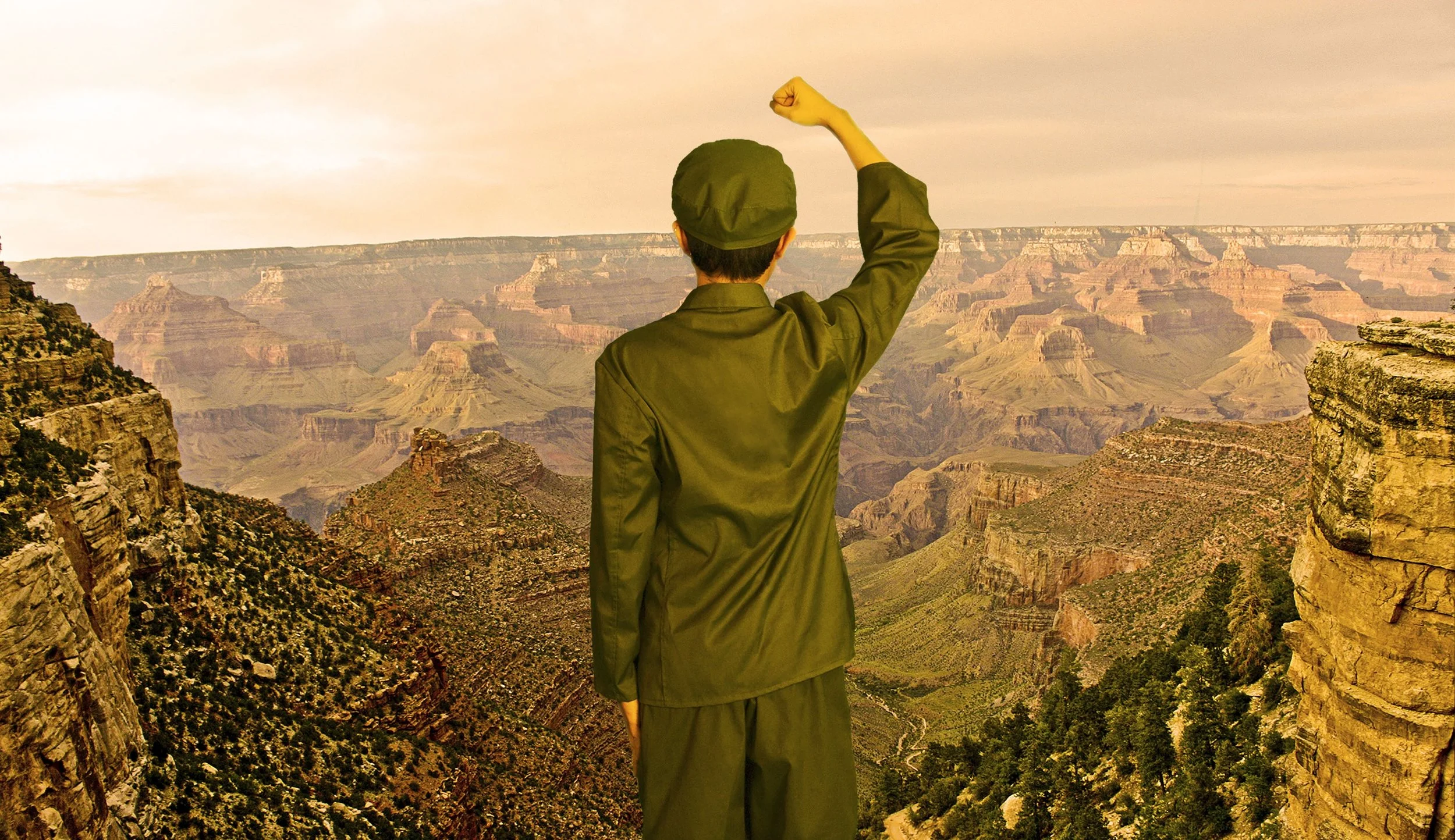
Mei Xian Qiu, Grand Canyon, 2010. From the series, Let a Thousand Flowers Bloom. Photograph on Plexiglas substrate, 20 x 35.5 inches.
Image description: The back of a man wearing a green“Mao suit" or tunic (Zhongshan) and cap, facing the expanse of the Grand Canyon at sunset, tight fist raised.
We met in the spring of 1989, while I was a first-year engineering student at Fudan University. I can’t say much for my studies that year, but at the time I was known for fixing things. Cameras, bikes, and transistor radios; carburetors and broken umbrellas. Every mechanism I took apart brought me closer, or so I hoped, to understanding the endless change unfolding around me. That year, as the celebrations announced the Year of the Snake, the crowds refused to disperse. Young people flooded in from across the country and it wasn’t long before I joined them at the Shanghai Railway Station. Even now, as I sit at this table and watch the days of my youth pass by, I can hear those whispers of a new tomorrow and all those words filled with meanings I did not understand.
One day, I fixed a broken megaphone for a man named Tiao’er. He shook my hand and thanked me, telling all the others that I was a comrade to be counted on. The next day his voice rang out across the park, “We must go north, we ride north to the capital. The trains will be coming soon.” As students cheered, I sat on my mat, hunched over a Nikon F2 SLR. It was a beautiful device, I thought to myself. I wiped the corrosion and closed its cover. I held it up to my eye to test it. Through the lens I saw the crowds of students sitting in groups around their radios and cookstoves, smoking cigarettes and passing out bowls of food. I saw my friend Tiao’er, but instead of a megaphone, he held the hand of a young woman with short, cropped hair. As they approached, I noticed that she was crying. They told me that the camera’s owner had been taken.
“Arrested,” she said between gasps for breath, “And disappeared.” She told me to keep it, that the camera was mine. “Yes, bring it and join us tomorrow,” Tiao’er said as he wrote down the meeting location. “Soon we’ll march to the heavenly gate.”
That night, I dreamt of open skies. I left the camp and walked westward toward the river. Camera in hand, I was searching for a place I had heard about and had yet to see for myself. For miles, I walked, until I saw it at last—rising high above the Huangpu River, a brightly-lit structure covered in red and gold—the first McDonald’s on the Bund. They say it had seating for two hundred families of three and I believed it as I climbed the steps to the upper floor. It was packed, as packed as the student camps. But here, another movement was taking place. It was heavily Western, oddly religious. A colonial fervor had taken over every public and private space. Lost as I was, it felt like home. I glided from table to table pointing my new Nikon F2 SLR at portable bibles and color brochures describing my energies, the makeup of my constitution. Foreign missionaries offered me food. Priestly vendors avoided my camera as if snapping a picture might capture a piece of their soul.
I stood on a table to take it all in and felt a lightness above my shoulder blades. Across the room, I noticed a man with a head of white hair. Thin framed in a baggy suit, he stood on a chair and spoke to anyone who would listen.
“Young comrades,” he said, fists gripping steaming paper bags, “Forget about these meager imports, these philosophies born upon the wind. Join me and find the true religion, a timeless and ethereal vision. Join me, my friends, and follow the Tao.” He dropped his bags and looked at me. That night I traded the sit-ins, the meetings, the speeches, concerts, and trains for a hamburger sandwich with a patron of the Tao named Zhu Shenming.
We developed a kind of friendship. When the schools shut down, I spent my days with Mr. Zhu. He told me about the wars, the revolution, and all the movements that he’d survived. Gone were his days as a soldier, a businessman, of heavy packs and smoke-filled rooms. He claimed that the power of the Tao resided within his flat nose. With it, he always picked the winning side. “Rebirth,” he called it. He had died so many times that he was back a new man. “And all of this,” he gestured to the pamphlets I’d found on the sidewalk, “All of this will pass.”
It didn’t matter if I believed him. I lived in the stories he told. Two weeks later, he pulled up in a brand-new Volkswagen Santana.
“Do you know how to drive this thing?” he asked.
“Sure,” I said. “But why?”
“We’re going west.” He told me about the Abbess, the temples, the wide countryside ahead of us.
“The future is in the land,” he said, and I believed him.
“The Abbess is the key to our plan,” he said. “To her, the people will listen.”
I studied her through newspaper clippings and discarded magazines. This abbess of his was known across the Yellow River Valley as an adept of the Quanzhen School. She was the ritual master in a group of traveling nuns. The papers declared her: a living relic of the past…her songs still heard beyond the foggy dales and wispy moss of mountain streams…
She was, as they say, the real deal. The day we were to pick her up, I sat with Mr. Zhu outside the temple gates.
“You must not speak unless spoken to,” he told me as we exited the car.
Through the glare of a sun hanging low on the horizon, I could just make out a group of women through the metal bars. They moved in sync, holding nothing but breath between their hands. The yellow silk of their robes moved slowly as if they were underwater.
All at once the women stood at attention. They lined up in rows of three. As if prompted by an invisible hand, they turned in a single motion to let the Abbess through.
She stepped so lightly that she seemed to float on a layer of air. She posed for a photo. I clicked the shutter and caught the moment on film: a woman in black with silver hair, wearing trousers and a collared shirt. Behind her, a girl my age carried a heavy trunk. On either side, the others stood with faces turned slightly away from the camera. At the edge of the frame, Mr. Zhu stood with his hands in his pockets, leaning against an iron gate.
“Can you feel it?” the Abbess said to me. With her hands together, she turned and turned, then stopped and stood perfectly still.
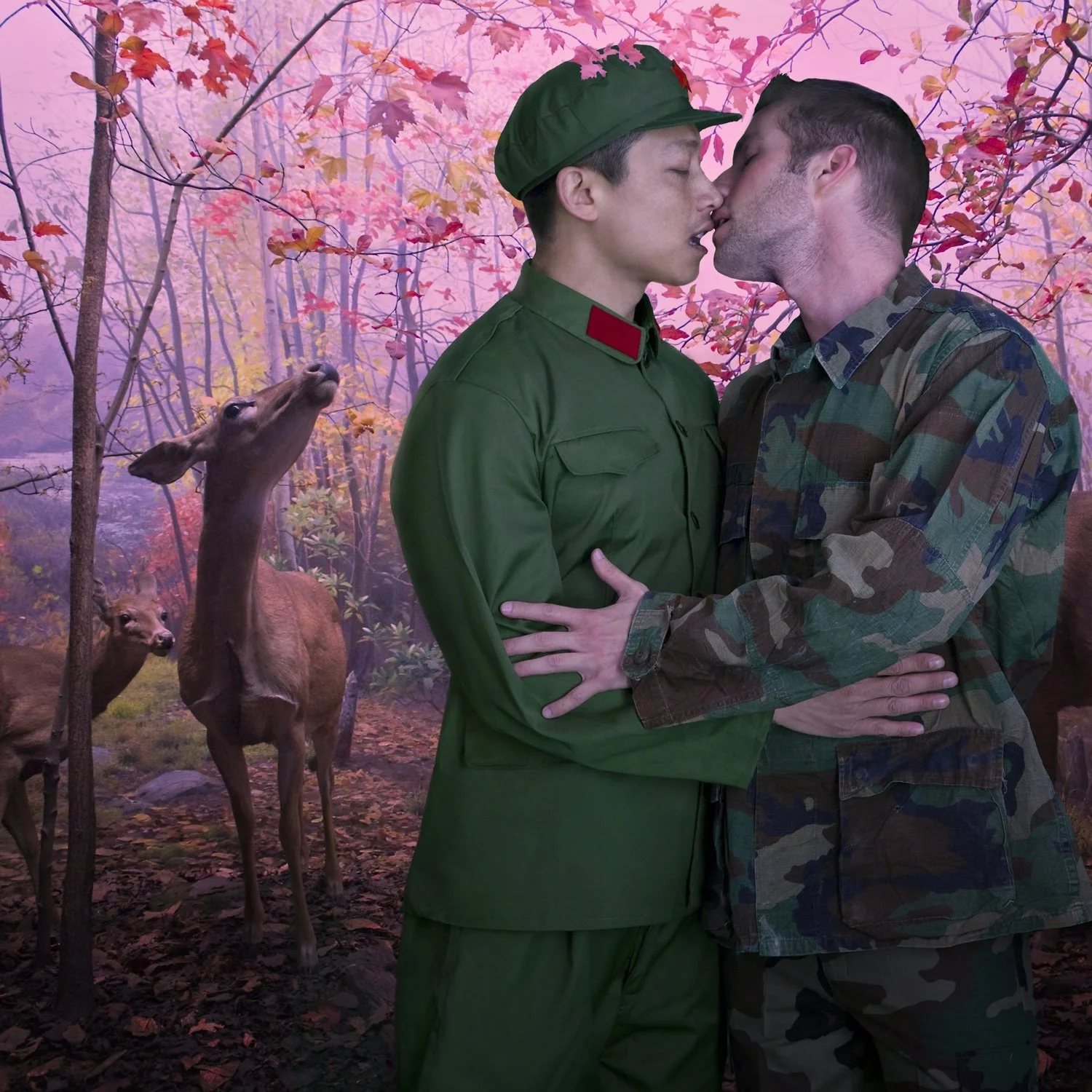
Mei Xian Qiu, 8990, 2010. From the series, Let a Thousand Flowers Bloom. Photograph on Plexiglas substrate, 34.5 x 34.5 inches.
Image description: Two soldiers are going in for a kiss, one man wearing a Mao suit, the other US Army fatigues (woodland camouflage), while two deer look on wistfully from a pink and lavendar forest.
*
We left Shanghai a week later. I drove Mr. Zhu and the Abbess for hours on highways, over hills and rivers, through endless fields of flooded grass, to find the land that Mr. Zhu assured us would be ours. We drove through May and into June. Each time we stopped, Mr. Zhu stepped out and looked around. Again and again, he’d shake his head.
Despite her years of travel, the Abbess was not used to traveling with men. When Mr. Zhu asked if she needed anything, she said a simple, “No.” When he asked about her latest tour, she said she was unscheduled. She was overseeing the renovation of her temple. The permit process had been delayed at every step. She shook her head and stared out the window.
We drove past fields of rice, the shoots still green as the first days of spring. I thought of Tiao’er and the girl whose name I never learned. I wondered where they might be at that moment as I drove the car in silence, searching for the perfect words to describe my sudden urge to turn on the radio. As my classmates at Fudan used to say, all one really wants to do in times of great tension is to put on some tunes. I happened to know that the car itself had a cassette tape deck and a multi-speaker stereo system. But in the presence of the Abbess, I didn’t say a word.
“With all due respect, I have a suggestion,” said Mr. Zhu. He advised her to increase her temple’s funding, to open the grounds to tourists, even foreigners, as the officials themselves had recently agreed to do.
“What would you have me do?” the Abbess replied, “Sell incense and cheap divination? I’m here on this so-called journey, as you have requested. A favor, and nothing more.” She punctuated this statement with a silence that I feared would eclipse every inch of the vehicle, if not my entire being.
For days I felt the tension of our silence in my bones, tightening from my knuckles to my mouth’s right corner, the side of my neck. I clenched my jaw as I searched for the words to request permission to break from these discussions of public and private affairs, to turn away from the harsh sounds of strategy and political means and fill the silence with something light and lippy: to simply put on a single tune.
We drove for miles along canals and ruddy dirt roads. I watched their expressionless faces bounce in the rearview mirror. The Abbess refused to say a word. Mr. Zhu looked on with narrowed eyes and lips, surveying the countryside with the gaze of a land developer.
One afternoon, we arrived at a small village beside a quarry. “Turn here,” said Mr. Zhu. I parked by a hand-painted sign for a restaurant, between a pile of gray cinder blocks and a fat mama pig. She hardly noticed us, lying there panting on her side. Her piglets buried themselves in her folds.
“A bunch of little zhu!” I muttered to Mr. Zhu as a muddy piglet skittered away from our feet. He didn’t appreciate the joke.
The Abbess emerged from the car in her best robes. She was certainly dressed for attention.
All eyes were on us as we stepped inside. I scanned the room for a table. Workers covered in dust sat smoking. In one corner, a woman cradled an infant. A soldier wearing a green uniform stood at her side.
The voices around us picked up one at a time as we found a place in the corner. I listened to the accents and unfamiliar patterns of speech around us. An elderly man served us the only food available, a loose pig bone soup with cabbage and hand-pulled noodles. The Abbess skipped her soup for tea. As we sat, the tension between the Abbess and Mr. Zhu sat too. I felt it grow into an almost physical presence, a thick white smoke obscuring the porcelain dishes between us. I searched my bowl for bits of meat, ate quickly, and stood. I wandered the room, pointing my camera at everything.
The soldier was speaking loudly now to the owner of the restaurant. He was there with his wife, meeting his infant child for the very first time. It was his last day home, the end of a week’s leave. He couldn’t have been much older than I.
“Soon we'll be back in Beijing,” I heard him say. Foreigners were everywhere and things were heating up. The students had taken to the streets. They’d barricaded themselves at Tiananmen Square. He took a drag of his cigarette and noticed me standing there.
“How old is she?” I asked, nodding at his infant daughter.
The mother spoke in a dialect that I could barely make out, “Almost one hundred days,” she said, beaming. “Today is the third day of the sixth month. And did you know that today is the new moon, too?”
I nodded. “She’s beautiful,” I said. “And such big eyes. She’ll grow up strong.”
The wife held her hand up to block the lens. She smiled, but her husband tensed in his uniform.
“Your accent is very interesting,” he said.
“I’m with them,” I replied, hardly lowering the camera from my face. I pointed at Mr. Zhu. “I work for that guy—he’s a famous businessman.”
“Put that thing away,” the soldier said.
I noticed his rifle beneath the table.
“What would a famous businessman be doing in a place like this?” he said, standing now. His wife put a hand on his arm.
“Eating, mostly,” I said as I backed away. “You see friends, we are patrons of the Tao. Now, if you will excuse me—” I waved at Mr. Zhu, but he wasn’t looking. His gaze was on the Abbess, who looked up at him at last. He picked up a piece of cabbage and held it out. All at once I saw them clearly. My boss held his chopsticks up to the Abbess’s mouth. She accepted. And the expression as she chewed, such pleasure at this indulgence in the aged woman’s face, now glowing profusely, was all that I needed to recognize the life they must have lived together many lives ago.
The soldier frowned as his wife stood up beside him. The young woman watched the Abbess with wide eyes of recognition.
“Auntie, is it you?” she crossed the room.
The soldier narrowed his eyes at me. He followed his wife, who suddenly turned and whispered angrily to him. The man grew pale and stopped in his tracks.
“It would mean so much,” said the woman to the Abbess, holding her baby out to her.
The Abbess nodded. Mr. Zhu and I exchanged a quick glance.
Within seconds, Mr. Zhu was kneeling. “Hand me the child,” he whispered to me.
The Abbess was already in motion, using red and gold ribbons to attach bells and pendants to various locations along her own braided hair. She revealed a horsehair brush from a fold in her robes and with the remnants of her tea wrote stylized characters on the cement floor at eight points around Mr. Zhu. He held the baby up for her.
The Abbess knelt, then stood, then turned in circles, humming high-pitched sacraments for the longevity of the child, its parents, and all the rest, unveiling a latent fluidity of motion, tracing paths through the air with her fingertips, allowing her movements to lead us to a place beyond where words could go. I saw it all: the sweat drops catching on Mr. Zhu’s temples, the infant cradled in his arms while the couple watched in silence, plastic chairs behind them, metal-framed fluorescents above, a bowl of soup at the edge of the table so close that it might fall, the black metal backing of my camera, black hairs on the back of my hands. The gray walls around us seemed to glow with a brightness that had been there all along, had always been, right there as it was in that moment. Mr. Zhu returned the baby. The mother held the infant, an extension of her arm. All of us, inseparable as light on film.
The Abbess stood there, silent and expectant. She stared at the woman. I couldn’t figure out what she would expect.
I swear the Abbess winked at us before she turned. She approached the young woman with outstretched hands. “And could you find it in your heart, little sister, to help an old woman in need?”
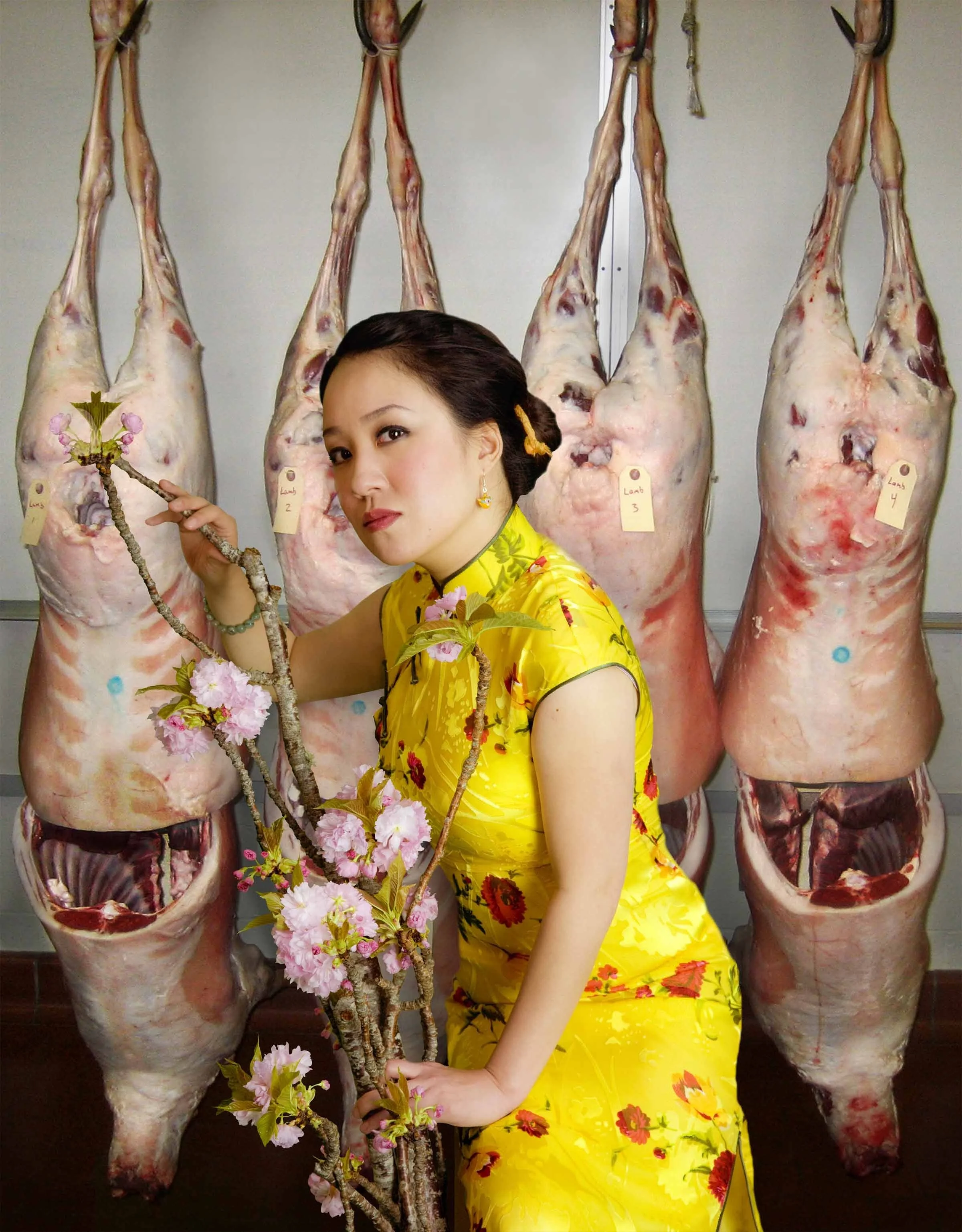
Mei Xian Qiu, Cherry Blossoms, 2012. From the series, Let a Thousand Flowers Bloom. Photograph on Plexiglas substrate, 35.5 x 20 inches.
Image description: A woman in a bright yellow, classical Chinese dress (qipao) stands in front of four slaughtered animal carcasses hanging upside-down, as if in an abbatoir; she is holding branches of cherry blossoms and stares straight at the viewer.
*
Back in the car, I whispered “Auntie, how much did they give you?”
She didn’t answer but opened the window. “She must have been one of the girls,” she said as she looked out. In her gaze I saw an old village temple nestled between tree-covered hills. “It couldn’t last,” she shook her head.
In the rearview mirror, I saw the soldier speaking to a small crowd and pointing our way.
“Let’s get going,” said Mr. Zhu. I felt the press of his knees against my back.
I tossed my camera onto the empty passenger seat, started the engine, and pulled out into the lot.
I slammed the brakes. My Nikon F2 SLR tumbled to the floor. Its motor drive whined and clicked and made a terrible grinding noise before it went quiet. I stopped myself from swearing as I looked back at Mr. Zhu.
“Are you crazy?” he shouted. His nose was bleeding. I grabbed my last clean handkerchief and pressed it to his face. The Abbess didn’t pay us any attention. She turned her head toward my window, moving her face around to get a better look.
Then I heard the other noise.
I opened the door and stepped outside. A screaming piglet lay under the fender, flailing on the ground. It was all out of shape, half under the wheel, with its legs splayed out to the sides. The animal grew quiet as I bent down next to it. “You’re okay,” I said, as much to myself as to anyone.
I put out my hand and felt its breath. I felt the wetness of its nose. It was screaming again, but softer now. I heard something catch and saw the blood in its mouth. It pressed one hoof into the red soil, pressing again and again.
I felt a heavy hand on my shoulder.
“We’ll take it from here,” the man’s voice came from behind me. I turned to see the soldier standing with a company of men and women in uniform. He raised one hand and the others stood at attention. “Young man, you’ll be coming with us.”
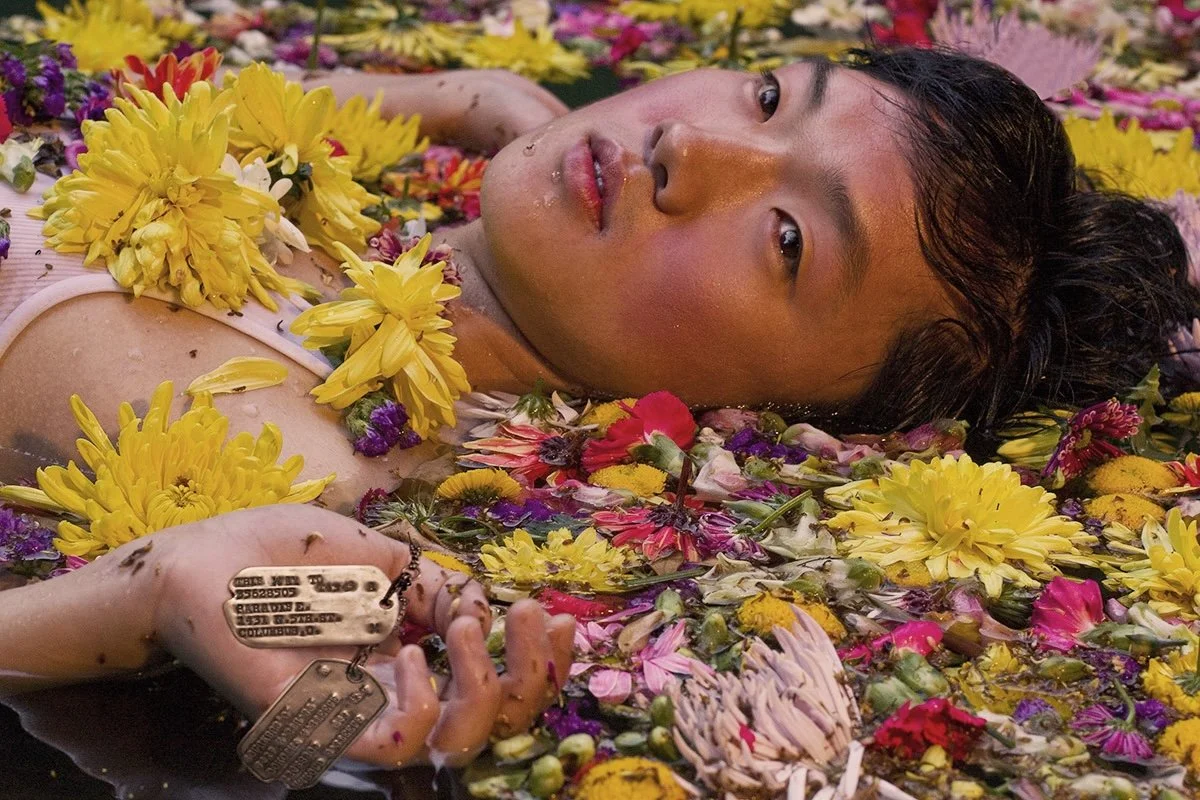
Mei Xian Qiu, This Way to Paradise, 2012. From the series, Let a Thousand Flowers Bloom. Photograph on Plexiglas substrate, 23 x 36 inches.
Image description: Close-up of a young soldier’s face looking as he floats in water like Ophelia (dead or alive?), covered and surrounded by pink, yellow, and red flowers (mainly chrysanthemums), his left hand open to the sky and holding a pair of dog tags.
*
How many bridges rolled by as I sat in the dark, keeping my head from bouncing against the metal walls that surrounded me? How many vehicles did I enter with my hands behind my back? I must have slept because I remember shots in the night and the sound of tires on the pavement. Diesel trucks and whispers, cracks and alarms. I heard a dying animal, a cry for help and the pop of a neck. I saw a man in a loose white shirt and grocery bags in his hands. He took a step and pointed left, then right, as a line of tanks came to a halt. His grocery bags were full of chickens, dead from the market where his father—the doors swung open and a voice told me to disembark. I saw canvas shoes and rubber-soled boots, dry dirt and fences, a tower, a wall, and a blinding white sky.
The same strong hand led me through a gate where I joined a crowd of hundreds of students. I saw Tiao’er without his megaphone. Unshaven, with a nervous look in his eyes, he told me all about the weeks spent in the square, the days and nights and songs and shouts, the final night that did not end. He was sorry that we’d been separated. Who could say who was who and where in such crowds, such rolling seas of bodies, as he called them. But he wanted to know what I had seen. What had I seen in the capital?
That was many weeks ago. I tell you again, I wasn’t there. All I know I learned from people I barely knew. As sure as I sit at this table, I wasn’t there. I was far away from all of that. I was driving a 1989 Volkswagen Santana, thinking about the silence of the radio as I drove a famous businessman and a holy woman down a country road. I saw her arms outstretched. I saw him running barefoot through the grass. There were pigs, that’s what I’m trying to say. They called themselves the Abbess and Mr. Zhu. You see, there were pigs and a shack made of cinder blocks. A bowl of noodles and a couple with an infant child with ribbons in her hair. She was a sweet girl, a baby girl. This whole thing is a mistake, a misunderstanding. The Abbess, she was squatting down by the car when I heard a terrible noise. She took it in her hands and twisted its neck. It was already dead when you found me, its mouth still wet on the side of my hand. It was just a pig, a little zhu. I have photos, if you could only find my camera, I’d show you where we were. June fourth? I wasn’t anywhere. I was driving through the countryside, red dirt and blood in my mouth. I was a thousand miles from the capital. You see, I didn’t see it. I’ve told you everything I know. They brought me through a wire fence, along the wall to where they kept the others. All I know I heard from people I’ve barely met. Sure, I’d love some water. But I don’t know why they sent me here. I’ve told you this already. You brought me in for questions and here I am. Many weeks ago, at this very table I told them all I knew. I asked where they would take me next. The examiner offered me a glass of water and a pad of paper. I wrote down all I knew. I slid the paper across for him to read and asked again. After a long pause he looked up at me and answered. “West,” he said. “You’re going west.”
Derick Chan was born in Singapore and raised in California. A writer and technologist, he has been at various times a photographer, yoga instructor, and death metal guitarist. He has degrees in East Asian Studies and Computer Science from Penn and an MFA from the University of Virginia, where he was a Poe/Faulkner Fellow in Fiction. His writing can be found at LIT, HAD, Peregrine, and the Sino-Platonic Papers.
*
Mei Xian Qiu (https://meixianqiu.com) is a Los Angeles-based artist who has lived and worked in Europe, China, and Indonesia. She was born into a third-generation Chinese minority family in the town of Pekalongan on the island of Java. When she was born, her parents gave her a number of different names (Chinese, American, and Indonesian)—tthe local priest gave her a Catholic name—in preparation for societal collapse and subsequent potential futures. Her series of photographs, Let a Thousand Flowers Bloom, which depicts a Chinese takeover of the United States, takes its title from a popular Western misquotation of Mao Zedong’s “Let a Hundred Flowers Blossom, Let a Hundred Schools of Thought Contend.”
‘But it’s not a real name, you know.’––a short story by Nandini Bhattacharya on how certain choices, unwittingly, scar a life.