
Xiao Gou
By Alice Stephens

Jessica Wee, Wash wash wash, 2020. Oil on canvas, 24 x 24 inches.
Image description: Dark ground with ambiguous woman in pale blue bath surrounded by pinks, greens, and a plume of white steam,sharing intimate, solitary bathing rituals.
After the dark of the cinema, we squint as we emerge into the sunlight. Aili is quiet, and I can see she is thinking about “Red Sorghum,” the movie we have just watched, a very sad love story that ended in tragedy due to the Japanese bastards. I, too, would like to think more about the movie, but there are other, more pressing matters at hand. Namely, how to know what Aili wants. If Aili were Chinese, I would know exactly what to do, but even though she looks Chinese, Aili is American, and I am often confused by her habits and mannerisms.
For instance, I invited her out today—most girls would dress up in their very best for the occasion, but Aili is wearing blue jeans with a hole in the knee. They fit her very well, hugging her form in a way Chinese clothes would never, but the ripped fabric turns the whole thing into a joke whose punchline I cannot understand. Her top is nothing my Xiao Gou would wear—she favors flower prints and frills—but a plain cotton shirt the color of dirt. I suppose I should be happy that the shirt doesn’t have holes. On the other hand, she has outlined her eyes in black, her lips are the bright red of a New Year envelope, and from her earlobes—fleshy for good luck—dangle festive silver earrings, so I know she has taken some care with her appearance. I just can’t tell if that care is for me, or for the general public.
Thinking to impress her, I take her to a games arcade. She takes a cursory look around and shakes her head no when I offer to pay for a turn at the pinball machine, lights winking seductively. It seems impossible to impress this girl. Even my Phoenix bicycle means nothing to her. When I tell her to sit on the back rack because I will be riding her to our next destination, she laughs in that strange open-mouthed way and again shakes her head no. I am learning to read her head movements, a secret language in addition to the English that I struggle with. Our conversation is bilingual, as I speak in English and she in Mandarin, both of us seeking to improve our skills in the other’s native tongue.
“We can only go by bicycle,” I inform her in her language.
“I don’t want to,” she replies in my language. “I can walk.”
“No,” I say. “It is far.”
“Where?” she asks. She demands to know everything in advance, unlike Xiao Gou who likes to be surprised on a date. But of course, I told Xiao Gou this thing with Aili is not a date.
“We’re going to eat,” I say, slipping into Mandarin in exasperation. “Special Xi’an food.”
She makes a noise in her throat which I take to be approval because she immediately straddles the rack. “I’m starving to death.”
For a moment, I am too shocked at her unladylike position to say anything. If she were Chinese, I would immediately scold her, but I must think of a polite way to get her to sit more modestly. “Better to sit with legs together,” I manage to say.
“No thanks,” she replies. “It is easier for me to…” She can’t think of the word so she spreads both arms wide, tilting them up and down. “I am clumsy.”
It is not how I would describe her. Her limbs, hands and fingers are graceful and delicate, and she moves like a butterfly floating on the breeze, effortlessly and without a care. But I do not argue with her. Xiao Gou is waiting for us.
As I push off, she keeps a grip on the rack. At least that way she is like a Chinese girl, too modest to hold on to a male she isn’t related to. When I bank into a turn, I feel the back get wobbly as she overcompensates. It’s not that she’s clumsy, it’s that she doesn’t trust her body not to get hurt. “Pínghéng,” I say to her over my shoulder.
“Eh?”
“Pínghéng.” I lift both hands into the air and hold them out.
She shrieks as the bike shimmies, then laughs when my hands once again grip the handlebar. “Pínghéng,” she repeats. “Pínghéng.”
“In English?” I prompt, braking as we near a huddle of cyclists waiting at a crossroad.
“Balance,” she pronounces. Several heads swivel to look at her and stay swiveled. Because of my good looks, Phoenix bike, and fashionable clothes, I am used to being the center of people’s interest. But it is nothing compared to the unabashed stares Aili attracts as people try to figure her out and fail.
As I twist around to talk to her, I feel the heat of their attention engulf me. “Balance,” I dutifully echo. Then, to show everyone that ours is a relationship between equals, I say again in Mandarin, “Pínghéng.”
A few of the bolder cyclists nose in closer to us, and I can feel Aili stiffen. She does not like to be the center of attention. I, on the other hand, enjoy it. My father says that I am truly a citizen of Deng Xiaoping’s China. Whereas before, attention would get you punishment and humiliation, now it’s something to strive for.
Not that Aili is shy. She lectures to a packed classroom. That’s where I met her, pushing my way to the front of the admiring crowd that surrounded her after class to introduce myself. Though there were many contenders, I was the one with the best English and most confidence, and offered to accompany her to the bus stop, and accompanied her every week after, not alone, of course, always with a mob tagging along, but with the understanding that I was her escort, not the others. Then, after the final class, in front of all those hangers-on, I offered to show her around the city that Sunday.
“I’ve seen the city,” she answered. “I’ve been here for four months.”
Suddenly, it occurred to me that I might be humiliated in front of my classmates. Not that we’re part of a real institution; the class was organized by an entrepreneurial teacher from Aili’s school, Shaanxi Normal University, attracting students from Xi’an’s many universities for a special lecture series by a real, live American. Even at the dear price of 10 yuan, every desk was taken, and still people had to sit on the floor or stand in the back. I was not the only young person eager to hear about the West. Of course, we were all shocked when it appeared that the teacher was Chinese, just like us, and I, for one, immediately thought how to get my money back. But once she started to speak and move about, everyone’s doubts vanished. She’d wave her hands in the air as if catching fireflies, snap her fingers, clap, all while releasing an unending torrent of words, only about a half of which I understood. Most understood even less, and just took in the spectacle of her, with no thoughts of having been cheated of their yuan.
My classmates’ eyes were on me, and I knew not a few of them would love to see me humbled. I surprised even myself by saying, “I show you my Xi’an. The people’s Xi’an.”
Her bus was trundling toward us, people jockeying into position to board. “The people’s Xi’an, huh?” she said, smiling as if I’d said something humorous. “No Wild Goose Pagoda? No Muslim Quarter? No city wall?”
“No,” I said. “I show you my typical Sunday.”
“Ooh.” She drew out the sound, her voice trilling in a tone of excitement that sounded like a bird call, head dipping and rising like a bird’s as well. “I’d like that!”
“Yes?” I wanted her to say it loud and simple enough that the others could understand.
“Yes,” she affirmed, joining the throng of passengers rushing the bus as it nosed to the curb. I and another student, taller even than me, directed her through the knot of people, pushing to the front with authoritative commands and a few sharp elbow jabs.
“I meet you here Sunday 10 o’clock,” I told her just before she boarded.
As others shoved in behind her and she disappeared into the bus, I heard her call, “It’s a date, Peng!”
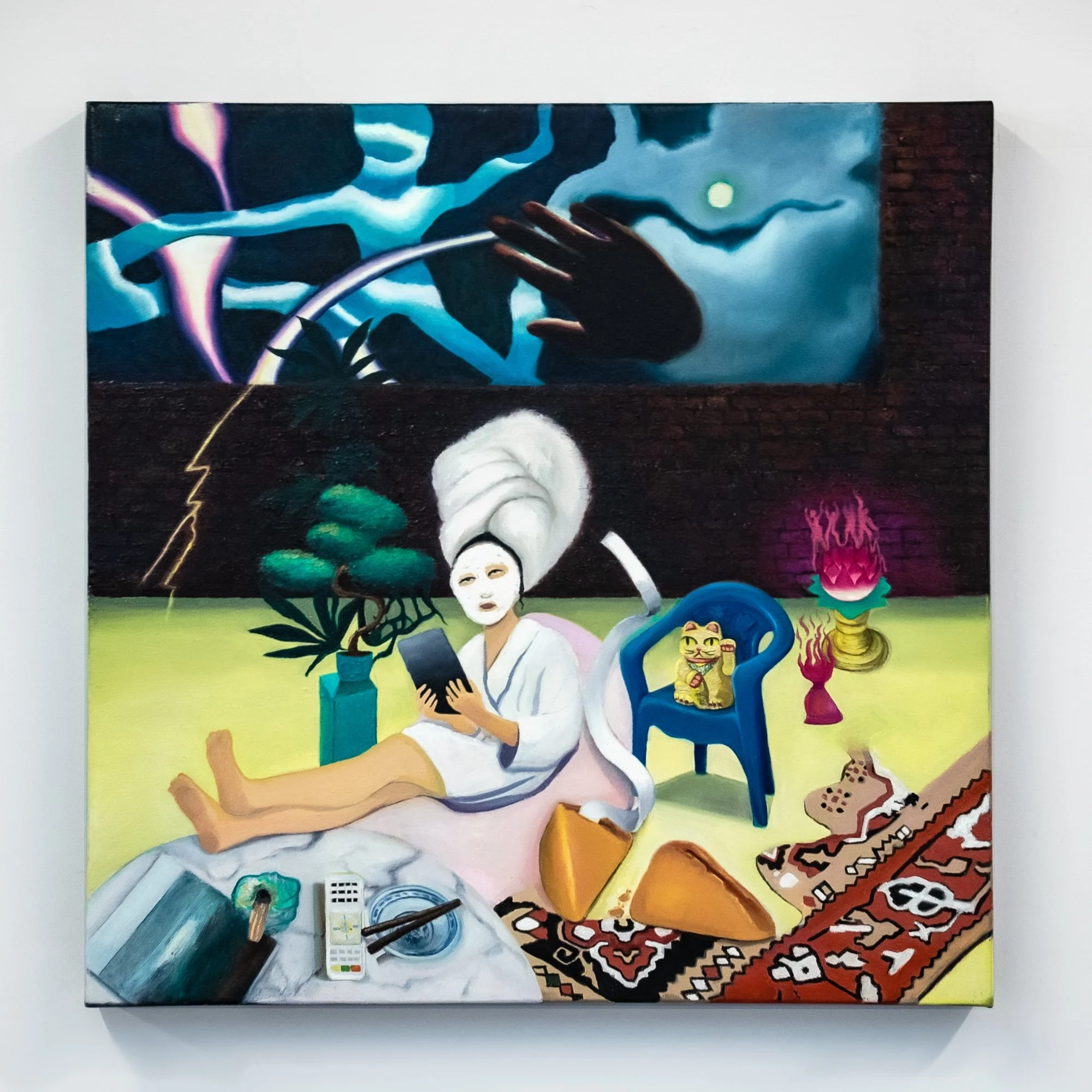
Jessica Wee, Praesagium, 2021. Oil on canvas, 24 x 24 inches.
Image description: Against a dark sky and yellow ground, a woman in a white robe with her hair up in a twel reads news on her iPad, surrounded by symbols of fortune, good energy and luck, both familiar and exotic.
The whole way home, I repeated to myself, “It’s a date, Peng.” At home, I rushed to my English dictionary and looked up date. When I saw what it meant, I became excited. A plan began to form. Far-fetched, yes, but my father always tells me that these days, the world is there for the taking. He tells me to cultivate the right relationships, think fast, and take advantage of any opening that is presented to me.
The cyclists in front of us start moving, as do I, and she’s caught off guard and grabs ahold of my waist with a tiny yelp. After a moment, she removes her hands. Her touch is not hot and eager, like Xiao Gou’s, but impersonal and cool, leaving my skin tingling like camphor balm for sore muscles.
I glance at the digital watch my father brought me from Beijing when he attended the Central Committee of the Chinese Communist Party plenum last year. Unless Aili eats like an underfed university student, we are going to be late to Xiao Gou’s. I put my all into cycling but start to feel the sweat beading under my best shirt. Xiao Gou tells me that in the strange logic of capitalism, the little crocodile, like the red scarf of a Young Pioneer, bestows high status. I slow down again because making a connection with Aili matters more to me than Xiao Gou’s wrath. I would never forgive myself if I didn’t at least try for… What? For a mutually beneficial relationship with an American. Since I never met an American before Aili, and don’t know anyone who has, not even my father, I don’t know how far this can go.
Though the food is better at Old Hu’s, I take her to Comrade Qi’s restaurant. Bringing a foreigner to eat here will keep relations strong between our families. Comrade Qi’s wife is at the abacus, and after we ask after each other’s families, I order black vinegar peanuts, cold skin noodles, and two mutton bread soups. Handing me a dish of peanuts, Qi’s wife demands to know about my guest. I enjoy her look of shock when I tell her Aili is my American friend. She asks excitedly whether she will pay in FEC. I tell her of course not, Aili is eating there as my guest, and I will pay in our national currency. I wonder that she would ask; with her husband’s connections, she can access the special currency herself and doesn’t have to bother a customer. But that’s the way it is in Deng Xiaoping’s China: everyone is looking to make money and more money.
As we sit down, I say, “My friend at Foreign Languages University says they want an English teacher. You take the job.”
She waves a fly off the table. “Maybe.”
She says “maybe” a lot. It is a useful Chinese phrase.
“It is good job. It pays good money. You can stay in Xi’an. I think you must stay here.”
Picking up a peanut with her fingers, she says, “I can’t. I must finish university. One more year.” The peanut crunches between her teeth.
The soup and flatbread arrive, and I am disappointed to see Aili start to shred the bread, plopping doughy tufts into the rich, oily broth. “You eat soup before?”
“Of course, Peng,” Aili answers with a loose shake of her head. “This is number one food of Xi’an.”
I pluck a pair of chopsticks from the caddy and hand them to her, but she grimaces and reaches into her bag, taking out a plastic case which holds a pair of wooden chopsticks. “I use mine.” She clicks the chopsticks at me in a rude manner that even a young child would know not to do. At least she has the decency to lower her voice when she confides, “Those are not clean. People eat and put back but there is no wash with soap. I don’t want to get sick.”
I have no idea what she’s talking about, but Qi’s wife is approaching with the noodles so I decide to move the conversation on. “You eat this noodles before?” I gesture at the wide, chili-flecked ribbons slick with oil.
“No, Peng, never,” she answers with a smile that makes me think she’s making fun of me.
I decide to continue as if we are both serious. “Name is liángpí miàn. Very famous Xi’an food. Everywhere in China know about liángpí.”
Comrade Qi’s wife, who is hanging around to get a good look at Aili, commands me to tell her that she herself hand-makes the noodles. I know it isn’t true, but I translate into English. Speaking straight to Qi’s wife in Mandarin, Aili asks for a bottle of beer.
“Oh, no. I don’t want beer,” I assure Aili.
She laughs again, but laughter has tones too, and the tone is mocking. “It’s not for you, Peng!” My mind is paralyzed with shock. She’s a woman. Ordering beer. In public. In the middle of the day. Seeing me aghast, she assures me, “You can have some, if you want.”
Comrade Qi’s wife slaps down two glass tumblers and pops the lid off the green bottle with an expert flick of a wrist. Aili pours the pale yellow liquid until the froth rises to the very brim but does not spill over. Cocking the bottle at me, she nods her head. So much communication goes on through the movement of her head and I can decipher almost none of it beyond yes and no. This time, though, I know what she’s offering. “No. In China, only cadres drink beer at the day.”
“Cadres and foreigners,” she corrects me. “Cheers!”
“Cadres and overseas Chinese,” I correct her, speaking in Mandarin and bouncing my head around, hoping it’s the appropriate head movement for the conversation.
“Peng,” she says, slithering her head around in yet another strange gesture, “I am not an overseas Chinese. There are many different Asian people, aren’t there?”
“In China, there are only Chinese people,” I tell her.
“The Japanese students at Shaanxi Normal University are very surprised to hear that,” she says before slurping up noodles so the sauce spatters. I lean away from her, careful of my shirt. “Why can’t I just be American?”
“Because once Chinese, always Chinese. Ask your mother and father.”
She concentrates on eating, which is good, because time is ticking away. In just 15 minutes, we are supposed to be at Xiao Gou’s house, and we are a 15-minute bike ride away, without any red lights. But now that I have brought up her parents, I want to know more about them. I wonder how America can change a Chinese person, and vow to myself that it won’t change me.
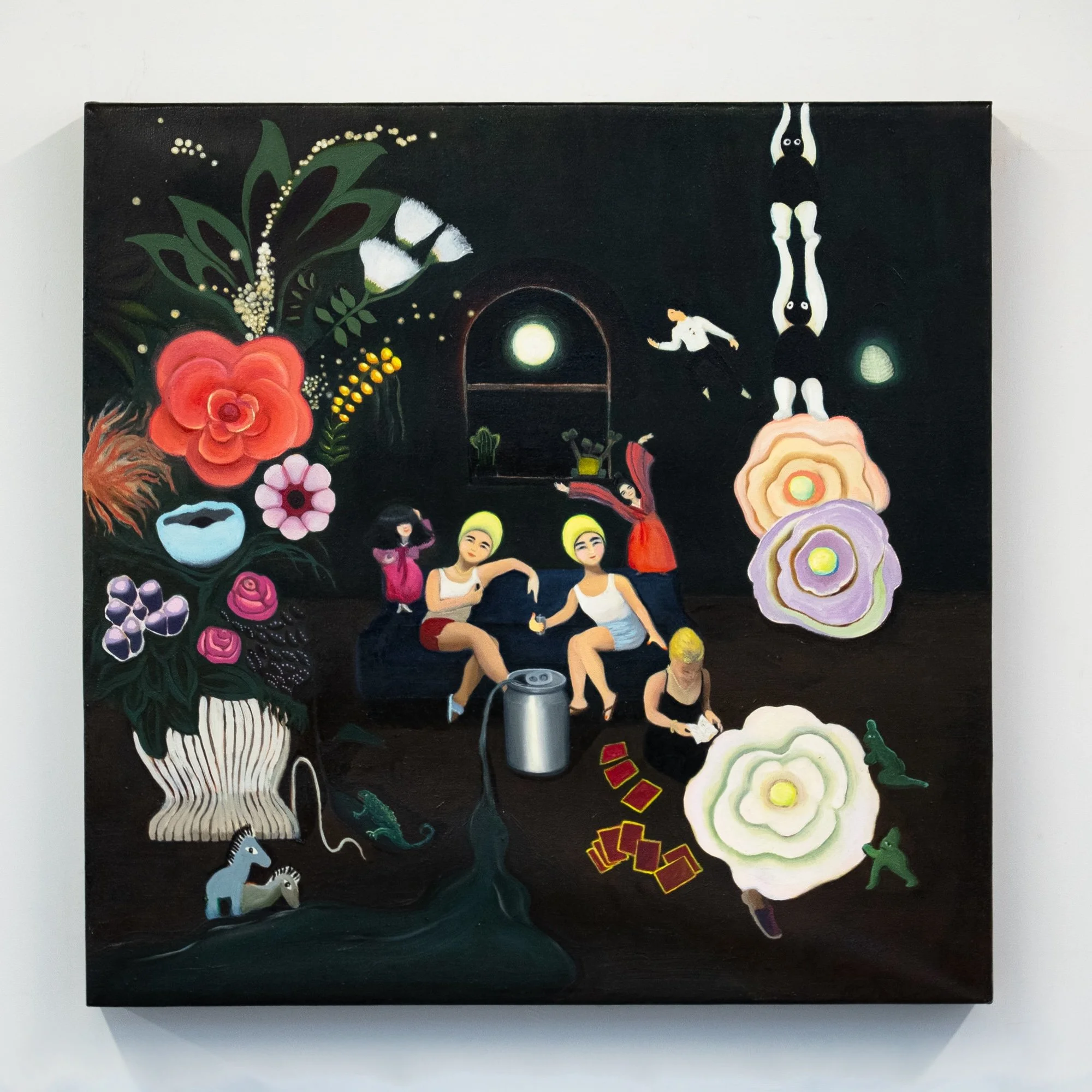
Jessica Wee, Single K-sisters drinking beers, 2021. Oil on canvas, 24 x 24 inches.
Image description: Two central female figures drinking beers, joking, sharing stories represented by bright colorful symbols against a black ground.
“Your mother and father are not…?” But I can’t think of the word in English, so she rummages around in her gaudily embroidered handbag from Dali, where the ethnic minorities are allowed to wear their traditional costumes rather than the more sensible clothes of modern China, and brings out a battered English-Mandarin pocket dictionary, which she hands to me. Our fingers brush, but where this might provoke a blush from a Chinese girl, Aili doesn’t even notice.
As I flip through the pages, Aili takes quick, tiny sips of soup. “Strict,” I sound out, struggling with the awkward collision of consonants.
Lips pursed for another slurp of soup, she gives a canine shake of her head. I wish the dictionary could tell me whether she’s answering my question or doesn’t understand my pronunciation.
“Strict,” I repeat.
“Oh, strict!” Somehow, she makes the word sound so easy. “In Mandarin?”
“Yángé,” I speak slowly, being clear with the tones, which I know she has a difficult time with.
“Yángé,” she repeats, a hand mimicking the rising tone of both syllables.
I try the question again, “Your mother and father are strict?” Aili has taught me that there are also tones in English, but it is up to the speaker and the situation when to use them.
This makes her laugh. “No. They are easy.”
Comrade Qi’s wife comes by to ask how our food is. It’s just an excuse to gawk at Aili up close and ask a few nosy questions about her as if she weren’t sitting right there. But Aili doesn’t care; she grins and does a head dance for Qi’s wife, continuing to eat as I answer.
Finally, Comrade Qi’s wife leaves to attend to a new customer. I drain my bowl. “It is getting late. We must go.”
“Go?” she echoes, beer drying on her upper lip. “Where?”
“Next we go to…” I riffle through the dictionary. “Park. The park.” It’s an effort to fit those sounds together.
She says the word in my language to confirm, then her head prances and bucks. “I love parks! Chinese parks are very interesting. I like to look at the people.”
And, I know, the people like to look at her, but I don’t say that. Even though I told her to hurry, she still pecks at her food, dipping her head to take in tiny amounts. I decide not to talk until she is finished, but she starts chittering away about old people exercising and dancing in parks and how that doesn’t happen in America. Normally, I would love to hear about America, Gold Mountain as it was called back when China was under feudalism and people were free to make the journey if they dared. Aili has planted a wild seed of hope that keeps growing even in the hostile conditions of reality, which includes Xiao Gou who by now must be impatiently waiting for us to arrive. Oblivious, Aili nibbles on. Is this how Americans eat, or is this particular to Aili?
Even though I am full, I finish the noodles and then the peanuts, so that she won’t be distracted from the soup. Finally, when there is still enough in the bowl to feed a starving child of the American ghetto, I visit Comrade Qi’s wife by her abacus and pay. The beer is a fifth of the bill, more expensive than the peanuts. “Tell her to bring her friends,” Comrade Qi’s wife orders.
“You can tell her,” I reply. “She speaks Mandarin.”
She giggles into her sleeve. “I could never talk to an American. I’m too shy.” Such an assertion would surprise anybody who knows her, but her cheeks are flooded red like a sunset sky.
Back on my Phoenix, we are already forty minutes late, and still several miles of pedaling away. Xiao Gou will be livid now, probably plotting how she will get back at me, maybe by dancing with that pompous Yang Weidong at the next disco party. Every red light is an agony.
Aili asks, “What’s the name of the park we are going to?”
“Xinqinggong Park,” I answer, adding, “First we stop somewhere.”
“Where?”
I should have told her this when I could gauge her reaction, but as luck would have it, we are cruising at a fast pace down Xixin Street. “My Xiao Gou’s house.” I am so flustered that I speak in Mandarin, using my endearment for her instead of her real name.
“Xiao Gou,” Aili repeats contemplatively. Then, in English, “Little dog?”
“Yes. We Chinese use xiǎogǒu for special friends.”
“Special friends.” In Mandarin, “Girlfriend?”
“Yes.” Two more blocks. I ease up a little on the pedals. Now that we are so close, I am nervous.
“So,” she says slowly as she figures it out, “we are going to your girlfriend’s house?” She does not sound angry. Am I relieved or disappointed? If she were angry, that would mean she had feelings for me.
“Yes.” I stop outside Xiao Gou’s building and peer at my reflection in the handlebars, running my fingers through my hair so it falls as Xiao Gou likes. She was the one who advised me on my clothes, choosing the shirt with the crocodile and my only pair of jeans.
Aili is wearing her usual half-smile, like everything teeters between the amusing and the boring. Her hair is tousled and her lipstick faded. She looks sloppy and shoddy, and not at all as I described her to Xiao Gou. I want to ask her to fix herself up so she can make a good impression, but of course, I can’t. Because I am nervous, I ask in Mandarin, “Are you ready?”
My watch tells me we are almost an hour late. I knock softly on the door. Nothing. I picture Xiao Gou standing behind the door, making us wait just as she had to wait. I knock harder. Still nothing. Maybe she got tired of waiting and went over to a friend’s, or worse yet, Yang Weidong’s. This thought has me yanking open the door, knowing that if her parents were home, they would have answered already. As we make our way to Xiao Gou’s bedroom, I want Aili to appreciate the magnificence of her home, the tile floors, the large rooms, the tasteful calligraphy scrolls, but she barely gives it a glance.
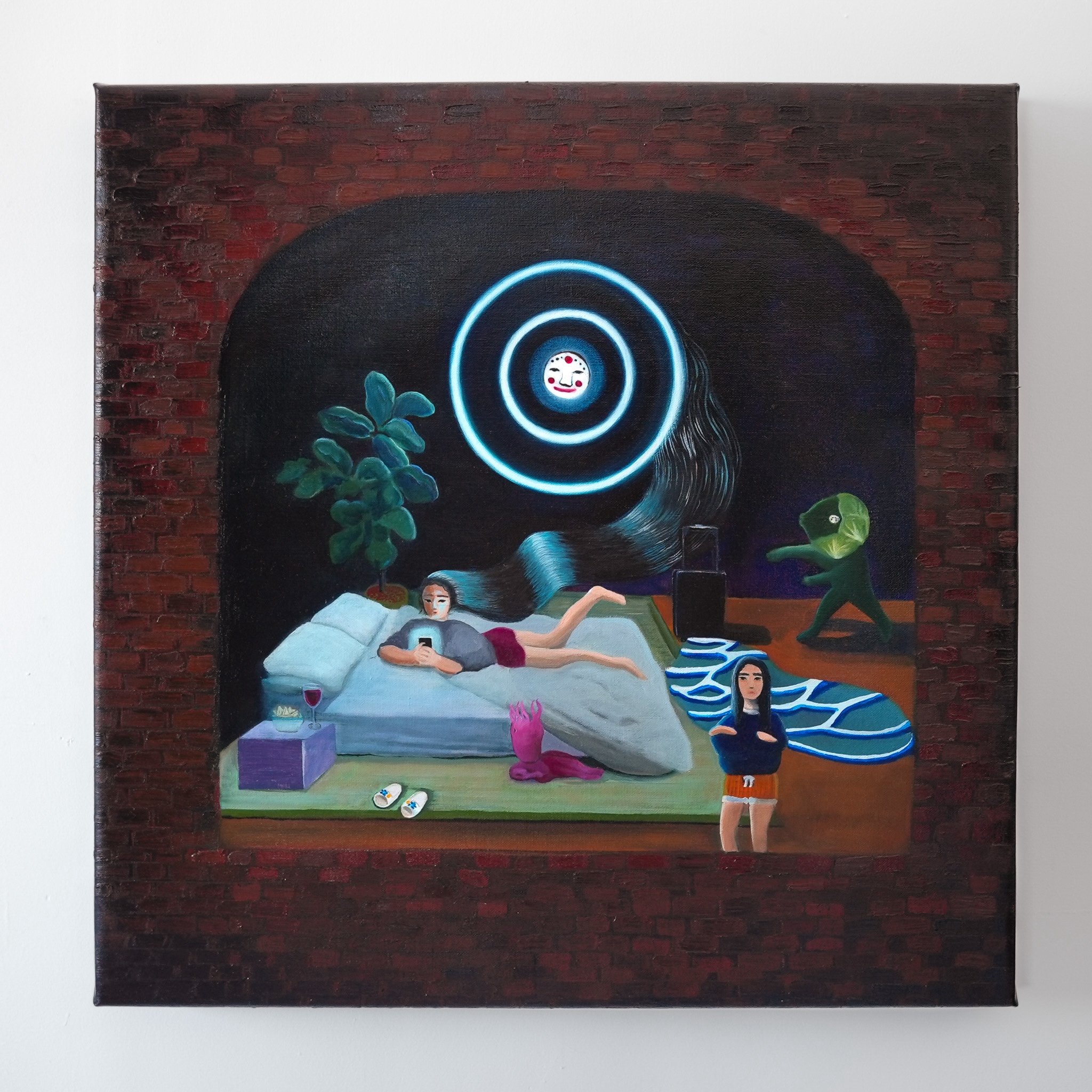
Jessica Wee, I told you so, 2022. Oil on canvas. 24 x 24 inches.
Image description: Within a russet cave-line frame are two female figures, one standing in the foreground, one on a pale blue bed against a wall decorated with a traditional Korean folkloric mask Hahoetal (a unique dichotomous symbol that embodies tradition while allowing the wearer to realize self-expression and liberation); the moon glows like the neon lights in a psychic shop.
I open the door to Xiao Gou’s room and there she is, laid upon her bed like an empress, leafing through a magazine with an open pit mine on the cover. Her skin glows like mother-of-pearl in the sunlight, her plump body tempting as a bowl of rice. She’s wearing her favorite dress, red as the Five Star Flag, with a nipped-in waist and a flared skirt, the short sleeves showing off her arms with the adorable dimples at the elbows that I always want to sink my fingers into. When I introduce them, Aili expresses pleasure in making her acquaintance, while Xiao Gou merely nods before berating me for arriving late. She had left a Sunday visit to the Feng family early, forgoing red bean cakes, only to be left waiting. With Aili right there, I can’t blame it on her, so I apologize. To my horror and dismay, Aili, who I didn’t think could follow our conversation, then apologizes for eating so slowly.
Without even acknowledging Aili, Xiao Gou glares at me. “Eat? What does she mean eat?”
Cursing myself for underestimating Aili’s ability to understand Chinese, I say, “We ate at Comrade Qi’s restaurant. My father asked me to take the American there.” I speak quickly, in heavy Shaanxi accent, hoping Aili won’t be able to follow. “I’m sorry, but I had to do it. For my parents. You know.”
Xiao Gou sneers unpleasantly, then slowly leafs through her father’s economic report magazine, one hand flicking the pages, the other lightly stroking her hip. I stand suspended between her draped on the bed and Aili leaning against the doorway, hands in back pockets. Xiao Gou is the only person who ever makes me doubt myself. Until Aili. For a moment, I hate both of them and wish I could storm out of there. Finally, I say, “Please Xiao Gou. Let’s play at the park, like we planned.”
After the euphoria of arranging a “date” with Aili, I realized that I had to tell Xiao Gou, because if I tried to hide it from her, and she found out, that would be the end of us, and I couldn’t, can’t, bear that thought. When I explained that it was a strategic relationship I was seeking, a connection to America that I could exploit to build a glorious future for us, she insisted on being included, to which I immediately consented, already scheming things to my advantage by giving Xiao Gou the impression that the date would not begin until the afternoon. Together, we planned the outing—a bike ride around Xingqinggong Park, a paddle on the lake, snacks, getting our photo taken—free of the bickering and hurt feelings that too often spoil our time together. But now she’s showing me a completely different face, threatening to ruin the afternoon. I wheedle in my most conciliatory voice, “Come on, you are beautiful in your dress. Let’s go get your photo taken.”
With a pained exhalation, Xiao Gou flings her father’s magazine to the floor, bending the cover, and brushes past Aili. Xiao Gou collects her bike from the shed, and then we are presented with another problem: Xiao Gou balks when she sees Aili straddling the back of my bike. I take her by her dimpled elbow and move behind the bike shed so Aili can’t see us. Folding her arms across her chest, Xiao Gou says, “You said she was pretty, but she’s not. She has freckles, and her eyes are uneven, and her cheeks stick out.” She sucks in her cheeks, plump as steamed buns, so her lovely, full face is cinched into a figure 8.
Keeping my voice low, I hiss, “I said she was good-looking, not pretty. She is good to look at because she is interesting. But she is not beautiful, like you, nor even pretty.”
“Look at the way she is dressed. She is insulting you! Wearing clothes that a night soil collector would be ashamed of.”
“She’s a foreigner. They have different ways than we do.”
“People are people all over the world, and no one decent wants to be seen with holes in their clothes like some kind of beggar.”
Usually, I am a calm and logical fellow, but somehow, whenever I get into an argument with Xiao Gou, all reason leaves my brain, and I am left sputtering. “What do you want me to do? Tell her to go home and dress properly? Why are you making trouble?”
We both know why, but she’d never forgive me if I say it.
“It’s embarrassing for you to be riding her around like that. What will people say?”
“What do you want me to do?” I repeat.
Xiao Gou sighs, then pronounces, “The only solution is for me to ride on your bike, and she ride mine.”“We don’t even know if she can ride a bike,” I protest.
“Why don’t you ask her?” Xiao Gou jeers.
“I will,” I bark. As we emerge from behind the bike shed, we see Aili standing under the ailanthus tree, spiky blooms just beginning to emerge, that shades the walkway to the apartment, smoking. As she watches us approach, she blows a lazy funnel of smoke in our direction. In English, I ask, “Can you ride a bicycle?”
“Yes,” she replies in our language, flicking ashes.
Now, Xiao Gou is anxious to move us along, wary of the attention a smoking female might attract among the residents of her building. She wheels her bike to Aili with a sweet smile, the first attempt she’s made to charm, then sits sideways on my bike rack, one arm hooked around my waist, and I pedal off, glancing over my shoulder to see Aili wobbling in my wake. She’s taller than Xiao Gou, and her knees come close to the handlebars, the bare skin flashing from her ripped jeans every time her leg is on the upswing. I can see she has poor bike riding skills, so I immediately strike biking around the park from the itinerary. Also paddling, the three of us in a small space out in the middle of the lake, no longer seems like a good idea.
“Did you see her smoking?” Xiao Gou hisses in my ear. “Shameless!”
“Don’t be a hypocrite,” I snap. “I saw you smoking at the last dance party.”
“That’s different,” Xiao Gou says. “That was when I was out with others at night. Not in the middle of the day, like some sort of a…” She can’t even say the word.
I’m glad that I didn’t mention the lunchtime beer to her.
“Why do you keep looking back?” she asks crossly.
“To make sure she doesn’t get lost! She’s not familiar with our roads.” I go over a pothole and her arm tightens around my hips. I like that, so I go over another pothole.
“And the way she sat on the back of the bicycle,” Xiao Gou continues. “No decency.”
“I think you’re being unreasonable,” I say. “It’s going to make the afternoon very uncomfortable if you are so critical. She’s an American. She’s different. Why can’t you just accept that and try to get the most out of the afternoon?”
“What, like a visa to America?” she sneers. “That’s what you want, isn’t it?”
“What is wrong with that?” As we approach the west gate of the park, I plead with her. “Everything I do is for you, for our future together. That’s all I’m trying to do. Give you the life you deserve.” She wraps both arms around my waist and places her cheek on my back. She’s placated. For now.
After paying the attendant the four jiao fee, we leave our bicycles at the parking lot and stroll toward the lake. The paths are thronged with people enjoying the splendid spring day, families and university students and senior citizens and bachelors and teens. I encourage Xiao Gou to try her English on Aili, but she turns a shade of royal vermilion. “It’s alright,” Aili says. “I like to speak Chinese. But Chinese people want to speak English only with me. So, I am happy to speak Chinese with you, Xiao Gou.”
Xiao Gou stops right in the middle of the path, people behind her be damned. “What did she call me?”
“Sorry, sorry,” Aili slaps a hand over her mouth but not before we see a big grin. “I know that’s not your name. I…” She looks at me helplessly, which only makes Xiao Gou angrier. If only she would say Xiao Gou’s actual name, but it’s obvious she can’t remember it.
I realize the afternoon is ruined beyond repair. And yet, we continue in misery, drifting along the park path, stopping for honeyed rice cakes, watching a shadow puppet show, and having our photo taken by one of the men who prowl the park with Hong Kong cameras slung around their necks. Even as I pay the photographer, I wonder if I’ll bother to pick up the photos, me standing between my irate girlfriend with eyes like scimitars and another girl staring into the distance with an absent smile.
Finally, I suggest we leave, and both agree for the first time since they’ve met. As we bike home, Xiao Gou keeps her hands on the coils underneath the seat and doesn’t respond to my chit-chat. When we arrive at her building, she takes the bicycle from Aili and puts it in the shed before running into her building without a word. I gesture to Aili to get on my bike and as we pedal back toward the center of the city, I spill all my woes. “She is not a good girlfriend. She smokes and drinks beer at dance parties. I say her not to do drinking and smoking. She does not listen. I know she dances with other boys when I am not at dance party. I am angry to her.” She says nothing while I complain.
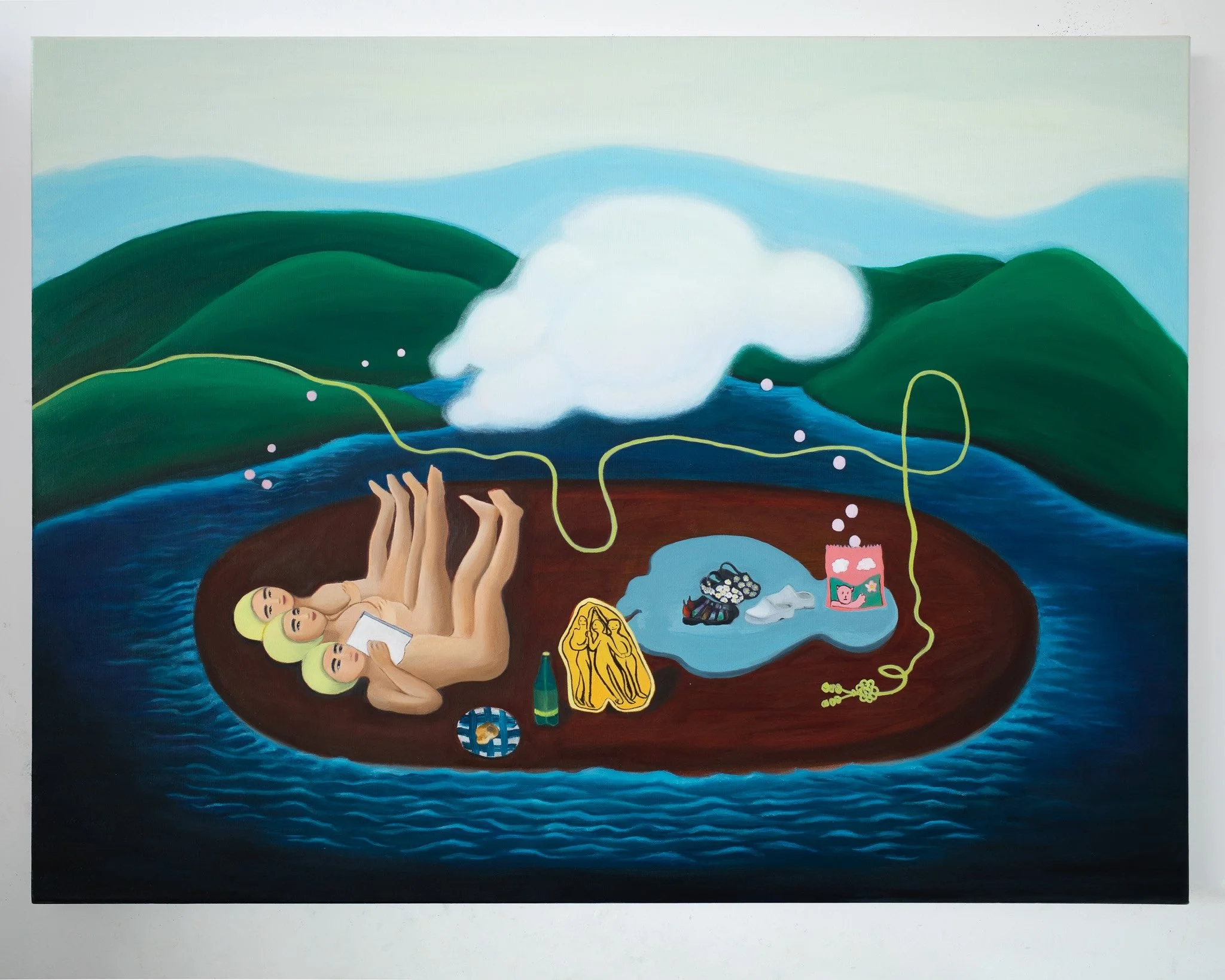
Jessica Wee, Ladies of the lake, 2022. Oil on canvas, 30 x 40 inches.
Image description: Three central nude female figures (Three Graces) lying on their backs on a russet oval in a dark bluelake, legs in the air, against green rolling hills and a pale blue sky with white clouds.
We are back where we began, among the shops of Dongda Street. I am desperate to salvage something of the day. I remember Aili telling our class how much she likes to eat grilled lamb kebabs from the roadside stalls, so I stop at one and signal the man for 10 kebabs and two flatbreads. As soon as she settles on the narrow bench, kneecap poking through rent pants, she orders a beer. I am annoyed until she says, “How much?” and pays the man. She asks if I want some and I say no, so she swigs straight from the bottle.
As we watch the meat sizzle, I say, “Why don’t you stay in Xi’an? English teachers can get very good money. All Xi’an university want English teacher born in America.”
She gulps beer before replying, “I wasn’t born in America.”
“Really?” I say, using a word I picked up from her, remembering to use the rising tone.
She watches the man turn the kebabs, smoke rising from the bubbling flesh. “I was born in Korea.”
“You are overseas Korean?” I ask, surprised.
She laughs in that way that is more like a sigh. “I suppose.”
“How did your family go to America?”
“Ah. It’s difficult to understand. I didn’t go to America with my mother and father. I went alone. In America I am the daughter to a new mother and father.”
Our meat is lifted from the coals, the vendor stuffing the chunks into split flatbread. He hands us the food as I try to comprehend what she has said. “You left your Korean family to join an American family?” I ask in Mandarin.
After taking a big bite, her head bobs up and down.
“You are Korean and not American?” With this news, I am tempted to pour myself some beer.
“Good question,” she says, dabbing at the grease-slicked corner of her mouth with a wrist. “I am American. I am…” A hand weaves in the air, a signal that she is searching for a word. She gives up and says it in English, but I don’t understand.
“Dictionary?” I suggest.
Wiping her fingers off on her jeans, she pulls the dictionary from her bag and tries to find the word with one hand, the other clutching the flatbread. “Yímín.”
I almost choke on my food. “You? How?” She doesn’t look like an immigrant.
She stares at me as if she had never thought about it before. “It was when I was a baby. I had no…” She sighs, fingers the pages of the dictionary. “Kòngzhì.”“Your Korean family give you to American family for you to be American?”
Her head rocks, telling me that she is thinking. “It’s not simple. My father was American.”
“You go live with your father.” I forget to use the question tone, making a statement.
“No. I go live with new family. New mother, new father.”
“New American father?” This time, I use the question tone.
Mouth full of food, she makes a noise I take to be of agreement.
“Strange,” I say. It doesn’t make sense to me. But I know one thing. “Lucky!”
“Am I?” She stares into the charcoal, pulsing with heat that occasionally flicks the air with a hungry tongue. “Maybe.”
“Many people fight to go to America. I want, but too difficult. I must study very hard to pass English exam for university or I must have money.” I set my head to bobbing like I have seen her do when she is excited or enthusiastic about something. “Why not you stay here for teaching me English for university test.” I forget to use the question tone, and it comes out more as a command.
My words bounce off her like the sun’s glare off a window. She looks at me with that tiny smile of hers, and something else. Something unfamiliar. Pity. Is she pitying me? Me, a Battalion Leader in the Young Pioneers and now a prefect in the Communist Youth League. This girl who doesn’t have a real family, a real country, a real history.
“You are nice to ask,” she says in a soft, flat voice.
“I pay,” I desperately croak. A promise I can’t keep.
“Peng.” Surprising me, she speaks in her language. “My boyfriend is coming in one month and we are going to travel in China, then Thailand, then I go home.” She looks at me, eyes glittering with sympathy. “Your English is the best of any of my zhōngguó péngyŏu. And look at you in your Izod shirt. If any of my zhōngguó péngyŏu will make it to America, it’s going to be you.”
She is doing what I have done so many times before, saying no to someone who is desperate for what you have. It is like biting into a bitter, unripe fruit, and I can’t help myself. “You are a waste of good fortune,” I spit in Mandarin. “Through no effort of your own, you are an American. All that America has to offer is yours, but you don’t care, you wear clothes with holes in them and act like a loose woman, drinking beer and smoking cigarettes. A real Chinese would never behave like that.” It feels good to say it, but as soon as my voice evaporates in the air, I know that with those few words, I have wiped out the whole day. My father always tells me to never reveal emotion in network relationships. Nobody wants a weak link.
We finish our food in silence, me devouring the rest in a few bites, she nibbling away until she’s licking the last crumbs from the heels of her hands. Without a word, we both stand. “Peng, you don’t have to walk me to the bus,” she says in my language.
“I want,” I insist in hers.
“It’s so close,” she protests, flinging an arm out in the direction of the bus stop only a few blocks away.
“I go with you.”
She does that twitchy thing with her shoulders. “Alright.”
I know not to offer a ride on my bike, and we walk, me on the street, she on the sidewalk, the silence between us filled by the ticking of the bicycle chain. She doesn’t look at me, but marches along, ignoring the gawks and glances of my compatriots, ignoring my sidelong looks. Too soon and not soon enough we are at the bus stop. “Do not wait with me,” she says, and this time, I know to let her go.
“Good-bye, Aili,” I say.
“Good-bye, Peng,” she replies. “Thank you for showing me your city. It is true that I see new things.” She puts out her hand. Hope stirs in me, and I meet her hand with my own. Squeezing hard, she says, “You and Xiao Gou make a lovely couple, and will have a very prosperous future.”
Of course she’s right. Xiao Gou’s right, too. Aili is not pretty.
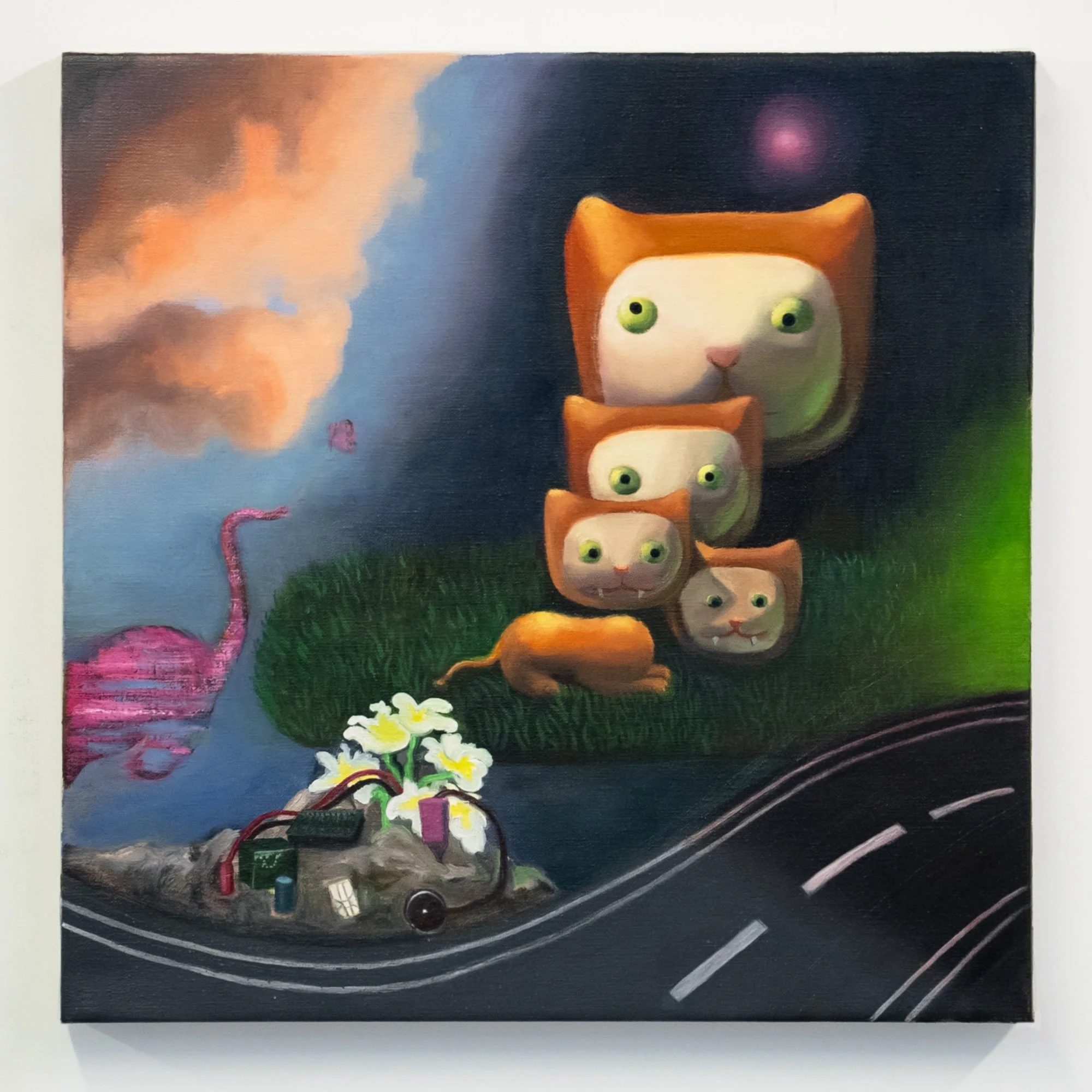
Jessica Wee, Horang-i호랑이. 2021. Oil on canvas, 18 x 18 inches.
Image description: The horang-i guardian tiger of Korean folklore reimagined in a sci-fi context. On the right, multiple orange tiger heads floating above a dark rolling highway; on the left, an orange-lit cloud against a blue sky. More of a cute avatar than powerful guardian, the disembodied tiger questions the place of tradition in a hyper-technologized, uncertain world.
Born in Korea, Alice Stephens was among the first wave of intercountry, transracial adoptees. Author of the novel, Famous Adopted People, she is also a book reviewer, essayist, short story writer, and co-founder of the Adoptee Literary Festival. Her historical novel set in Imperial Japan, The Twain, will be published by Regal House Publishing in February, 2027. “Xiao Gou” is a part of her current project, a collection of autofictional stories on her adoption.
*
Jessica Wee (https://jessicawee.com/) (BFA Concordia University, Montreal, Quebec, Canada; Diploma, Angel Academy of Art, Florence, Italy). Wee was born in the US to Korean parents and raised in France and Canada. Her work explores her experience navigating between cultures by crafting alternate worlds that connect multifaceted layers of identity. Her paintings weave together personal experiences, art historical references, and fantasy, while portraying domestic scenes and quotidian moments where characters appear to transform, multiply, or divide—alter-egos that exude a sense of mischief, independence, and freedom as they soar through space or peer through windows, as if slipping in from another dimension. Wee is currently a 2026 MFA candidate at Concordia University.
“Last names come first in Japanese, you racist piece of—” a brawl, a funeral, and a stolen father in a short story by Jay Lindstrom.