
Welcome to Earth
By Kannika Claudine Peña
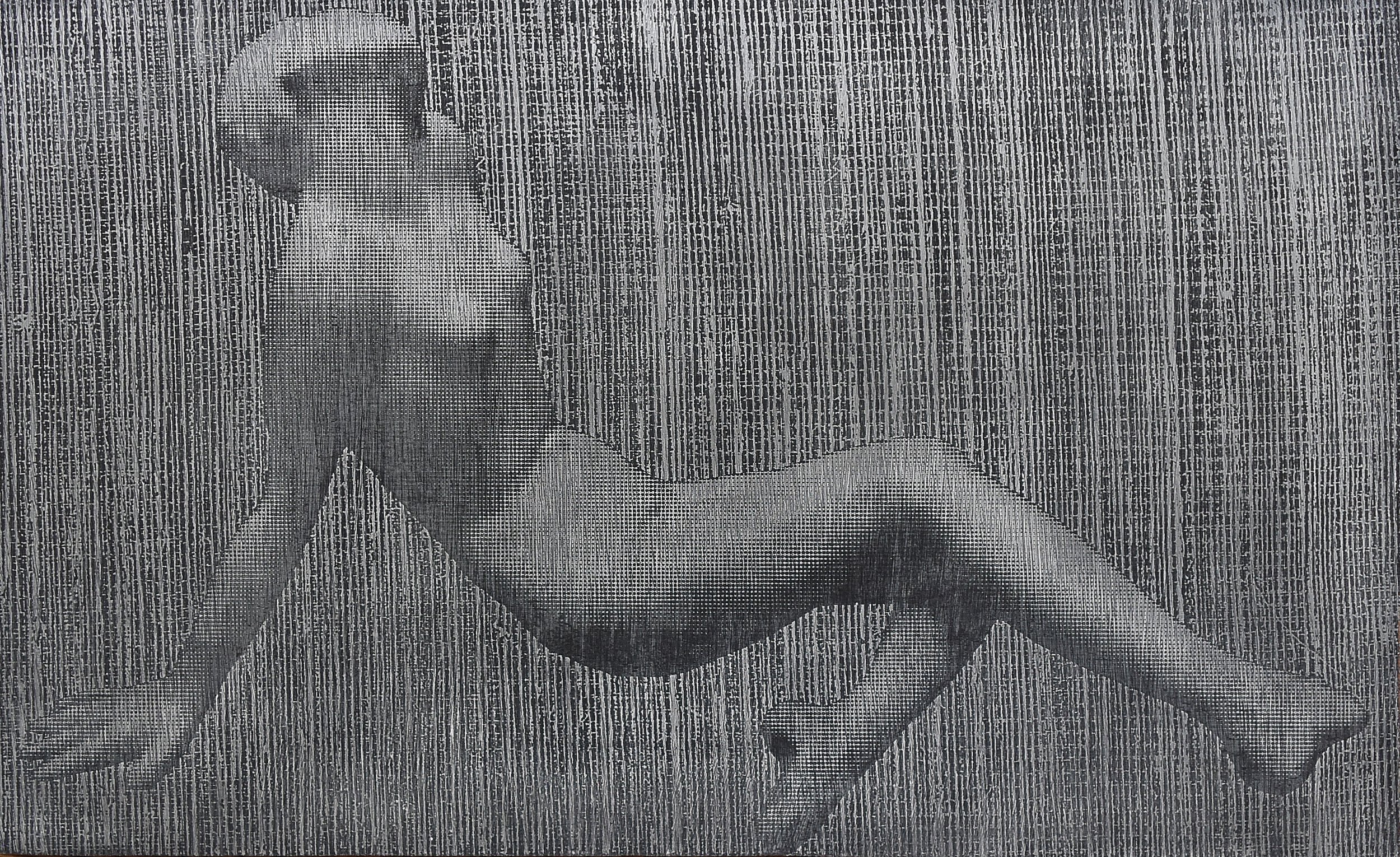
Jill Paz, Figure Drawing 1 (Domestic Abstractions series), 2021. Acrylic on laser-carved wood, 14.5 x 22 inches.
Image description: Reclining female nude in profile floating against a vertically striped background in black and white.
The night before the asteroid was supposed to drop, Tiya Adora barged into my room and told me to get ready to leave.
“There’s no time,” she said.
Until the day she died I don’t think she understood how I was both at home and working. So she felt no qualms pulling me away from my computer. As far as she was concerned, whatever I was doing wasn’t real.
Most days I can’t even disagree with her.
“I’ll be done in three hours,” I said, hoping that in three hours, she would forget.
“Okay, I’ll wait here.” She sat on my bed behind my desk. I could feel her staring at my monitor and it made me angry, though I was sure she couldn’t actually see anything clearly.
In a moment I heard her shuffling in bed; another moment more, she was asleep. Still, hearing her breathing right behind me irritated me to no end. When she died, this very moment crossed my mind: how annoyed I was hearing her breathe loudly in her sleep while I worked.
*
“We can’t drive to Cagayan. It’s too far,” I said, even as I was already behind the wheel. Tiya Adora put her seatbelt on beside me.
“It’s okay. Here.” She pulled out a wad of cash from her bra pocket.
“Money’s not the issue,” I said. Though of course in this economy it was. I took the bundle. It was still warm, and I imagined it was slightly damp. Holding it made me squirm. It was the closest I’ve gotten to a kind of human contact in what felt like years. I resisted the urge to ask her how long she’d kept the cash in there.
“Then what is?” she asked. I was already pulling out of our tiny garage.
I had to go back down and lock the gate before I could argue back. But by the time I had my seatbelt on, it felt like a moot point.
*
My mother basically had to bully me to get me to stay with Tiya Adora. She refused to leave the house, and she needed a caregiver. All the ones the family hired barely lasted a month. So they decided on me. They figured I was an easy target.
In the end, they were right. It really wasn’t that hard for me to say yes. I had no choice; I just liked to pretend I did. So I put up a fight, which my mother kindly let me do.
By then everyone had given up on Tiya Adora. No one could convince her to move away from the old house, which was already falling around her. When you asked her about her life, she would shoo you away and say, “How do you expect me to still remember? Stupid.”
For her, the past was not a source of bittersweet nostalgia, but a deep well of mistakes and regrets. She remembered people for the wrongs they committed, even if she wasn’t involved. Ask her about a neighbor or a cousin, and she would be quick to bring up a catalogue of their past sins. Adela’s children with three different fathers, Tonying with his kleptomania and drug problem, that family who used to rent the house next door—they covered up the abuse of their youngest.
But I don’t think she’s doing it out of spite. It seems that for her, these sins were simply more interesting to remember. Whenever she talked about them, she became more animated than usual. Ask her how she learned about these things, or how sure she was of their veracity, and she’d shoot you a pained look. “How dare you question a woman who’s lived through a world war, a dictatorship, and a pandemic?” she said when I asked her, once.
Whenever we happened to be in the same room, I would often catch her staring at me. When our eyes met, she’d hold my gaze the way creepy children do in public. Perhaps she acted like a creepy child because she’d grown old enough to be treated like one. Whenever my well-meaning dad visited, he catered to her every whim. “O tyang, drink your water. How are you feeling? Let me help you with that. Oh no, does it hurt?” he said in the same tone of voice he used for his only grandchild.
Tiya Adora played along, clearly enjoying the attention but also offended by the sickeningly sweet coddling. “Stop, I’m not a baby,” she would say. If it were my mother, she would go on a whole tirade, but since she never quite treated my father like family, she was a little more restrained with him.
But when he left, she’d complain to me.
“Acting so kind like he’s a saint. Does he think I no longer remember what he did to your mother? Tsk.”
While she liked bringing up people’s old sins, you couldn’t just pull whole stories out of her. It was always up to her, whether she was in the mood to enumerate and elaborate. It’s as if she was informing you that it was up to her which detail warranted forgiving and forgetting, and that she knew more than she let on.
But what I think people missed out in her telling of her stories was that she was waiting for us to ask her, “Well, what about you? What gives you the right to judge?”
She probably wouldn’t have given an answer, but she would’ve liked to have been asked all the same.
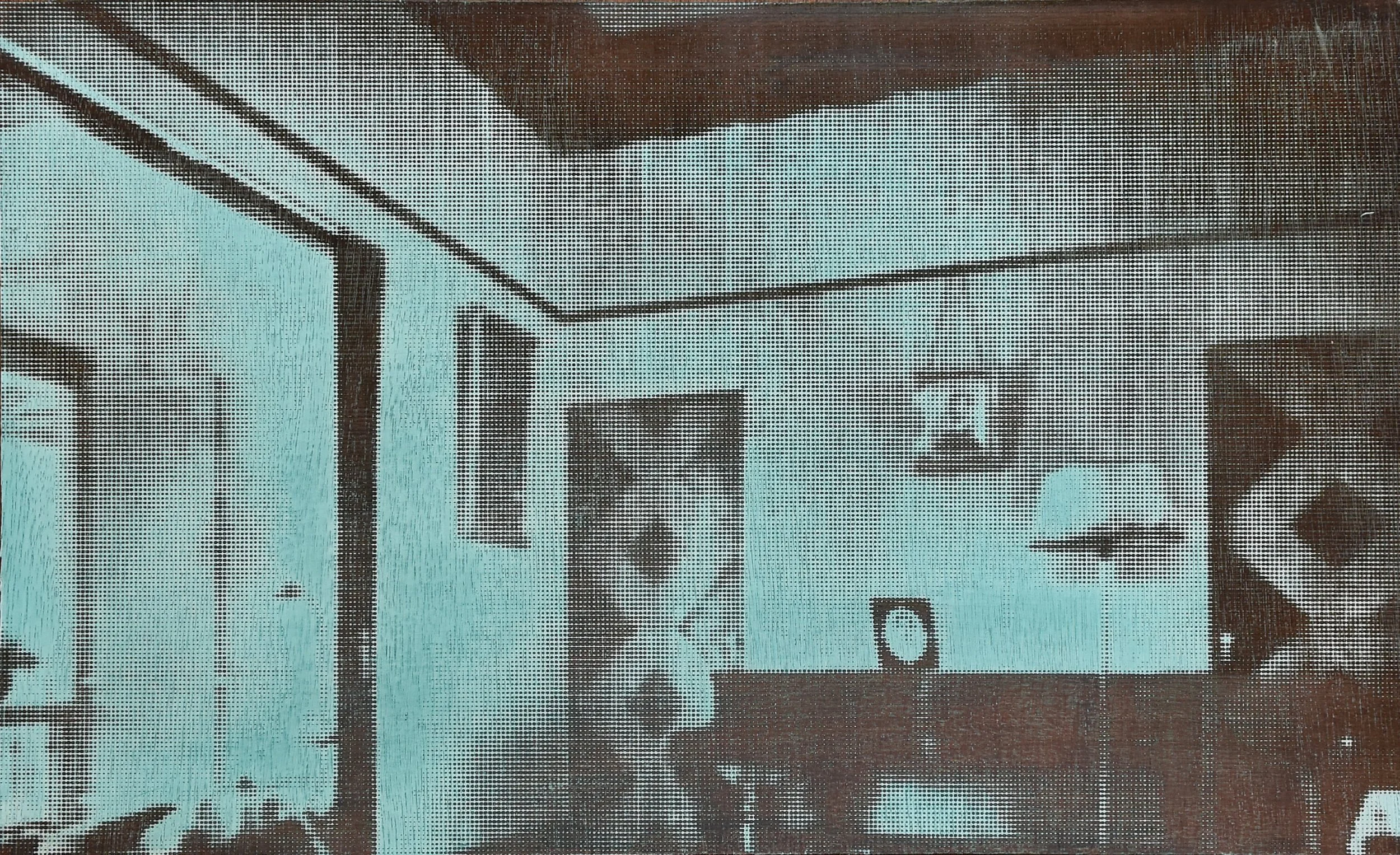
Jill Paz, Living Room, (Domestic Abstractions series), 2021. Acrylic on laser-carved wood, 14.5 x 22 inches.
Image description: A photographi-derived image of a domestic interior with a dot matrix pattern in turquoise and black.
*
“Why don’t you sleep?” I asked.
She had complained about the gas station boy just because he looked at her briefly with sleepy eyes.
“I can’t sleep.”
“Well, try.”
“I’m too excited.”
This was new. I had no idea how to deal with the information. All my life I couldn’t remember a time when she expressed a positive emotion.
“Imagine, an asteroid.”
“Yeah, okay.”
“Are you imagining it?”
“Sure.”
“What do you see?”
“A rock.”
“Kids these days. You have no imagination.”
“But it is a rock, isn't it? Also, I’m not a kid.”
“You’re a child! Admit it.”
It irked me that she’d caught on to something fundamental about me. That I had never felt like a grown-up, that I’d given up on eventually becoming one.
“Imagine the world ending.” She grinned.
“Why would I want that?”
“Don’t you want to start over?”
She made sure to look me in the eye so I would catch her look of pity.
*
Don’t you want to start over? I was a month away from 40, and I was tired. Instead of starting over, what I wanted to happen was for everything to be over. Imagine 20 more years of the same thing. I shuddered and found myself gripping the steering wheel hard. I felt a kind of anger bubbling up in me, the kind I felt whenever I knew I couldn’t say no to another unpaid overtime at work.
To calm myself down, I looked outside and saw a bird perched on a tree branch by the bridge. I couldn’t say what kind of bird and what type of tree. Right beside the bird, piles of colorful plastic bags dangled limply on the branch. I felt embarrassed at the sight of it, as if I were directly responsible for them. Taken apart, all components of the scenery were miracles, sure. Yes, even the way humans had come up with the idea of plastic, the closest we would ever get to actual immortality. But as with anything humans invented…
If the world had the chance to start over, the best thing it could do was get rid of our kind.
I considered saying the thought aloud.
But then a beautiful song started playing on the radio. I didn’t even know it was on. I had no idea who was singing. These days it’s impossible to keep up. Tiya Adora was speaking over the tune, but when she heard the verse before the chorus, her voice started fading away. For a few seconds, we sat in silence, listening, as if stunned into submission. That we were hearing what seemed like the perfect song, a sound that could’ve only been made by humans, made me feel ashamed for even thinking about the obliteration of our species.
I didn’t know what I believed in anymore.
*
“Why do you even want to watch the world ending?” I asked when we stopped at a Jollibee to eat.
“Why don’t you?” she asked.
“If it has to end, I don’t need to be there.”
“But if it ends, we’ll all be there—ended.”
She sat up, as if readying herself for an attack. It made me strangely combative, seeing her that way. I decided to give her what she wanted.
“Have you ever considered that we’re all living in a world that has already ended? How boring, right? That the end should look so much like the only reality we’ve ever known.”
She sighed and rolled her eyes. “I wish you would stop mumbling.” She added, laughing, “This is why you never got married.”
She was, of course, referring to my long engagement. Ten years with a man who, in the end, said, “I’m sorry, but you lost me.” Ten years, I stood by him, turning a blind eye to his mistakes, big or small, trying my best to be good to and for him. There was that year I paid for his one semester of law school, only for him to give up. I didn’t say anything when he did, though maybe I should have. Instead, I put on an encouraging smile and said, “Well, it’s not for everybody.”
I didn’t even bring it up when he broke up with me. He did. He said, “I’ll pay you back.” (He never did.) “You know why I quit right?” (I didn’t. Maybe he was too lazy.) “Because I almost had an affair with a classmate, and I couldn’t do that to you.” (So he had to give up on law school to stay faithful to me?) “Say something!”
“Should I say thank you?” I asked.
In the end, it was entirely my fault that I hadn’t kept his fire going. My mother said, “Well, that’s that.”
I wanted to leave Tiya Adora right then and there. Let her chase the asteroid on her own and die in a place where no one knew her. Imagine surviving through all the world’s worst tragedies and only gaining mastery over how to hurt others in the fewest words possible.
I wanted to tell her no one’s going to miss you. But then she might turn that back around and say the same thing about me.
And the awful thing was she knew I would be the first to agree.
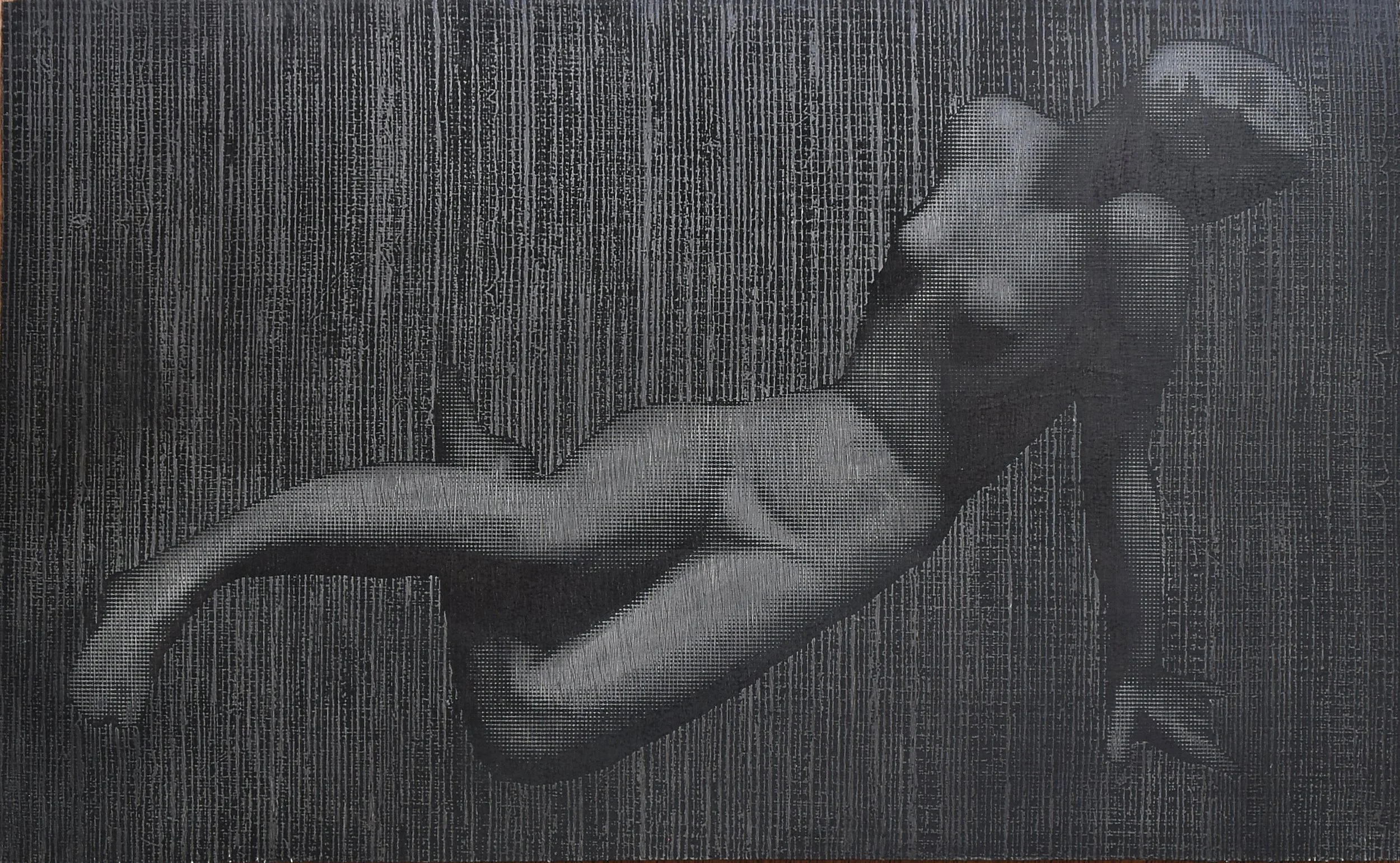
Jill Paz, Still Life Drawing, (Domestic Abstractions series), 2021. Acrylic on laser-carved wood, 17 x 11.5 inches.
Image description: Reclining female nude twisting to face the viewer and deeply shadowed, floating against a vertically striped background, all in black and white.
*
The day Tiya Adora died, she showed me a photo of a man on a boat. And then she waited.
“Who is he?” I asked, barely interested. I don’t remember what was on my mind back then, but I do remember being irked. It was like receiving a hello text from a former coworker, followed by nothing.
“I suppose your aunts and uncles have talked about him,” she said.
“About who?” I asked.
“I exchanged letters and pictures with this man for ten years. And then I learned he was married. His wife wrote my mother a letter.”
For some reason, my first reaction was to giggle. Her ears reddened.
“You’ve never heard this story before?”
I had, but only in bits and pieces. Despite her encyclopedic knowledge of people’s sins, this was Tiya Adora’s one personal entry to the family lore. Because of this, or rather what she’d decided to do with her life after, which was to stop participating in life, as if in penance, the family had graciously allowed her to judge them and everyone else. She, at least, had been willing to sacrifice herself just to spare the world of her mistakes. The least everyone could do around her was allow her to be their conscience.
When I was in my teens, her tale was told as a simple cautionary one. “You don’t want to end up like Tiya Adora.” By the time I was in my 30s, the married women in our family, who seemed to have had enough of married life and wouldn’t wish it on their worst enemies, changed their tune. “Well, it was nice while it lasted,” implying theirs hadn’t been nice because they’d lasted. Sometimes, when they were feeling subversive, they’d even say, “Too bad she didn’t even get some action at least once.”
“Well, what makes you think she didn’t?”
“You know what? I really hope she did.”
But for some reason that day, I didn’t want her to know that. That the rest of our family still talked about her, considered her worth talking and speculating about. I was feeling mean; I wanted her to feel as forgotten as I was. I had just turned 40; I had to actively resist posting on social media something about how life starts at 40, just so people would remember to greet me on my birthday. So, I lied and said, “No, I don’t think so.”
Her face fell. I gave her back the photo. She looked at the man whose face had long faded, put the photo back down on the table, and left it there. I asked her what she was planning to do with her day. “Magpapahinga lang.”
Later, after the first half of my work shift, as I was microwaving our leftovers for dinner, it suddenly occurred to me how quiet the house was.
I opened her bedroom door to peek. There she was, lying on her back. Usually, the sound of the door opening was enough to wake her up. But this time, not a peep.
I called my mother. “I think she’s dead,” I whispered.
“Who—”
“Me.” I thought she was asking who was calling.
“Stop joking around. Who’s dead?”
“Oh.” I had a sudden vision of myself on the same bed, looking much like my great aunt. “Tiya Adora.”
“What, how?”
“She took a nap.”
“Maybe she’s just sleeping!”
“I don’t think she’s breathing.”
“You don’t think, you don’t think! How about you check?”
“Check what?”
“Her pulse. Her breathing.”
I entered the room, slowly, trying to delay the truth. I stood by her side. I wanted to feel something, but the sight of her there, freshly dead it seemed, roused nothing in me. Imagine her alive, I told myself. But somehow, I couldn’t. It was as if all this time I’d known her she had already been dead, as had I. We hadn’t known each other while we were alive.
I grabbed her wrist and dropped it as soon as I did. The wrist lay limp and didn’t even land on the bed. It dangled on the side. Wow, it’s just a body.
Tiya Adora had wanted to tell me her story and I had denied her the opportunity to her face. What had I done? That was her one story, her one transgression. And I’d let it disappear.
In a panic, I said, “Ma, did I tell you about the day Tiya Adora wanted to see the asteroid dropping?”
“Are you sure she’s dead?”
“Ma, just let me tell you the story.”
“Why?”
“Because—it’s a story.”
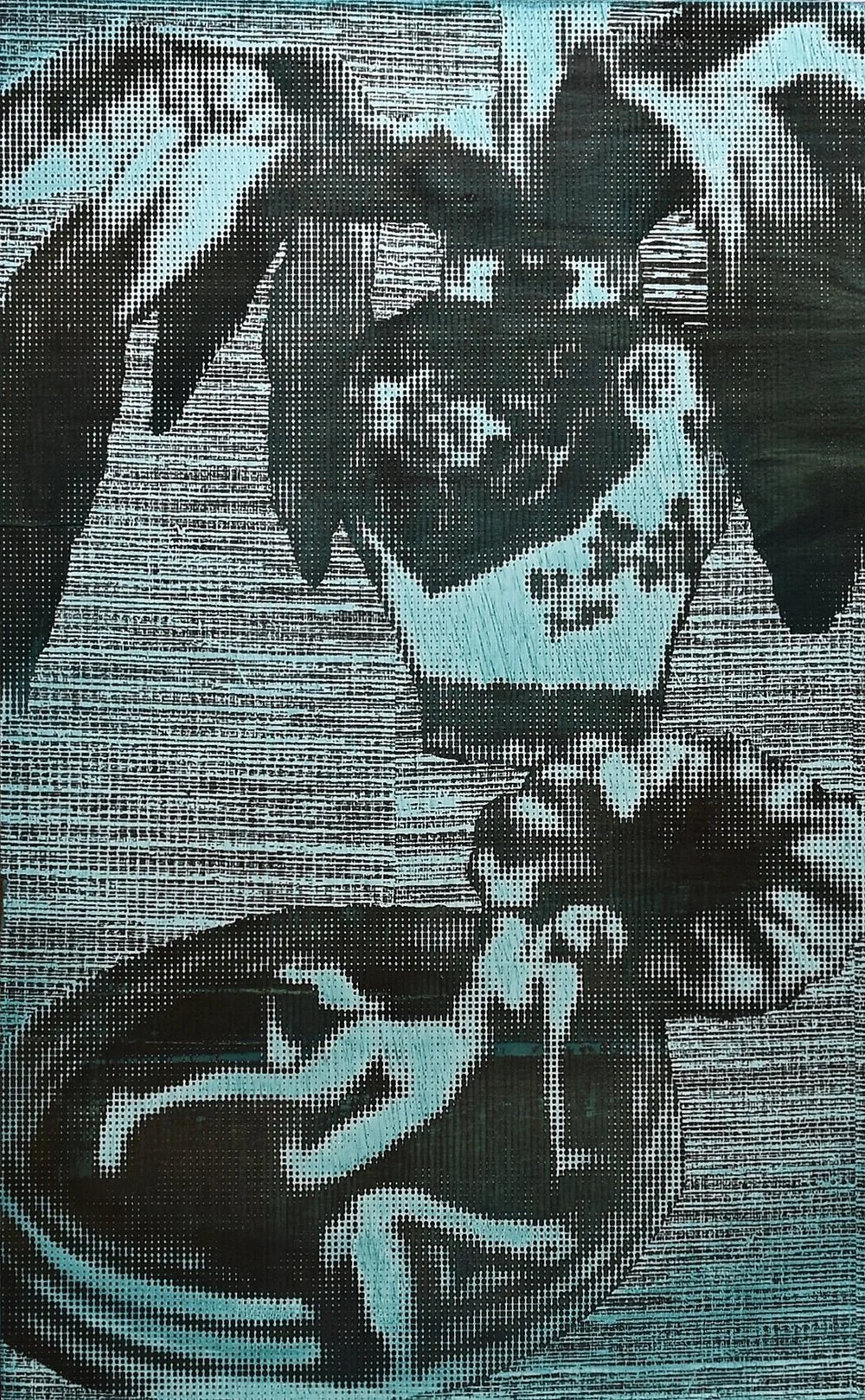
Jill Paz, Figure 2, (Domestic Abstractions series), 2021. Acrylic on laser-carved wood, 14.5 x 22 inches.
Image description: A photographi-derived image of a still life with a dot matrix pattern in turquoise and black, depicting a vase above and a dish below that holds a diminutive reclining female nude.
*
It was daylight when we reached Cagayan. Tiya Adora never knew because she was fast asleep even before dawn broke.
I stopped on the side of the road right past the welcome arch. Then I looked up ‘asteroid Philippines today’ on my phone and found a bunch of videos and photos and news articles. Welcome to Earth, Asteroid RW1! I tapped her on the shoulder to awaken her. She opened her eyes, confused for a second, and then angry.
She hit me on my arm and shoulder. I let her. It didn’t hurt that bad.
“We missed it, didn’t we? We’re still here!” she said.
When she calmed down, I showed her photos and videos of the asteroid sighting that people had posted online.
She fixated on one nine-second video, a shaky vertical shot of the asteroid dropping and exploding in mid-air, bookended by seconds of pure darkness. In the background, a man exclaimed, “Ayan s’ya! Oh my gosh, wow, wow.” The second wow sounded slightly underwhelmed.
“That’s it?” she said.
“That’s it,” I said.
But even amidst her obvious disappointment, she couldn’t quite quit watching the video. No matter how many times she saw the asteroid dropping without consequence, I knew by the look on her face that she was expecting something else to happen, an alternate ending. Or quite simply, a definite ending. A definite end to us all.
As was I.
Kannika Claudine Peña is an author from Bataan, Philippines. Her debut novel, All the Lonely People, was published by Milflores Publishing in 2023. Her short stories have appeared in the Growing Up Filipino anthologies (published by Philippine American Literary House), Novice Magazine, and Philippines Graphic Reader.
*
Jill Paz (https://jillpaz.com) (b. Makati Philippines) is an artist based in Manila. She studied at the University of British Columbia and Parsons School of Design (NY), and received her MFA from Columbus College of Art and Design (OH). Her studio practice is informed by her relationship to her homeland as a Balikbayan, which translates from the Tagalog language to "person who returns home.” The 20 panel paintings that make up Domestic Abstractions, a selection of which is shown here, were produced with a digital optical laser and layered with acrylic washes over a gesso ground to create intricately detailed surfaces. Paz is the recipient of a fellowship from the Greater Columbus Art Council and has compleed and residencies at Ox-Bow School of Art, Banff Centre, Mildred’s Lane, Virginia Center for Creative Arts, and the Philippines Artist Residency Program. Her work has been exhibited widely, notably at Centre Intermondes in La Rochelle, France and Art Basel Hong Kong.
“Last names come first in Japanese, you racist piece of—” a brawl, a funeral, and a stolen father in a short story by Jay Lindstrom.