
Tall Grass
By Alvin B. Yapan
Translated by Christian Jil Benitez
Had Police Officer II Bong and Police Inspector Roman not known that the woman’s husband was already dead, the two would’ve been more persistent with their questions. She didn’t fear the tall grass that grew by the side of the road. Some of its blades arched, even reaching the middle of the cemented road. But the woman didn’t bother avoiding them as she walked, busy as she was answering to her buzzing phone. If she only knew what the two cops were going through, handling the case of a series of murders in the abandoned Springfield Subdivision. The grass that overran the vacant lots were just like this, taller than most people. The lots became a dumping ground for bodies, all of which, according to the SOCO investigation, could’ve been killed by a single person. A serial killer in the Philippines! Would this finally be their chance to prove that the Philippine police could take on a case like this? Bong and Roman couldn’t believe that they’d encounter something like this in their careers. But in the past few days, so many things had already happened to change their minds.
They got out of the police car to talk to the woman. It wasn’t difficult to find her. She still used the last name of her husband, the primary suspect of the murders they were investigating. The only problem was he had long been dead.
“Good afternoon,” Bong greeted her. “Are you Flora Marasigan?” He sounded like he was already apologizing for asking her name. He was worried that he’d need to bring up her husband’s past again. That he’d relive the wounds her family tried to forget.
Flor looked at them without any fear. She’s been expecting them to come. Bong and Roman looked at each other. They weren’t used to being welcomed like this. They were two cops in the middle of one of the poorest towns in Metro Manila. Even those playing basketball in the street stopped when they arrived. Despite turning their backs on the gathering crowd, Bong and Roman could feel people’s eyes on them, wondering what the two cops could possibly want from them.
“Are you Edsel Marasigan’s wife?”
“Yes,” the woman said curtly. Unsure whether she was really unbothered or just putting up a tough act, Bong followed her into her house as she invited them in. Its walls, made from hollow blocks, were unplastered. The policemen wondered how her husband could even be involved to the murders in the tall grass. They thought that one of their relatives must have known about her husband’s past. Or perhaps, someone was copying his old ways to get away from the investigation. Especially when they heard a victim’s family claim that the murderer was the ghost of Flor’s husband returning for revenge. Was it really that impossible to have a serial killer in our country, Roman joked, that this one had to be a ghost?
But Flor didn’t have a single bone in her body that sought revenge. Instead, Bong and Roman felt a sense of resignation from the suspect’s wife. Flor told them how one night, she and her daughter woke to the howling of dogs. The wind was restless. Flor went out of her room. She didn’t have any reason to do so; she should’ve been afraid of what only the dogs could see. But something seemed to pull her out of the house, despite her terrified daughter’s pleas to stay in their bedroom.
“When I opened the door, there was a box on the rug. I knew right away what’s inside. When I opened it, there they were—my husband’s bones.”
“How did you know those were your husband’s bones?” Bong asked.
“Because one day, he didn’t come home. And he’d never leave us just like that.”
“You didn’t bother to know who brought you the bones? Or even go to the police to report?”
“When he was returned to us, I just wanted to be thankful. My husband’s been missing for a long time. My daughter and I could finally sleep in peace knowing where he was.”
“You didn’t think about having it investigated?”
“What for? To lock up whoever killed him? A lot of people get killed out here. We’re just one of many people who had a family member killed. We’re lucky we even got my husband’s bones.”
Bong and Roman could no longer bring themselves to ask Flor whether she knew that her husband had been a hired killer when he was still alive, back during Martial Law at the end of the 70s and the beginning of the 80s. Her husband suddenly went missing after what came to be known as the EDSA Revolution. One of countless desaparecidos. Since then, Flor worked in the town’s health center. She was already forty, around Bong’s age, a little older than Roman. When her phone buzzed again, Flor stood up, saying she had to get going. She had just gone home for a quick lunch, and she had to go back to the health center. She lived alone in their house now. Her daughter had already moved to another country, working as a nurse. With Flor choosing to live a quiet life, Bong and Roman could no longer do anything. Roman understood that the woman didn’t want revenge to forgive her husband’s past. Roman didn’t believe that Flor didn’t have the slightest idea of what her husband used to do. That was her husband, she used to sleep beside him every night; he played with their daughter and joined them in every meal. Perhaps Flor was overcome with certainty that if she learned the truth, she wouldn’t be able to come to terms with the past of the person she once loved and married. Before leaving, Flor told them where they had placed her husband’s bones in the public cemetery.
When Bong and Roman told Joyce about Edsel Marasigan’s bones, she immediately asked the others to come with her to his grave. They had to burn his bones so they could stop the killing ghost. That was the advice given to her by Mario, who has been studying how to appease restless spirits who didn’t get a proper burial. Their group found out that their parents buried Edsel alive in the middle of the tall grass. It had been their revenge for their farmer relatives whom Edsel killed so the subdivision could be built. It was the same subdivision that his ghost haunted, leading to its desertion.
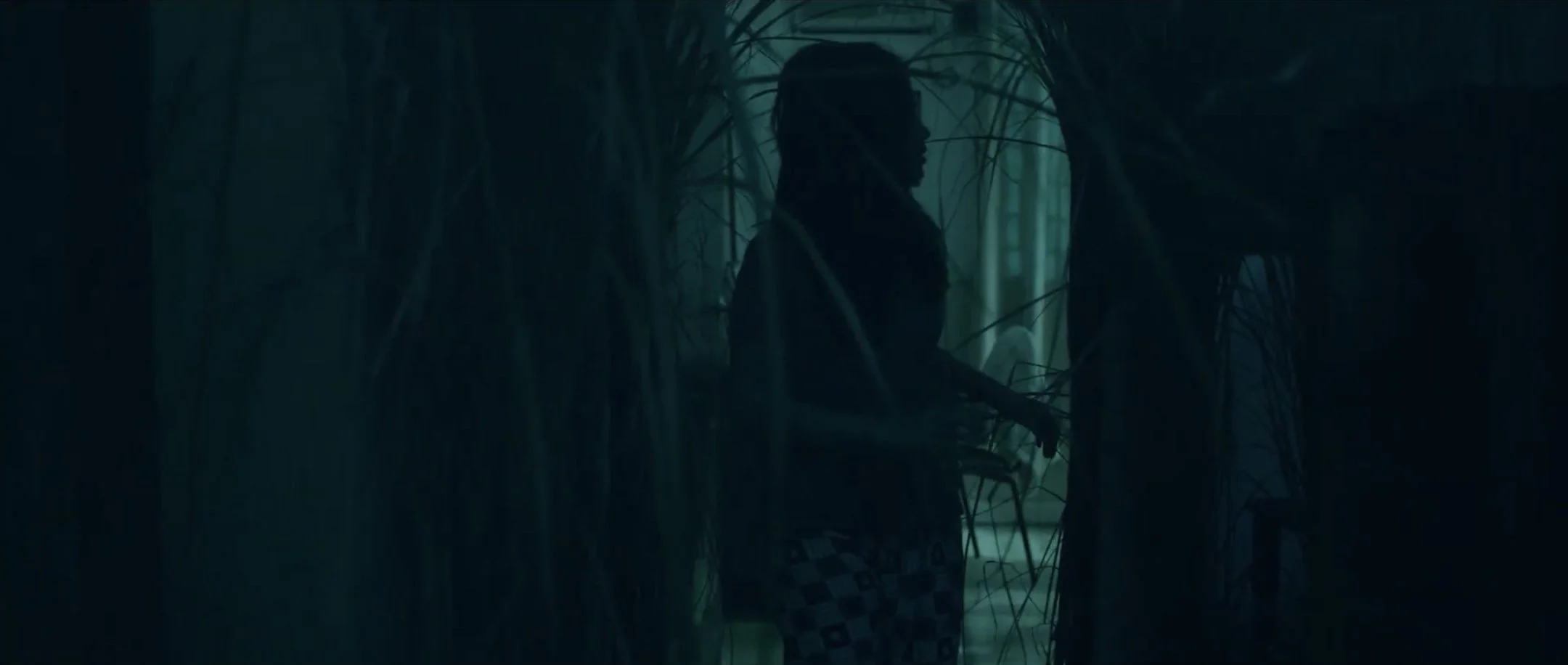
from Talahib (2023) - Joyce
At first, Bong and Roman didn’t think much about the owner of the subdivision. It was unlikely they’d dump bodies in the vacant lots in their own subdivision. Roman even pitied the owners as it has become difficult to sell the lots overrun with grass. Curious, he asked how much a lot would cost; he joked that if it was cheap enough, he’d live there even if it was haunted by a ghost. Just so he could have a piece of land he could call his own. When the two cops visited the owner of the subdivision in New Manila to question him, they found out that the patriarch used to be a military general and was now a cripple; his only son has been long sent to rehab. A security guard watched over the gate of the house, and because they couldn’t show any warrant, Bong and Roman had to force their way inside. When they finally entered the house, the former general was sitting on his wheelchair. He had been staying on the ground floor, so they saw him right away: the nurse was changing the bag at his side which collected his urine and feces. Although he was already paralyzed from his waist down, the general still had the energy to blame his son. How he wasted everything he worked for. He said nothing else to Bong and Roman.
They were almost outside the house when the general’s nurse ran after them. “Stephen’s in a rehab,” she explained, referring to the general’s son.
“He’s kind, don’t hurt him please. Whatever reason you came here for, he didn’t do it,” the guard added, who didn’t want to let them in earlier. It was as if a gag finally came off his mouth. He told him how the general sent Stephen to rehab to protect him from Duterte’s drug war. The nurse agreed. For the longest time, the father and the son were no longer on good terms. The nurse and the guard told their story, as if they’d forgiven the father and the son for their misgivings to each other. But all they could do was to stay silent. They couldn’t tell any of this to their masters.
When they first visited Stephen’s house, Bong and Roman still had no lead on who the killer might be. But each September, a body would be found among the tall grass. So when the patrolling police caught Joyce and her group, Bong and Roman went along with their excuse. They claimed they were spirit questors. The place had become popular because of the restless spirits of the dumped bodies. There were already six of them in their group when they were caught. They’d become close to each other even though they still didn’t know how their parents knew each other. They were all brought together by their common curiosity about the crimes happening in the vacant lots. Vernie and Paul even became a couple. They found each other when they passed by the streets of the abandoned subdivision during a fun run. After twisting an ankle, Paul had to limp the rest of his way. He thought he saw someone looking behind the dancing blades of grass. As his friends teased him, Vernie helped him up. She told him she also saw the shadow behind the grass. Among the six of them, Mario was most fascinated about the stories of haunting in the place. He eventually found Joyce, who also kept an eye for the latest news on crimes in the subdivision. And while Patrick grew up in the US, his parents couldn’t keep him from going back to the Philippines. He decided to write a thesis on the effects of continuous urbanization on the rise of crime in the country. This way, he met Mia, who had the same interests. They were all youths born at the dawn of the new millennium. And though they all grew up not knowing each other, they were all brought together by a secret long kept by the tall grass.
When they were caught wandering around the abandoned subdivision, two other bodies were found among the tall grass. A woman, and a man whom Bong and Roman suspected tried to rape the woman. The woman was a call center agent. She must’ve thought that the killer who saw them among the thicket would save her. Perhaps the woman even urged the killer to murder the man who tried to rape her. Even though the rapist was probably already on his knees, begging the killer to forgive him, that he’d never dare assault someone again. Perhaps the woman thanked the killer, Roman thought, before she herself was finally murdered.
Mario used the incident as an alibi for Bong and Roman. Because the two cops wouldn’t believe them if they told them they were there to end the killings in the tall grass. To the policemen, they were just typical millennials. So Mario told them they just wanted to pray over the place, as part of a tradition during All Soul’s Day, although they were there a month early. Bong and Roman accompanied them back to the old acacia tree where the patrolling police caught them. They lit a candle. When Bong saw the shovels lying around, he returned the machete they confiscated from the group. Bong and Roman didn’t know that that night, Joyce and her group planned to dig up the ghost killer’s bones. They learned that he was buried alive here under an acacia by their parents. They made their parents confess about what they had done. They admitted fear overwhelmed even their conscience. That they no longer knew what was right and wrong. It was their parents’ only explanation. The children couldn’t forgive their parents for the crime they discovered. They felt like they had to do something. To give peace to the restless ghost. Their parents told them many times that their generation just couldn’t understand. That they couldn’t imagine how it was like living in a time with fear of tall grass and not seeing it as a secret place for sexual encounters.
Before Joyce and her group got to dig up the killer’s bones, they were gripped by fear when the tall grass suddenly moved. They heard the grass rustling, though their skin didn’t feel any wind. It terrified them, hearing something that didn’t correspond with what they felt. Vernie felt something poke her. But when she looked down at her thighs, it was only a blade of grass. She thought that the wind must have blown it. But then the blade started coiling around her leg and she felt its strength like a hand tugging her. She fell in shock. Bong and Roman couldn’t believe it; they thought that the group was only pulling a prank. But they saw how a force quickly dragged Patrick away, the tall grass engulfing him. Even Bong and Roman were swept away as Joyce rushed to help her friend. Until Patrick’s screams were muffled too by the tall grass. And then at once, everything went silent. They didn’t know where to go in the middle of the thicket. They no longer had any voice to follow. For a while, they still felt brave: there were still several of them, and only one entity chased them. But when the tall grass yanked Mia away, they saw the shadow of a man behind the grass. Before they could even recognize his face, they saw the sickle on his hand raised in the air. And then, slashing Mia’s neck. Blood spurting everywhere. The blades of grass, sharp as the sickle the man held, were all soaked in blood. The group fled, getting separated from each other, even before Mia’s body fell to the earth trembling. SOCO would eventually find her body, concluding that she died due to asphyxiation. Just like the other victims found among the tall grass. She simply ran out of breath, and her neck wasn’t slit by a sickle.
Shocked, Roman couldn’t call for back-up right away. His radio didn’t work in the tall grass. He could hear the fear in Bong’s voice, as he kept his gun pointed to the grass. With his gun, he followed the rustling of the grass. Something was following them behind the thicket. The killer, hiding behind the grass, was trying to get them one by one. Bong was about to shoot at the shadow; fortunately, Roman was there to stop him. Vernie and Paul were nowhere to be found, separated from them when they all fled, so Bong could’ve mistakenly shot either of them. When Mario saw the grass coming closer again, he slashed at its blades with the machete. Blood spurted again everywhere, as if Mario hacked an arm. They didn’t know whose blood it was. Was it still Mia’s? And where was Patrick? The blades of grass that Mario slashed bled. Bong and Roman couldn’t understand anymore what was happening. They all ran through the tall grass to find their way back to the road. When Bong and Roman finally emerged from the thicket, only Joyce made it out with them.
Joyce was the first to realize that the blood on their body had suddenly vanished. The killer only had power in the tall grass, she realized. It was then that Joyce confessed how they were connected to the killings in the subdivision. Joyce told Bong and Roman about their parents’ crime, which now haunted their children. Bong remembered then what he and Stephen talked about when he and Roman visited him in rehab. He thought that Stephen was just under the influence of drugs. But the nurse who welcomed them said they had to tranquilize him, because the former general’s son might end up flying into a rage again. When Bong saw him, Stephen was staring at a tuft of grass in a corner of the compound. As if he feared that something might come out of it.
Bong tried talking to Stephen. The young man was sitting on a wheelchair, like how they found his father in their house. Bong had to know where Stephen was on the night the call center agent and the man who tried to rape her were murdered. Stephen confessed to Bong. He admitted to killing all the victims. All who had died and were yet to die in the tall grass. He claimed it was him and his father who killed them all. Bong already expected this kind of answer. So he looked for a proof for Stephen’s claim. Perhaps Stephen only saw the victims being murdered. Whoever witnessed such a violent crime would’ve also probably lost their mind. Stephen looked at Bong when the latter told him he could understand the young man. Light passed across Stephen’s face. Bong hoped the young man would finally give him an answer. But Stephen simply asked him a question. Would Bong also turn himself in if he were in his place? He was a witness but hadn’t done anything. Stephen didn’t tell Bong if he or his father had anything to do with the killings. The young man went back staring at the nearby tuft of grass.
Roman got answers for Bong after interrogating the nurses at rehab. It was impossible for Stephen to kill the victims in the tall grass. He’s been inside the center for months, since June. Learning how much Stephen’s stay in the center cost surprised Roman. As it turned out, it cost much more than the small room he rented at the heart of Metro Manila. Perhaps the two cops could return some other day when the young man’s eyes had more light in them. Bong and Roman left Stephen still staring at the grass, as if waiting for something to come out of it. And now, Bong and Roman themselves avoided tall grass whenever they saw it, as if something would also come out from the thicket. This was perhaps the fear that Stephen felt before. It was the same fear they all felt when Joyce explained to Bong and Roman the history of murders in the tall grass she managed to piece together.
But before something came out of the tall grass again, before the blades of grass moved once more, Joyce led Bong and Roman back to the shade of the acacia tree, where they were supposed to dig up the killer’s bones. They had to burn his bones first before the ghost kills her other friends and gets back to their parents. Because children had to carry the burden of the sin of their parents. In the darkness of the abandoned subdivision, Joyce, Bong, and Roman began to dig. There was no time for the policemen to doubt Joyce’s unbelievable explanation of how to appease the ghost. They couldn’t do anything but go along with the story; they didn’t have any other explanation for the bloodbath they’d just witnessed. When their shovels finally hit something solid, they were surprised. It turned out that there really was a coffin buried underneath. And so, they kept on digging. They had to burn the bones of the killing ghost. But when they finally opened the coffin, they were shocked when they found no bones inside. Instead, there it was, Vernie’s body. Joyce jumped right away to the open coffin. It couldn’t be, it couldn’t be that another friend died like this, and in a way that their parents had once killed the killer. Their parents said they even waited two hours after nailing and burying the coffin. Four minutes would’ve been enough for the killer to run out of breath. But they all waited two whole hours to make sure no one would come rescue him. Only after then did they go their own ways, promising each other to carry their secret to the grave. They promised to raise their children without knowing each other for their own sake.
But Joyce was already too late. Vernie was dead. It didn’t even take a day for the police to search through the tall grass in the abandoned subdivision. They found Mario, Patrick, and Paul, all of them dead from asphyxiation. Bong and Roman couldn’t describe the howls of Vernie’s mother when she saw her daughter’s body in the morgue. She didn’t know whom to ask for forgiveness. Should she ask it from Vernie for making her bear the burden of their past? Should she ask it from the authorities, for committing the crime they only did because they wanted justice? And if she were to ask the killer for his forgiveness, who or what should she seek to be forgiven? His spirit? The things he left behind? His family? His bones they could no longer find? Or each other, and themselves? Questions came at the sight of their dead daughter like flowers of the tall grass floating in gentle wind.
Joyce’s parents burst into anger when they found out someone returned Edsel Marasigan’s bones to his wife. Only their group had witnessed the crime they themselves committed. Joyce’s father cursed. Even their daughter, the only one left alive among their children, was put in danger. He called Patrick’s parents overseas. He had to let them know that their son who went back to the Philippines has died. They blamed Patrick’s parents. They were certain it was them who dug up the killer’s bones. In hindsight, they should’ve known it when Patrick’s parents suddenly went abroad. Perhaps their guilt got to them, so they dug up the killer’s bones and returned them to his wife. Joyce realized there was nothing else they could do, no matter how much they blamed each other. But she didn’t understand that they weren’t simply blaming each other but apologizing to each other. Because sometimes, blaming another is just a ruse to ask for forgiveness.
When Bong, Roman, and Joyce went to the public cemetery to look for Edsel Marasigan’s bones, they thought the bones might help build a case against Joyce’s parents. Though they already confessed to the crime they committed, they still hadn’t found any evidence. They had to make sure that the prosecutor would have a case to file, even if Flor Marasigan wouldn’t want to be a part of it. Joyce’s parents could retract their confession at the last minute. They were no longer a family of farmers. They now lived in a subdivision whose very construction their own ancestors once protested. They all made careers that had nothing to do with soil. They raised their children far from the earth.
When Bong and Roman found Edsel Marasigan’s name on the stack of graves in the public cemetery, they quickly hammered on his gravestone to open his niche. No one was around to stop them. Flor didn’t lie: inside was a sack of bones, which they presumed to be Edsel’s. Flor and her daughter didn’t bother building a box for Edsel’s remains. Or even looking for one made from cardboard. Bong and Roman wanted to take the bones as evidence, but Joyce stopped them, begging them. She couldn’t let the bones of her friends’ murderer simply remain evidence. She had to burn his bones. For the sake of her friends’ souls. For the sake of her own peace. Because amid the terror of the tall grass, Joyce couldn’t believe only she survived. She couldn’t forgive herself for being the only one to survive among her friends. Joyce pleaded that she would testify against her parents, if Bong and Roman would give her the bones of the killer ghost.
Bong and Roman argued over Joyce’s plea. Roman was surprised that Bong was willing to give way to the young woman. After all, the killer’s bones were useless to them now; Joyce’s promise to testify against her parents would be far more helpful. But Roman wouldn’t budge. He didn’t believe Joyce’s explanation. Her testimony would be weak because she didn’t witness her parents murdering the killer. They had already visited Stephen again by then, who was ready to talk to them after being told about the terrifying things that happened to Joyce’s friends. Bong and Roman already knew then what he was looking out for behind the tall grass. Stephen’s testimony, which gave them the name of Edsel Marasigan, would be more powerful. It was because of him that they were able to find Edsel’s wife, and eventually his bones. So they needed Stephen’s testimony more. How he discovered it was his father who paid Edsel to scare and kill Joyce’s farmer relatives. Only then would Joyce’s parents be compelled to confess to their own crime. They’d be compelled to confess they all made a mistake in chasing down and murdering the killer. Because by putting justice in their own hands, they couldn’t trace the series of murders back to Stephen’s father. Only then would the former general and Joyce’s and her friends’ parents would finally come to face each other. They didn’t need Joyce. Bong left Stephen his phone number. They just had to wait for his decision to testify against his father.
Bong and Roman argued over Joyce’s plan to burn the killer’s bones. What would happen to other cases that didn’t have anything to do with Stephen’s and Joyce’s parents? To the hauntings in the tall grass? How would the spirits of those who were murdered and abandoned in the tall grass be appeased? They had to stop the endless cycle of violence in the tall grass. Bong reminded Roman that they had no way to make Edsel’s bones evidence to prove that he himself was murdered. They didn’t need Edsel’s bones to file a case against Joyce’s and her friends’ parents. Only bones were left of him; there was no more flesh to examine. They weren’t like the police in other countries who had sophisticated tools for investigation. And they were running after a ghost. But because the two cops couldn’t come to an agreement, Roman decided to leave Bong alone in handling the case.
“I can’t do cases like this anymore, Bong. Should we chase those we can’t put behind bars as far as afterlife?” That was Roman’s farewell to his fellow cop investigating the murders in the tall grass. He didn’t go with Bong and Joyce to the mortuary to burn the killer’s bones to ashes. He didn’t even help them return the gravestone back to the niche, so no one would realize someone had stolen the bones inside. When they were handed the ashes, Bong and Joyce didn’t know what else to do. They simply left them along with other unclaimed ashes. The government would know what to do with them. Joyce was left wondering. What was the logic behind the need to burn the killer’s bones? Mario was no longer around to ask about his research on vengeful ghosts. Was the burning of the killer’s bones also vengeance on her part, or was it an act of letting go? Because where does vengeance end and letting go begin?
Later that night, Bong woke up to Stephen’s call. He said he’d never forgive himself if something happened to Joyce. Like how he wouldn’t forgive himself for what he had done to his father. Bong thought Stephen called to let him know he was now willing to testify against his father. Still dazed, Bong couldn’t understand him. Stephen said the killer visited him in his house, thanking him. Thanking Joyce. For if it weren’t for them, he’d never get to leave the tall grass. But now, he was finally free to go wherever he wanted. He didn’t need to stay anymore in the abandoned subdivision where his body was buried. They gave him freedom by burning his bones.
Stephen woke up in the middle of the tall grass. But he was still lying on his bed. Looking up, he could still recognize the ceiling of his room. His nightmare didn’t bring him to the tall grass; the tall grass visited him in his room. He woke up with their house overrun by grass. With a gun in his hand, he chased the killer peeking through the blades of grass. When he went out of his room, the grass got even thicker down the hallway. When they lashed, the blades could wound, so they slashed at Stephen’s arms and face. He couldn’t put down the gun in his hand aimed at the killer, though he knew well enough that bullets wouldn’t hit the ghost. He didn’t even pray for the repose of the spirit who was once a killer. Stephen’s rage was on his gun, so he fired at the killer who only laughed and laughed. Suddenly, the tall grass vanished, along with the echoes of the killer’s laughter. Stephen thought he finally woke up from his nightmare. But flowers of the tall grass swarmed their house, floating everywhere. Flowers that were ready to take root inside the house, waiting for the right time to grow once again.
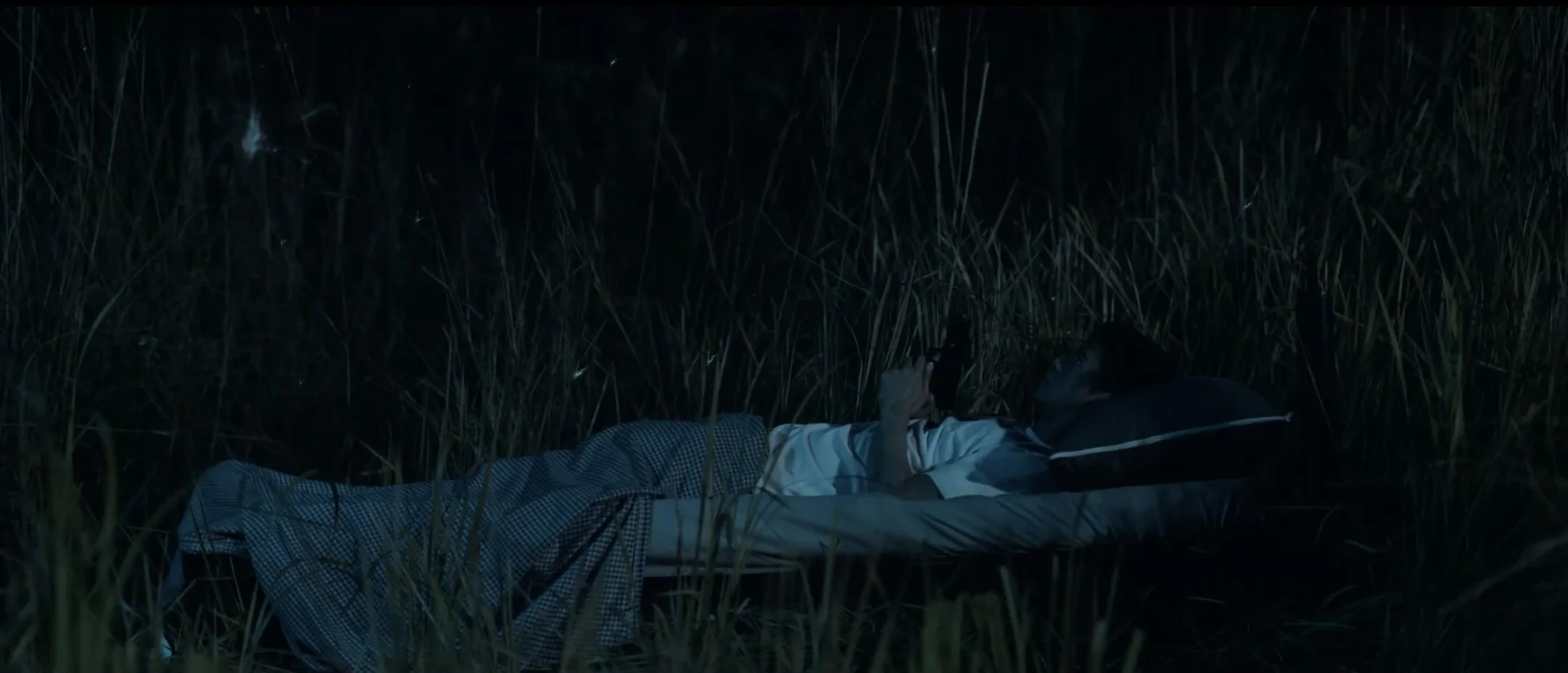
from Talahib (2023) - Stephen
Driving the police car, Bong went to Stephen. It was him who knew where Joyce lived. As soon as they arrived in Joyce’s house, they heard her scream and rushed inside the house. When no one opened the door despite their frantic knocks, they forced it open. They realized then they were already too late. They couldn’t come inside the house because it was already overrun with grass, blocking the door. Bong felt the grass still growing. They couldn’t force their way into the house. No matter how hard they tried to cut the tall grass, he knew it would only grow back over and over. Like the grass that Bong himself would cut down every so often around his father’s grave.
Bong visited his father once before he and Roman went to Edsel Marasigan’s wife. He didn’t know what to do during his visit to Flor. Whether he’d tell Flor about her husband’s past. Though he knew there would be no answer from the afterlife, Bong still talked to his father. Asking whether he heard him. Whether it would be better if Flor didn’t know about her husband’s past. Whether there was a way of knowing the answer for things like this. He asked if it was more important to just forgive. Between his doubts and fears, Bong asked his father how he himself became a cop. More questions hovered above his father’s grave.
Bong and Stephen were forced to part the tall grass inside Joyce’s house, and each time, they would see a chair. A table. A cabinet. But they didn’t know where they were inside the house, whether in the kitchen, the living room, or one of the bedrooms. Bong suddenly felt something moving behind them. He turned and aimed his gun. They didn’t stop calling out for Joyce. He and Stephen couldn’t hear her screams anymore when they went into the tall grass. The rustling of the blades of grass drowned all noise, all screams, cries, and pleas. Only fear remained as the grass bent and danced. A fear that shook him and Stephen. Making them feel small. And then, something rustled again behind them. Bong almost fired his gun; if Stephen didn’t stop him, he would’ve shot Joyce. With Roman no longer around, Bong was thankful Stephen was there, because the one moving behind the rustling blades of grass turned out to be Joyce. Bong felt afraid of his own gun. He apologized to Joyce. He didn’t know it was her behind the grass.
But before Joyce could even answer him, she noticed the blood on her hands. Joyce realized she was also holding a knife. She looked at Bong and Stephen. Whose blood was on her hands? She thought that in the tall grass, all the blood wasn’t real. But the blood on her hands stayed even long after the grass had vanished. The bed finally returned inside the bedroom, the table to the kitchen, the sofa to the living room. And by her feet, they saw Joyce’s parents’ bleeding bodies. Joyce was horrified upon seeing her parents’ bodies. She couldn’t understand. Their bodies were riddled with stab wounds, soaked in a pool of blood. And Joyce was holding the knife. She ran after the killer in the tall grass that grew inside their house. She was just fighting for her life. She looked at her bloodied hands. She looked at Bong and Stephen. Bong couldn’t do anything but point his gun at her once again.
Stephen went pale. Something suddenly dawned on him. He looked at Bong’s gun. He remembered also firing his gun in the middle of the tall grass that grew inside his own house. He remembered walking through the grass. He remembered chasing after the killer in the tall grass. He remembered the ghost smiling after he shot him. Stephen remembered his father. He remembered his father who stayed on the first floor of their house. He remembered the tall grass that grew by the stairs when he followed the killer. Stephen couldn’t move. He couldn’t look away from Joyce, who killed her own parents in the tall grass. Stephen remembered his father, who asked him if they could just forget everything and leave the past behind. To let it stay buried, like the killer whom Joyce’s and her friends’ parents buried alive in the middle of the tall grass. Stephen stared at Joyce. He didn’t want to look away from Joyce. As if time stopped at that moment. Could he still ever go home? Stephen didn’t want to know what he had possibly done to his father. He wanted to stay in that moment. And just like him, Bong also couldn’t move, and wouldn’t move, still pointing his gun at Joyce. He didn’t know whether to arrest the young woman or help her.
Joyce let go of the knife she was holding, its sharp clink dulled by the pool of blood on the floor. She didn’t know what she had done. She really didn’t know what she had done. She remembered the knife going through the killer’s flesh. She remembered hitting the bones in his body. But how could a ghost ever have flesh and bones, she asked herself as she stabbed the killer’s body. But she didn’t care anymore. As long as she chased the killer. Killed the killer. As long as the violence in the tall grass finally came to an end. She had to bury the knife over and over in the body. But it turned out to be not the killer’s body, but her parents’. She no longer recognized them in the thicket. It wasn’t her fault. She didn’t know. It was then that Joyce realized she couldn’t blame herself. She found herself asking herself for forgiveness. It was too late when she finally understood that not only was asking for forgiveness fearful, but that fear itself was also at the heart of forgiveness, and it was the kind of fear that hides among blades of tall grass.
Translator’s Note
Alvin Yapan’s “Tall Grass” follows two policemen, Bong and Ramon, and a group of millennials, led by Joyce, investigating a series of murders in a vacant lot overrun with tall grass (Saccharum spontaneum), locally known as talahib. Previously unpublished in Filipino, the story was first adapted as the full-length feature Talahib (Legends of Tall Grass, 2023), directed by Yapan himself, as part of the Sinag Maynila Independent Film Festival.
The story evokes the familiar trope of two cops trying to solve a mystery in an eerie location, and so responds to a cultural question that has long been posed to the Philippines: is it even possible to have a serial killer here? Through one of his characters, Yapan answers yes, and “this one [has] to be a ghost.” For in making the serial killer as such, the story reveals the contemporary series of murders to be enmeshed in the much larger history of the country—from the land grabbing and other human rights abuses under the dictatorship of Ferdinand Marcos, Sr. between 1970s and 1980s; to the extrajudicial killing during Rodrigo Duterte’s so-called “war against drugs” from 2016 to 2022.
In translating this winding story, aside from tuning in to Yapan’s signature rhythmic prose, I also had to attend to the different timeframes at work, disentangling them to an extent in English from their virtual concurrence in the original Filipino. This translation then, more than a carrying over between languages, is a navigation, too, between temporalities: coming from Filipino, where all the actions might as well be happening in the same present, the story, to be rendered legible, if not legitimate, in English, needed its events to be somehow delineated from each other and sequenced, by way of verb tenses. Therefore, in the sudden narrative turns in the present translation which may jar readers, what presses—haunts—is panahon, Philippine temporality, from the other side.
Alvin B. Yapan is a writer of fiction in Filipino, with works including the historical novel Ang Sandali ng mga Mata (Time of the Eye, 2006), which won a grant for the English translation of Christian Jil Benitez from PEN Presents x International Booker Prize; and the short story collection Sangkatauhan Sangkahayupan (Humanity Bestiary, 2016). Both works received the Philippine National Book Award. His novel Sambahin ang Katawan (2011), translated into English as Worship the Body (2024), was published by Penguin SEA. His research focuses on folk aesthetics, the epic genre, and literature in Filipino, with his book Ang Bisa ng Pag-uulit sa Katutubong Panitikan (The Efficacy of Repetition in Folk Literature, 2023) winning the Philippine National Book Award for Literary Criticism and Cultural Studies. He teaches Philippine literature at Ateneo de Manila University and is also a filmmaker.
Christian Jil R. Benitez is a Filipino poet, scholar, and translator. He finished his PhD in comparative literature at Chulalongkorn University, Thailand. He teaches at the Ateneo de Manila University, in the Philippines, where he earned his AB-MA in Filipino literature. His first book Isang Dalumat ng Panahon (ADMU Press, 2022) received the Philippine National Book Award for literary criticism and cultural studies. His translation of Jaya Jacobo’s Arasahas: Poems from the Tropics (PAWA Press and Paloma Press, 2024) was a finalist in the 37th Lambda Literary Awards. He was also among the inaugural winners of PEN Presents x International Booker Prize for his sample translation of Alvin Yapan’s Time of the Eye (Ang Sandali ng mga Mata, ADMU Press, 2006).

“Last names come first in Japanese, you racist piece of—” a brawl, a funeral, and a stolen father in a short story by Jay Lindstrom.