
He Was Cool
By Justin Wu

Franklin Lei, Late Night Dessert, 2018. Oil paint on board, 8x10 inches.
Image description: Chinese corner restaurant with a brightly-lit interior in white, yellows, and gold, as seen from the exterior through its windows from the darkened street at night. A car is parked outside, and silhouettes of people dining inside are visible.
My grandpa was cool. He was one cool dude. He wore his cap like they do in the music videos. With his brim down low and over his eyes, he possessed a mystique, a morning fog kind of feel.
He wore tons of different caps, with tons of different logos. Warriors. Giants. I Heart SF. Each one was different, but every one smelled the same, of dandruff shampoo, medicine for the hair. To a six-year-old me, that was the stuff. The medicated stuff that smelled of cool.
To be cool like him, I’d grab a cap from his stack. He’d stack them on the banister beside the stairs. I’d pluck one off the top, stuff my head right inside, adjust the straps or the Velcro or the strip with the teeth. No matter what I did, his caps never fit. My head was too small or too flat in the back. He’d grin from time to time, then say a few things, and though my Cantonese was piss-poor (and still is), I’d understand the gist of what he was saying. In that melodic yet forceful mother tongue of his—don’t worry, hou jai, you’ll grow into it someday.
We’d roll out on school mornings, down to the bus stop, with him in a cap and me in a cap. We’d roll to the donut shop on the corner, where the nice old lady would hook us up with freebies. She’d speak Cantonese with Grandpa, and I’d blink and nod as they did their Canto thing. They’d chat about my school, chat about the block, chat about which market had the best deals on bok choy, and after all that chatting, and me standing silent, she’d smile and slip in an extra something for our order. Didn’t matter that the only Cantonese I’d said was hello and thank you. I looked the part. Amazing what sharing a language will get you. One glazed donut with the rainbow sprinkles.
That’s how the years passed, kindergarten to fifth grade. To and from school. Donuts and buses. We’d lean against a wall, cross our arms at our chests, and pose with our caps shading our eyes. He’d handle everything—the snacks, the bus fare, the books in my backpack I never felt like carrying. And we’d stand and wait, and I’d stand and eat, and he’d offer his donut if I were still hungry. People passing by would flash us their smiles. My, my, look at those cool dudes.
Then one morning, something went down. Something to shake up our daily grind. The lady at our donut hookup was nowhere in sight. Someone else took her place, towering over the counter. He smiled, at first. But he most definitely didn’t speak Cantonese.
“What will it be?” the tall man said.
My grandpa pointed at our usual donut.
“Is it the chocolate? Do you want the chocolate?”
Grandpa shook his head, pointed closer at the glass.
“The glazed? The maple? What do you want?”
More pointing, head-shaking, Grandpa tapping on the glass.
“For Christ’s sake man, in English. ENGLISH.”
The pointing didn’t stop, the finger-tapping didn’t stop, the tall man’s cries for English didn’t stop, and I didn’t speak up, didn’t bother to help, my face burning as red as the HOT DONUTS sign. English. English. I had forgotten all English. And Grandpa’s English was as poor as my Cantonese. He knew the word donut. Knew how to say sweet. But Vanilla-Frosted glaze with the rainbow sprinkles? I had a better chance of writing my name in calligraphy.
I sweated under my cap, a cap that wasn’t cool. A grandpa who wasn’t cool. Who couldn’t even order a donut. No matter how he wore his cap, or what was on his cap—the Golden Gate, Niners, Property of Alcatraz—he’d never be one of those dudes in the videos, their caps pulled low on MTV. He was that dude from China, where they had that funny language, the source of all the ching-chongs hollered at me during recess.
“Sprinkles.” The tall man held a donut in his tongs. “What you want is spring-kuhls. Spr-i-i-i-ng-k-u-u-uh-ls.”
I rushed out the shop. Didn’t say a word. Ten-year-old me had to save his own cool. Grandpa followed soon after with the donuts in his hand. He held out the bag and rustled it at me. I turned my gaze to the street, not looking at him, not looking at anything except for the bus, which would take me away from the donuts, the shop. The very tall man who talked to us like we were three. And Grandpa just stood, rustling that bag of donuts, signaling over and over, eat, eat. I couldn’t tell him no or that I wasn’t hungry. Or step back and pretend like we weren’t related. Amazing what not sharing a language can do. An ocean of silence between Grandpa and me.
With my eyes straight ahead, I slunk down the block, past a storefront or two to put more distance between us, but my grandpa, those donuts, they kept rustling after me, and I lengthened my strides to escape them. Too tight, I remember. The cap was too damn tight. I yanked the thing off to air my brain out. The scent of dandruff shampoo faded into the fog, and with it, so did the rustling behind me.
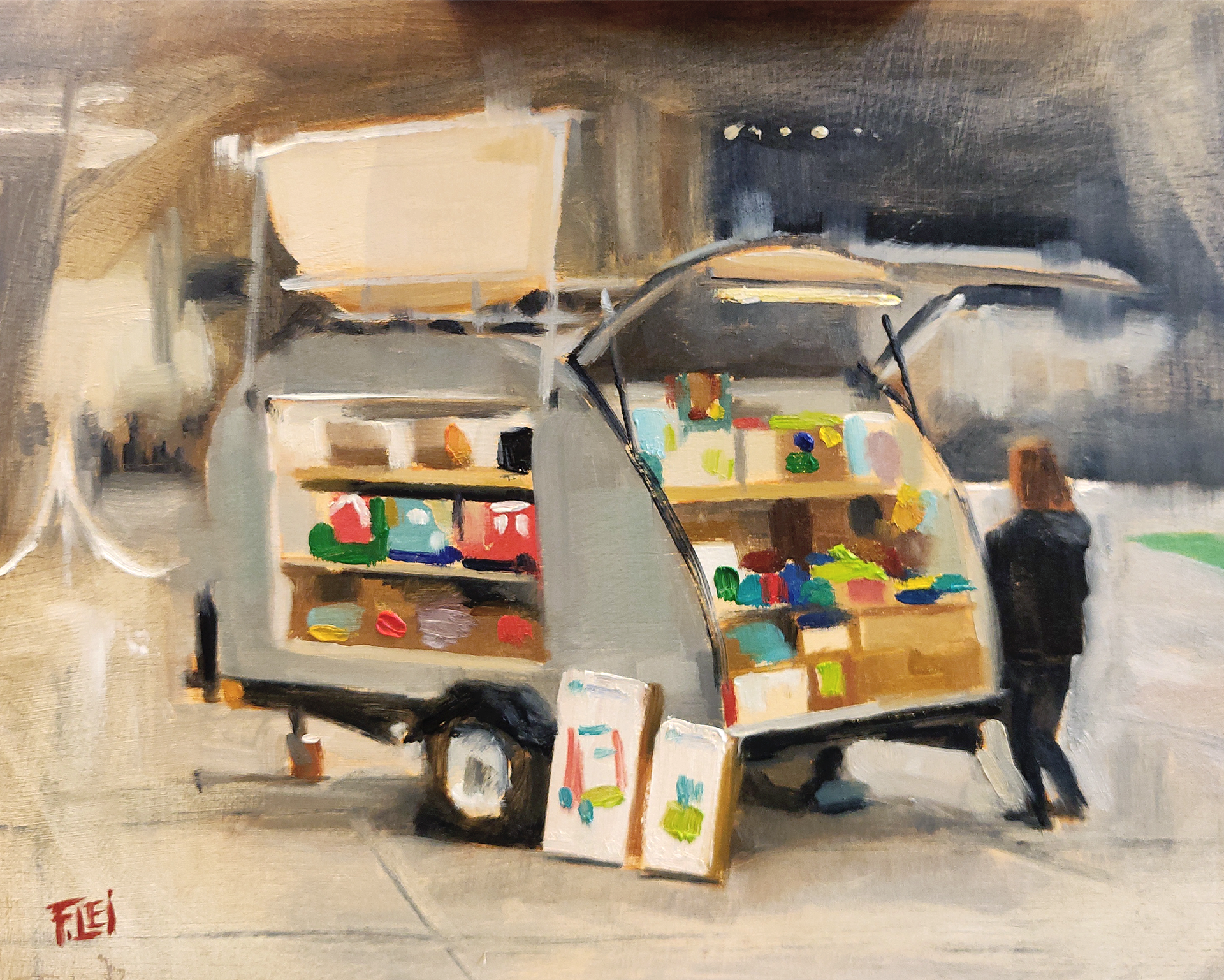
Franklin Lei, Toy Cart, 2018. Oil paint on board, 8x10 inches.
Image description: A small grey, two-wheeled trailer displaying brightly colored toys stands at the center of the picture. The lone figure of a red-haired woman dressed in black, perhaps a potential buyer, stands while browsing. The background is of pale brushy washes in grey and umber.
*
I chugged the rest of Grandpa’s soup and pushed my bowl aside.
“Mom,” I said.
“Hmmm?” Mom said.
“From now on, I want to take the bus by myself.”
Mom set her bowl down. She leaned forward in her chair. Steam billowed out from the rice cooker on the counter.
“What do you mean?” Mom said.
“I’m old enough,” I said. “I can go to and from school all by myself.”
Mom glanced at Grandpa. Grandpa picked at his fish. With his chopsticks, he plucked the bones from the belly.
“What’s wrong with your gung-gung?” Mom said.
“Nothing,” I said.
“You always go with gung-gung.”
“I told you, I’m old now.”
“Did something happen this morning?”
“I never said that.”
“Then why all of a sudden?”
“It’s not all of a sudden.”
Grandpa kept at it, picking at his fish, and I knew that he knew the words bus and school. He didn’t look up. Not even once. His chopsticks clinked at the sides of his bowl.
“Do you know the way?” Mom said.
“With my eyes closed,” I said.
“Are you sure you can handle it?”
“It’s cool, Mom. It’s safe.”
“All by yourself?”
“I won’t be alone. All of my friends take the same bus home.”
If Grandpa understood, he wasn’t letting on. He deposited his fish bones, one by one, onto a napkin over the table.
“I don’t see why we need a change,” Mom said. “Your gung-gung has always kept an eye on you.”
“I told you, Mom. I don’t need a babysitter. And don’t you think he’s got better stuff to do? Him and Grandma can bus to Chinatown. They can finally make it to happy hour at Fung Wong.”
I had come prepared, had brainstormed the whole day. Couldn’t focus in class. Didn’t even finish lunch.
“I don’t know,” Mom said. “Let’s ask your gung-gung.”
Official translator. That was my mom’s role. Any convo requiring actual phrases between Grandpa and me had to go through her. My usual gems, such as I’m full or go bathroom, wouldn’t cut it at that moment. Mom was our lifeline. She spoke to Grandpa, and he spoke to her, Canto to Canto, as I followed along. My ears perked up to the bits I understood. Or thought I understood. Grandpa nodded at Mom.
“You’re lucky,” Mom said. “Your gung-gung agrees. One week, okay? One week to start out. If one week passes without any problems, then we’ll see if we can do a whole month.”
I pumped my fist, grabbed my chopsticks, and drummed them over the edge of the table. Grandpa stared, just sat there and stared, and without his cap on, I read his eyes clearly. Didn’t need Cantonese to read his eyes. I stopped with the drumming and gazed into my bowl. He whistled at me, forced out a smile, and forced out some words I got the gist of. In that mother tongue I had little care for—you’re growing up, hou jai, I can see you’re growing up.
*
He didn’t look nasty. Not like how I’d remembered. He looked pleasant that morning. Must’ve had coffee.
“What will it be?” the tall man said.
Calm and cool, I looked up at the man. No pointing for me, no tapping on the glass. I knew what I wanted. Knew how to say it. In my best English, I told him my order.
“One vanilla-frosted donut with the sprinkles on top.”
I articulated, yeh, articulated like crazy. I didn’t rush my cadence, didn’t mess up my plurals, didn’t mispronounce the letter r as w. Spwinkles, pwease. That would’ve been bad. I dictated as if being recorded, a sound bite for education, one for the language labs, the ESL classes all across the globe, where students would load up language apps on their phones and hear my impeccable voice. Chapter Five—Desserts. Vuh-nil-uh fraw-stid doh-nuht.
“Will that be all?” the tall man said.
“That will be all, thank you.”
I sounded proper as hell. Voice inflection and all. Even threw in a British accent toward the end.
The tall man smiled, and I smiled back, being one of the good ones, with command of my r’s. Did he recognize me without my cap on? Probably couldn’t pick me out from a lineup of Asians. I handed him the money, and he handed me the donut, and as we nodded at each other, I gave him a pass. If he’d ever assumed I couldn’t speak English, I didn’t blame him. I looked the part.

Franklin Lei, Late Check-in, 2017. Oil paint on board, 9x12 inches.
Image description: A buff-colored low-slung building shown late at night; a bright red neon sign spelling the word MOTEL and strings of small lights hang on its facade; the silhouette of a trash can stands on the sidewalk out front.
*
One week of riding solo turned into one month. One month without issues turned into one year. One year of bussing to and from school turned into the norm. I was a free bird. I was free to forget as much Cantonese as I wanted, which wasn’t that much, wasn’t much at all, and without the soundtrack of Grandpa in the morning, the few words we would share, look there—bus coming, forgetting became easy, and man, did I forget, and my piss-poor Cantonese got pisser-poorer, or pisser-poor, or piss-poorer (damn these compound words). Turns out, forgetting as much Cantonese as I could didn’t stop some kids from giving me the slant-eyes. If they only could’ve heard me ordering a donut…
Slanted or not, I’d return home every time. Grandpa would open the door and smile. He’d point to the counter, where my snack would be waiting, and I’d flash a thumbs up before pigging out. Phoenix rolled wafers. Strawberry Pocky sticks. Vanilla-frosted donuts with the rainbow sprinkles.
*
The years passed by, with me being cool, not wearing a cap, no one cramping my style. The tall man left the shop, and I left the house, left the city I was born in, left everything for college. And would you believe it, even though I had driven miles and miles away, there were still donut shops? Donut shops everywhere, and cafés, and diners. So many chances to show the world I knew English. One raspberry-filled sugar donut, please. One nitro cold brew with a splash of oat milk. One All-American Breakfast and a side of potato salad. Eggs sunny-side up. Pardon me—scrambled. You should’ve heard me, enunciating and shit. Man, I must’ve impressed a lot of people.
During the height of my powers, with my English-speaking friends, doing English-speaking things, drinking English-sounding beer, something would always pop up from time to time to remind me—you’re still that kid in the donut shop. The looks I’d get at certain parties, at certain frat events, at certain local bars that desired to keep things local. Have no fear, it’s English to the rescue! Nothing a little enunciation wouldn’t solve. And by that time, I’d been so good at forgetting, at dumping any and every thing Cantonese, I’d forgotten basic customs, the Lunar New Year. I’d even forgotten about my very own grandpa. So imagine my surprise upon checking my mail and finding a red envelope addressed to me. From: Grandpa—the writing belonged to my mom, but the hundred inside most definitely did not. How could I forget? I had a grandpa. What was once his daily presence had dwindled down to nothing more than a red envelope slipped into my letter box.
I dialed Mom’s number. Told her to thank Grandpa. She told me I could thank him all by myself. My face turned hot, red like the envelope, its gold-foiled characters out of place in my dorm.
“I can’t,” I said.
“Why not?” she said. “I’ll put you on the speakerphone. He wants to hear your voice.”
She put me on the spot. Grandpa said hello. In my piss-poorest Cantonese—doh jie, lai-see. I even wished the man a Happy Lunar New Year. He started cracking up. So did my mom.
“Hou jai,” Mom said.
“What?” I said.
“You just wished your grandpa a happy birthday.”
*
I was chilling in the lounge when the phone call came.
“Hou jai,” Mom said.
“That’s me,” I said.
“Are you busy right now?”
“Nope, not really.”
Another check-in, no doubt. The same back and forth. Mom would ask about me, and then she’d ask about school, and then she’d ask about me having enough to eat. My answers were canned. Well, good, and yes. I usually let her calls go to voicemail.
“If you’re out with your friends, I can call back later.”
“Mom, I’m not busy.”
“Are you sure?”
“Positive.”
Same old, same old, except for her voice. The cracks in her voice. That wasn’t the same.
“Mom, what is it?”
“Hou jai, your gung-gung…”
“What is it? What happened?”
“Your gung-gung passed away.”
My dorm mates were there, in the lounge with me. We’d been chatting about parties or girls or midterms. Some concert somewhere. Or weekend plans. I don’t really remember. It’s all the same in the end.
“He had been growing weak.” Mom sniffled on the call. “Nothing but old age.”
“Okay,” I said.
“He didn’t want you to know.”
“Okay, okay.”
“I’m sorry, hou jai.”
“Okay, okay.”
All the English in the world, but all I knew was okay.
My grandpa was gone.
Okay, okay.
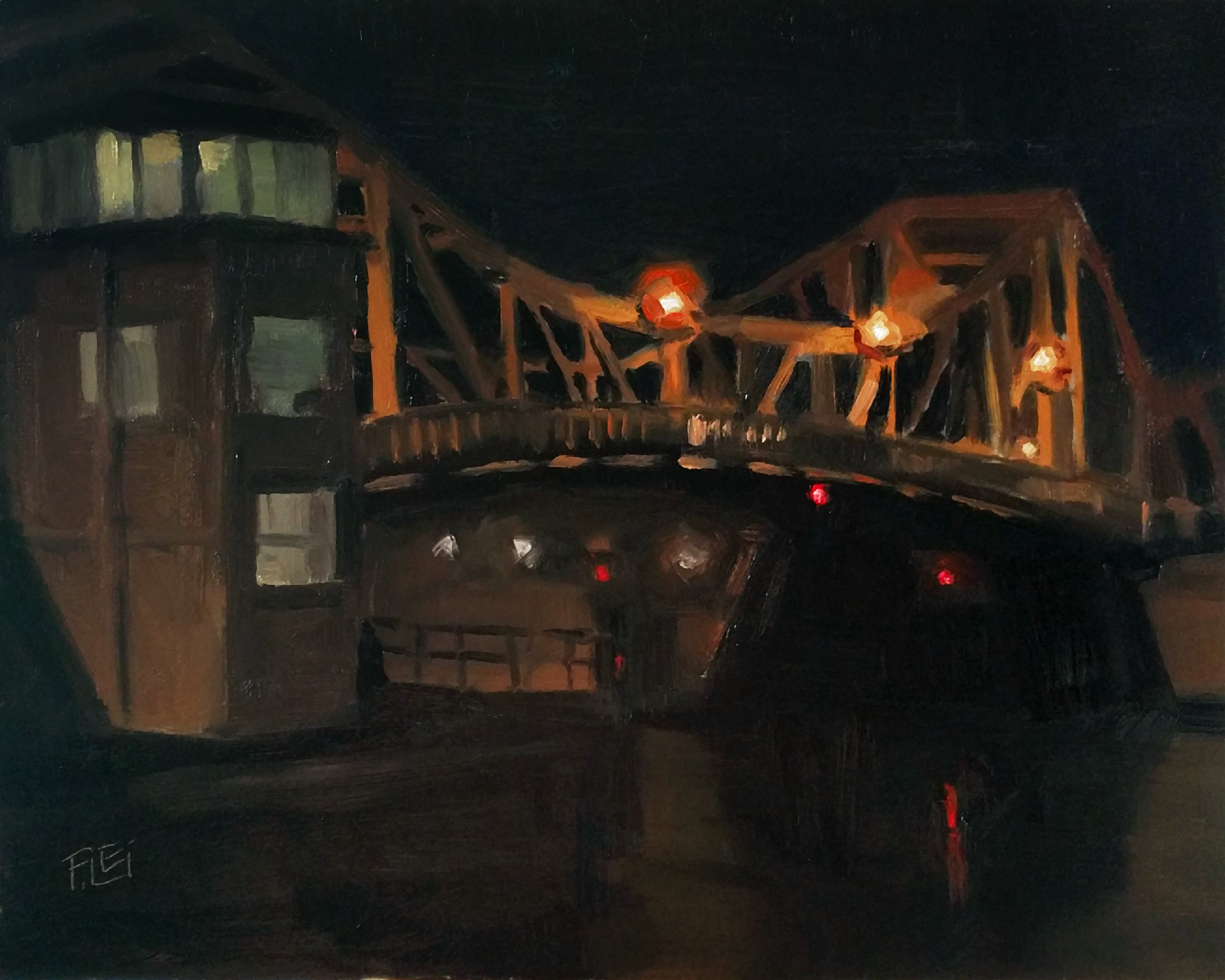
Franklin Lei, High St. Bridge Lights, 2017. Oil paint on board, 5x7 inches.
Image description: Late at night against a black sky is a small bridge, its trusswork lit orange by a few red lights reflected in the dark waters below.
*
His cap, damn it. He was missing his cap. I stared into the casket. Grandpa with no cap. He would never go out without wearing a cap. Didn’t anyone know? He needed his cap.
Mom whispered beside me. I guess I’d frozen up. A line had formed leading up to the casket. With my incense in hand, I bowed three times, mouthing a few words, the best I could do. I thanked him for all those red envelopes. I apologized for not coming to see him more often. I asked if he wanted to check out my school, to bus it like old times, though the trip would be farther, and instead of the Muni we’d need the Greyhound, but a bus is a bus, and I’d cover the fare. Just say the word, Gramps, and I’ll grab our caps. He didn’t respond. I should’ve learned Cantonese.
I stuck my incense into the pot and the smoke carried my message away. As I stood to the side, Mom greeted the aunties, the uncles, the cousins, the family friends. So many people I should have recognized, or maybe had recognized, once upon a time. Each one of them looked me up and down, nodded at me, then shared words with my mom. Cantonese, of course. Fast and foreign. Didn’t matter how hard I flexed my brain. I couldn’t get the gist of anything being said.
Then—an appearance. A ghost from the past. Someone I did recognize. The donut shop lady. Her hair had gone grayer, her face had grown older, but there she was, vanilla-frosted sprinkles. She flipped up her glasses and squinted at me. What had I expected? A free donut? Just like the rest, she nodded at me, and then she turned her attention to Mom. I didn’t blame her. Didn’t blame anyone. Everyone knew I didn’t know Cantonese. After three years of doing English-speaking things, I had finally come home and looked the part.
The donut shop lady bowed and chanted, but she couldn’t stop glancing at Grandpa’s head. His very bald head. She couldn’t stop glancing. I couldn’t stop glancing. Didn’t anyone see?
“His cap,” I said.
“What?” Mom said.
“I told you on the phone…”
“Not now, hou jai.”
More guests, more bows. Mom smiling and greeting. Grandpa lying there, suit-and-tie but no cap. The man was riding his final bus to the stars. He’d never go out without his cap.
“Mom,” I said. “I’m going to use the bathroom.”
The room was packed as I squeezed through the crowd. So many faces—were we all related? The who, the what, the why of them being there—I found out later on from speaking with Mom. Most of them had been regulars at Grandpa’s Lucky Mart. Wasn’t that some cool shit? Lucky Mart on Jackson. According to them, he stocked a mean shelf of snacks. Pocky in every color. Wafers in every flavor. And they’d come and he’d chat and he’d never kick them out. The donut shop lady was his best customer. Grandpa eventually sold and retired. You see, he’d just been blessed with a grandson. I had never known. Had never bothered to ask. He’d done all that, all that and more, all before his little shit of a grandson up and left him at a donut shop.
I darted out of the wake, dove into my car, and floored it the five miles to my mom’s house. Right on the banister, like how I remembered—a collection of caps stacked high to the ceiling. So many caps, but Mom hadn’t brought one. Nah, nah. He couldn’t go out like that. I tried a cap on, tried another, then another. Too wide. Too long. Too big all-around. I tried Golden Gate Park, SFUSD, Fisherman’s Wharf, Chinatown Market, that free cap they gave at the bank down the block, Year of the Rabbit, and one with a cable car. Nope, no luck. None of them fit.
A scent drifted in and hovered above me, like smoke from the incense back at the wake, that scent of his hair, that dandruff shampoo, that medicated cool, and Grandpa, what gives? He said I’d grow into every one of those caps, but none of them fit. None of them fit. I grabbed one at random and pulled it over my eyes. None of them fit, no matter how hard I cried.

Franklin Lei, Fountain of Yellow, 2019. Oil paint on board, 8x10 inches.
Image description: In a lush green garden covered with bright yellow flowers, a small clearing leads to an ornate white marble fountain.
Justin Wu was born and raised in Northern California, in a neighborhood with boba shops on every other block. All those cups of tea with oat milk and grass jelly have permanently altered his circadian rhythm. He spends his late nights at the office and his later nights writing stories, and if life were to never change, he’d be okay with it.
*
Franklin Lei (https://www.instagram.com/franklinlei/) is an artist living and working in San Francisco who works with traditional as well as digital media. He loves plein air painting (https://www.franklinlei.com/pleinair) and portrait painting (https://www.franklinlei.com/portraits).
“Last names come first in Japanese, you racist piece of—” a brawl, a funeral, and a stolen father in a short story by Jay Lindstrom.