The Righteous
By Layla Sabourian
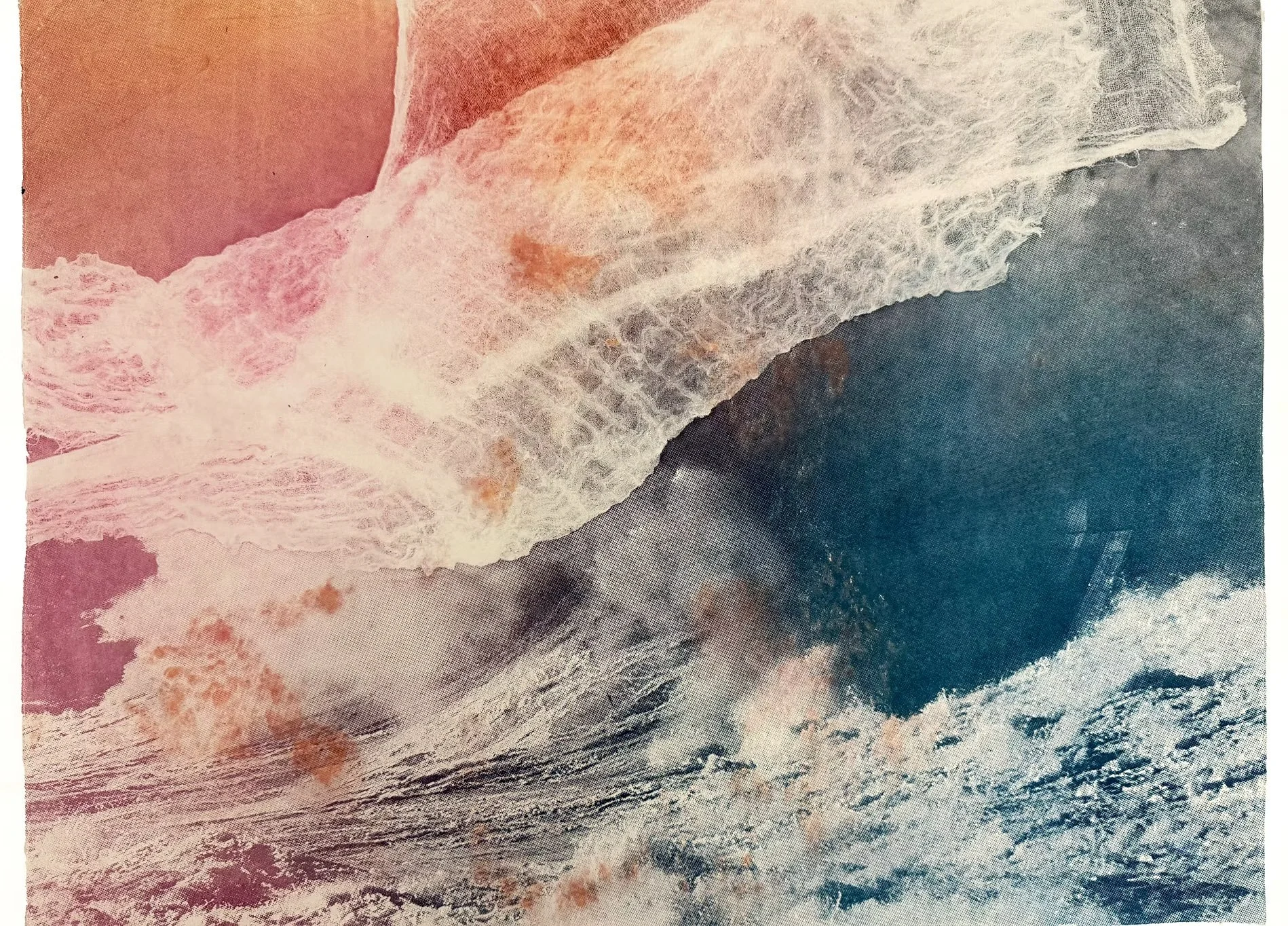
Nazanin Noroozi, False Dawn 0033, 2025. Pigmented linen pulp paint on cotton base sheet. 30 x 40 inches.
Image description: Sea waves lapping a beach, seen from above, and superimposed on a great wave seen from the side, with spray, and possibly smoke in a gradient of orange (top left corner) transforming to Prussian blue (bottom right corner).
My hands remember everything.
That is what they never understood — the men with their questions, their forms, their clean fingernails. They could break a hand. They did break a hand. But breaking a hand does not erase what it has learned.
My right hand remembers every grip, every hold, every rotation on the mat in Krasnoyarsk, where I took bronze and stood beneath flags that were not mine and yet, for a moment, felt like they were. Wrestlers from Kazakhstan slapped my back. A boy from Uzbekistan asked for a photo. Someone from Japan said my name slowly, carefully — with the particular attention of a person who knows what it costs to say a name wrong — as if the syllables were worth protecting.
I did not have a word for it then, but I felt it: we were all Asian on that mat. Not in the way the textbooks meant it — not a category on a form — but in the older way. The way of roads that had run between us for centuries, carrying silk and salt and wrestling holds and prayers. Kazakhstan. Uzbekistan. Japan. Iran. We were not strangers. We were the continent, recognizing itself.
Outside my country, I was a hero. A body that had earned something. A name spoken cleanly.
Inside, I am something else.
My left hand remembers writing, the week before they arrested me:
We endured beyond what we ever imagined for ourselves.
I posted it without thinking. Like breathing. Like lifting. Like trusting that tomorrow would arrive in the same shape as today.
I did not know how quickly a life could be rearranged.
—
It started with water.
The tap in our apartment in Qom ran the color of old coins. When you poured it into a glass, it settled in layers — a thin line you could see if you held it to the light. My mother boiled it anyway. She always boiled it twice, as if care could correct what had already gone wrong.
We stopped buying meat first. Then fruit. Then anything that required choosing. My mother would hold things in her hand for a moment before putting them back, like she was saying goodbye without wanting to admit it.
These are the kinds of changes that don't announce themselves. They arrive quietly. They stay.
My neighbor, Agha Reza, said he had never seen it like this. Not in all his years. He said the earth had been emptied out, that what we were drinking now was what remained after everything worth taking had already been taken.
My grandfather had told me, once, that our ancestors built qanats — underground channels carved by hand through rock, running for miles, carrying water from the mountains to the cities. For three thousand years, Iranians had solved the problem of water. The knowledge had always been here. What was failing now was not the water. Something else had been broken.
I did not think of gods then. I thought of training. Of weight. Of the next match. Of the simple fact that a body needs fuel, and that mine was being asked to do more with less.
When Dara called me from the bazaar and said the shopkeepers were closing their doors, I knew training had to wait.
“Come,” he said. “We’re going to the street.”
So I went.
I made my sign from a cardboard box my mother had saved. I painted the words in red because red carries further.
Freedom.
And underneath:
My life for Iran.
We were not asking for miracles. We were asking for water that did not hesitate before running. For bread that did not require calculation. For the ordinary shape of a life.
I stood in Nabut Square and shouted until my voice broke.
Seven days later, they came for me.
—
They put me in a room with a number above the drain.
Someone had scratched it into the metal. Not carefully. Not cleanly. Just enough to remain.
48.
I traced it with my finger. I did not know whose counting that was — whose sixty-three days it had not yet reached. I made the number mine anyway.
After enough hours without sleep, after enough repetitions of the same questions by men who did not need my answers, the room began to change.
There were forty-eight versions of me in the room, and all insisted that I was the copy.
Some had unbroken hands. Those were the ones who had agreed sooner. Some would not meet my eyes. And all of them carried the same certainty, layered and recursive, like something repeating itself across distances.
You are the copy.
I said it once, out loud, just to hear it exist in my own voice: “I am still here. I am the original. The athlete. The wrestling champion of Iran, an inspiration for the youth.”
The sentence did not fit in my mouth.
They laughed. “No. You are just a copy. A traitor. An enemy of God.”
But how can a copy remember? A copy cannot carry what a real body has lived.
“Tell me about Krasnoyarsk,” I said. “Tell me about the third round. The boy from Kazakhstan. The moment before the shift in weight. Tell me what my hand felt when I found the angle.”
None of them could.
Because memory is not an idea. It is a weight. A pressure carried in muscle and bone.
They beat me then.
My coach had said discipline is a form of prayer. Wrestling had prepared me for taking blows, for absorbing weight, for finding the angle of survival. I did not break.
So they beat me again.
They wanted me to confess. To name my crimes against God. I could not think what those crimes were — to speak of the water, the mismanagement of it, the bread that required calculation, the slow and ordinary debasement of a life. These were not crimes I could confess to.
The pain increased.
I fell asleep, or into unconsciousness — I could not tell which.
I had been locked in a room with a drain, a scratched number, and forty-eight versions of myself insisting on what I was. The copies of who I should be, if only I could accept their God, their methods, their version of my name.
—
And that is when she came to me.
Not suddenly. Not dramatically. The way something long present becomes visible only when you stop looking elsewhere.
There was a thin line of dampness along the base of the wall. I had been watching it for hours, thinking of the tap at home, of the way water carries what it is given, whether it should or not.
And then she was there.
Not a body. Not exactly. A presence — like standing near a river you cannot see. She looked ancient. Older than borders. Older than the names we give to land.
West Asian before that phrase existed. Before the maps came that called this region the Middle East — the middle of someone else’s world, the middle of someone else’s story. She was Anahita of the Avesta, the Aredvi Sura, worshipped from the Caspian to the Indus before the conquests arrived to rename everything. A memory that had survived every empire that tried to erase it.
I should have asked who she was. Instead I heard myself say:
“Do you know who I am? I am not the copy.”
The water moved.
“You are the one who was brave enough to speak for your mother,” she said. “For me. For the people of Iran. For the tap. For the things we stopped buying. For the way people live when no one is watching.”
She took me in her arms. “I am Anahita. And you are my son. A hero. Do you know what your name means? Saleh. Not merely righteous in the legal sense — virtuous. The one who acts from inside, not from fear. The one who cannot be silent when the water sickens, because silence would be a betrayal of his own nature. That is virtue. That is you.”
“They broke my hand,” I said.
Then I shall be your hands.
“They said I confessed.”
I was there to witness.
She held my hand throughout what came after. She did not let go.
The words on the confession had been taken from me early, before I understood the shape of the room, the shape of what they wanted. In court, I said they were not mine. The judge did not look at me when I spoke.
She pressed my hand.
I see you as the real one, she whispered. The world outside these walls sees the real you. In cities you have never been to, people are pronouncing your name, writing it — in languages you do not speak. Outside, you are still the boy who stood on a mat and earned something. The hero other teenagers look up to. The definition of perseverance. Of honor. Of truth. Of strength.
“Silence,” the judge said. “You are nothing. A copy. An enemy of God.”
I wanted to crumble. But she took my hand — back to late December, after an injury, back in the gym. Lifting. Moving. Alive in the simple way a body is alive when it is used fully.
Seven words:
We endured beyond what we ever imagined.
I did not know it would outlast me.
—
They executed me before dawn.
The day before the new year.
Nowruz. Three thousand years of it. The oldest Asian new year — older than every border, older than every flag. The fire, the sprouted wheat, the goldfish turning in their bowls. The day the world is supposed to begin again. They chose that morning on purpose.
The hour when things are supposed to begin again.
—
My hands remember everything.
The real one endures.
Not in the way they meant to end me. Not in the way a record ends.
But in the way water continues.
Somewhere, in pipes that hesitate, in rivers that refuse to disappear completely, in the hands that still lift and carry and refuse —
something remains.
Not unchanged.
Not untouched.
But not erased.
—
In memory of Saleh Mohammadi, born 11 March 2007, executed 19 March 2026 — eight days after his nineteenth birthday, one day before Nowruz, the Iranian New Year. He was held for sixty-three days.
Saleh was born in Saveh and grew up in Qom. He won a bronze medal at the Saitiev Cup in Krasnoyarsk, Russia, in September 2024. He was arrested on 15 January 2026. His family, teammates and coaches said he was not at the scene of the alleged crime. Security camera footage did not identify him. He retracted his confession in court, stating it had been obtained under torture. His hand had been broken during detention.
He was a wrestler. A son. A boy who believed that discipline was a form of prayer.
His name was Saleh. It means righteous.
Layla Sabourian is an entrepreneur, author, and accidental nomad who turned exile into a career and displacement into disruption. She holds a US patent, a literary agent, and an unfinished to-do list in four languages. Her poetry collection Whispers of Iran is forthcoming from Seis Letras (Spain), and her novel Whispers of the Goddess — in which the Iranian goddess Anahita gets a long-overdue story — is currently seeking a publisher.
*
Nazanin Noroozi (https://www.nazaninnoroozi.net) is a multi-disciplinary artist working with moving images, printmaking, and alternative photography processes. Her work examines loss, displacement, and collective history while grappling with themes of the personal archive, collective history, and displacement. Through layering, distortion, and repetition, she produces densely textured visual fields that resist linear narrative while allowing contradictory sensations to emerge such as safety and vulnerability, intimacy and alienation, and visibility and erasure. Noroozi’s work has been widely exhibited, notably at Baxter Camera Club NYC; SPACES, Cleveland, OH; NY Live Arts; Athopos, Athens, Greece; Immigrant Artist Biennial; Noyes Museum of Art, NJ; School of Visual Arts Chelsea Gallery; and Golestani Gallery, Düsseldorf, Germany. She lives and works in New York City.
“Last names come first in Japanese, you racist piece of—” a brawl, a funeral, and a stolen father in a short story by Jay Lindstrom.