
The Breath (With)Drawn
By Ashley Marilynne Wong
Review of Ling Ling Huang’s Immaculate Conception (New York: Dutton, 2025)
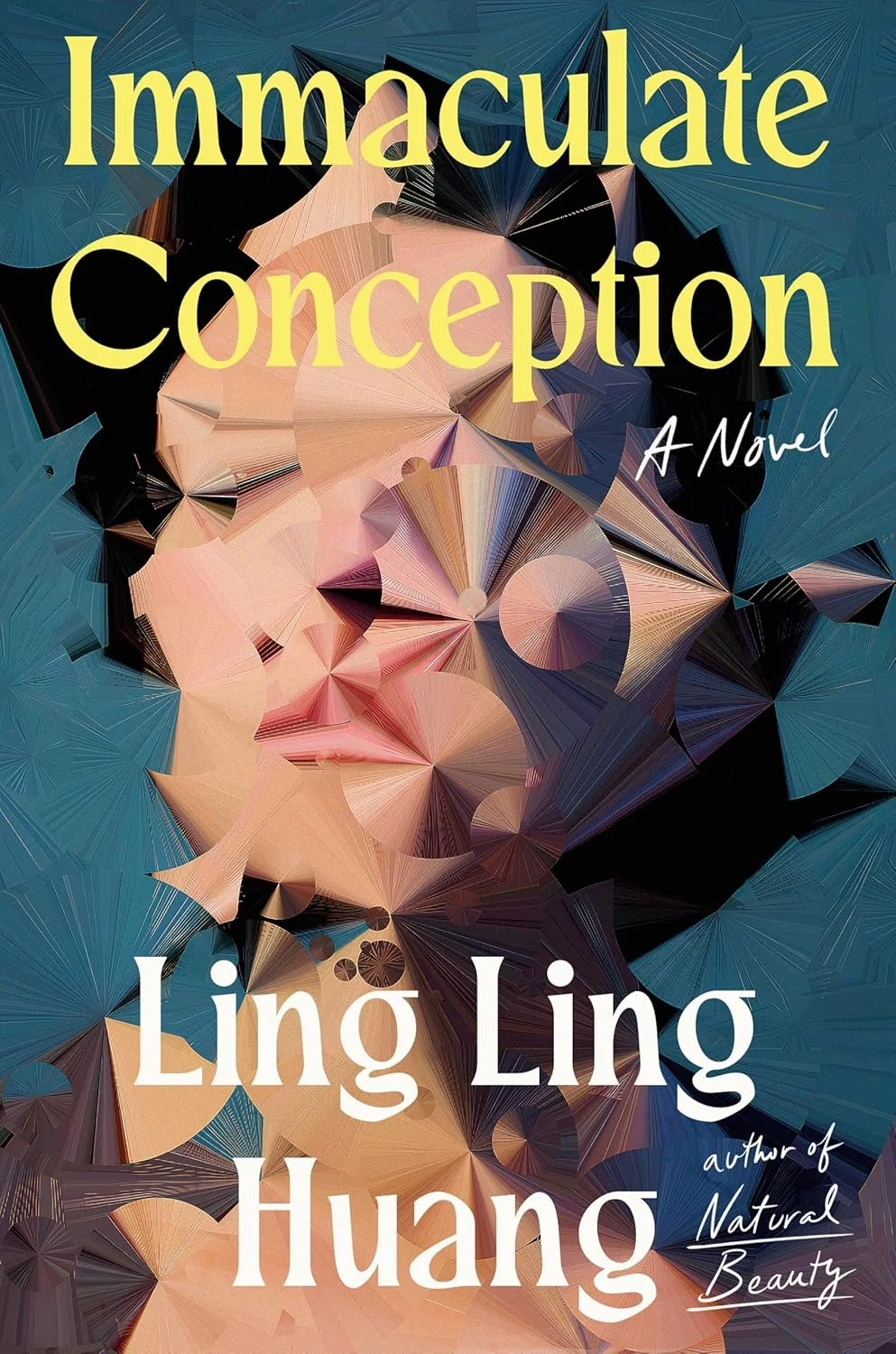
After the success of her debut horror, Natural Beauty, Ling Ling Huang returns with Immaculate Conception, her glitteringly brilliant and aptly titled second novel. Part coming-of-age dark academia and part techno-dystopian literary thriller, the book combines Aldous Huxley’s visionary acuity, Angela Carter’s ingenious enchantment and Huang’s signature hypnotic voice to explore the transcendental themes of art, technology, intimacy and empathy. Despite defying generic categorisation, Immaculate Conception could not be further from being thematically original. However, its biggest, or rather deepest triumph, lies in its wholehearted capacity to plunge the reader into their emotional core. That, in my view, has more than made up for its lack of thematic originality. After all, to echo Mathilde, one of the novel’s protagonists, ‘Who does originality actually serve? Not the public. The public needs to be shocked and reminded of their own feelings, which everything else in the world seeks to numb. Whatever the purpose of art is, it isn’t to be original for originality’s sake.’ Indeed, from its dizziest emotional heights, the prescient and fantastically true-to-life work of art parachutes the reader into their deepest friendship, as well as their greatest technological and artistic fear and joy.
Whilst the year in which the novel is set is unspecified, Immaculate Conception takes place in a dystopian near future when the United States is divided into ‘fringe’ and ‘enclave’ according to its citizens’ technologically predicted criminal proclivities. To prevent so-called contamination, buffers resembling art statues are erected all over the country to physically and economically separate the two groups, who are also artistically, culturally and psychologically alienated from each other through, amongst other methods, unequal internet access opportunities. Websites are either enclave or fringe, and as Enka, the novel’s fringe narrator, describes, ‘The internet stopped being a place to connect to others or to exchange knowledge, and became a way to perform belonging in the world you had inherited’. It is almost impossible to transcend one’s social status in this dystopian future, but upon receiving a Dahl Fellowship for technology artists, Enka earns a scholarship to study at the prestigious Berkshire College of Art and Design, consequently becoming an honorary enclaver and meeting Mathilde.
Enka’s first impression of the person who will eventually become her best friend could not be more glowing; she sees Mathilde as well connected, supremely gifted in medium and knowledgeable about art, probably far more knowledgeable than their lecturers. It is this intoxicating idealisation that initially gives life to and later (with)draws breath from Mathilde’s art – and even life, at Enka’s own expense. This idealisation is particularly clever as it is an allegorical mirror in which complex relationships between human, art and artificial intelligence are examined with exceptional nuances. The looking glass Huang holds up to the reader’s gaze is one that the twenty-first-century global citizens cannot resist looking into and away from, sometimes both at the same time, making it a universal contemporary human dilemma. As the use and abuse of artificially intelligent tools like generative AI has become one of the world’s hottest debates, dominating multiple areas of human lives such as the arts, education and the corporate sector, Huang’s fictional virtual art museum, the Stochastic Archive, is simply too close to home. It is indeed emblematic of the present, given that the twenty-first century is rife with pseudo-writers, irresponsible content creators – no, generators – and opportunistic corporations keen on maximising profit and productivity at the dire cost of authorial authenticity and genuine connection. This author-audience disconnect produces an illusion, particularly to those self-and-other-deluding fabri-creators, that anyone can write or make art in any medium; though to discerning readers, viewers and the rest of the art enthusiasts, of whom there are still fortunately many, that is most certainly not the case. Suspicions abound, and whilst the resulting scepticism or sense of misgiving these art lovers have developed is reasonable and more than healthy, disorientation is inevitable. Not just for the consumers, either, for as the scene and description of the Stochastic Archive incisively illustrate, the nightmarish threats of plagiarism accusations could not loom larger for true artists.
In their second year at art school, a few weeks before their sophomore exhibits, Enka, Mathilde and their course mates receive what Enka calls ‘a rude awakening’ from their art lecturer, Professor Thomasina. The professor describes how everyone can now create ‘weird art’ via the Stochastic Archive:
The creators have made the software open-source, so not only have they uploaded their artworks, but the general public can, as well. This digital museum has only been online for fourteen hours, and already, hundreds of thousands of people have uploaded and copyrighted their generated artworks. We expect this to continue and to proliferate at astonishing speeds.
In light of the development, she urges her students to reconsider the pieces they will be exhibiting to prevent accusations of plagiarism that might make them liable to lawsuits. The consequences of this are devastating. More than half of the students pull out of the exhibit; then they begin dropping out of art school at an alarming rate; and their lecturers live in constant fear to the point of destroying their own art. This harsh psycho-environmental backdrop colours and clouds Enka and Mathilde’s already co-dependent friendship, livening yet worsening their dynamic.
The co-dependent nature of the two’s friendship can be traced back to the moment Enka sees Mathilde’s first-year exhibit, which she initially responds to with wholehearted empathy. The exhibit documents Mathilde’s father’s final moments on earth, through a wooden sculpture of him and a voice note in which he delivers his last words to Mathilde, telling his daughter he loves her and that she is the best thing that has happened to him. When Enka meets Mathilde after holding the sculpture’s hand and listening to the message, her congratulatory wishes turn into a hug of solidarity, making it an intimate moment that seals their friendship – in more ways than one, for better or worse. Before long, the two art students became inseparable, drawing envious gazes. Those who witness their all-consuming friendship label Enka ‘the beautiful one’ and Mathilde ‘the genius’, and fellow art majors who can’t stand their intimacy whisper that ‘it’s already been done by Tehching Hsieh and Linda Montano’. Enka’s conscious disagreement with that assessment merely scratches the surface of her own internal mirror, as portrayed by her observation that Hsieh and Montano had ‘needed a rope to bind them for that year. What Mathilde and I shared was deeper, a devouring that needed no vow’.
Enka’s desire to absorb Mathilde’s artistic gifts complements and clashes with her drive to be a true friend to the latter. After her first-year exhibition, Mathilde sinks into a deep depression. What was supposed to be her cathartic act of art-making had thus turned into an incartceration, a prison made of memories of her parents from which she cannot escape. Memories of her father’s last breaths cannot be untangled from the fact that shortly after his demise, Mathilde’s mother took her own life, hence her retraumatisation after producing the exhibition that takes the art world by storm and garners her offers of representation from multiple galleries. She stops going to classes, falls ill and spends most of her time in bed, exhausted but often unable to sleep. This period of Mathilde’s life sees Enka gleefully assuming the role of Mathilde’s surrogate mother, albeit with a not entirely pure motive:
Maybe I even envied the grief that surrounded Mathilde. It was clarifying, burning away anything else that might distract her from art. A moat that kept her safe from the desires of others and her own. On the other hand, I was insatiable. All anyone had to do was look at me, and I was filled with a longing to be touched. I wanted to be serious, to be wholly dedicated to art and matters of the mind, but my body’s hunger voided everything else, erupting with rashes and pimples when I didn’t heed its call.
The physical hunger Enka experiences leads her to satiate her mental one through the breath she (with)draws from Mathilde’s physical, emotional and most of all, artistic vulnerabilities. A pattern of Enka spending all her time by Mathilde’s side when the latter needed healing and empathy, and then immediately ghosting her when she was thriving – sometimes for months or years at a time – soon emerged. Nearly a year after ignoring her texts and rebuffing her initiative to talk about the frost that has coated their friendship upon Mathilde’s return from representing America at the Venice Biennale, Enka contacts Mathilde to invite her to her wedding. She does not know it when she calls Mathilde, but Enka soon finds her friend in a vulnerable physical state after her pregnancy through the artificial insemination tool Mathilde created that enabled her to self-impregnate without the need for sperm. Enka might not have been aware of her subconscious push-pull dynamic with Mathilde, but the pattern persists as she ghosts her friend for a second time after Monica, Enka’s mother-in-law and the wife of the Dahl Corporation founder, offers Mathilde a representation which she accepts. When a tragedy strikes her friend two years after that second ghosting, it is Enka who finds Mathilde hiding in her deceased father’s abandoned cactus sanctuary, grieving for her dead daughter in a deeply traumatised state. It is also Enka who moves Mathilde to her house so that she can take care of her friend and give her undivided attention, only to abandon her when she is on the brink of recovery, this time with some added ghostly bonuses: betrayals – ones that will haunt Enka herself for the rest of her life.
Whilst the first and second parts of Immaculate Conception, respectively titled ‘Early Style’ and ‘Middle Style’, are finely paced, ‘Late Style’, its final section, is a train wreck in slow motion. Meanwhile, the novel’s epilogue, ‘Retrospective’, might just restore one’s faith in humanity and human-made art in a heartbeat. Despite the difference in pacing between the opening and final sections, the book does not feel unevenly paced, at least not in that regard. There are, nonetheless, one or two minor plot points that feel slightly disorienting, an example being the speed at which Enka’s husband falls in love with her. To me, plot points like these seem only to, rather conveniently, propel the novel forwards, but given Immaculate Conception’s acute observations on rapid technological advancements and how they are received, this could indeed be deliberate. Perhaps it is an analogy of the often complex and fraught human-technology relationship rendered, albeit somewhat crudely, in passionate, perfectly imperfect brushstrokes. The author might have felt compelled to explore that push-pull dynamic between people and technology in more ways than, say, solely relying on Enka and Mathilde’s co-dependent relationship, though I am aware that this is mere conjecture.
That aside, Ling Ling Huang has thoroughly succeeded in shocking the reader’s every feeling into life – into a life of acceptance that celebrates and honours human friendships, our responses to art and the all-too-real-life experiences artificial intelligence can neither emulate nor possess, through a novel I believe this century desperately needs. Through, dare I say, Hope with a capital H, physicalised into a timely and timeless literary guardian angel.
Ashley Marilynne Wong graduated with a degree in English with Creative Writing from the University of Nottingham. Her poetry and non-fiction have appeared in Spillwords and Dark Winter Literary Magazine. In 2021, she won the YOUth of Tomorrow writing competition with her poem ‘Six Ways to Expose Your Daughter to Domestic Abuse’. As an unapologetic bookaholic, Ashley tends to read for at least three hours daily – occasionally all day.

‘A snapshot of our planet, filled with souls dead and living, crying out that they matter, that their stories must be told.’—this September, Ng Yi-Sheng reviews writers exploring their own pasts.