
Review of House of Caravans by Shilpi Suneja (USA: Milkweed, 2023)
By Shyamasri Maji
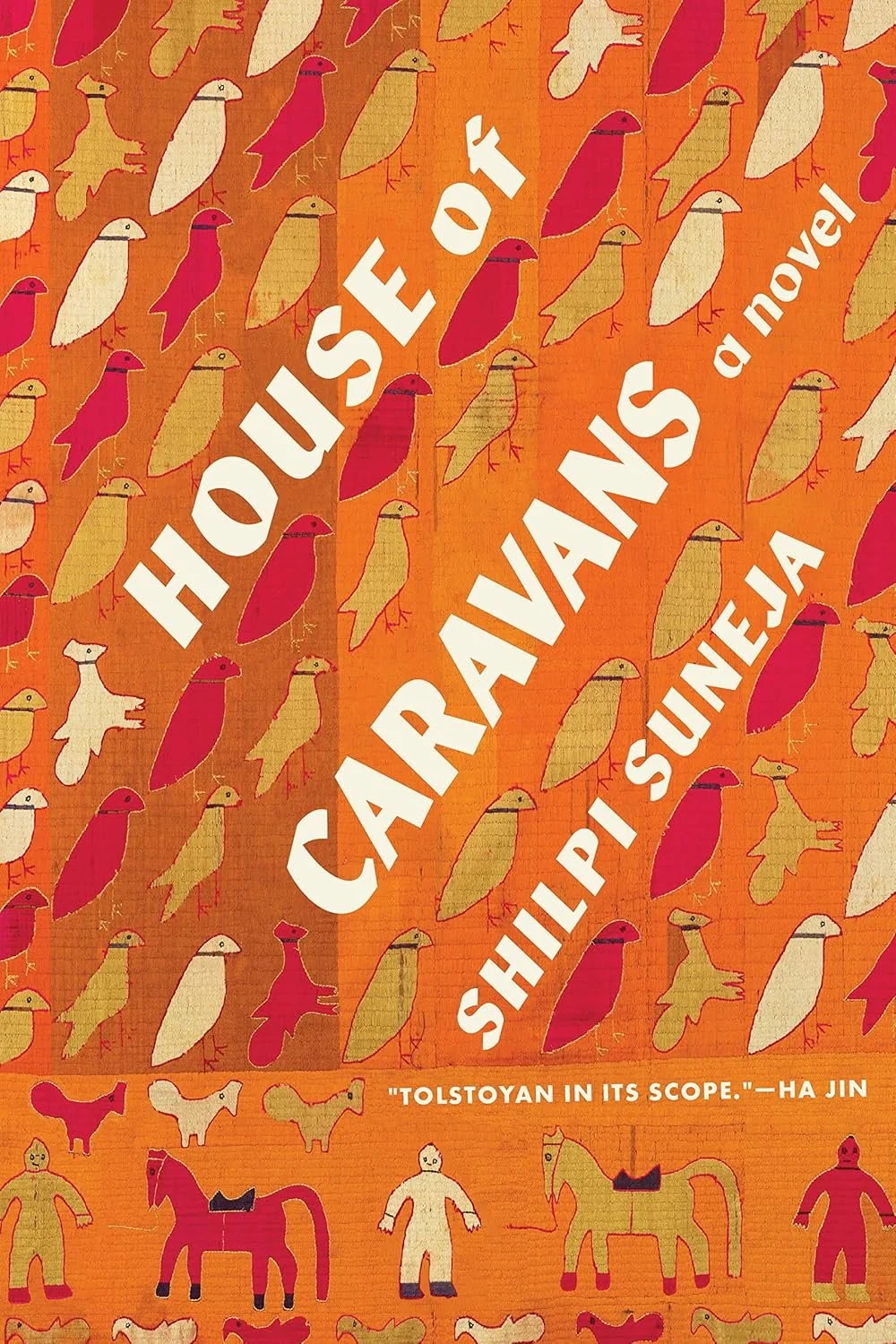
Literary critic Frank Kermode once observed that “memory invents a past.” How does memory “invent” a past (de)formed by a historical incident? Is it not safer to keep history and memory in watertight compartments? Or what happens when they are allowed to flow into each other’s territories? These questions flare up like allergic reactions on the skin while reading Shilpi Suneja’s debut novel, House of Caravans, which reviews a historical incident from the personal perspectives of its characters. Suneja was born in Kanpur, a city in the state of Uttar Pradesh, India, and currently lives in Cambridge, Massachusetts.
House of Caravans is set against the backdrop of the Partition of India, a watershed event in South Asian history. The Partition gave birth to the Islamic Republic of Pakistan in 1947. The division of the Indian nation took place on the basis of the religious identity of the citizens. Communal riots broke out in different parts of the subcontinent causing vandalism, pogrom, rape, murder and migration at a large scale. Thousands of people from Hindu, Muslim and Sikh communities lost their lives and millions became homeless. The displacements had far-reaching effects. In her book Partition’s Post-Amnesias, Ananya Jahanara Kabir observes, “The division of families and cultures through the drawing of national borders over ethnic, linguistic, and filial identities seems the least horrific of Partition’s long litany of horrors.”
Suneja explores the long shadow of Partition on the lives of three generations of the Khatris, a Hindu family. The title, House of Caravans, presents the image of a mobile home, a phrase with oxymoronic resonance, underscoring the idea of a nomadic lifestyle. Though the characters in this novel are not nomads, they go through displacement, uncertainty and unsettlement. Their experience of migration challenges the notions of fixity inherent in the concepts of identity, home and family. The story begins with two brothers, referred to as Barre Nanu (“elder grandfather”) and Chhote Nanu (“younger grandfather”). Instead of using their proper names, Suneja introduces them to the reader in terms of kinship as per their relationship with Karan, the narrator, who is a postgraduate student at the City University of New York. The dyadic structure of storytelling follows two timelines and two points of view. While the present is set in the year 2002, when Karan arrives in Kanpur from the US after Barre Nanu’s death, the past zooms in on socio-political upheavals that were taking place between 1943 and 1947, unfolding snippets from Barre and Chhote’s youth. The present incidents are narrated in the first person by Karan. Other characters interacting with one another in the present time are Bebe, a single parent to Karan and Ila, Chhote Nanu, a cranky old man, and Siddiqui, Karan’s biological father, whose identity is revealed only after Barre Nanu’s death.
The past, recounted in the third person, presents an omniscient point of view. Barre Nanu and Chhote Nanu left their mother, ancestral house and family business in Lahore (Pakistan) during the Partition riots. Barre found a job at a bank and settled down in Kanpur, India. He married a local Muslim girl named Attiya Rehman in 1949 and had a daughter with her. However, they were soon separated due to the Inter-Dominion treaty that was made between India and Pakistan to rescue the abducted women who went missing during the Partition mayhem. Attiya was taken away to Pakistan on the premise that her name was registered in the list of missing women and therefore the inter-community marriage was not legal. Chhote too had a terribly disturbed past. He had suffered imprisonment and inhumane torture due to his love affair with an Anglo-Indian woman. The woman was killed and her son was lost. These mishaps left Chhote shaken forever.
The timelines move alternately, from the past to the present and vice versa, in the manner of a pendulum in a wall clock. The non-linear flow of time emphasizes the functional and cognitive role of memory in the production of an alternative past, which does not feature in mainstream discourses of history. The dual timeline serves as a method to retrieve the ancestral memories of Partition with which Bebe, Karan and Ila had no direct connection but whose lives were disrupted by its horrific implications. The transgenerational format of the narrative historicizes the transfer of the trauma of separation from one generation to another. The futility of dividing the subcontinent on the basis of religion was reflected in the society as well as in the family space. Very poignantly does Suneja connect this historical event with the theme of dysfunctional family. Due to Barre Nanu’s separation from Attiya, Bebe grew up without a mother. She fails to acquire skills in cooking and managing household chores. Her relationship with Siddiqui was not accepted by the latter’s mother because of their religious differences. Born out of wedlock, Karan grew up without knowing who his father was. Bebe never had a proper family life. Her efforts to settle down failed with the breakdown of her marriage with Keshav, Ila’s father.
The pain constituting the postmemory of Bebe is reflected in the anguish of Karan and Ila as they explore the secrets of their personal lives. It was during his visit to Kanpur in 2002 that Karan learned that his father’s name is Irshad Siddiqui. Siddiqui, a writer and historian, lived close to their house, but Karan was completely unaware of his proximate presence. Communal differences had dug such deep roots in the society that any kind of inter-communal alliance in the decades following India’s Independence triggered fear in the minds of the Hindus and the Muslims.
While walking the lane where Siddiqui’s house was located, Karan realizes that in spite of living in the same city, the Hindus and the Muslims segregated themselves into ghetto-like communes:
I circled the block and entered the lane parallel to ours. So much had changed since the last time I’d walked past. All the nameplates, posters, even graffiti were written in Urdu. Sadly, Urdu wasn’t an option for me at school. I’d studied French and Sanskrit instead. It seemed like a calculated move by the government to leave Urdu out of the school curriculum.
The lane seemed to belong to another country, another time. The houses had their own colour schemes—more green and whites, red roses sprouting from yellow butter cans. The residents sounded more polite, calling each other “darling” and “jaan” and “jaanam.” I smelled cardamom, kewra, hing, cloves. The young men wore skullcaps, the old sported beards. More and more Muslims from all over the city had concentrated here, where they felt safe in numbers.
The excerpt not only describes the cultural ethos of the Muslims but also underlines their anxieties about being a minority community. To Karan, a boy raised in a Hindu house in a Hindu neighbourhood, this lane is an unfamiliar zone. He was not ignorant of Muslim culture but Karan’s recapitulation of learning languages at school hints at the author’s intent to highlight the political motive behind excluding the Urdu language from the elementary education system.
Though Urdu is often viewed as the lingua franca of Islamic culture in the Indian subcontinent, particularly in North India, it was used for literary purposes by poets and writers of both communities. Here, the author uses it as a pertinent trope for elucidating its role in manifesting anxiety for and resistance to the underrepresentation of Muslims in the social and political domains. This is more directly conveyed in the slogans of an ongoing election campaign which Karan can hear from Siddiqui’s house. Though the slogans are a part of background noise, Karan cannot ignore them. They reveal the rise of religious fundamentalism and right-wing politics that view Muslim residents as outsiders in India.
Siddiqui recognizes Karan immediately and also agrees to accompany him to the house of the Khatris. Their short journey from one lane to another seems similar to that of crossing the national borders during the Partition. It emphasizes the notion that even after fifty years of Independence, Partition is not located in a particular time-zone in the historical past. Rather, it is a continuous reality that runs parallel to the diachronic flow of time across history.
This father-son trip through the Hindu and the Muslim neighbourhoods is a reiteration of Chhote Nanu’s experience of leaving Lahore with Henry, the infant son of his beloved Nigar Jaan, on the refugee truck in 1947. Since then, over the years, the issue of crossing communal borders either in state-territories or in social relationships has been a sensitive issue to both the Hindus and the Muslims.
Bebe is happy to see father and son together. Even Chhote Nanu does not object to what was happening and reveals that he had read all of Siddiqui’s books. He also shares his insights on the history of Sufi saints in Pakistan, which in a way points out that political interventions or nationalist ideologies could not infringe upon the cultural memory of diverse groups constituting a nation for centuries. Karan feels the warmth of mutual concern in the communion of long-separated relatives.
Suneja critiques the politics of violence inherent in the colonial policy and the nationalist ideology that divided people on the basis of race, religion and culture. Unlike most Partition novels, this book does not glorify a martyr or predict any utopic condition to take hold of the current dystopic situation. Instead, it draws our attention to the far-reaching impact of this divisive mentality on the transnational lives of South Asians in the post-9/11 era.
Suneja seems to believe that the ghost of Partition haunts the ancestral memory of South Asians in the US and subsequently presents her opinions through Karan. According to him, the Twin Towers in Manhattan, which were destroyed in a terrorist attack in 2001, fuelled racist feelings towards South Asians in different parts of America, including 74th Street in Jackson Heights, the so-called Indian neighbourhood in New York City. Karan observes that instead of putting up a united resistance against the recent ethnic defamation, most South Asians in Jackson Heights “hid behind old grievances, behind boundaries that made them Indian versus Pakistani versus Bangladeshi.” The racist rage and disharmony, in this context, threaten their efforts to find a home in the diasporic space. The vulnerability of the situation deconstructs the traditional fixed concepts of home and belonging; it reiterates the idea of viewing one’s home as a mobile entity. The author tries to connect the Partition trauma with the insecurities following the terrorist attack on 9/11. She uses the recent incident to underscore the belatedness associated with Partition horror. This introspective experiment appears a bit contrived, since the contexts of the two events are different, and unlike Partition, 9/11 affected transnational communications across the globe. Seventy-five years ago, the displacement that resulted from Partition was led by violence. In recent years, migration of South Asians for economic and academic enhancements is more a matter of choice than compulsion.
On the whole, Suneja’s storytelling is smooth and characterization vivid. The novel ends with an urge to retrace one’s roots no matter how difficult the routes may be. Its intricate plot increases the tension and makes the story all the more dramatic. The unsettling experiences and tragic fate of the characters leave one choked with seething sadness. In the end, when the family members come together and decide to visit their ancestral place in Lahore, a luminance takes over the long-standing darkness.
Shyamasri Maji is an academic based in West Bengal, India. She writes book reviews and literary articles, some of which have been published in reputed journals such as South Asian Review, Indian Literature, Economic & Political Weekly, Asian Review of Books, Antipodes, Kitaab and World Literature Today.
‘The truest, most vivid sketch of non-performative unconditional love’—Ashley Marilynne Wong reviews Susanna Kwan’s Awake in the Floating City (New York: Pantheon, 2025).