A Map with No Lines: Reading toward Meaning in BOH BEH ZHAO
By Chong Jing Gan
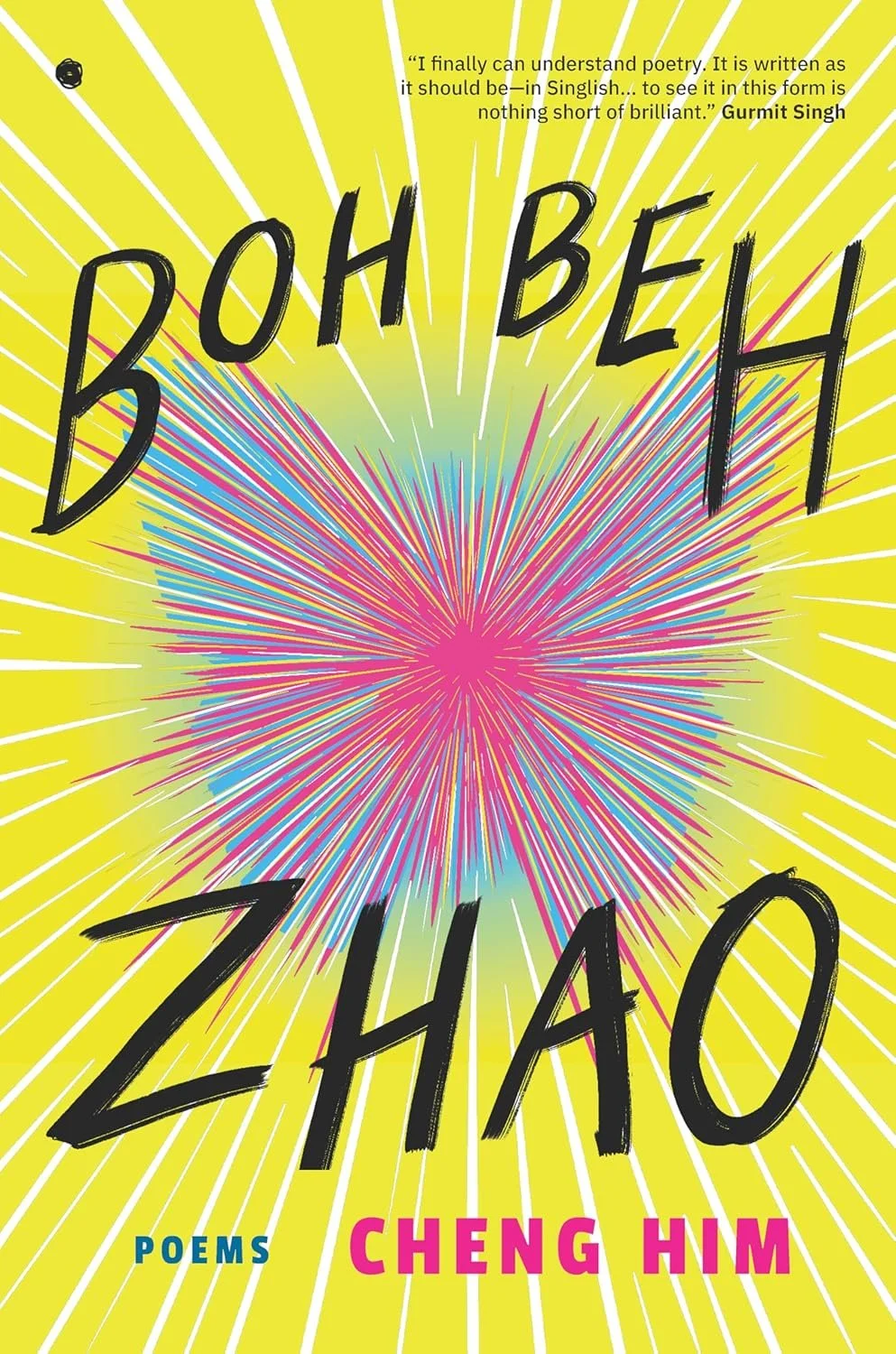
Reading Cheng Him’s debut collection of poetry, Boh Beh Zhao, I found myself suddenly transported back to a stuffy classroom: literature class on John Donne and the metaphysical poets, sleep-deprived students struggling to take notes and stay awake, and the teacher at the whiteboard reciting literary critic Samuel Johnson’s contemptuous judgment that in metaphysical poetry, “the most heterogeneous ideas are with violence yoked together”.
I have forgotten much of John Donne, whose literary rebellion against classical form has, in the centuries since, been enfolded into a lionised Anglophone canon and proselytised in countless classrooms like mine, but that judgment has lodged in my mind for many years since. It’s always left me with a lingering sense of uneasiness. To yoke together heterogeneous ideas. To violently, oppressively, shackle contradiction by language. To commensurate the incommensurable.
It echoed in my mind again as I read “Declaration”, the second poem in Boh Beh Zhao, which begins with a quote by the Gautama Buddha proclaiming, “Throughout heaven and earth, / I alone am the honoured one”, before launching into a breathlessly long run-on sentence written in vernacular Singlish, wherein the collection’s protagonist, ah seng, bursts out of a taxi and climbs on top of a car in the middle of the PIE expressway. Bursting into a euphoric, swelling vision, the poem vividly describes elephants in the Singapore Zoo crying and beer-drinking men in kopitiams (coffeeshops) cheering yum seng (drink up), before abruptly jerking to a halt as our young hero’s mother drags him off the car and scolds him back into the taxi.
When I read the poem aloud to my mother, we burst into uncontrollable laughter. “Like that also can be poem ah?” she gasped when she’d finally stopped, wiping tears from her eyes. Some say that humour arises from incongruity, or the absurd; the sudden presence of the incommensurable, where we expect the commensurate. And “Declaration” is full of jagged, incommensurate pieces that seem to form a comically mismatched jigsaw. The omniscient enlightenment of the Buddha, versus the feckless audacity of a troublemaking child. The infectious, overflowing id of this child, permeating through and transmuting the world, resonating in the soaring cries of coffeeshop uncles and zoo elephants, juxtaposed against the bathetic anticlimax as we are brought crashing down to the car, the road, lao bu (old ma) and si ginah (damn kid). The balanced, chiasmic construction of the Buddha’s translated self-apotheosis—“heaven and earth”, set against “I alone”; the undifferentiated, sweeping span of “throughout” against the singularity of “the honoured one”—contradicted by the rambling enjambement of images that follows in the poem.
It is easy, and perhaps even tempting to end interpretation there; that the poem’s achievement is in this humourous juxtaposition of ill-fitting parts. Throughout the collection, Cheng Him transplants the philosophical and theological texts of various Buddhist sutras into an everyday vernacular, and maps a journey of transcendence onto the unlikely hero of a hedonistic, violent, and misogynistic ah seng. There’s a beguiling allure to this classist dichotomy of high and low culture. We laugh at the absurdity, and in doing so reinforce that opposition of form and content. Or worse, we celebrate the poetic project as a happy union of high and low, an elevation of Singlish into the realm of the artistic and the literary, something to be excavated and purified from its lesser position of colloquialism and creolisation.
But something in Boh Beh Zhao resists that easiness. Not that it is not funny—the collection is extraordinarily funny—but it’s not the kind of humour that releases the tension of the poems. The laughter it incites is unsettling and restless, the kind that asks more questions than it answers: like that also can be poem ah?
In “Declaration”, the unsettling force of the poem is in its headstrong momentum that dissolves without resolution. Throughout the poem, one image surges into the next without pause, chained together by the repetitive connector of “until…until…until…”, continually deferring an ending both syntactically and temporally until the poem abruptly comes to an end with lao bu’s scream, “what you think you doing?” Each image—of turf club horses, elephants, kopitiam uncles—represent this animus within ah seng, that unspeakable thing that compelled him to scramble out of the taxi and climb up atop a car, but they never settle into a semantic or aesthetic coherence, constantly searching for the next reference—the next “until”—to inform what they mean. The chain of image and meaning is never complete; instead, it is hurled back at the reader in the form of lao bu’s angry question. In the end, the titular “Declaration” remains unspecified and unspoken, except in the restless flight from one image to the next.
The use of the word “until” as a deferral of meaning is simultaneously an elegant poetic gesture and a familiar, everyday linguistic sleight; in “TOTO”, for example: “his phone explode / siala / who call until like that?” Say until like that, eat until so full—rather than denoting time or distance, “until” as it is used here creates an associative chain of meaning, deferring the meaning of the verb to the descriptor that follows it, intensifying and altering the meaning of what came before. Other colloquial syntactical constructions serve a similar function throughout the collection; in “Liminal Space”, in a moment of ennui-laden existential contemplation as he smokes a cigarette, ah seng reflects, “ah hun kee / sng already ji tao butterfly / float away, macam life like that”; in the following poem, “Sio Hun Kee”, lao bu, ranting at ah seng’s smoking habits, goes: “the whole room smell like what / you know? forest fire haze / whole world orh orh colgate on fire / like that”.
I make this point not to paint this enmeshment of poetic and vernacular as some kind of rarefied novelty, but rather to highlight the simultaneous friction and intimacy that is brought about through such gestures. Cheng Him’s poems heighten the inherently figurative register of spoken vernacular Singlish—a creolised and hybrid set of languages within which meaning is necessarily relative, relational, formed in simile, translation and movement. Rather than sinking deep within any one phrase or word in each poem, then, we skim across the unsettled, agitated surface of its language, chasing one image into another, constantly in pursuit of the thing it is trying to say.
Cheng Him slyly acknowledges this in a winking, self-reflexive poem, “An Admission”, which begins the third act of the collection. “i dont think / i write until / so zai [impressive] leh”, Cheng Him confesses, thus rupturing the contained narrative of the collection and revealing their presence as the narrator of ah seng’s life. In yet another figurative leap, they dismiss the notion that their writing could be like an old, ragged ‘good morning’ towel, worn to the point that “you pick me up / can see / the light / coming / through all”. On one hand, by rendering the nostalgia-soaked image of the ‘good morning’ towel as something wrung out and tattered by abuse, they indicate their refusal of nationalist politics cloaked in sentimentality, and their repudiation of the confinement of Singlish as a static, singular language that reflects some kind of essential national identity. On the other hand, they reject the notion that their poetics is one aimed at transparency—letting the light through—illuminating the reader with some hidden, enlightening truth. The poetic text is uncertain and unmoored, not just as a result of the poet’s mastery, but as a reflection of the unwieldy and volatile nature of the language of the text.
When I first read these poems, I often found myself halted by words I didn’t recognise, or words that I did, but spelled out in unfamiliar romanisations, or whose meaning I was uncertain of. It made me think about how I had encountered each of these words myself. I picked up my Singlish piecemeal, collecting scraps and snatches in different spaces—extended family dinners, kids at the playground, schoolmates in the canteen, bad TV shows, things heard in wet markets and hawker centres—and later, another set of vocabulary and vernacular amassed in the army. There was no rulebook or dictionary to consult, just repeated phrases, cadences, and registers whose rhythms and melodies are tattooed into your mind through repetition and halting mimicry. The Singlish I know is not a national lexicon but a fragmented mirror image of myself, and all the various contexts that have shaped my becoming in this place. The jagged pieces don’t often fit together, as they don’t in Boh Beh Zhao.
Like my own gradual accumulation of Singlish, Cheng Him’s poems draw from a jukebox pastiche of references and memories—Mandopop lyrics, Hokkien folk songs, children’s games, Buddhist sutras, everyday expressions, and a Marx quote comprise the various epigraphs that begin the poems. Together, these fragments of linguistic flotsam assemble into an image of a diasporic Singaporean Chinese cultural milieu, caught in swirling tides of language and culture in a nation constantly wracked by transformation. In “Kong Meng San”, ah seng and lao bu visit the temple to pray, but ah seng does not understand who they are praying to, and lao bu, equally clueless, can only “hantam” (hazard) an answer. They carry out the ritual of paying respects, going through the motions, but there is a hollowness to it, a history they cannot trace.
I think again of Samuel Johnson. Perhaps a Singaporean poetics cannot help but be a violent yoking of heterogeneous ideas, in a cultural landscape moulded by a colonial past and its afterlives in a capitalist autocratic state. Perhaps our project of language cannot help but be an attempt at commensurating the incommensurable, a reflection of the contradictions that underpin our nation-becoming. Perhaps that is why every line in Boh Beh Zhao makes me laugh, uneasily, recognising an absurdity that is also embedded within my every day.
But the collection presents hope in this absurdity too, in the constant search for meaning in places where it has been displaced or disappeared. Throughout the narrative of the collection, lao bu and ah seng wrestle with a set of philosophical and existential questions that mirror the linguistic and aesthetic contradictions of the text. Like the unstable, shifting language of the collection, the narrative world of the poems are dominated by elemental images of ephemerality. ah seng’s constant smoking forms a haze that obscures his vision, smearing the world into a blurry miasma of lights and rain; in his drunken stupor, the solidity of the world gives way to a liquid flux, and he is stuck in a state of “swimming sinking / same same”. lao bu, conversely, is referred to consistently as a butterfly—at once a slang for her occupation as a lounge hostess, as well as a meditation on fleeting mortality and impermanence, and a foreshadowing of her impending death. Taken with Boh Beh Zhao’s interpolations of Buddhism and Marxism, these images transform into commentaries on both/either the cycles of selfish desire that drive human suffering and/or the capitalist systems of gendered labour and consumption.
The tragedy of the collection, ultimately, is that ah seng and lao bu are never able to overcome the cycles of anger and abuse in their relationship, and the structural and emotional barriers separating them before lao bu’s tragic death. In turn, lao bu’s death catalyses a remorseful transformation in ah seng, presented through a series of increasingly abstracted meditations. In the collection’s epilogue, “flotsam”, Cheng Him breaks from the Singlish deployed throughout the collection and crafts a prose poem that structurally echoes a Buddhist koan—illustrating a series of fantastical images that, as with the rest of the collection, continually defer their meaning into an endless spiral. Taken in totality, the epilogue gestures toward a “knowledge [that] is a map with no lines”. A way of knowing one another beyond language, that discards the need for certainty and meaning, that accepts the unknowable and the unspeakable, in the interstices of what can be said, in the flight between images and words.
To me, such a way of knowing materialises most fully not in the lyrical conclusion of the collection, but earlier, in the last moments of lao bu in the poem “One Last Thing”. As she realises that the sound of her voice and the characters of her name will be forgotten by ah seng with time, her last wish is a plea to ah seng: “please / you still will come / [to] the kong meng san / and find me?” Even emptied of history, language, and meaning, the ritual and the gesture persist; the act of pursuing meaning where there is none animates the relationship between mother and son, chasing after the tenderness that could not be expressed fully in life, even after death, even after language has failed.
Chong Jing Gan is interested in how storytelling, memory, and translation are intertwined with the nation-state and how people navigate belonging and identity within and beyond it. His writing has been published in SUSPECT, PR&TA, sploosh!, and Plural Art Mag.
‘The truest, most vivid sketch of non-performative unconditional love’—Ashley Marilynne Wong reviews Susanna Kwan’s Awake in the Floating City (New York: Pantheon, 2025).