
Difficult Observations
By Tan Yanrong

Given its major concerns with pregnancy, childbirth, and motherhood, it is not entirely unexpected that Mia Ayumi Malhotra’s Mothersalt would allude to other women’s literary and personal writings on motherhood, reference historical accounts on how the medical institution polices women’s bodies, and cite feminist polemics against such injustices. More mysterious is the place of aesthetic philosophy in Mothersalt. Much of Malhotra’s “Notes” reference literary and critical works around Japanese aesthetics and beauty, works which make their influence known through Mothersalt’s simultaneous concerns with beauty and form, with poetic process and artistic identity. It is from Japanese aesthetic tradition that the fourth-generation Japanese American poet claims her cultural heritage. [1] It is to poets and artists in the Japanese canon, and to aesthetic principles like wabi-sabi, that one might attribute Malhotra’s dextrous use of the prose-poem form; her evocative imagery of rippling ponds, blossoming flowers, changing seasons; her choice of beauty as subject matter. Yet, all this must be carefully balanced alongside her other (arguably more apparent) subject matter: pregnancy, parenthood, and pain, in their biological, psychological, and political ugliness.
Behind this formal and generic miscegenation of the self-consciously aesthetic with the almost inevitably unaesthetic lies one of Mothersalt’s key concerns: the seeming incongruity between art-making and life-making. What does poetry have to do with pregnancy? What does the poet do with pregnancy? As the speaker confesses in ‘On Mothering’,
Some days I feel monstrous. Chimeric. As though I am that impossible beast, that mother who also writes.
The writer-mother senses a particularly urgent need to define herself, even with whole portions of her physical and psychic life designated to another’s development. At times, it steals from itself to feed itself.
If art-making is the process for making and defining oneself as a self, how can it coexist with the life-making process often defined by the literal, biological, and psychosocial loss of the self to another?
Equally impossible is the question of how one might make art of life-making. The organisation of conventional poetic form seems inadequate before the messiness of motherhood:
When I became a mother, my lines began to grow less regular, less sculpted—and this itinerant prose did not adhere to shapeliness. (‘On Form’)
Given this seeming incompatibility of poetry with pregnancy, of motherhood and artistry, ‘On Ambivalence’ has good reason to ask: “why would a person ever try to do both?”
Nevertheless, Mothersalt asks how one might try to do both. Mothersalt is a beautifully done work of art, working with poetry’s formal constraints to constrain and thus refocus perception upon new visions of beauty. As poetry on and of pregnancy, Mothersalt itself becomes a resource for new perspectives on birthing and parenthood, femininity and gender, self and identity. What Mothersalt makes newly, beautifully perceptible, is how life-making and art-making both put ordinary perception to work as a process for making beauty—above all, the beauty of new perception brought into being.
*
Echoing the wonder of where babies come from, the opening poem ‘Where Poems Come From’ already intimates an intimacy between life-making and art-making. Watching her child watch birds, the speaker wonders at the beauty of childlike perception, in a poem beautiful for its wondrous perceptiveness.
Could be from under a duck’s wing, gray-brown
feathers flecked with light. Or the duck itself,
a muddy brown, eddying along pond edge.
[…]
Entering the aviary, you saw it first—a dabbling teal,
scarcely distinguishable from foliage. Duck, I said
and pointed, quacked. […]
The “duck’s wing” is concretised into “gray / brown feathers” under a focalising “light”. More broadly is the poetic movement whereby that which is otherwise “scarcely distinguishable from foliage” is clarified and vivified into “dabbling teal”. As the mother “point[s]” out the duck to the child, the poet “points” in such a way as to bring into being new ways of seeing. This is ‘Where Poems Come From’: from the pointing of new paths for perception.
This is where beauty comes from: the perceiving of new ways for perceiving. Such is the principle of the Japanese art and aesthetics from which Malhotra draws inspiration. In Mothersalt’s “Notes” section, Malhotra cites The Pillow Book, wherein the court lady Sei Shonagon’s otherwise mundane records of her daily life at the Heian court become poetry through the sheer force of her attention, through the unrelenting exactness of her own taste for beauty. Such exactness is the principle behind wabi-sabi (also cited by Malhotra), which might be described as a programme for retraining one’s perception, to effortfully and purposefully see the ordinarily un-beautiful as newly beautiful.
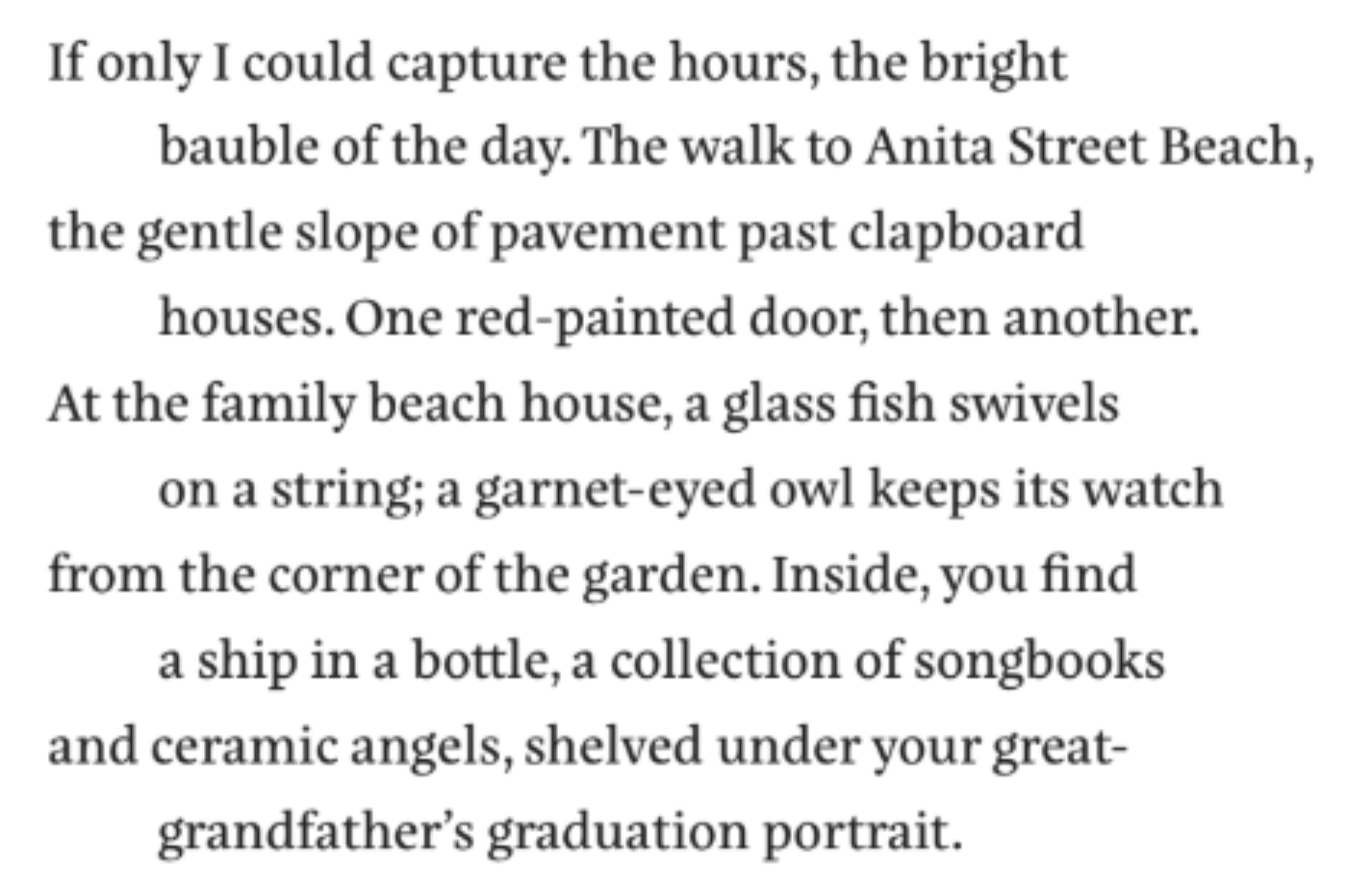
Mothersalt too is an education in how to see beauty and aesthetic value by seeing anew. In ‘Last Day in Laguna’, metre and form masterfully constrain one’s perception, bringing more perspective and focus, more vibrancy and depth, more beauty.
Excerpt from ‘Last Day in Laguna’
With enjambment to start, stop, and refine sight, Malhotra “bright[ens]” the “bright / bauble of the day”; picks out the “white[ness]” of “white / stones, picked from a bed of rocks.
Excerpt from ‘Last Day in Laguna’
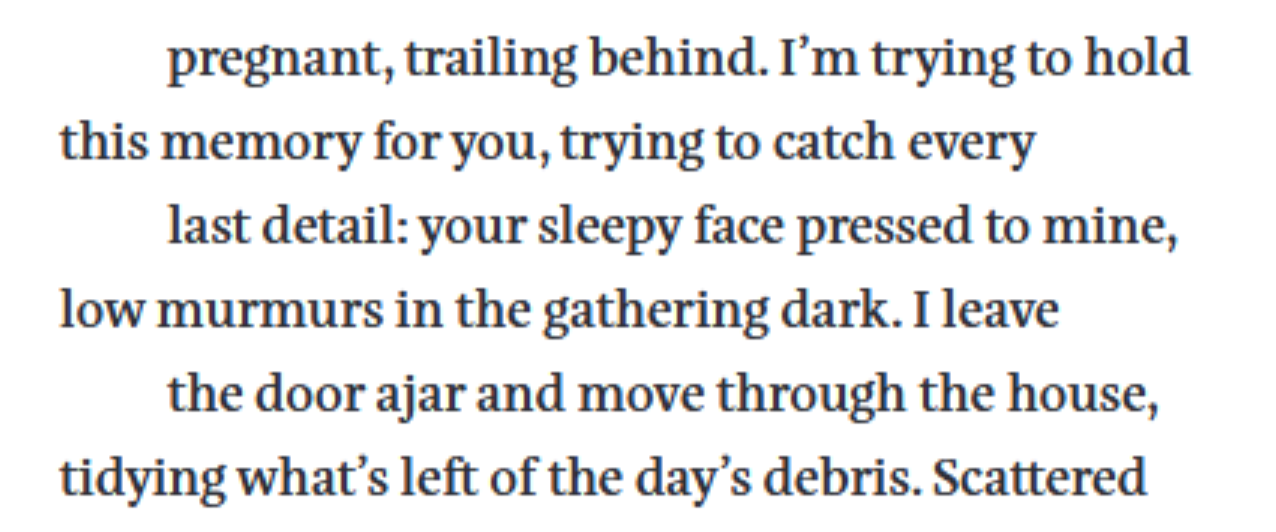
Reading “I’m trying to hold / this memory for you” and “I leave / the door ajar”, one momentarily misperceives the “[held]” object as physical and the “leav[ing]” as intransitive. At the clarification of the subsequent line, one becomes newly cognisant of the difficulty of perceiving clearly—alongside the fact that it is difficulty that makes that moment of clarification all the more beautiful.
This is where the beauty of Mothersalt comes from: its demand for its readers to self-consciously and effortfully engage with the difficulty of perceiving anew, precisely at the moments when their perception comes under the constraints of poetic form.
This poetry of perceptiveness is Malhotra’s aesthetic accomplishment as much as her theme, particularly where it relates to another of her themes, the problems of perception around pregnancy.
Pregnancy, in its pain and extremity, can constrain perception, including self-perception. The speaker’s recall of her first birth in ‘Dear Body— [I want to tell you]’ is fractured by the “glare of overhead lights” and “faces and names [she] [doesn’t] remember”. By ‘Dear Body— [At my second birth]’, she even loses sight of herself.
I sink to my knees, wracked by contractions so strong, it’s a kind of dismemberment. I no longer know myself, but I know this pain—or maybe it knows me.
This problem of pregnancy’s constraints upon perception is exacerbated by patriarchy’s purposeful constraints upon reproductive bodies of women and people of other genders. In ‘Bad Birth: A Retrospective’, the speaker is particularly critical of “twilight sleep”, a procedure which caused “delirium”, “hallucinations”, and “memory loss”.
How many of our mothers gave birth this way? Eyes wrapped in gauze, wrists rubbed raw from a struggle they would not remember.
Simultaneous with such medical procedures for constraining women’s literal perception are the rhetorical procedures by which society constrains possible perspectives on pregnancy, women, and gender: “the truth-claims of obstetrics” and “what they seek to resist or deny about women”. These are among the “flat description[s] of what it feels like to be a mother” which Malhotra seeks to combat, as she makes clear in an interview, [2] and against which Mothersalt searches out new perspectives.
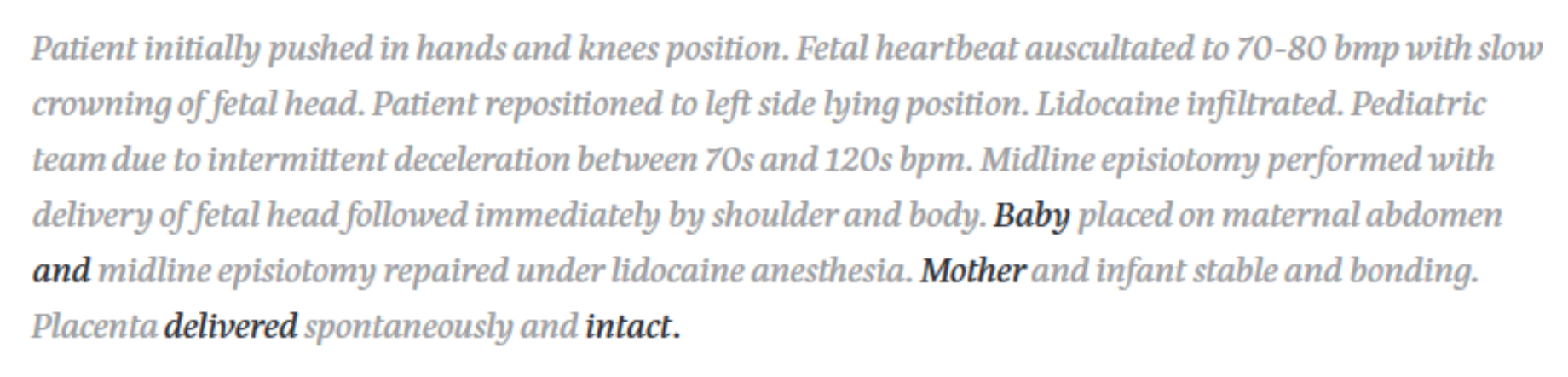
For if poetry constrains perception to renew it, might it not also engender new perspectives on pregnancy? Mothersalt’s different forms, of different perspectives, draw attention to how perspective can differ. ‘Mothersalt [Patient initially]’ makes formally, visually, literally perceptible a contest of perspectives:
Excerpt from ‘Mothersalt [Patient initially]’
In grey is a clinical report, with its relentless sequence of passive sentences and its cold terminology, all constraining perception of the mother into a mere body to be objectified and disciplined under the medical apparatus. In contrast—in quite literal, visual contrast—is the black text speaking directly to the senses and renewing focus upon the sheer bodily vitality of the mother and child.
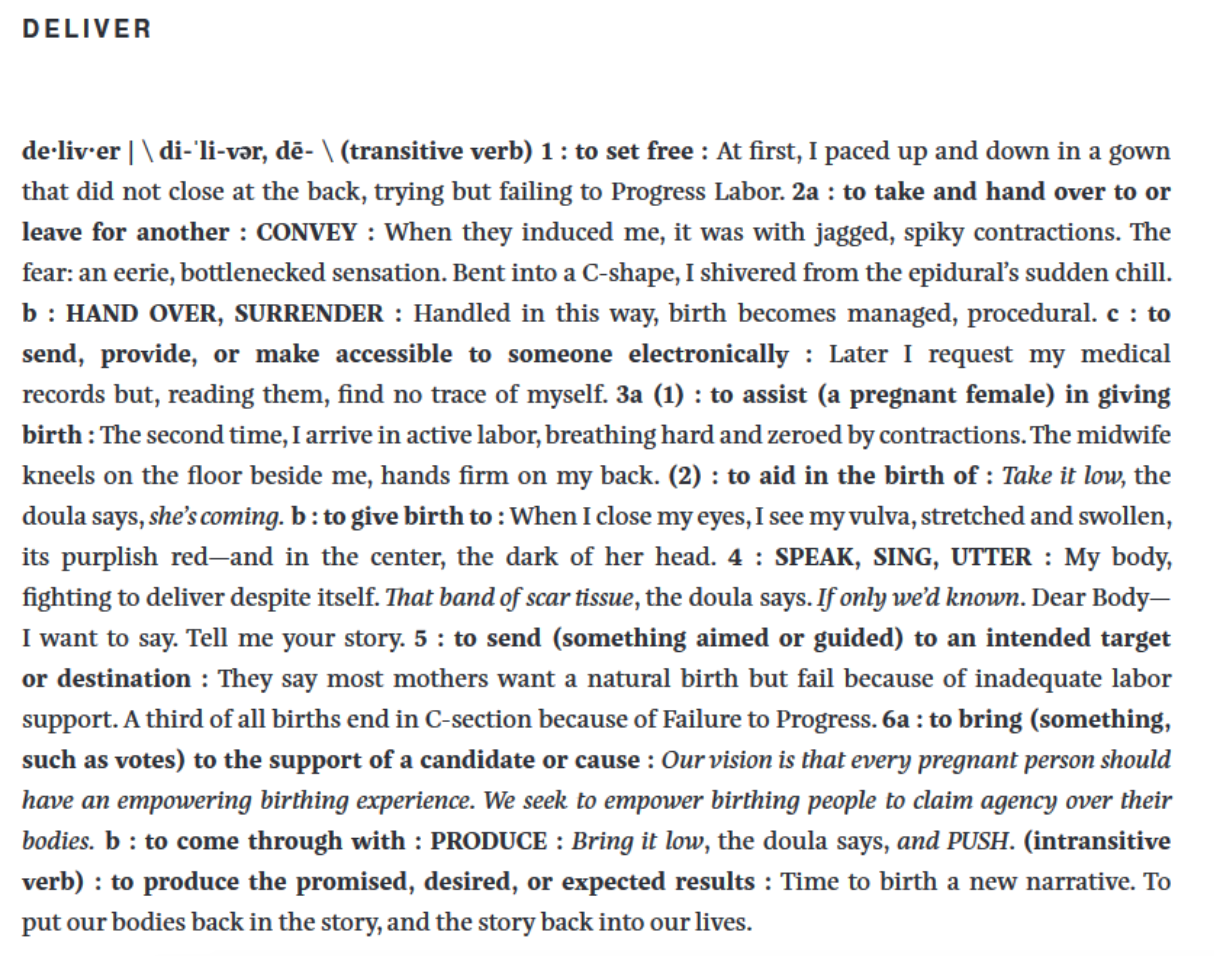
Image of the poem ‘Deliver’
‘Deliver’, styled after a dictionary entry, visualises how closely the institutions of healthcare, politics, and language work together in organising certain perspectives on pregnancy. Language genders, femininises, passivises the “pregnant female” and brackets her into the mere object of an “assist[ed]” delivery. Yet ‘Deliver’ closes with an assertion that language can be reclaimed for the self-conscious reorganisation of new perspectives: “Time to birth a new narrative. To put our bodies back in the story, and the story back into our lives.” For it is also language which would bring new (italicised) emphasis to “every pregnant person”—including those who aren’t women—as agentive subjects delivering a wider “vision”. There are as many definitions of a word as there are perspectives on their significance. And there are many forms for defining one’s perspective, so that what looks like the surrender of the self in one view, can be re-envisioned as the (re)production of the self in another view.
With birthing and motherhood comes social and institutional processes compromising one’s perception. But if poetry’s beauty arises from the conscious adoption of new ways of perceiving over habitual ones, perhaps it might also engender a politics of critically adopting new points-of-view over institutionalised ones. As the art of perspective, poetry can become a resource for one to perceive how one’s perception has been compromised—to then perceive how else one might perceive.
“Difficult beauty, they say, takes time.” So says the speaker of ‘Dear Body—[We all pass through]’, reflecting on the rewards and difficulties of motherhood. Mothersalt’s aesthetics reflects how it is the very difficulty of perceiving anew that engenders beauty. This dovetails with Malhotra’s politics as to the need for new perspectives on motherhood.
Abstract time solidifies into “ungainly hours with a “hamstrung gait” (‘Mothersalt [Like an object from space]’). The celestial sun “lifts its skirts and runs off with the days” while the speaker is “shot through with clotted milk” (‘Mothersalt [Patient initially]’). A vague “twinge in [the] left breast” is deliciously sensualised into a “Nipple elongated, silky with milk”. In the process, the focus shifts from the feeding of the child, to the nourishment of the mother, stealing a “single warm, creamy mouthful” and “drinking [herself] in” (‘On Weaning’). This is surely a new perspective, revising an earlier vision of motherhood “steal[ing] from itself to feed itself” (‘On Mothering’).
What is nourished is a new vision of birthing and motherhood. In this new vision, the constraints of pregnancy and parenthood can be as reinvigorating for self-perception as poetic constraints are for artistic vision.
Previously mentioned is how the pain of pregnancy constrains self-perception in ‘Dear Body [At my second birth]’. But it is also worth noting the speaker’s insistence on perceiving pain clearly: she “refuse[s]” not only the “stares”, but also the “wheelchair” and “epidural” that might make pain less perceptible. Though she “no longer [knows] [herself], she seems almost electrifyingly self-willed in her determination to “know this pain” that “knows [her]”.
In ‘Mothersalt [If the body goes rogue]’, pain is thus reclaimed and revised:
If pain is a house, I want to live in it fully—to throw the windows wide and let the light stream in. To examine the locks, pry open the hasps so every sash can be lifted.
The house is a container, appropriate to how pain contains one to perceive nothing but one’s body in pain. But the house’s containment also enables conscious alteration—amplification—of perception. The “windows” constrain and limit light to “stream in” upon particular paths. The paradox of poetry and pregnancy is that even as it contains perception within its “locks” and “hasps”, it is the very containment that makes more “ful[l]” occupation of that bounded structure possible.
This is a paradox Malhotra herself perceives—a paradox which she also credits as the generative force behind Mothersalt. In a “Process Note”, [3] she reflects that she exists
more fully in my mothering than I do anywhere else, but also that the institution of motherhood will erase you—or at least it will try—and that this book is the ember I clutch in my hands as I emerge from the fire.
In ‘On Form’, the speaker makes a claim for aesthetic constraint in relation to biological, creative, and cultural generativity: “I became a mother and I began to write like a Japanese woman.” This is later demonstrated in ‘Spring’, wherein the teaching of how to see under aesthetic constraint becomes part of the programme of parenthood and cultural inheritance. After “[taking] the baby to the Japanese garden”,
I point at the koi, telling her I like the black and gold one best. Teaching her what is pleasing and what is not.
Drawn together are the baby “under the cherry blossoms”, being taught to understand what is aesthetically pleasing and not; the mother “[understanding] for the first time why people go to see the cherry blossoms”, including why her grandmother “wanted her bed turned to face the tree in her garden” in her last days. What enables aesthetic tradition to continue through generations against the constraints of time is, paradoxically, a continuous deference to formal constraints.
All this is represented through a form that itself participates in cultural continuity through continuing constraint. Much of ‘Spring’ is in the prose poem style echoing older Japanese writing, the haiku-like ending a homage to Soetsu Yanagi, a Japanese art critic on the Beauty of Everyday Things. The poem is of one who parents as a Japanese mother and daughter, by one who “write[s] like a Japanese woman”.
The new constraints of motherhood, no longer easily distinguishable from the constraints of aesthetic form, make new poetry, make a new self-as-poet. So it is that the speaker, constrained in parenthood as in poetry to educate her child as well as her reader, is freed to renew the imperative of her own aesthetic and genetic predecessor—
Look. Oh, look.
Notes
1. JL Odom, “Poet Mia Ayumi Malhotra Interweaves Personal Narrative, Cultural Ties in Mothersalt,” SF Gate, May 13, 2025, https://www.sfgate.com/news/bayarea/article/poet-mia-ayumi-malhotra-interweaves-personal-20324610.php.
2. Odom, “Poet Mia Ayumi Malhotra Interweaves Personal Narrative, Cultural Ties In ‘Mothersalt.’”
3. Mia Ayumi Malhotra, “Process Note #56 : Mia Ayumi Malhotra : On Mothersalt,” Periodicities : A Journal of Poetry and Poetics, May 1, 2025, https://periodicityjournal.blogspot.com/2025/04/process-note-56-mia-ayumi-malhotra-on.html.
Tan Yanrong graduated with a Masters in nineteenth-century literature, writing on style and sociocognition. Their article examining black humour in Rape of the Lock is forthcoming in Eighteenth Century: Theory and Interpretation. They recently presented at the University of Liverpool’s Current Research in Speculative Fiction Conference.
‘The truest, most vivid sketch of non-performative unconditional love’—Ashley Marilynne Wong reviews Susanna Kwan’s Awake in the Floating City (New York: Pantheon, 2025).