
Over Fragmented Waters
By Bekah Lazar
Diane Briones Williams, Monsters & Aliens #01, 2018. Pigment print on archival paper.
Image description: A woman dressed in a domestic servant’s uniform, a dress of dark blue with white trim, her head obscured by a sculptural weaving of turquoise and orange that resembles a fantastical helmet with horns. She is seated in a white space, her head and upper body set against a background of two, flat, rectilinear shapes that are also turquoise and orange.
When Maribel changes the soap in the dispenser on the third floor, her hands work in swift, practiced movements: pry the face of the container away, exchange the empty bag inside for another one filled with bubblegum pink guts, reapply the plastic face, and give it a couple pumps to encourage the movement of the slimy liquid.
This is her last task of her newly appointed weekend afternoons. The dispensers on the first and second floors have already been changed, the bathroom floors mopped, the windows wiped down, the carpets in both the cubicles and meeting rooms all vacuumed. As she washes her leathery hands free of the pale pink suds, Maribel silently mulls over her mental checklist for the closing routine: store the mops and buckets back in the janitor’s closet, check that all the meeting rooms and higher-level personal offices are locked, and disinfect the doorknobs as she leaves. It’s a simple weekend routine, scrawled onto the piece of notebook paper in her pocket and worth $13.50 an hour. $67.40 a day. $135 per weekend. It’s still not enough, but it’s something.
Maribel looks at herself in the mirror while she turns off the tap. She wipes her hands on a piece of the paper towel roll she’d just put into the dispenser several minutes ago. When that doesn’t dry her hands entirely, she wipes the residual water off on her blue janitor’s uniform. It leaves a dark streak the same shade as thunderstorm skies.
She takes a deep breath, grabs hold of her cart with her mops and buckets and half empty Windex bottles, and exits the bathroom. The tiles sparkle on her way out.
*
Lily is a kind child. She has hair the colour of a lemon popsicle and striking baby blue eyes. The way she laughs reminds Maribel of an ice cream truck. Her two oversized front teeth make her look like a bunny when she smiles.
“I’m going to be out late tonight, so just make sure she’s in bed before ten. She has school tomorrow at 8:30,” Lily’s mom says as she rushes around the house, a chic brown purse bouncing against her hip. “I should be back around ten thirty or eleven.”
Maribel smiles. Folds her cracked hands together. They’re still dry from the shower she had earlier. “Alright. I’ll take care of her well,” she says.
Janet returns a brief smile and begins to dig through her purse. There’s a small MK charm hanging off the handle. It could feed Maribel’s family for weeks. “I’m sorry this was so last minute,” Janet says, still rifling through the contents of Maribel’s entire pay period slung across her shoulder. “I know we only have you over during the day after school, but my sister is out of town and you’re the only other person I can trust with Lily.”
“It’s no trouble,” Maribel says. Her voice is soft.
“Ah! Finally.” Janet pulls her wallet out of her MK-charm family-feeding purse. “Is $100 enough for one night?”
Maribel hesitates. Does the math in her head. It’s 6 pm now, and she’ll be here until 11 pm. 5 hours then. At her usual $15 an hour, $100 is more than she could’ve asked for.
“That’s fine,” she says, and takes the crumpled bills with careful hands.
“Okay! Good.” Janet flashes her an overly white smile. “You can make whatever you want for her dinner. You know her preferences by now,” she prattles off before a car horn pierces through the closed windows. Maribel jumps.
“Alright! I’m coming!” Janet yells, and heads towards the door. On her way there, she makes a detour towards the child sitting on the sofa with a long-haired doll in her lap. She plants a quick kiss on the crown of the child’s head and then makes her way towards the front door with a big glass center. On sunny days, it stamps tiny rainbows onto the foyer’s marble floor, but it’s dark out now. Only the streetlights shine through in muddled yellow blobs.
“Thanks so much again, Maribel,” Janet says as she swings the door open. “I’ll text you when I’m on my way home.” And then she’s gone.
Maribel stares at the stack of twenties in her fingers. Then, meticulously, she spreads them all out on the nearest granite countertop, smooths out each individual bill, and folds them each in half before placing them in her plain leather wallet from her weathered brown purse.
“Can I watch the TV?”
Lily’s voice carries across the foyer. Maribel smiles. Makes her way across the polished marble to the suede couch where Lily is braiding her doll’s long hair. Lily has a voice that reminds Maribel of wind chimes.
“What do you want to watch?” Maribel asks her as she lowers herself down next to her.
“I don’t know.” Lily is a funny kid.
“Well,” Maribel says, and reaches for the remote. “I heard there’s a new show on that network—Nickelodeon, I think it’s called.”
Lily chews on the doll’s hair. “They have SpongeBob.”
“They do.”
“Can I watch that?”
“Sure.”
Lily shrieks in delight. “My mom never lets me watch TV after five.”
Maribel waggles a finger in her face. “Don’t tell your mama about this, then. And you only get an hour. Deal?”
“Deal!”
As soon as Maribel presses down on the remote button, the TV explodes into colour. Lily bounces in her seat, the doll lying forgotten beside her. Maribel makes her way to the kitchen just a room away, where the living room is still visible to her.
Their fridge is considerably more stocked than her own at home. She pulls fresh organic potato bread from a white drawer and sharp cheddar cheese from another. She wiggles a tub of vegan butter out from behind a carton of brown cage-free eggs. Laughter from the cartoon travels into the kitchen. Maribel glances out into the living room.
For a moment, she watches: the yellow sponge says something to some other sea creature and erupts into a nasal laugh. The colours on the TV are so vibrant. She had no idea that colours on the TV could be so vivid until Lily. It almost makes her eyes hurt. The sponge is hit on the head with a boot. Lily bursts out laughing. Maribel stares and forgets to blink.
A commercial break commences, and she pulls herself back to earth. Her hands go through the motions she’s memorized by now: butter the bread, place in a pan over medium heat, place cheese on bread, butter other piece of bread, place on top, flip. Lily loves grilled cheeses. All children here seem to love them. It’s quite convenient.
Maribel adds a garnish of apple slices on the side of the plate when she brings it to Lily, whose attention is captured as soon as the sandwich enters her vicinity.
Lily squeals. “Thank you, Mary!” she exclaims before biting into an apple slice.
Maribel smiles. On the TV, a squirrel in an astronaut suit swims into view and begins to sing about her home. Here, it’s dark outside.
“Of course.”
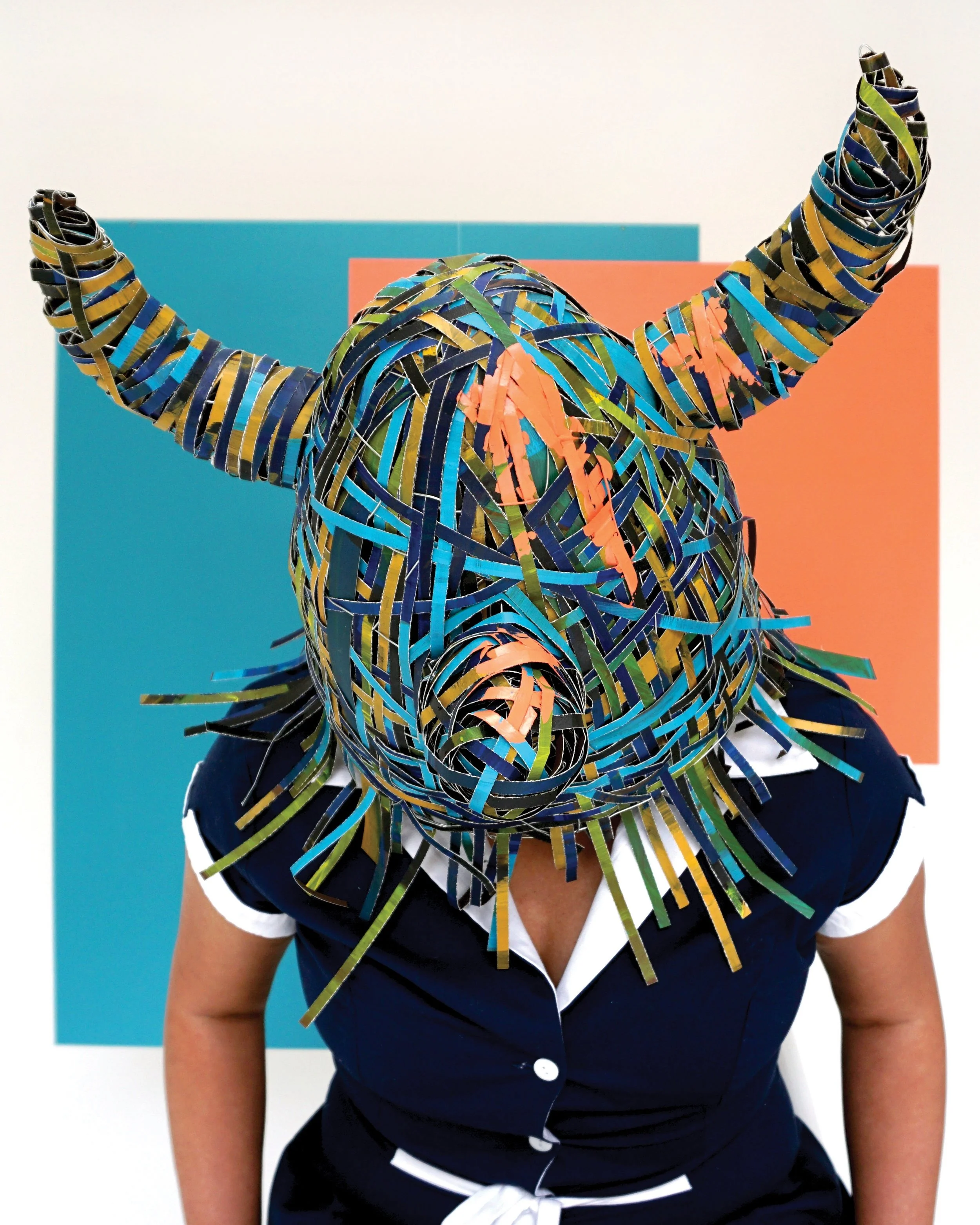
Diane Briones Williams, Monsters & Aliens #02, 2018. Pigment print on archival paper.
Image description: Confrontational close-up of the same woman as #01, cropped from the waist up and leaning towards the viewer, her sculptural woven helmet-mask is visible in all its detail against the same two, flat, rectilinear shapes in turquoise and orange.
*
Maribel’s bus pass is $90 a month. She buys the monthly pass because she uses the bus every day and it’s cheaper to buy the monthly pass than to pay $3 twice a day, sometimes more. She reminds herself of this when she taps her transit pass to the card reader at 11:30 pm. $90 is far cheaper than $168, even though it could pay for an entire month's medical expenses.
The empty bus groans to life. Maribel watches the world go by outside: blurs of pale yellows against charcoal sky, smudges of green and white. The trees look so different here, even when they’re just smears from behind a window.
After several silent minutes, she pulls the yellow cord to signal the bus driver to stop. It’s fun to have a cord to pull.
*
The house is quiet when she returns, because it is past midnight and the strangers she lives with are people who have no reason to be up at this hour. She shuts the plain door that has no crystalline glass in the middle; the keys in her hand jingle like church bells.
Maribel opens the old white fridge with a half-broken light inside that flickers on and off sporadically. She takes her Tupperware full of cold pasta salad from her designated ledge and eats it in the dim kitchen lighting while trying not to make too much noise. When she’s finished, she washes the oil from the plastic and leaves it in the broken dishwasher to dry. She takes a Ziploc full of boiled peanuts from her shelf in the cupboard and goes into her room.
*
Her phone plan is $15 a month for an iPhone 6 she bought pre-used on Facebook marketplace. It’s past midnight here, but Maribel hits “Facetime” on the slightly cloudy screen anyway. The person on the other end picks up, and Maribel sees sunlight.
“Ma!”
Maribel smiles. “Hi, anak ko.”
“Angel!” A second voice yells from a distance. “Is that your mom?”
“Yah,” the little girl on the screen says. She’s missing a tooth in the front. Maribel doesn’t know when it fell out. “We just got home from school,” she babbles. “Lola and I got food on the walk back home.”
“Really?” Maribel places the phone down on her window ledge and peels open the peanuts with her hands. “What did you get?”
“Kabobs.” The screen on the other end begins to shake as Angel runs through the apartment. She coughs as she scurries through the house; phlegm audibly tears at her throat. “Lola said we could get them if I promised to start on my math worksheet as soon as we got home.”
“Yes, so you’d better get started on that.” An older woman picks up the phone from Angel’s hands. Maribel’s heart falters for a brief moment.
“Hi, ma.” Maribel pops a peanut in her mouth. “How are things?”
“Your daughter is a handful, you know that?”
“I know.” She laughs. “How has she been?”
Her mother presses her mouth down into a thin line.
“We might need to take her to the doctor again. She hasn’t stopped coughing.”
“Did you buy that nebulizer I told you about?”
“I did.” Her mother scrubs at her eye with the back of her hand. “It helped for a little while, but not entirely. It might be getting worse.”
Maribel plays with empty peanut shells in her hands. “I’ll send more money then,” she says. “Go into the city. Take her to a hospital. I’ll send some extra for a stronger inhaler.”
Her mother frowns. “You’re already sending so much.”
“Take her,” Maribel implores, voice raising. “I got another job that I do on weekends, so I’m making more money now. You just need to take care of her.”
On the screen, worry settles on her mother’s face. “I can find work too.”
She thinks of her mother’s gnarled hands. Of the $14 she sends once a month for generic brand ibuprofen to combat the inflammation in her mother’s joints and how that is still not enough. “No,” she says, firm. “I’m the one working here. I can do it.”
Her mother’s eyes flicker elsewhere. “Okay,” she says, hesitant but not willing to argue. “If you say so.” And then, “I believe your daughter wants to talk to you.”
The phone is passed back into Angel’s hands. There are little ribbons in her hair. They’ve come slightly undone in the heat-induced frizz. “Ma! When are you coming home?”
Maribel pauses. A plane ticket to Manila would easily be over $1,000. After her $950 rent in a house with poor heating and the $500 she sends to her mother back home, only $290 remains—barely a quarter of the amount she would need to visit her daughter back home. Her daughter who is in an apartment with no heating, only family members to fill the beds.
“Soon, anak,” she says instead, and nudges the corners of her mouth up in a hopefully convincing smile. “Soon.”
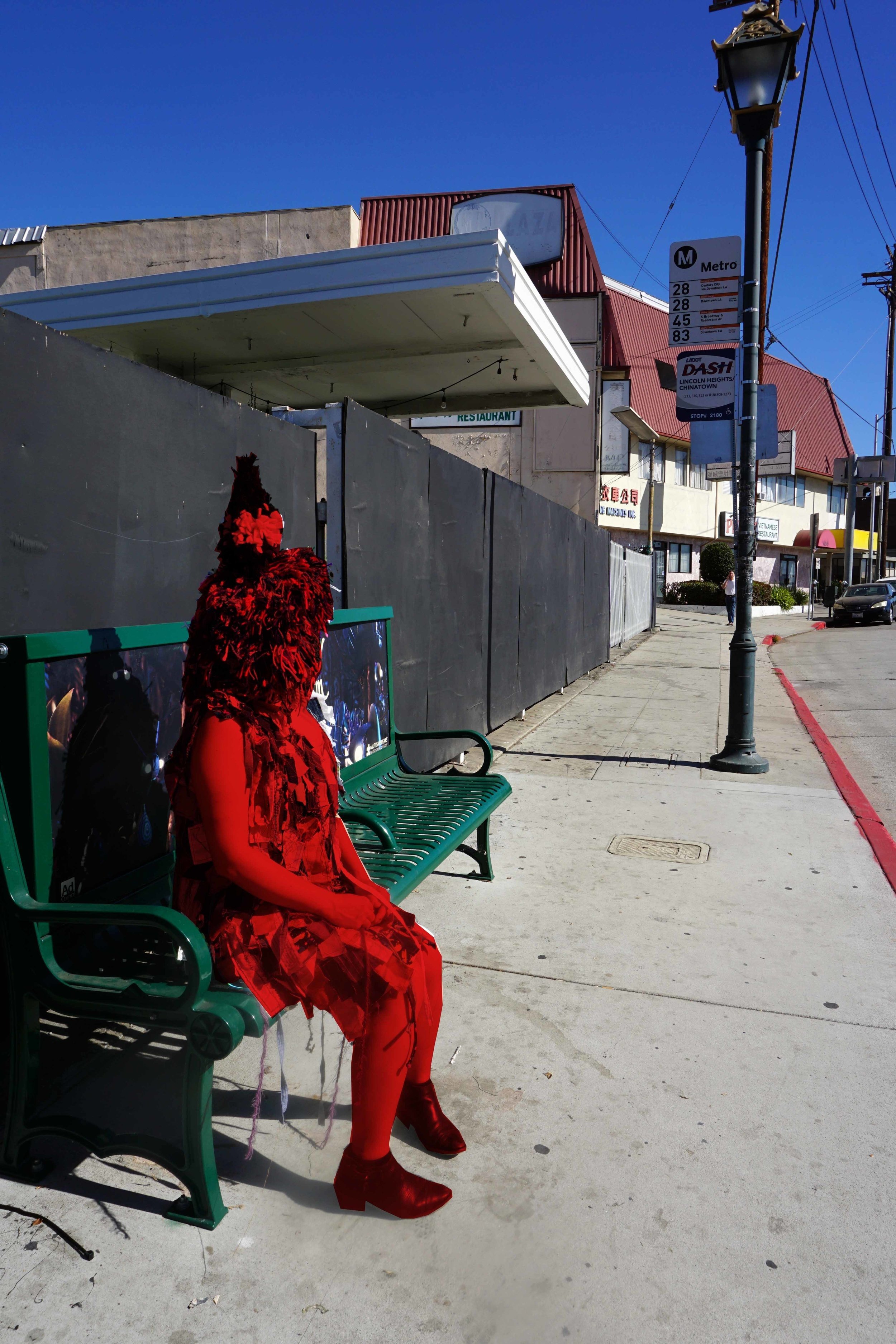
Diane Briones Williams, Pleasantly Peculiar, 2019. Pigment print on archival paper.
Image description: Seen from the side in bright sunlight, a woman dressed from head to toe in highly saturated red with a woven sculptural mask covering her head, is seated waiting on a dark green bench at a typical Los Angeles bus stop.
*
Lily’s school has a half day today, so Maribel takes the bus to her elementary school and waits by the gate stationed in the brick fence. Mothers with big sunglasses and shiny shoes congregate in clumps around her. A father in a golf shirt checks his phone. Someone jingles their car keys in a fit of impatience. Maribel straightens out her wrinkled skirt and holds her chin high.
“Mary!”
She smiles as Lily runs out the open gate into her waiting arms. A woman with a chunky charm bracelet stares. Maribel smooths down Lily’s blonde flyaways with her cracked hands.
“Do you wanna do something fun today?” she asks Lily, who nods vigorously. “Do you want to go to the library?”
“Yeah!”
*
Maribel taps her $90 transit card to the reader and drops a handful of quarters into the cash receiver for Lily. They weave through bodies to the back of the nearly empty bus and sit down on a pair of worn blue seats.
In one of Lily’s hands is a red lollipop that Maribel bought at a corner store for $1.25. Maribel holds the other free hand, calloused fingers woven into Lily’s smaller ones. She marvels at the smooth skin, the richness of youth. She wonders if they will ever be eroded at all.
Maribel pulls the yellow cord. The bus stops without a word. It’s phenomenal.
*
On the weekend, Maribel dons the keys to the corporate buildings she’s been assigned to and pulls on her blue janitorial uniform. It cost her $30 and she had to pay for it herself. She’d forgone buying eggs and meat that week. She’s learned to love the taste of peanut butter sandwiches.
Maribel dunks a mop into her bucket, squeezes it, and begins to mop the bathroom floor in quick side-to-side motions. There’s a method to this, she’s found. While she waits for it to dry, she powers up the bulky vacuum she hauled out of the supply closet and goes over the carpets until the dust compartment turns a cloudy grey. She returns to the bathroom, pulls on blue latex gloves, and digs through the metal bins in the stalls. She tosses bags of used sanitary products in her industrial trash can and replaces the brown paper lining. She scrubs the toilets clean. She wipes down all the mirrors. She defaces the plastic soap dispenser and refills its bubbly organs. The bathroom glows in soft light. Maribel disappears.
*
“They say it’s pneumonia.”
On the phone’s screen, Maribel’s mother presses her lips together in concern. Maribel blinks and listens to the cacophony of noise on the other side of the line—people in the apartment complex chatter on the balconies; wheels roll over an unpaved road; Angel sings a nursery rhyme Maribel can no longer remember the name of.
“Do you know how much treatment is going to cost?” she asks her mother, because her mother is there and she is not. Maribel is here.
Her mother is silent for a heavy moment.
“Without insurance, upwards of forty or fifty thousand pesos if we go to the hospital in the city.”
The world spins for a moment.
“We’ll do it.”
Her mother’s eyebrows knit together. “Mari—”
“I said we’ll do it! I’ll find a way to pay for it. I’ll ask for more hours. I’ll send more money. Everything they need to do, let them do it.” When she speaks, her voice cracks. “She has to get better. She has to.”
From the phone’s speaker comes someone’s laughter from outside an open window. A breeze knocks the palm tree leaves together. The envelopes on the table in the apartment read Santolan, Malabon City. Metro Manila. The eyes of her mother harden, determined.
“Okay.”
Maribel breathes.
“Thank you.”
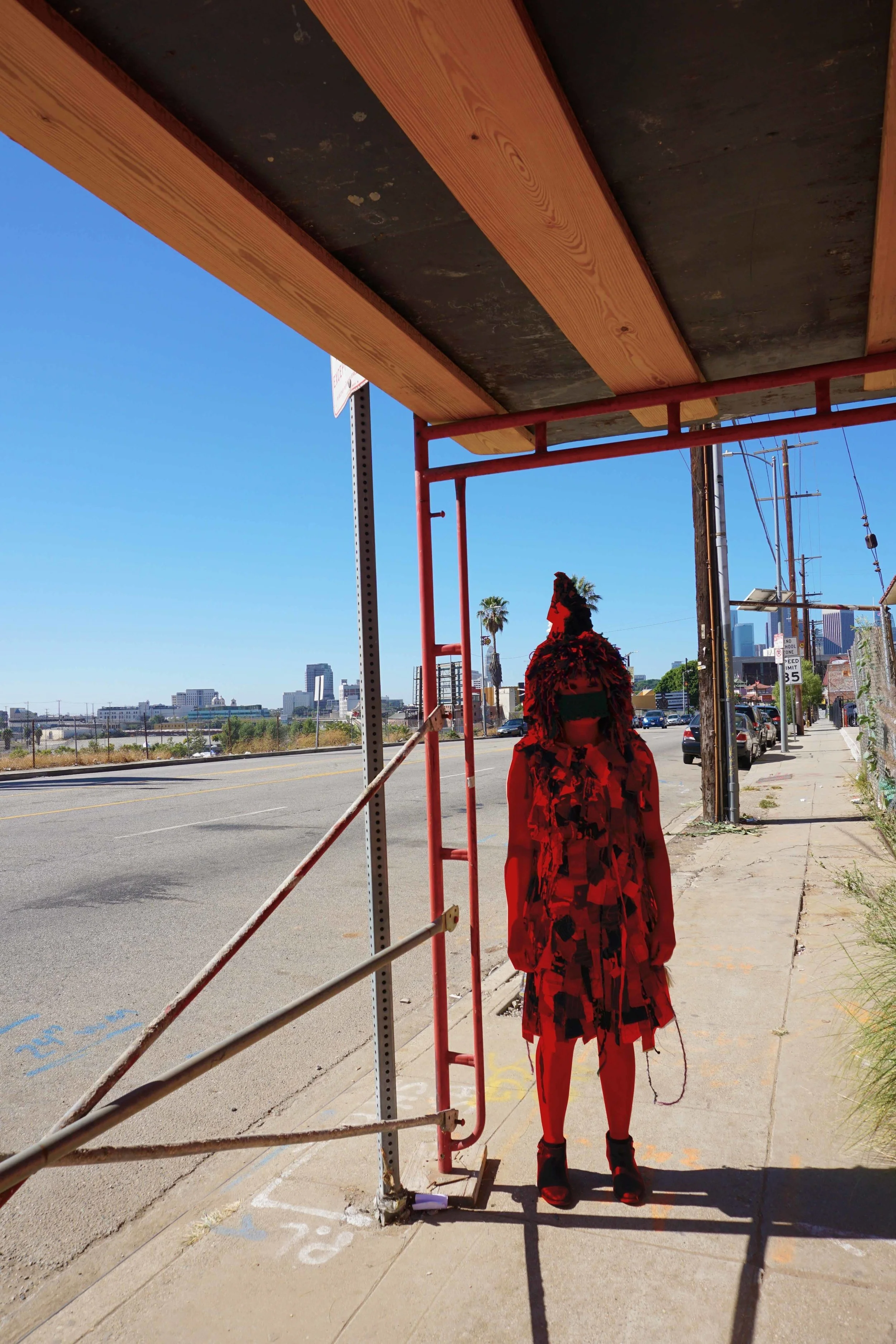
Diane Briones Williams, Delightful Savage, 2019. Pigment print on archival paper.
Image description: The same woman, seen in bright sunlight, this time standing and facing the viewer on a typical Los Angeles siidewalk under a scaffolding, with scruffy palm trees and buildings in the distance, dressed from head to toe in a highly saturated red costume, a woven sculptural mask covering her head.
*
The big bowl in the middle of Lily’s dining room table holds a pile of mandarin oranges and Pink Lady apples and various other fruits. Maribel picks a fresh Asian pear off the top of the pile and begins to cut.
Lily sits at the table with homework strewn out all over the sleek black surface. She’s spread dozens of crayons all over it and is scribbling on a worksheet with a sky-blue crayon that matches her eyes. The half-empty crayon box has a big 120 on it. When Maribel brings her the slices of pear on a pink ceramic plate, Lily abandons her work and grins.
“What did you do at school today?”
“We had a spelling test.” Lily takes a bite of the pear with her bunny teeth, then frowns. “I got one wrong.”
“That’s okay,” Maribel says, and brushes down Lily’s cowlick. “There’s always next time. And you know how to spell that word correctly, now, right?”
Lily nods. “I’ll do better on the next one,” she says with resolve.
Maribel smiles. “I know you will.”
Lily resumes crunching the pear as she picks up a bright red crayon and resumes her attention on her worksheet; it’s some sort of page scanned from a colouring book that depicts men in a boat that’s sailing onto the shore of an island. A big flag is raised on their ship.
With Lily now busy, Maribel threads through the house to the supply closet where she digs out a vacuum with a skinny handle and no cord. The white noise of the vacuum is loud, but both of them are used to it by now. Lily continues to colour, unbothered.
The head of the vacuum whirrs over the vinyl floors. Angel should be waking up around now. Maribel’s mother is probably putting ribbons in her hair, but they’re going to slip out because she doesn’t always remember to double knot them. They’re probably cooking day old rice with eggs. Maybe they’ll run into that street vendor that Angel likes and buy a cup of taho for 20 or 30 pesos each to keep them company alongside the rising sun. Or maybe they won’t; Maribel doesn’t know these things anymore.
She vacuums the house. She empties out the dishwasher. She refills the soap dispenser beside the sink. Lily kicks her feet that don’t touch the floor and hums.
*
By the time a key in the doorknob turns, the house is already spotless and there’s a fresh casserole in the oven. Maribel likes the ceramic casserole dish. She thinks it’s funny.
“Maribel!” Janet gives her a too-white smile as she walks through the door. “What’s cooking? It smells really good.”
“Broccoli and cheese in the casserole dish. It’s about done. Lily is taking a nap in her room.”
“Oh, how lovely. Thank you so much.” Janet motions towards the several pear cores still displayed in the centre of the pink plate. “Lily liked those then?”
“She did.”
“That’s good. I bought them at the grocery store over the weekend. They’re expensive!”
Maribel nods. “But they are delicious.”
“Sure are.” Janet unzips one of her ankle length boots and steps out onto the clean vinyl. “They have them in the Philippines, don’t they? Or is it too hot to grow those?”
Maribel hesitates. “No, we have them. Only in certain areas, though.”
“Where are you from again?”
“Manila,” she says, because it is the easiest.
“My brother’s fiancée is from the Philippines too,” Janet says as she removes the other boot. “You’re nothing like her, though. She’s loud. Always bringing her family over. But they’re nice, they make good food.”
Maribel smiles and says nothing because she does not know what to say.
“He’s the only one of us to marry a foreigner, actually,” Janet continues as she sheds her long overcoat to hang on a steel coat rack. “They went to visit her cousins recently. He showed me pictures. They stayed away from the big cities since they’re so polluted, but the beaches look beautiful. I’m considering going there for a vacation next year. Maybe I’ll buy some property there at some point so Lily can have a nice vacation home when she’s older.”
“Yes, the beaches are nice,” Maribel finally says. She doesn’t mention the small apartment in which her mother and daughter live with their inflamed joints and clogged lungs. Or the way she used to peddle plastic containers in the city as a child on weekends. Or how the ocean is oftentimes the most beautiful only in the spots that tourists decide are worth maintaining. “It’s a very beautiful place.”
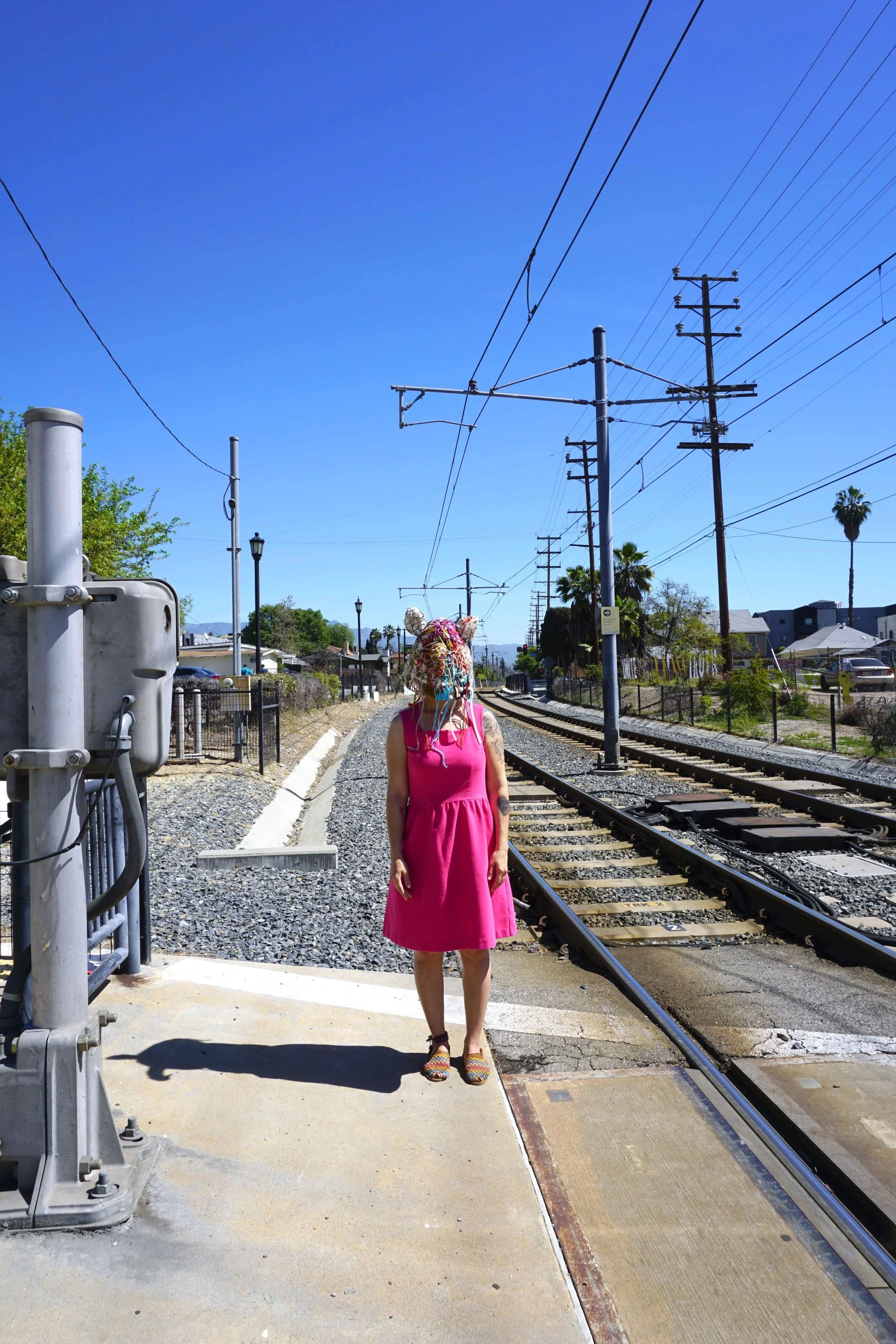
Diane Briones Williams, Photo from Mujer Inmigrante, 2018. Pigment print on archival paper.
Image description: A woman in a bright pink dress, seen in bright sunlight, standing on a platform beside a railroad track and facing the viewer. She dons a helmet-like covering woven from strands of colored wool and yarn that resembles a cozy snood with teddybear ears. Her left shoulder is tattooed with a floral design, and her forearm with a large, dark, heart.
*
At home, Maribel takes her half-full Ziploc bag of peanuts and breaks them open at her wooden kitchen counter. She chews them quietly, contemplatively. It’s dark out. Angel should be getting home right about now. Maribel’s mother should be placing the breathing mask on her and switching the nebulizer on. While she breathes, her mother might take several generic brand ibuprofen tablets and stretch her fingers out as far as she can. Maribel doesn’t know if the windows will be open or closed. She hopes that her mother called the hospital in the city. She remembers antibiotics and inhalers and ventilators and the crinkled twenty dollar bills she’s already stuffed into an envelope labeled Santolan, Malabon City. Metro Manila to be converted later. Her hands break the last peanut shell in half.
Maribel shakes crumbs out of the plastic Ziploc bag and watches them flutter into the sink. She turns the bag inside out to wash any leftover crumbs away and scrubs the tricky corners with a soapy finger. When she’s done, she places it inside-out on the countertop to dry.
*
“What did you do at school today?”
Angel coughs, then grins. She has a green stick of ice cream in one of her hands. “We’re learning multiplication now. Lola says I’m really good at it.”
“She is!” her Lola’s voice says offscreen.
Maribel smiles, heart too heavy, heart too tender. There is empty space in her arms where her daughter should be. “What’s four times two?”
“Eight!”
“Seven times three?”
“Twenty one!”
“Five times six?”
“Thirty!”
Maribel laughs. “You are good at it.”
“Told you.” Angel hacks up a cough from her wet lungs. Maribel’s heart hurts.
“Have you been using the nebulizer?”
“Yeah. It smells funny.”
Maribel laughs. “But does it help?”
“Kinda.” Angel takes a bite out of her ice cream. “Lola says we might need to go to the doctor again cause I won’t stop coughing.”
“Do you want that?”
She pauses. “I don’t like coughing,” she says, seemingly thinking out loud. “And I don’t like the feeling in my chest.”
“We’ll get you a doctor then,” Maribel says, voice soft. “You’re gonna feel better soon.”
Angel grins. Green cream has gathered in the gaps between her teeth like she has eaten moss. Some of it has rubbed off on her chin. Instinctively, Maribel reaches forward to wipe it off. Her finger meets a phone screen.
“And when you come back, we should go to the big mall. They sell a lot of stuffed animals there. I really want to get a bear.”
Maribel looks at her daughter, who bites off another chunk of ice cream and chews with her mouth open. Light streams through the windows behind Angel. The sky is blue over there, across the world, while it is still dark over here. Metal pots clang together in the background and she knows her mother is preparing meryenda for both of them. The apartment looks warm, golden squares of the afternoon sunlight stamped onto the wooden floors. An ache swells in her chest.
“Okay,” she says. “We’ll go as soon as I get back.”
“Angel!” Maribel’s mother’s voice cuts through the delicacy. “Come here. We need to do your inhaler.”
Angel coughs, shreds her vocal cords, and smiles again.
*
When she rides the bus, Maribel imagines her mother and daughter clumped together with other people in a vehicle far smaller than this one and infinitely more colourful. She pictures Angel running to the stopped Jeepney and flashing her tooth gap at the driver as she drops the fare in, her grandmother panting as she jogs to catch up from a distance. They squish themselves in between other bodies and watch the world play out around them in swipes of greys and blues and yellows, keeping a careful lookout for their destination so they know when to knock hard on the walls. “Para,” they say with their mouths, and the driver listens. Then they hold hands as they depart from the crowd of bodies into the humid air. One day Angel will be big enough to take it alone. Maribel wonders if she will be around to teach her.
The buses in this city are long and hollow and move like snakes with cracked spines. They announce their stops over a loudspeaker and electric signs. They’re not very crowded on weekends, so Maribel has gotten used to riding alone in its cold metal bowels. Just her and the bus driver and the magic yellow cord.
*
Maribel shuts the face of the soap dispenser and envisions the hands that have touched the mechanism at the base of it. Dozens, possibly hundreds of hands, have been cleaned by the bright pink liquid who gives Maribel $13.50 an hour on weekends. She gives the dispenser a couple quick pumps and feels the soap plop into her hands, then rubs it into bubbles. They’re soft against her cracked skin. When she closes her eyes, she sees sparkling bathroom floors and Lily’s 120 piece crayon box and purses with letters on them. And a 3400 peso nebulizer and her daughter’s tattered lungs. Tomorrow she will go to another office building and empty the metal bins in the bathroom stalls of sanitary products because nobody else will. Her mother will walk with her daughter to a Jeepney where there is no cord to pull but there is a guiding hand to hold. Thousands of miles away, there is sunlight she can’t reach.
Maribel opens her eyes. Washes her hands free of the white foam. Dries her hands on a paper towel, then tosses it. Today she will finish cleaning these bathrooms and try not to disappear.
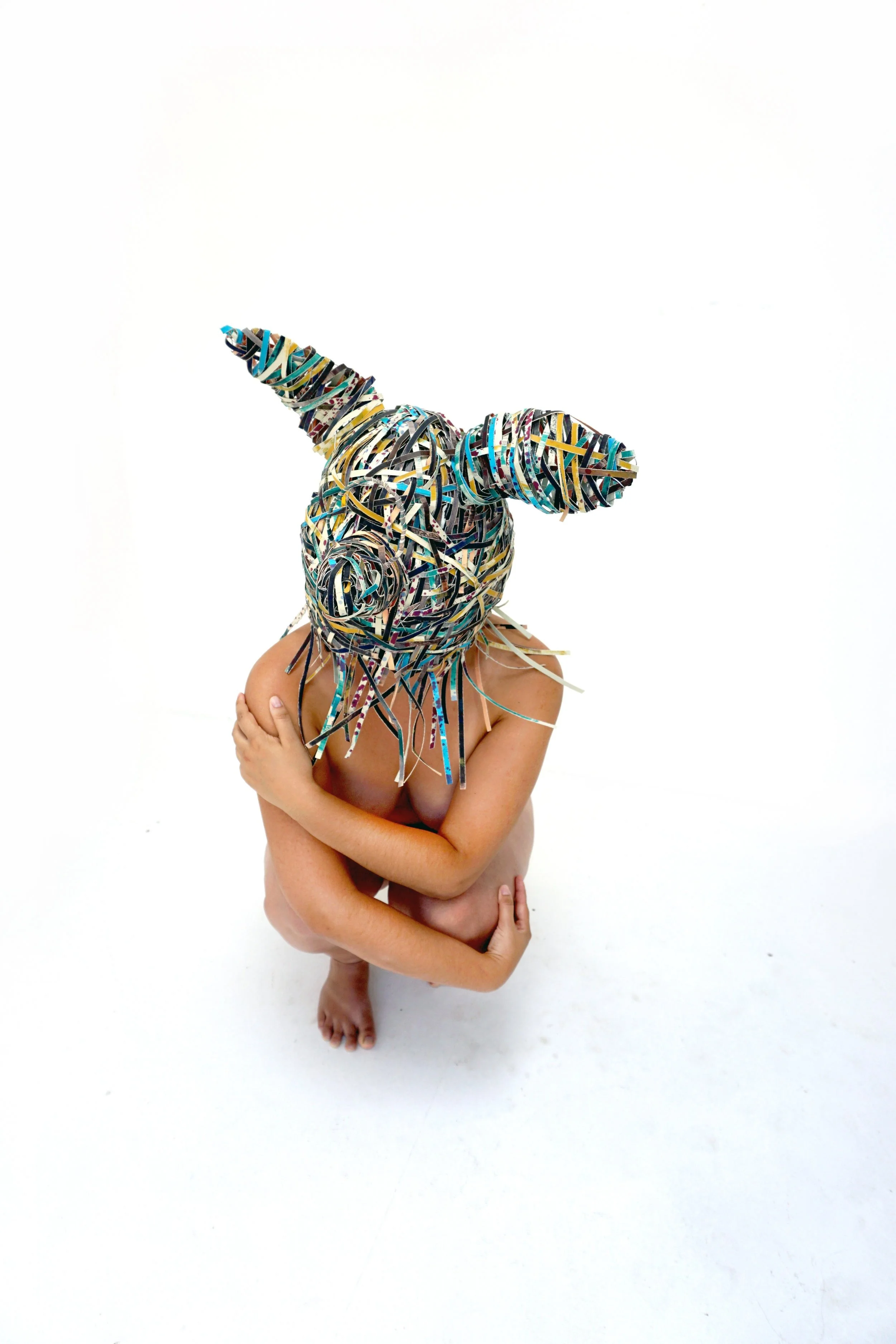
Diane Briones Williams, The Other #2, 2018. Pigment print on archival paper.
Image description: Seen from above, a woman crouches, nude, in a white space, hugging herself while donning a sculptural woven helmet-mask in hues of green and blue.
Bee Lazar (they/them), aka "Beaks,” is a tisoy first generation Filipina-American with maternal roots in Manila and Kalibo. You can find their work in Reed Magazine, The Lupa Newsletter, Tension Literary, EcoTheo Review, Gold Man Review and A Brand New Word in the End Drops Out, an anthology under West Trade Review. When not writing, it’s safe to assume that they’re either cutting up dollar store magazines to madly collage or reading Craigslist Missed Connections posts for fun.
*
Diane Briones Williams (b. Tarlac, Philippines; lives and works in Los Angeles, CA) holds a BFA from California State University, Long Beach, and an MFA from USC Roski School of Art and Design. Raised in the Philippines and sensitive to the spaces between cultures, Williams explores through mediums that include performance and woven sculpture how colonization, migration, and memory shape identity across generations. Her work is held in public as well as private collections and has been included in numerous solo and group exhibitions, notably at the Armory Center for the Arts (Pasadena); 18th Street Art Center (Santa Monica, CA), Official Welcome (Los Angeles), Museum of Art and History (Lancaster, CA); Robert and Frances Fullerton Museum of Art (San Bernardino, CA); California State University San Diego; Children’s Museum of the Arts (New York, NY), Berkeley Art Center; San Francisco Arts Commission Galleries; and Grafiska Sällskapet (Stockholm, Sweden). For more info please visit: https://dianewilliamsartist.com
“Last names come first in Japanese, you racist piece of—” a brawl, a funeral, and a stolen father in a short story by Jay Lindstrom.