
My Ejecta
By Nandini Bhattacharya
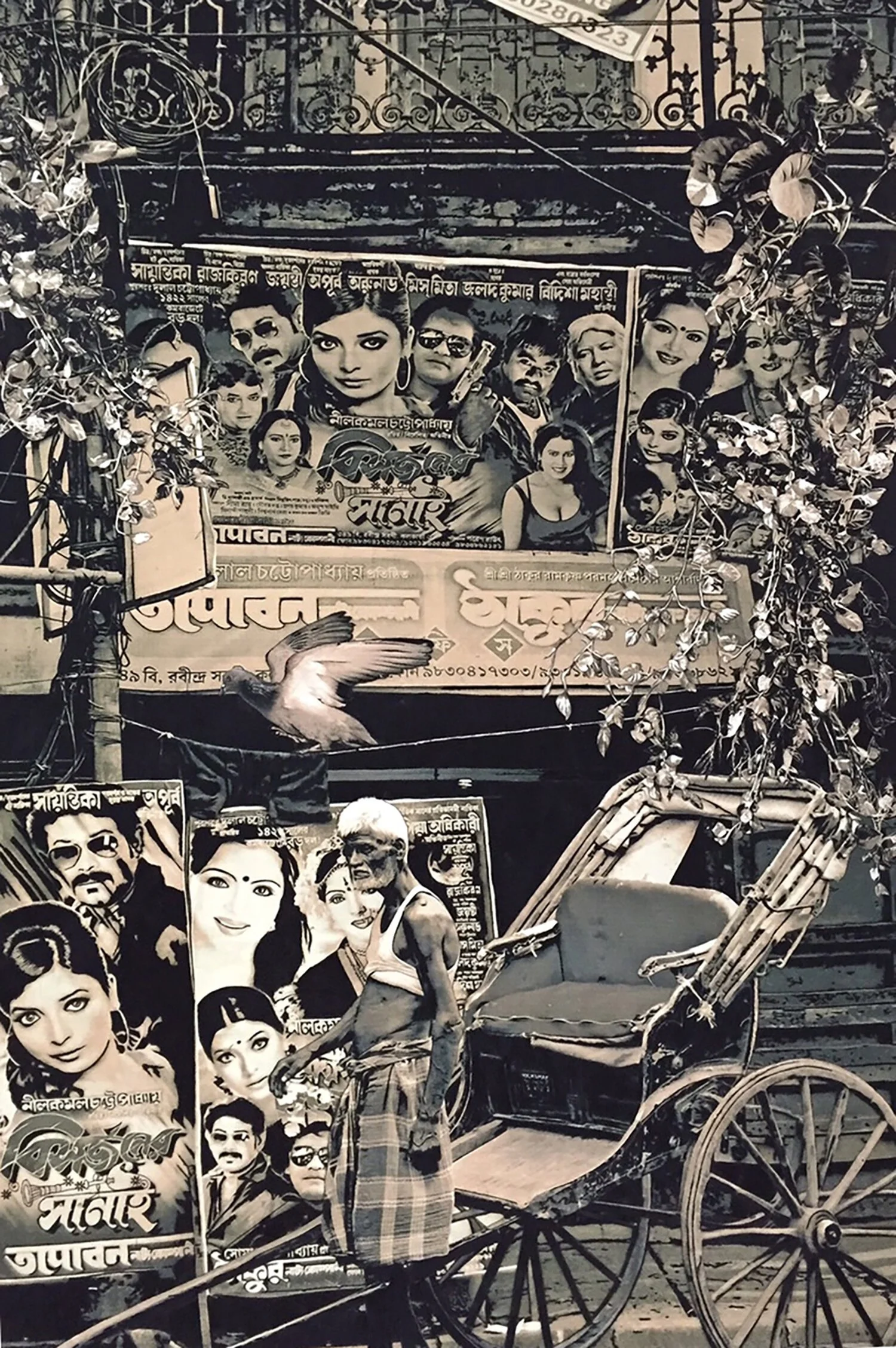
Suhasini Kejriwal, Beadon Street, 2015. Embroidery and acrylic paint on canvas, 61 x 41 inches.
Image description: In a vertical composition of photographic greys, sepia, black, and white, many-layered images vie for our visual attention: a rickshaw and its driver standing in front of movie posters and below a wrought iron balcony, a pigeon alighting on a wire, and lush foliage.
Safina sat facing me across the coffee table that morning, stiff, as if ready to give up her seat as soon as asked. Her knees touched. She held her little girl’s soft, pudgy hand. The girl sat at ease, her solid, chubby body comfortably stacked on itself, little fat legs dangling well above the carpet.
“But where did you even find this name?”
Safina blinked once or twice. She glanced at the girl. She cleared her throat and looked at me, hesitant.
“In your book, on table, Doctor Bazar.” Wouldn’t call me Russell though I’d asked her to many times in the four years I’d known her.
Because how long ago had my ancestors come from Ukraine or Poland or wherever? Probably ragged, grimy, eyes bleak. Stooped like burden bearers. I’ve never wanted to know exactly who they were. I’m not the type who goes to Ancestry.com. They might disappoint me. Or maybe I don’t want to know exactly what they left behind. I did notice a look passing between Safina and her husband five years ago when they first heard my name, but I’m used to that.
In my book, on table. Which one? On which table? In my study? Or on the dining table where I rarely eat and haven’t had dinner guests in five years? I couldn’t think which table, which book.
“But it’s not a real name, you know.” I tried to keep my tone gentle, neutral. I didn’t want to make her feel disrespected, small.
“I very much like, Sir,” she said, confidence butting into shyness this time, slowly turning into a glow.
“Please. Don’t call me Sir. Just Russell, please.”
Not in a hundred years would she call me Russell. It was stupid of me even to ask. I knew that.
“I like name,” she said, her shoulders lifting very slightly, almost elated. A little concession, leaving out the Sir. Stress on “name.” The little girl never took her eyes off me. I always remember her from that time, a thumb thrust deep into her mouth like a stock image of a cute child. Though I think I’ve imagined the thumb since, probably a false memory. The girl’s eyes were soft, untroubled.
Safina cleaned my house. A modest one in Schaumburg, Illinois. She’d come to me five years ago, recommended by a married colleague with whom I’d had a little affair, then stayed friends with. Safina had come with her husband. Who came to check me out, looking out for his wife, I’m sure. I’ve forgotten his name. A scruffy-looking couple. From Pakistan, they said. There were stories there, of course. I was sure of it. I didn’t ask. If they wanted to, Safina would probably say something. But she’d leave out important or at least vivid parts. Her English was ragged.
She announced she was pregnant about a year after she started working for me. Her husband came that day too. What the fellow did I couldn’t say but I assumed he drove a taxi somewhere in the city. Yes, probably. That was what these fellows—poor guys, exiled and under-employed—often do. Or maybe he worked in a store or restaurant on Devon Street, the ethnic neighborhood where I still go sometimes to eat Indian food. I’m not sure I’d recognize him. There was something closed about him, about his face. Dignified, craggily noble, but as though something inside was hardened. Or even dead.
They’d brought me a cardboard box of sweets stenciled with patterns in pink, green and silver. We each had one—I was being polite—but the sweets were a little too intense for me. I had to throw them away later because I’d tucked them away in the freezer and forgotten, and when I found them two months later, they were crusty with ice and hurt my teeth to bite into.
That day, Safina had looked transformed, no question. Her plain, acne-scarred face was glowing. She was almost beautiful. I had a strange feeling. I had to look away. I hoped the husband hadn’t seen it. I can’t define it to this day. I never felt that way again.
*
She is “vacuuming” and one thing on one page of one book on Doctor Bazar’s desk she sees. Beauty-ful picture. Big cloud. But like sun going down. Her back pain like cart of bricks stand on it. The baby kick in that time, khudaa. But she still want to see nice picture in nice book with shine pages. Then she see also nice word.
E-J-E-C-T-A. On top. Yes, nice word. Big word. Thick-thick writing.
Ejecta. Beauty-ful name.
She make up mind. Then-then. Nice name for sweet baby. Doctor who look inside say girl. Make Amir’s face not happy. But Safina like very much that it will come out of her a girl. Talk to daughter, teach her, one day go shopping.
*
That morning, I tried hard. “Safina, maybe you can give your daughter a nice Pakistani name. There are so many nice ones, aren’t there? Your name’s very nice too. Something like that? She’s your daughter. Don’t you and your husband want to hold on to your culture?” I had to try. I did try.
Safina’s face clouded for a second at that, and then I was taken aback at the sudden tears in her eyes. Shoot. “Oh Doctor,” she said, “my country, you know, not so good. Better America here. Better she grow up American. She lucky, you know.”
I knew. Or at least I believed I knew. I believed my own ancestors came from places of political terror, maybe torture, outrage. And I read world newspapers hungrily and grimly. Everywhere the same disasters. People starving in the streets. Sounds from jails. People outside not able to sleep at night because of the sounds. It is sad. I know that. But I didn’t shuck off my heritage or roots. I never would. One reason I couldn’t commit to my colleague even though she was ready to ask her husband for a divorce was that she isn’t Jewish. I’ve not been able to find the Jewish woman I want to spend my life with.
And then the name itself! Ejecta! Did Safina think it was a real name, an American name? I wondered how to explain to her in words that would mean something to her what the name meant.
Also, had she been going through my stuff? My papers? Books? How else would she even have come across the strange, weird name she’d chosen for her little girl? Most people wouldn’t know what it meant, but it just sounded ugly. Couldn’t she tell? Of course she couldn’t. Her English was so poor. She wouldn’t prefer one type of sound over another. Her husband had never said a word in my presence. Did he even speak English? Or understand? Maybe between the two, Safina was the functional communicator. And now this little girl would carry the burden of her parents’ uninformed choice through life.
Why did I feel responsible? I didn’t know. After all, Safina hadn’t asked me. And she’d even handled my stuff, something I’d told her not to do please. Just leave them as they are, I’ll take care of them.
Still. “Look, Ejecta actually means a bad thing. Like things that blow up, you know? Not good, very bad. Comes out of volcanoes. Do you understand what ‘volcano’ means? Big mountain with fire?”
Safina didn’t seem to hear me. Or to care. She only said, “But I like, Sir. You know? Nice English name. Pretty. No one also has that same name. No my friends, friends’ girls. No. All same. Ejecta so pretty. I like.”
Ejecta! What could I say? It didn’t matter to Safina that Ejecta—not even a real name—meant ‘things thrown out,’ and in particular ‘materials that have come out of a volcanic explosion.’ Really, what could I say to her? It wasn’t even clear she knew what the word ‘volcano’ meant, though she had to know what a volcano was.
*
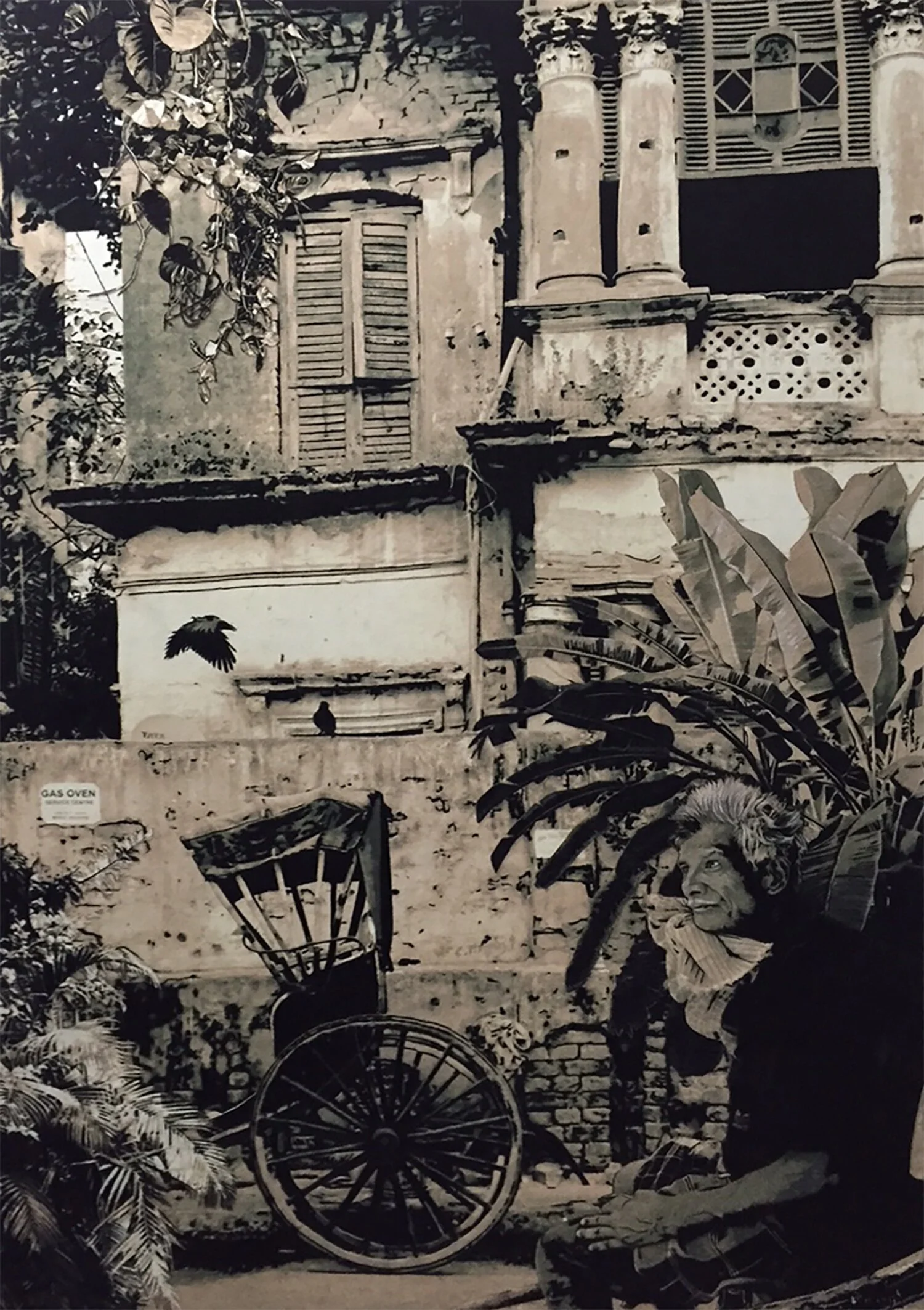
Suhasini Kejriwal, Rest, 2015. Embroidery, acrylic paint, digital print on canvas, 57 x 40 inches.
Image description: In a vertical composition of photographic greys, sepia, black, and white, our eye moves upwards from a parked rickshaw and a banana tree to take in a corner of the crumbling facade of an old-style residential building with ornate columns, a shuttered window, a pigeon on the wall and another in flight, and leafy foliage above. A small sign on the wall advertises GAS OVEN.
After her daughter was born, Safina would bring her along sometimes and I didn’t mind at all. The kid never made any trouble. Sometimes I saw her when I was leaving. Like a little upside-down ornamental cabbage, in her frilly dress, fussing with her toy. Nothing ever out of place when I came back, mother and daughter gone, the lights dimmed just to the softness I’d told Safina I liked.
I only found out about the name later. I guess they’d taken their time naming her. I think the girl was three or four when Safina told me. I’d asked. I don’t remember why. Maybe out of politeness. I really don’t remember.
*
Ejecta go to school one day and then five years gone. How? Allah.
She not so good girl. Fight a lot. Always complain from teacher. Safina read a little bit good English, but not all. “Dear Mr. and Mrs. Riaz, I regret to say that today Ejecta...”
“Why you name me Ejecta, stupid?” Sometimes she cry and angry in house. Fight. Hit things. One day hit Safina. Amir not home. Safina not tell Amir. What good? He have so much anger any time.
Then Safina find Ejecta smoke. Very angry. Very sad. Why her little girl Ejecta smoke? So bad. So bad for health. So bad for mosque. Everyone know. Ejecta smell like cigarette. She say and Ejecta shout. “I didn’t ask to be born, did I? To dumb idiots like you. Who told you to have me? I do what I like.” Then she use very bad word. With F.
*
I found Safina in tears. I’d come home early from the University with a splitting headache. The start of one my migraines could take the world away from me for days.
She was inside my bathroom. Her cleaning pail and things were inside. The bed was made, the carpet vacuumed. I didn’t like walking in on her. It made me uncomfortable. As if I was catching her naked. Me, Dr. Bazar. Her employer. University professor.
“Safina?”
She didn’t answer.
Strange. What was she doing in there? Or maybe she wasn’t in there. She’d just left her things there and was in another room. Dusting. Yes. Of course. I had to go. I swung the door open.
Safina was on the toilet. She jumped when she saw me. I was relieved that she was sitting on the lid. Hopefully she hadn’t been using… She was disheveled. Her hair hung down both sides of her face, two limp, straggly curtains. Her right hand clutched the end of her veil—I think it’s called a doopata—balled up.
“I very sorry, Doctor,” she said and just stood there. That day, I truly saw her face after many months, maybe years. I was shocked. It was lined, splotchy and haggard, all at once. Her eyes were almost buried in puffy skin. She must have been crying for some time.
I suppose my chivalry or something was stirred. I stepped forward, and she shrank back with equal rapidity. I stepped back. She stepped forward. Like dancing puppets, us two.
“What’s wrong?”
“I so sorry, Sir,” Safina said suddenly, abruptly, as if regaining her senses. “Very sorry. But I not use toilet. I go clean now.” Of course I had to step aside and let her go. She scuttled away.
I went to my office. I kept my ears pricked up for any preliminary sounds of Safina leaving, though I didn’t know what they would be, I’d so rarely been home when she cleaned. I heard the vacuum cleaner roar again and then soft, swishing sounds as though someone was moving things very gently. I felt myself tense and started to get out of my chair. I had to see her again, I couldn’t just act callous. My head was killing me, though. But before I was quite off the chair, there was a knock on the door.
“Please, come in,” I said. Safina was an outline at the door. Her face was in the shadows.
She told me. Ejecta was now a teenager, and almost completely out of control. In a trembling voice, wiping tears, Safina said Ejecta was running wild, probably going with dealers but definitely doing drugs (this news had come from the school that expelled her) and was a terror at home. Searching hard at times for the right word and using lots of hand gestures to describe things she couldn’t say in English—index and middle finger held up to pursed mouth, rigid index finger dug into inner elbow—Safina suffered in my plain view like a tortured animal, never coming beyond the frame of the door.
I felt totally helpless. I was sure I was helpless.
*
If Ejecta die, Safina die. This she say hundred percent. And maybe Ejecta die if she stay here.
Amir has said. She go Pakistan. She must to go. If she not go she be haraam. She shame. Sad and shame. No, no, Amir say shaking head side-side, daughter must go Pakistan. Save her from drug. From black man pick her up in big car with big things stick out from wheel, four sides. Say he boyfriend. Shame.
Ejecta say no go. Fight, fight. Safina try make stop till she can no more. Shame and sad. Sad and shame.
Why Ejecta do so to her Ammu, Abbu? Why she not become good student, good girl, go college, good marriage? Why Ejecta not love them? Why Ejecta not love good life, good American life?
Why Ejecta loud shout at her Abbu, at Safina? What they did wrong? What they not did?
Oh Ijju! Why? Why?
Then Ejecta throw boil water on Amir, and Amir skin come red and soft and he scream and scream and scream then ambulance come. Amir go hospital and doctor do operation two hours. One eye gone. Can’t save. Good doctor try, Safina sure. But no can save. Amir come home and go to bedroom and never come out now. Ejecta never say sorry. Never say any word. Just come, go, open fridge, take, eat, sleep, go, come. No more school, no more college, no more big good life. No more dream.
Why like this? Why Allah punish her and her little daughter, so pretty, so angry?
*
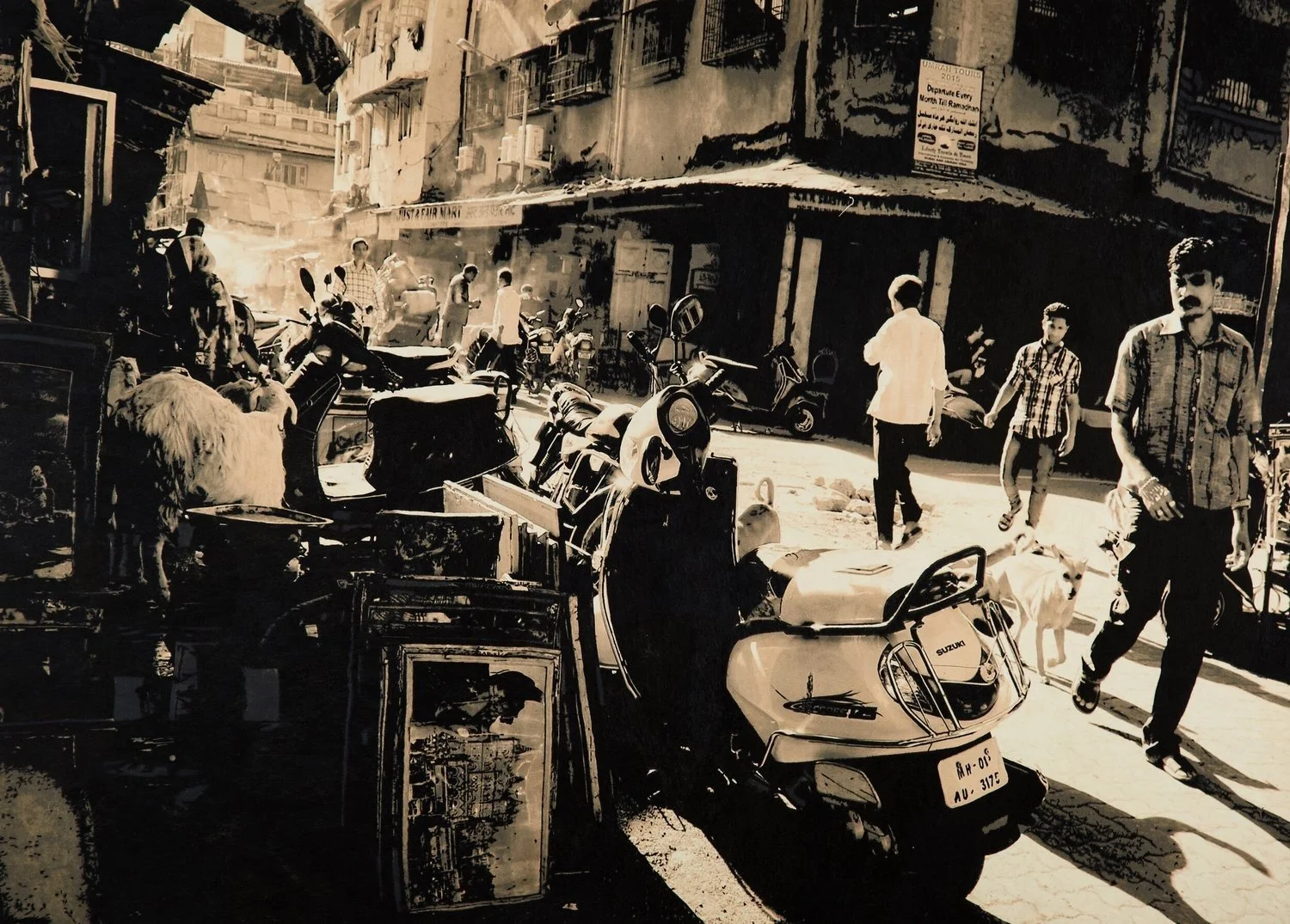
Suhasini Kejriwal, Everyday Extraordinary, 2017. Acrylic paint, embroidery, digital print on canvas, 54 x 75 inches.
Image description: In a horizontal composition of photographic warm sepia, black, and white, a large white goat finds himself among a throng of motor scooters parked at an intersection of old, canopied buildings. Young men and a dog wander across, bright sunlight casting their shadows on the ground.
Now and then I sat in my office and looked at my bookshelves and my desk, at the books. Which one was it? Where had Safina seen the word and the picture? Got the outrageous idea of naming her daughter Ejecta? Thinking she’d make a special life, destiny, for a child of poor immigrants. What irony. But I’d tried to dissuade her. It wasn’t my fault in any way, shape or form. She wouldn’t listen. I did understand that. Still, somewhere in the back of my mind something kept coming loose.
Safina came to ask me for an advance on a non-cleaning day. Amir was in the hospital. She sat on the couch facing me, across the coffee table. Last time she did that, the girl who became Ejecta was sitting next to her, her little dollar store sneakered feet well off the ground. Now Safina sat on the couch explaining why Amir was in the hospital, looking like the gray ghost of who she used to be.
I could tell. The girl had gone very deep into a world of drugs, alcohol and probably pimps and prostitution, a world that wouldn’t let her go, or come out of her, easily. I wouldn’t consider adding to Safina’s pain by saying anything, of course. Safina told her story, stock still, dry-eyed, like someone with nothing left to lose. And after she left—of course I told her she didn’t have to return the money though she insisted it was a loan—Ejecta came.
Ejecta came at eleven that night. I was in bed, reading. The doorbell rang. No one came to see me at this hour. I thought about ignoring the bell. I couldn’t do it, I felt unnerved. I padded out to the hallway in my carpet slippers and pajamas. Through the peephole, under the porch light, I could see it was a woman, not much else. I opened the door.
I hadn’t seen Ejecta in ten years at least. Her hair was teased up and dyed an unnatural orange, and her eyes were thickly scored and a little runny with mascara or whatever women use. Her lipstick was a shade of dark blood. Breasts nearly toppling out of her tight, skinny sleeveless top. She wore those jeans with lots of holes that I see some of my students wearing. She was undeniably, unmistakably voluptuous.
“Mind if I come in, Doc?” she said. I was astonished. By her audacity. And her effect on me. I nearly said no, then changed my mind. Maybe I could do some good. Maybe I could somehow help her, help Safina. I stood aside silently and let her pass through. She went straight to the living room as if she was at home and dropped down on my couch, at almost exactly the spot where her mother had sat that morning.
She asked me if I would marry her.
I just sat there for I don’t know how long. Maybe my mouth was hanging open. An older man’s slack mouth. Then she came over, sat on my lap, and nearly smashed her breasts against my face, my face into her cleavage. Her lower body started moving in a grinding motion and she brought her mouth down hard on mine and began pushing her tongue inside it.
“Ejecta, stop! For God’s sake, what are you doing?” I was breathless and unbearably aroused, but I’d managed to push her away from me. Her face still hung over me like the face of a sorceress who was once a siren: gorgeous but livid.
“Why not?” She said. She pulled one of her camisole straps back onto her shoulder. “Don’t tell me you don’t want a hot piece of pussy in your bed. I’m sure you do it with my mother, don’t you, Doctor? I mean, she’s always running to you for stuff, right? And you don’t give stuff for free, do you? So look at me and look at her. Look at my tits. You don’t think I can show you a much nicer time, Doctor?” The entire time as she said this, she looked straight at me without blinking. In her eyes I saw the scarlet of fury swirled with disgust.
I asked her to leave. I asked her, sternly, to leave. My voice was shaking, I’m sure, but my eyes burned and I felt dizzy. I was sore with lust, my body threatening to lurch into a feeding frenzy, my old bachelordom suddenly no refuge.
For about five minutes Ejecta cursed me and called me every terrible name under the sun and a few in her own language. Urdu, I believe. Yes, I think Urdu. I didn’t understand the words but I sensed their obscenity, profanity, viciousness like hot iron on skin. Then she stopped and started sobbing. Sobbing, then wailing.
“I have nowhere to go. Please, Doctor Bazar. If you marry me, I don’t have to go to Pakistan. I promise I will make a very good wife. I promise. Please. I don’t want them to send me away. If you marry me they can’t send me away. I don’t want to go to Pakistan. I don’t want to. . .”
I let her stay that night. I said she could sleep on the couch. But I told her firmly that she needed to turn things around, shape up, think about her parents. They knew what was best for her. They knew what she needed. They loved her. She owed them something, after all. They wanted the best for her. As for us marrying, it was an outrageous idea. She was eighteen. I was fifty-eight. And I didn’t believe people should marry for security anyway. They should marry for love. She would be okay. She would find love someday. Soon. Pakistan. . . who knew, maybe she would like it. She’d make friends. Start over. Go to college. Find the right guy. A nice Pakistani guy. Just give it a chance, I said. Just. Please.
She didn’t say anything else. Sat on the couch, staring at nothing. I brought her a quilt and a pillow. She took them, lay down. I said goodnight. When I was leaving the room, I turned once and saw her lying there, looking at me, but her face was in shadow and I couldn’t see her expression.
She wasn’t there the next morning.
*
Aziza. My child. My daughter.
Even if I went to Bombay, what was there? I lived and went to University in Karachi, thinking I was going to be big Engineer, have big job. I’ve seen bombs and what’s left. Nothing much. Maybe a few strips of flesh. Burned up orange-black looking thing like a melted plastic net. A shoe or hand somewhere else. Far away. Nothing to bury. I didn’t go. I accept. My daughter’s dead.
That name Safina gave her. That I never accept. Some word she found in that gora’s book. I looked it up. Like a prophecy. To me my daughter always Aziza. Flesh of my flesh. Amir’s daughter Aziza. But Safina didn’t listen. Safina was so worried about being American. Look what happened.
They said, when they came and showed us the badge—FBI—that Aziza joined ISIS. So she went on a “mission” to India, to Bombay. Blew up a whole bus and forty people. “Died instantly,” the FBI said, eyes not so black then like when they said “mission.”
Bad luck, that’s what it is. Why I left Pakistan? My fatherland. So my children are safe, no terrorist stuff, nothing. But Aziza never listened to me, anyone—tortured her Ammu very much for that name she gave her but Safu didn’t deserve that kind of punishment—just did what she liked. Kids in this country. Always doing haraam, no respect.
She was ashamed of us. Ashamed of her mother. Me, at least I had a real degree from a real university. But it made her so angry I drove taxi, worked night shifts at the Water Treatment Plant. She wanted me to drive Mercedes, go to some office. She wanted to buy things from big mall on Michigan.
Even when I lost my eye, I loved my daughter. Sometimes the empty socket still aches, burns.
Daughter, I’m sorry. If Allah forgives me, I won’t forgive myself. I wish Safu forgave herself, but I won’t forgive myself. I should never have left Pakistan. I should have refused. So many things. That name.
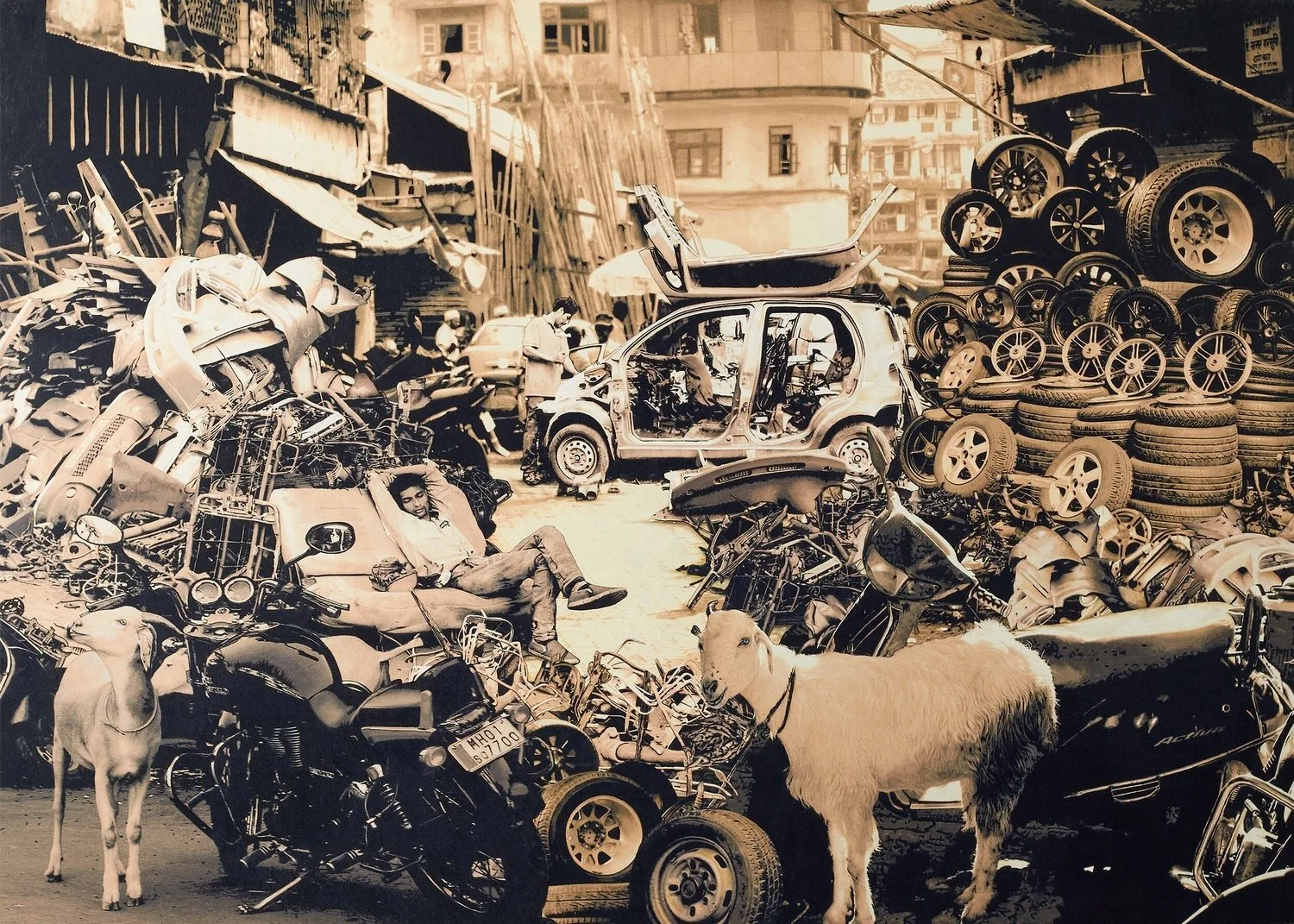
Suhasini Kejriwal, Sunday Afternoon, 2017. Acrylic paint, embroidery, digital print on canvas, 84 x 60 inches. Image description: In a horizontal composition of photographic warm sepia, black, and white, a wild array of junk and other objects, mainly tires, hubcaps, and a decimated mini car, are piled high in an alley between old buildings. In the foreground, two large white goats pose by a shiny motorcycle; in the middle ground, a young man stretches and relaxes in a pair discarded car seats.
Nandini Bhattacharya is a writer, Professor of English, public speaker, reviewer, and blogger. Her first novel Love’s Garden (2020) garnered critical praise as “a fascinating and well-crafted journey into India’s complex past” (Chitra Banerjee Divakaruni). Shorter work has appeared or is forthcoming in Sequestrum, The Common, Cincinnati Review, Bellevue Literary Review, Another Chicago Magazine, River Styx, Rumpus, Notre Dame Review, Oyster River Pages, Bangalore Review, Bombay Review, PANK, and more. She has been nominated for the Pushcart Prize and in Spring 2026 she will be the Invited Writer in Residence at the Pearl S. Buck Residency, Randolph College.
*
Kaleidoscopic and bordering on the psychedelic, Suhasini Kejriwal’s paintings revel in minutiae, overflow with information, and convey multiple viewpoints simultaneously. Her technique synthesizes the disciplines of painting, drawing, photography, and collage into a cohesive whole. Solo exhibitions of her work have been held at Gallery SKE (Bangalore), Nature Morte (New Delhi), Chemould Prescott Road (Mumbai), Anokhi Museum (Jaipur), and Galerie Christian Hosp (Berlin). Her work has been included in numerous group exhibitions throughout the world. Recent participations include the Yorkshire Sculpture Park 2024 and the Frieze Sculpture Park 2023, curated by Fatos Üstek. Kejriwal holds a BFA from Parsons School of Design, New York, and an MFA from Goldsmiths College, London. She completed a fellowship with Hamdasti (2017–2019), a collective that works to facilitate dialogue and collaborations between artists and communities. In 2020, she became a visiting fellow at Harvard University's South Asia Institute. Kejriwal lives and works in Kolkata. Please visit: https://www.suhasinikejriwal.com for more information and images.
‘But it’s not a real name, you know.’––a short story by Nandini Bhattacharya on how certain choices, unwittingly, scar a life.