
Tragedy of the Commons
By Jay Lindstrom
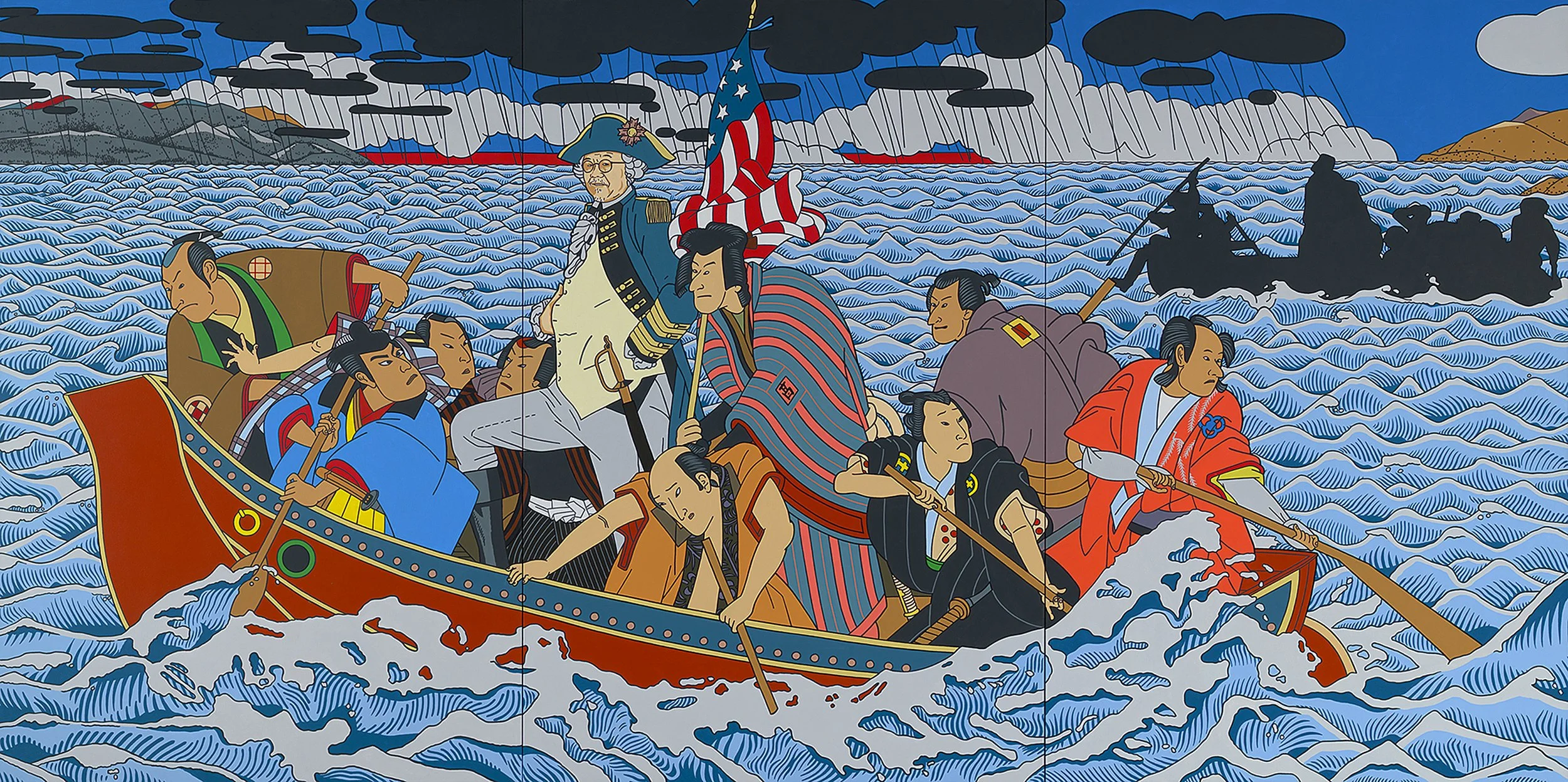
Roger Shimomura, Shimomura Crossing the Delaware, 2010. Acrylic on canvas. Triptych, 6 x 12 feet. National Portrait Gallery, Smithsonian Institution, Washington, DC.
Image description: Playing on Emanuel Leutze's famous 1851 painting, Washington Crossing the Delaware, a Japanese American “George Washington” stands in a small red rowboat flanked by Japanese samurai who paddle through a stylized sea of blue waves. One samurai holds an American flag.
“We misplaced the corpse—“
“—cremated the wrong person—”
“—well, yes… Your father’s body is still here.”
“And you still want to keep it?”
“No, you misunderstand me,” Frank said over the phone. “We’re not looking to prolong your father’s stay. You see, Gentle Embrace Mortuary is a reputable establishment. We pride ourselves in our ability to provide respite to those who are—“
“Can it with the damn ad,” Daniel Kudo snapped, clenching the tablecloth. “If you have my dad’s body, then who did I take home with me? I have someone’s ashes, don’t I, or did you screw that up too?”
A pause on the phone. “You are currently in the possession of Ken Hannigan Sr.”
Dan momentarily forgot his rage. “Ken Hannigan. As in, Hannigan Groceries? That Ken Hannigan?” Although a local chain, practically half the town knew their family name; not to mention, they owned half the businesses in town.
“Yes,” Frank said. “After seeing your father’s body, Ken Hannigan Jr. was quite pleased with the condition of your father’s corpse.” The funeral director hesitated before he said the next part. “He wants to use your father’s body as a substitute for our… clerical error.”
“A substitute?” Dan repeated.
“He is offering five thousand dollars if you agree.”
It made sense, kind of. Dan looked at his dress shoes. The black leather was peeling, and a gray numb formed at its end. Everyone in town saw hardships, and with small businesses struggling against corporate giants, it was hard to pass up money.
Dan cleared his throat. “Fine, but tell Mr. Hannigan I’m going.”
*
There was time until the service, so Mr. Hannigan and Dan agreed to meet at the Waffle House across the street. When Dan arrived, Mr. Hannigan gave him a tight hug.
“Thank you,” Mr. Hannigan said as he let go. “You’re a good sport, son. What’s your name?”
“Kudo,” Dan said. “Dan Kudo. I’m sorry, you are Ken Hannigan?”
“In the flesh! Why, is there a problem?”
Dan tried to word it diplomatically. “I was just expecting you to be…”
Mr. Hannigan laughed. “What, in tears? Grief struck? Crying like a sissy?”
Dan shook his head. “Well… Asian.” Mr. Hannigan was very Irish—almost the emerald-eyed poster child. His red hair, neatly trimmed and gelled, was marked with gray stripes. He towered over Dan like a titan, and his pronounced muscles squeezed at the edges of his tan suit. Looking closer, that suit could’ve probably fit three Dans inside with room to spare.
Mr. Hannigan laughed. “It’s kind of hard to be picky at this point! Can’t uncremate someone, can you?” He looked at the urn in Dan’s hands. “Is that…?”
“Uh, yes, sorry.” Dan held out the urn. Mr. Hannigan stared at it blankly.
“No use in giving it to me now,” he finally said. “Just keep it until your father gets cremated. Equal exchange of prisoners,” he joked. Dan put the urn back in his car.
“How about we get to know each other?” Mr. Hannigan opened the door and beckoned Dan to follow.
*
Once they were seated, Dan told Mr. Hannigan about his father. Kudo Takuji was born in Kyoto, Japan during World War II. He grew up during the height of its postwar boom. When he was twenty, Mr. Kudo was told by his doctor he had to move—the pollutants in the water were killing him (labor laws, as Dan understood it, weren’t as stringent back then). Combined with his engagement to Dan’s mother, it made sense to move to Washington, where Boeing was headquartered.
Moving to the United States was rough. Dan remembered sitting in their small apartment on the bathroom counter, his father sitting on the toilet lid, reciting which states bordered Mexico, what the First Amendment protected, the names of the Supreme Court Justices, and so on. Mr. Kudo was adamant to get every question right, so Dan became his study partner, much to the boy’s chagrin. They’d lock themselves in with some juice and crackers and study until Mr. Kudo could name everything on the list. He’d light up when he answered correctly and mutter curses in Japanese when he misspoke.
When Dan was in elementary school, Mr. Kudo insisted they only speak Japanese at the dinner table. “It looks good on a resume,” Mr. Kudo insisted. They sat in the living room, translating haikus and rengas and jiseis as father and son. The hardest part was how Mr. Kudo pushed Dan to keep the syllabic patterns of the tanka and haiku between translations. They’d throw away countless scraps as they tried to keep the form without losing the meaning. “Don’t forget its purpose,” Mr. Kudo would reiterate when his son presented a sloppy translation.
In high school, between Spanish I, English, and Japanese, Dan kept getting frustrated at all the syllables and pronunciations. Words blended together, phrases and clauses transitioned into each other, and after an exhausting school day, he found himself writing a language smorgasbord. When he ended Sophomore English and Spanish with a C, Dad grounded him for the entire summer. Mom always tried to justify his father’s harsh punishments. Dan remembered crying in her arms as she explained, “He just wants you to be better than him.” Even on her deathbed, she insisted Dan “be patient” with his father.
When she passed at the end of summer, the unspoken armistice between the two Kudos collapsed. Their relationship became tumultuous, and at times, antagonistic. Dan tried to repress the Japanese in his mind, insisting on fitting in at school. He only spoke in English and even dropped Spanish in favor of Computer Sciences. This caused several shouting matches; some nights, Dan would sleep in the car out of protest. Even after graduation, Dan spoke sparingly to his father, only reconnecting afterwards when he was broke. This mended their relationship slightly, but it was still strained after years of bitterness. That didn’t stop Mr. Kudo from weeping tears of pride when Dan got his first insurance contract.
Despite their reconciliation, Dan remained aloof. Part of it was resentment, part of it was frustration. He should’ve called, or texted, or something. The only moment he’d had with his father was a few family get-togethers, and now… he was gone. Dan arrived at the hospital too late. He didn’t even remember their last conversation.
Dan trailed off at this point. Meanwhile, Mr. Hannigan was engrossed by the story.
“I’m sorry for your loss,” Mr. Hannigan said after a moment, wiping the syrup from his lower lip. “You seem quite proud of him.”
“I am,” Dan realized. He took a moment to absorb his words. He was proud of Dad, wasn’t he? Now here he was, prostituting his father’s corpse for a bit of cash. It was a bit screwed up, wasn’t it? Looking at Mr. Hannigan, he was clearly ecstatic to keep the funeral, the way he listened to Dan’s words as if gospel. Wasn’t that worthwhile? His father could bring a bit of happiness instead of sitting on his bookshelf like, well, Mr. Hannigan Sr. had been doing before. Mr. Kudo would want Dan to be happy. He’d want to do good, even in death.
So what if Dan also got paid, right?
Mr. Hannigan put down his fork. “See, that’s what I thought when I saw your father,” he said. “A patriot. His body carries that inescapable pride you have for your legacy. You can tell these things when you meet as many people as I do. He knew the best way to provide for you was to give his life for the American way.”
Dan frowned. “That’s not—“
“See,” Mr. Hannigan looked out the window, “when men come to America, they’re always searching. Searching for something more. Opportunity. Your father found it and seized it by the balls, didn’t he?! Yes, your father threw that Communist crap all away to pursue the sweet American Dream, and look at you! You climbed your way up from nothing and seized all the opportunities you could grab. You stripped away that Jap-ness and embraced yourself as a true patriot.” He turned back to look at Dan with a smile. “He’d be proud of you, son.”
It was an intense smile, one that awakens your goosebumps in waves. What Mr. Hannigan said was a simulacrum of the truth. However, Mr. Hannigan remained so hypnotized by Dan’s story… he had heard what he said, right? Although he had a thousand questions, Dan decided it was best not to ask. No use angering the person paying you.
An alarm went off on Mr. Hannigan’s watch. “Whoops,” he said, slapping his wrist. The smile was gone. “That’s my wife, Rebecca. She’s already there, getting your father ready. I have to make a few calls, make sure the relatives arrive on time.” Like a true gentleman, Mr. Hannigan covered the bill. “Oh, wait!” He pulled out his checkbook and started writing. “This is half before… and I’ll get you that half afterwards. Now! My wife’s waiting for you. We got a few things we got to fix up. If you’ll excuse me.” He gave Dan a hard slap on the back before heading for his car.
Just in case, Dan looked over the check. It was legitimate.
*
Still perplexed by the strange encounter, Dan went inside Gentle Embrace. The interior of the reception hall was the one decent part of the mortuary. The first thing you noticed when you entered was the beautiful stained-glass windows. Hues of blue, red, and green cast into the interior; the rest was warm, lit by the hanging brass chandelier on the ceiling. Maple pews with velvet cushions lined the center. The floor was covered in a Persian pattern that ran along the aisles towards the stage; on it, an oak podium stood aside the open casket. Frank must’ve replaced the photo of Ken Hannigan Sr. with Mr. Kudo, but even so, it was odd to see the mismatched name next to the photograph of Dan’s father.
In fact, why were they using Mr. Kudo’s picture? Maybe it was to explain the body double. Dan would have to ask.
A boy and a girl—twins by the look of it—sat in the front pew. They couldn’t be older than twelve. Currently, they engaged in a thumb wrestling match: arms jolting—up and down, left and right—as they tried to assert their superiority. Meanwhile, Mrs. Hannigan was setting up Dan’s photos on the side table, much to his surprise. He never did come and pick them up from his father’s wake, he realized, so Frank must’ve had them in storage. It still felt wrong to take them without his permission. Was agreeing giving them permission? He realized he didn’t know.
“Don’t worry, dear,” Mrs. Hannigan said as he approached. “I’ve already gone ahead and replaced those cheap frames with tasteful ones.”
“Oh.” He hadn’t even noticed, but she was right: the picture frames he’d bought at Dollar Tree were replaced with gold and silver lacquered ones. Each frame’s embossing curled around itself over and over, so much so it became hard to determine where each ended and began. “Mr. Hannigan said you needed my help?” Dan asked.
“Yes, one moment,” Mrs. Hannigan swapped around two of the pictures and smiled. “Now, let me show you the issue.”
This was the first time Dan had seen his father since the original wake, and seeing the coroner’s work again drew fresh tears. The body itself was in pristine condition, and if it were not for the setting, anyone might think he was peacefully asleep. His face was relaxed for the first time in years, and his mouth was curled into a gentle smile. “Do you see it?” Mrs. Hannigan said after he had a moment to collect himself.
Dan scanned with a critical eye. “No,” he shrugged sheepishly.
“Look again,” Mrs. Hannigan said, enunciating each syllable as if he spoke a different language. Dan tried once more, but to no avail. “His clothes, dear. What have you dressed him in?”
Mr. Kudo was dressed in a black corduroy suit, its edges griseous. His white dress shirt had turned yellow; his tie was a cheap red paisley. Although it wasn’t anything special, it was Mr. Kudo’s favorite outfit—his only custom suit—and Dan thought it’d be better to cremate it rather than keep it as memorabilia. And besides, the suit was way too small. “You grew tall,” Mr. Kudo used to joke, “not wide, like me.” He always slapped his stomach for emphasis.
Mrs. Hannigan misinterpreted Dan’s smile. “I don’t know what you do with your dead,” she growled, “but here, we show them a bit of respect. We need a new suit.” She began to walk towards the door. Dan stared at her. “Come with me. We’re going shopping.”
“Shopping?”
“We can’t leave your father like that, can we?” Her eyes sparkled. “We’ll dress him up like a Hannigan.”
*
Mrs. Hannigan had Frank drive a hearse to the tailor downtown, Mr. Kudo in tow. (“Not like we could’ve brought them here,” Dan heard Frank grumble.) It was morbid, but Mrs. Hannigan insisted Mr. Hannigan would cover the costs. The tailor didn’t seem perturbed at her odd request. He simply pulled out his supplies and treated Mr. Kudo as if he were still living.
“Dress him like a Hannigan,” Mrs. Hannigan instructed. “No expense spared for my father-in-law.” Dan smiled, but she didn’t peer in his direction. Her eyes were on Mr. Kudo’s body, hawkishly examining every part of his face. “Frank, dear,” she called after a moment, “I will redo this atrocious makeup. This is not to my standard. Grab my makeup bag from the hearse.”
“Yes, ma’am.” Frank clamped his teeth. Unlike Mrs. Hannigan, he seemed preoccupied with Dan’s gaze, shooting nervous looks at him before dashing off. He came back with the bag a minute later. “Here go you, ma’am.”
She took it from him without a word and began her work. Dan figured this might be the time to ask about Ken Hannigan Sr. No one had mentioned a word about him since Dan’s arrival. Mr. Hannigan was obstinate, so maybe she’d have some insight into their strained relationship. “So,” Dan said, “what can you tell me about your father-in-law?”
Mrs. Hannigan didn’t look up. “Ken Hannigan Sr. was not a person my husband or I admire,” she said. He waited, but she gave nothing else.
“Why not?”
She continued to ignore him. “Okay then,” Dan mumbled. Then, he had a different idea. “I’ll hang out with the kids.” They might know why everyone was acting so strange.
When he went to the front, the twins (Nathan and Avery, he learned) were looking at the various threads. The craftsmanship of the tailor was high quality despite the fact they were in the middle of nowhere, but that didn’t stop them from finding flaws in every outfit. Currently, they were feeling up a mannequin’s torso.
“See, I told you it was polyester,” Nathan bragged. He’d crawled up towards its neck and was looking at the tag. “Nothing else has that cheap feeling to it.”
Avery rolled her eyes. When Dan approached, she looked insulted. “Oh, it’s you,” she scoffed.
“Hello Avery, Nathan,” he smiled. “How are you guys?”
“Good,” Nathan smiled politely. “Good as you can be. It’s our grandfather’s funeral today, so Mom says I’m supposed to be sad.”
“Death typically has that effect, yes,” Dan joked. When they didn’t laugh, he added, “Sounds like you didn’t know your grandfather well.”
“No,” Avery pipped in. She was fixing the mannequin’s collar. “This is our first time meeting him.”
“Oh.” So the kids had just as much of a clue as he did.
“Did you know we’re Chinese?” Nathan blurted.
Dan raised his eyebrows. Apparently, the Hannigans didn’t tell their kids what happened. “No, that’s my father,” he tried to clarify, “and he’s Japanese.”
“Well, Mom says he’s our grandfather,” Avery said. She took the handkerchief from the mannequin’s breast pocket and refolded it. “And of course we’re Chinese, Nathan. Why do you think we’re so good at math?”
Dan was about to correct them when Mrs. Hannigan called from the other room. “Children! The tailor’s got a suit. We’re leaving.” Before he could speak, the kids were dashing off to the hearse.
*
Upon their return, they could see that Mr. Hannigan had been busy. Several suburbans lined outside Gentle Embrace, guests flowing out like a tributary. Dan and Frank grabbed a wheel bier to cart Mr. Kudo’s coffin inside while Mrs. Hannigan went to greet the guests. He counted about thirty people. Although he tried to mingle with the crowd, most of them gave him glances. Dan knew he was an outsider, but even so, the hostility in the room was palpable.
As he traversed the room, Dan noticed something odd. The frames had moved. Again. When he approached, he realized the photos — his photos — had been altered. Although the light of the stained glass reflected off the lacquered frames and into his eyes, he could see someone had gone through and… cut him out. As in, cut Dan out of every photograph. With scissors. He picked each photograph out of his personal memory album; the one Mom kept until the day she died. Dan should be in every photograph; instead, he vanished into thin air. It couldn’t have been the kids: they were with him at the tailor’s, and there was no time in between they could’ve done such extensive work. That means the only person it could’ve been was—
“Please, be seated,” Mr. Hannigan announced from the podium. “We will begin the service shortly.”
This had to be deliberate. He didn’t want to make a scene, especially since they were just copies, but he wanted to confront Mr. Hannigan. Unfortunately, by the time he spotted where he was sitting, the pew was full of relatives. Dan took a seat next to the side table.
The first sections of the wake were, ironically, tiring. The eldest Hannigan (Mr. Hannigan Sr.’s sister) sang Psalm 27, to which Dan politely mouthed along.
You have been my help;
Do not leave me nor forsake me,
O God of my salvation.
When my father and my mother forsake me,
Then the Lord will take care of me.
Dan wasn’t sure when Mr. Hannigan got up, but upon seeing him standing behind the podium, he shot to full attention. Behind the podium Mr. Hannigan stood erect, holding the edges and gazing over the audience. His face appeared golden in the light.
“Thank you for attending my father’s funeral,” Mr. Hannigan smiled. “As you know, Ken Hannigan Sr. and I became estranged during our lives. He was the embodiment of the American spirit. So, if I may, I would like to recount his brave, enduring legacy he left for his family.” Mr. Hannigan gave a smile to his twins. They were seated in the front row, staring bright-eyed at their father.
“My father. My father! What do I say about him? He is someone who believed in the American Dream, that same dream James Truslow Adams coined in The Epic of America, that same dream derived before the birth of our nation in the Puritan work ethic. ‘Work hard, and you’ll be rewarded.’ Benjamin Franklin called it self-made man; Ralph Waldo Emerson echoed it in Self-Reliance, Fitzgerald’s Gatsby never stopped searching for it. When my father immigrated to America, he had high dreams and aspirations of a land of freedom, a land of dignity, a land of opportunity. Opportunity, he realized, was the land itself. The more you had, the greater your opportunities. Yet, did he do anything with his epiphany? No! Instead, he settled with his plot, built a picturesque life, and threw in the towel. He took his share and called it a wonderful life.
“But I am fortunate he passed his secrets on to me, to give me vision into that brute force the Communist method of madness is trying, as a last resort, to poison and corrupt our nation, so shaken and battered by Communist subversion. They seek to poison the land, to uproot the family, and all notions of honor and loyalty and fatherland and faith—nothing is spared. We will not sink into Communist anarchy like my father. I reject the notion of this American dream. We must reject Communism at its source, and realize the true American Dream does not leave room for traitors.
“So I took my opportunities when they came along, took them and drank as much as I could. I made Hannigan a household name. Now, I own opportunity. And now, my father — my real father — rests in this casket beside me.” Mr. Ken Hannigan Jr. gestured over to the open casket. His eyes locked into Dan and winked. Dan felt his stomach churn.
“Who was he? My father, Kudo T. Hannigan, was born in Kyoto, Japan. He was an engineer who loved to work on airplanes. He worked for Boeing for 35 years. He won the Aircraft Design Award for helping planes fly higher, although his hard work and dedication was rewarded with his firing when stock prices went down. He met my mother at a US Air Force base but had to move to the United States when the Communists poisoned him. It gave him an excuse to leave a third-rate country. He knew a life in America would give me all the opportunities I’d need to succeed. This is the father I remember. Some days, I even forget that he’s gone.
“Yes, that fake man, that husk of a human who claimed to be mine, only sought to corrupt the indomitable American spirit. He wasn’t a true American. I reject any notion of fake Americans. I adopt my own father. God bless the real Mr. Hannigan Sr.” Mr. Hannigan was in tears. “God bless you.”
Dan was gripping the cushion so hard his knuckles turned red. He looked around at the crowd, who didn’t look the least perturb. Even Frank nodded along blindly. The Hannigan twins made no reaction, absorbing their father’s bastardized story.
“The greatest lesson Mr. Hannigan Sr. taught me,” Mr. Hannigan continued, “is you only get what you take. Thank you, Dad.” He leaned over and kissed Mr. Kudo. When he came back up, he had white makeup on his lips.
Dan stood up, walked over to Mr. Hannigan, and punched him straight in his jaw.
*
The wake spiraled out of control after the incident. To his credit, Frank leapt in between the two men as their brawl began, managing to separate them before it got too visceral. After some coaxing, he pulled both into his office. “Mr. Kudo, I think you have some explaining to do,” Frank said as they sat down.
“Explaining?!” Dan said. Fire filled his stomach. “You know exactly what this is about!”
“Let’s be reasonable,” Mr. Hannigan said.
“You’re trying to steal my life!” Dan exclaimed. Mr. Hannigan and Frank stared at him as if he’d started speaking another language.
Mr. Hannigan laughed. “Yes, I guess I did. Really, I took what was rightfully mine.”
“Fuck you,” Dan spat. “It all makes sense now: why you were buttering me up, why you lied to your children, why you bought a damn suit. All for this damn lie! Hell, you didn’t even get my father’s name right. It’s Takuji, not Kudo. Last names come first in Japanese, you racist piece of—”
“Now Mr. Kudo,” Frank interjected. “Please calm down.”
“And you!” Dan whirled to face the funeral director. “You knew about this, didn’t you?” Frank flinched.
“I am not a nobody!” Mr. Hannigan yelled. The sudden outburst made the room quiet. “My apologies.” He took a breath and adjusted his suit. “I orchestrated it. I deserve the credit.”
“But he didn’t have to go along with your plan!”
“But someone would,” Mr. Hannigan smiled. “That’s the beauty of America, isn’t it? If he doesn’t, I can find someone worse.” He reached into his breast pocket and pulled out his checkbook. “Now, I was going to offer to buy your father’s corpse for $10,000, but seeing your reaction and your willingness to fight, I assume it’s off the table, correct?”
“Rot in hell,” Dan growled.
“Very well then. Frank!” Mr. Hannigan turned towards the funeral director. “How much will it cost to buy this fine establishment?”
Frank looked down. “About $150,000,” he muttered. “It’s prepared, just as you requested.”
“Excellent! Give me the paperwork, and we’ll transfer ownership.” Mr. Hannigan grabbed a pen and began scrawling something in his checkbook. He threw a check at Dan. “That’s the rest of your money. Oh, I know you can’t sue me. I have the time, energy, and resources to walk your lawyers around all day in litigation, and a rich man doesn’t whore his father’s corpse for $5,000. You’ll be in the ground before you get his body back.”
Dan wanted so desperately to protest, to give Mr. Hannigan some twist of fate or final “fuck you.” But he was right. He bit his tongue, his muscles exploding, ready to start a fight. But it was clear who would win that too.
Once he was done signing, Mr. Hannigan stood up and gave Dan a smile. “If you’ll excuse me,” he said, “I have to get back to my father’s funeral. Frank, make sure this fraud is escorted off the premises.
“I have to take care of my family.”
*
That night, Dan pulled into his driveway. His suit’s shoulder pads, although typically negligible in weight, pressed heavy into his shoulders. He had spent the afternoon calling lawyers in town — anyone who might be able to help him. The few that picked up wouldn’t give him the time of day when they heard the name “Hannigan,” but there were also a few that didn’t even pick up. He’d call again tomorrow.
As he began to exit his car, he remembered the urn — the one containing the real Mr. Ken Hannigan Sr., was still sitting in the front seat. He took it out. Dan had examined the urn before, but something new moved him. He’d seen the katakana on the side of the jar, but he had never bothered to translate it. Now, there was nothing he wanted to do more.
Dan spent the rest of the night pulling out his old textbooks, scribing the message by hand. He knew it was his father’s jisei — his death poem. As he worked in the lamplight of his study, he felt something move through his body. It wasn’t a bad feeling, nor was it desperation, nor loneliness, nor anger. It was something familiar — that feeling of warmth of a body next to you, warm and safe, touching skin to skin, crossing over and bumping each other as you move.
When he was finished, Dan looked at what he’d written.
My dreams are ashes:
fertilizing my bare grave
nourishing the earth—
O planter of treasured seeds
Sow your precious dreams in me.
Jay Lindstrom is a Thai-American composer, teacher, and award-winning writer from rural Oklahoma. He has been previously featured in Half and One Magazine and is a member of the Tulsa Night Writers.
*
Roger Shimomura (b. 1939) combines American culture with Asian traditions to create paintings, prints, and performances that play on Asian stereotypes and generate thought-provoking questions about racial and cultural identity. During World War II, Shimomura and his family were imprisoned at a camp in Idaho, where they became familiar with the widespread xenophobia taking place at that time. What if George Washington was Japanese American? Shimomura Crossing the Delaware is a play on Emanuel Leutze's 1851 painting, Washington Crossing the Delaware. Shimomura depicts himself as Washington in the iconic pose, but replaces the continental army soldiers with Japanese samurai.

“Last names come first in Japanese, you racist piece of—” a brawl, a funeral, and a stolen father in a short story by Jay Lindstrom.