
Drown Ground Crown
By Ashley Marilynne Wong
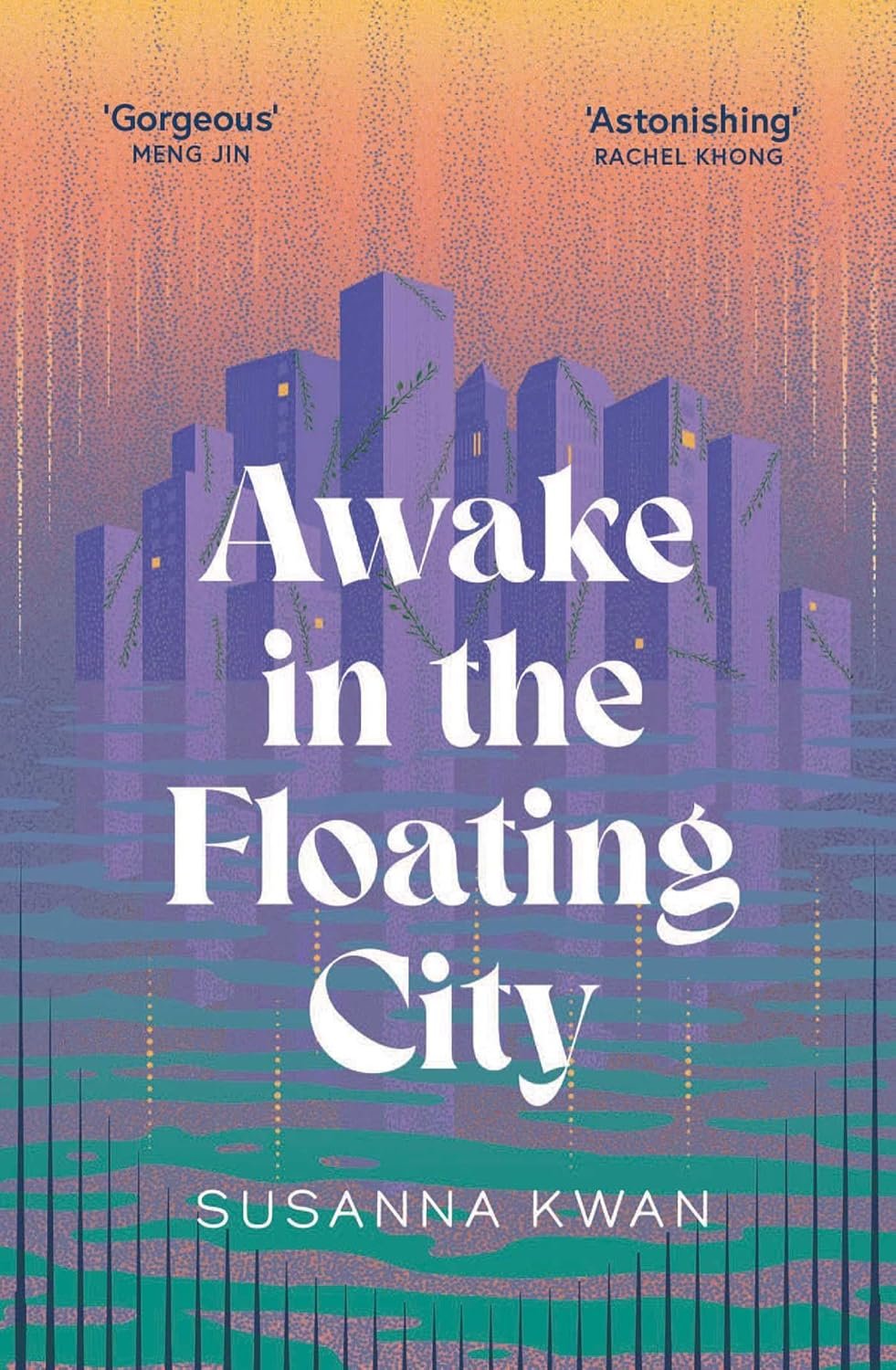
Imagine luxuriating in a hot bath inside a soundproof room amidst an all-too-palpable thunderstorm that has lasted for years. As you are submerged in the pure, resurrected water unpolluted by the dangerous forces outside, you know that your hearing is safe, that it will not be deafened by roaring noises that engulf and smother. Yet in your mind’s ear, the cacophonous music thrums and vibrates through your – not just corporeal but also existential – body. Instead of drowning in it through resistance, you surrender to its night-tune, its waves and currents, letting the sound ripple and butterfly into something both ethereal and recognisable. This is the portrait of the gentle power, the quiet confidence, that artist and author Susanna Kwan’s debut novel, Awake in the Floating City, brings to life to and for the reader, particularly through the multilayered relationship between its two protagonists: Bo and Mia. And, at large and closer to home, between friends and family, mothers and daughters, the carer and the cared-for, and human and nature.
The post-apocalyptic novel spans a year in the lives of the two main characters, a first-generation Chinese American and a fourth-generation one – with nearly a century’s age gap between them. Mia, the older of the two, is about one hundred and thirty, whereas Bo, the younger, in her thirties or forties. When their story begins, it is 2051 and San Francisco has been flooded for seven years. Consequently:
… streets transformed into rivers, and the rivers blew out windows, tore doors from their frames, widened into buildings through the new openings. The water took down statues and leveled groves, carried entire families away. People fled or drowned—or moved to higher ground, where they relearned how to live in the city they’d known as home, a place the rain had claimed.
The crumbling world Bo and Mia have to contend with, as it happens, extends beyond its physicality to encompass so much more. Two years before they meet, Bo lost her then seventy-one-year-old mother to the floods; and thirty years ago, Beverly, Mia’s only daughter, left her alone and untended to for Sweden, shortly after Mia turned one hundred. The two protagonists also share the common ground of never having known their fathers since birth. Whilst it is tempting to surmise through these coincidences that the intertwining of the two’s lives seems fated, the fact that is more grounded in their shared reality and universe – as Kwan has painted in Awake with her soft authority – is that Bo and Mia choose, over and over, to be each other’s anchor. To stop each other from drowning in more ways than one. And ultimately, to crown each other in real relational glory. In true, transcendental love.
It is Mia who initiates the choosing – a decision that cannot have been easy for the no-nonsense, straight-talking and reserved supercentenarian. However, Bo’s participation in that bond-sealing human act cannot have been further from passive either. When Mia sends her the invitation to be her paid carer, Bo is due to evacuate to Canada in a week to join her cousin and uncle, her only remaining family members. Her cousin Jenson, concerned for her safety and livelihood, has made the effort to secure her a passage to what is now his adopted country and home. Not only has he chartered a boat for her, he has also called at least daily to remind her of the time of departure and even gone so far as to travel back to San Francisco to accompany Bo on her upcoming journey. Despite her appreciation for his painstaking care for her and her budding yet solidifying determination to forge a new path, on the day she is due to leave for British Columbia, Bo’s attention is drawn to Mia’s offer of what she believes is beyond just a job, an offer in the form of a note slid under her door. To her, it is hope. The kind that haunts and holds at the same time, like a physical and psychological safe harbour on a desert island, a cocooning fortress from which she is reluctant to part. Because that initiation of a relational anchor frees her to be blanketed by the memory – or dare I say spiritual or soul presence – of her mother. And so, in the exact hour of her supposed farewell to her rented studio apartment, she ignores Jenson’s unceasing texts and calls, and chooses Mia – a choice she will find herself continually and consistently making. In spite of everything. Bo and Mia’s mutual commitment, as they will discover together, soon becomes an unbroken platofamilial wedding vow, as their bond transcends that of a client and support worker, mother and daughter (albeit surrogate), muse and painter, and friend and stranger.
Even though Bo’s age is not specified in the novel, the reader can deduce that she is in her forties or younger, given that her mother would have been seventy-three when Bo meets Mia, who could be her grandmother or great-grandmother. Nevertheless, the space between them – one that refuses to be bound by age and time – somehow allows for a mother-daughter do-over, with occasional, inevitable role-reversals, considering Bo’s caretaking position. And indeed, when Mia’s daughter shares the space the duo inhabits, both emotionally and virtually, its colour becomes murkier yet paradoxically cleaner and more transparent.
The seafood allergy scene illustrates that nuance beautifully. Shortly after they’ve known each other, Mia, touched by Bo’s effort of securing them a lobster – which is hard to come by in their drowned city – decides to tell Bo about Beverly’s seafood allergy and what she did to trigger and worsen it when her daughter was a child:
‘… My husband discovered it when he gave her a taste of crab fried rice from his leftovers. I didn’t believe it—it seemed too stupid to be true—so I made fish maw soup and added peas from the freezer because she liked those.’
‘What happened?’ Bo said, trying to hide her horror.
‘Her face swelled up within minutes and she was grabbing at her throat. He was right. And very angry. So I picked her up and walked her to the hospital across the street. They gave her a shot in her behind and she was fine. But that didn’t stop them from holding it against me. Beverly said it proved I didn’t care about her. She said that to me, her mother!’
Despite her initial shock and disgust, and her perception of Mia’s behaviour as monstrous, Bo consciously chooses to anchor the bond she and Mia share in unconditional positive regard – when Beverly calls and asks, in an almost conspiratorial tone, if her mother has been difficult:
In her neutral work voice, she said, ‘Everything is fine.’
‘She’s not being difficult?’ Beverly pressed.
‘She’s not,’ Bo said, firm and a little protective.
Beverly nodded, thinking. ‘Okay. Well. Keep doing what you’re doing. You let me know, will you, if you have any trouble with her?’
‘Of course,’ Bo said, though she knew she wouldn’t. She ended the call and peeked in on Mia before leaving.
In that particular conversation, it occurs to the reader that Bo and Beverly’s roles have psychologically switched, with Beverly being the observant and a little intrigued outsider and Bo the loyal daughter practising filial piety. It may be tempting to pass judgement on Bo’s – albeit indirect or even unintentional – dismissal of Beverly’s all-too-real internal narratives about her mother, untold stories that are nevertheless felt all too palpably. Yet it is this tension provoked within the reader that elevates the relational complexity Kwan sketches and seeks to explore in her book. Through the allergy scene, the author has illustrated the fluid, ever-morphing nature of relationship dynamics in just one simple snapshot. When Mia chooses to be vulnerable and tell Bo that story, she is her child self, confessing her shame and guilt with a touch of defensiveness, knowing she can trust and be loved unconditionally despite the confession. And she is also the friend, secure in the fact of her acceptance in that intimate moment. Rather than diluting them, these shifts amplify the unacknowledged hurt, pain and frictions in Mia’s relationship with her biological daughter, things that Bo – now both an insider looking out and outsider looking in – seems to have intuitively sensed.
For Mia’s part, a powerful way in which she anchors Bo in the latter’s true, existential identity is by not seeing her as a carer first and foremost. When Bo asks Mia what her neighbour Ricardo – who happens to be Bo’s late client – has told Mia about her, Mia responds that Bo is an artist who supplements her work with care-taking gigs. That may be Ricardo’s description, but it is Mia’s compassionate and intentional decision to centre that narrative that begins the process of bringing Bo and her art back to life, after Bo has been held down by paralysis even before the disappearance of her mother. Indeed, prior to working with Mia, the drowning city has submerged Bo’s will to live as a painter in a muddy, uncertain future, one from which she has felt she could not escape. But thanks to the gentle relational nudges which are all gifts from that sacred space she shares with Mia, Bo eventually finds hope for a future filled with freedom. These nudges assume various shapes, forms and sizes. They are the walks she takes with Mia which anchor her to all that she can see in the present from her high-rise apartment complex, whose desolate yet haunting beauty she has too often missed. They are Mia’s countless stories of hope, triumph and hardship, some of which the older woman has struggled to articulate to, let alone discuss with Beverly. And the Christmas gift, a small paintbrush with a yellow plastic handle, is also one of the well-timed nudges from Mia to Bo. So, too, is the sixty-year-old sweet they halve and share. All these gentle pushes eventually culminate in Bo’s decision to make Mia a memorial, an artwork that transcends the bounds of space, time, nature and soul. Mia returns the relational act of crowning through her repeated enquiries about when her memorial will be completed, not to self-glorify but to be an accountability partner who reminds Bo of her artistic potential and to push her towards it with the sheer strength of Mia’s belief. It is also a maternal commitment not to clip her surrogate daughter’s wings, to encourage her to keep doing and dreaming and living. Nevertheless, Mia and Bo’s relational co-crowning is not without its prickly parts, with thorns found within the way Mia pushes Bo away when the latter increases her shifts, which stems from Mia’s fear of dependency; in Bo’s occasionally patronising tone which she does not intend; and in how close she comes to giving up on Mia and her own art that the supercentenarian inspires during the toughest of times. Yet, like squabbling siblings who can’t stay angry with each other for long, they choose, time and time again, to repair their ruptures, to help each other stay afloat through the anchor and crown that is their sacred bond.
Awake in the Floating City might be too slow or quiet for some, but therein lies the truest, most vivid sketch of non-performative unconditional love. The kind that anchors you, helping you drift back into yourself with its quiet relational strength when you are drowning, instead of spotlighting itself by flooding and deafening you with the heat, sound and intensity of fireworks. It is, essentially, that companion who keeps you awake and afloat in the core of your own being.
Ashley Marilynne Wong graduated with a degree in English with Creative Writing from the University of Nottingham. Her poetry and non-fiction have appeared in Spillwords and Dark Winter Literary Magazine. In 2021, she won the YOUth of Tomorrow writing competition with her poem ‘Six Ways to Expose Your Daughter to Domestic Abuse’. As an unapologetic bookaholic, Ashley tends to read for at least three hours daily – occasionally all day.
‘The truest, most vivid sketch of non-performative unconditional love’—Ashley Marilynne Wong reviews Susanna Kwan’s Awake in the Floating City (New York: Pantheon, 2025).