
Wreaking ultion for the broken law
By Alicia Izharuddin
-
Content warning: sexual assault, extreme violence, and genocide
1.
Orestes. Medea. Titus Andronicus. Captain Ahab. The Count of Monte Cristo. Amy Dunne.
2.
In the words of Confucius: If you set out for revenge, first dig two graves.
3.
In between flagellating myself by attending to international news of war and mayhem, I watched a film that began with the slaughter of pigs in an abattoir.
4.
The film’s opening scene foreshadowed its shocking ending; again, a large knife aimed to kill but this time it plunged into a man’s back as he screamed to his death. Something unexpected happened as I took in the onscreen murder of this man, a cheat and rapist no less. This ruthless dishing out of revenge—thrilled and soothed an unhealed part of me.
5.
The film Insiang by the Philippine auteur Lino Brocka, was first released in 1976. Before watching it, I had seen his 1980 film Bona. Both films follow a familiar trajectory: a naïve, young woman from the slums of Manila falls victim to male predation and rises up with vengeance. In Insiang, the revenge is much more satisfying because the eponymous character keeps her hands clean in the slaughter; it is her narcissistic mother who takes the knife, killing the man who took advantage of Insiang’s innocence.
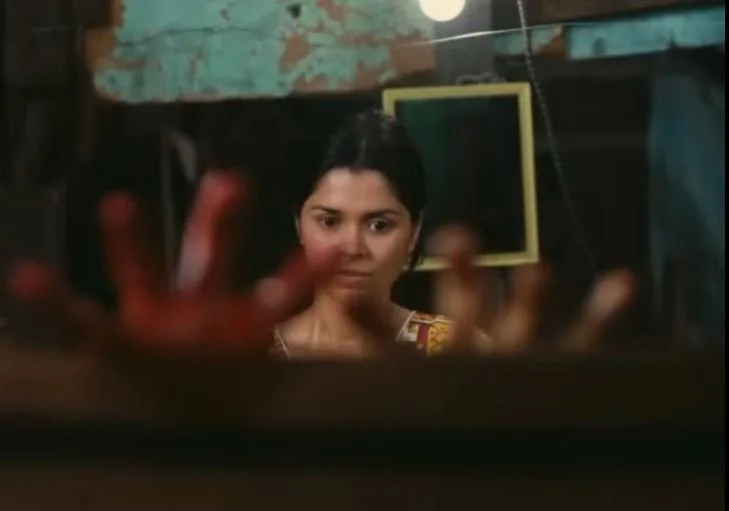
Insiang watches Dado die, film still from “Insiang” (1976), directed by Lino Brocka
6.
True to the era’s style, the films make maximum use of the freeze-frame during these scenes of female revenge and male pain. Bona scalds her philandering object of devotion, Gardo, with a boiling pot of water while his screams carry over beyond the shot, never to be pacified by feminine mercy. The camera zooms to Insiang as she watches in morbid fascination when her mother rips into her deceitful lover Dado with a large carving knife.
7.
During this same period, I watched film after film spanning the 1980s that starred the Indonesian ‘Queen of horror’, Suzzanna. Like Insiang and Bona, the characters played by Suzzanna are driven by violent revenge against men, but vengeance is carried out from beyond the grave. Empowered by her undead status, her spectral presence spells an endless bloodbath, each man dying in a more gruesome way than the one before. I remember feeling a complicated satisfaction on seeing her victims impaled, crushed by a falling brick wall, beheaded, I wanted the murders repeated again and again, even though these actors from over forty years ago have nothing to do with me. Surely, I wasn’t the only one who felt this way?
8.
The revenge narrative (pembalasan) of Suzzanna’s films offers a space for identifying with a sympathetic character who runs the gamut of human emotions; shame, anger, jealousy, desire, and care. Her original suffering morally redeems the unspeakable fates to which she subjects the men in the film. At the end of the films, she is not vanquished like a comic-book super-villain. She may even enjoy a romantic, happy ending.
9.
Suzzanna’s breakthrough film came in 1981 with the starring role in Sundel Bolong (dir. Sisworo Gautama Putra). Before becoming the titular ghost, she was Alisa, a newly married woman, but a series of horrific events—a gang rape from which she becomes pregnant, the acquittal of the perpetrators, the denial of access to an abortion, then suicide—create the conditions ripe for unstoppable revenge.
10.
“Now, it is your turn to be assaulted!” Sundel Bolong (1981)
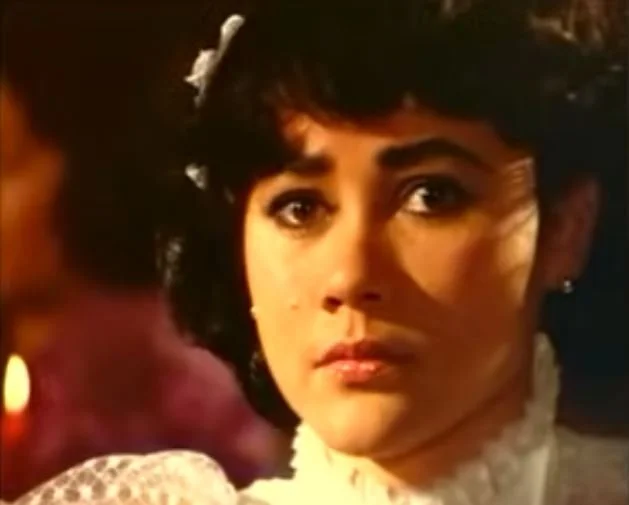
Sundel Bolong getting her way, film still from “Sundel Bolong” (1981), directed by Sisworo Gautama Putra
11.
In a postcolonial period hardened by authoritarianism and corruption, extralegal justice offers a pathway to settle old scores. The long shadow of repression cast by the 1965 massacre and mass disappearance of suspected ‘communists’ in Indonesia left little room for moral resolution in the 1980s other than a few state-approved domains such as popular cinema.
12.
‘Ultion’: a word so antiquated it has fallen out of use and taken out of the Oxford English Dictionary. It was last used in 1901 in George Bernard Shaw’s stage play, The Admirable Bashville; Or, Constancy Unrewarded. A word that carries little consequence in the story, it is delivered by a minor character, a police officer, as he assures the heroine of his authority to restore public order on behalf of a flawed institution:
13.
‘Fear nothing, madam:
The force protects the fair. My mission here
Is to wreak ultion for the broken law.
I wish your ladyship good afternoon’ (1907: 45)
14.
‘Ultion’ is an obsolete term for revenge. Its use in Shaw’s play is unusual because the policeman is not compelled by a personal vendetta. Instead, he steps in as an emissary, an agent of ‘the broken law’, a justice system that is far from perfect. He has been recruited to repair the broken system while doing its bidding. Revenge out of institutional obligation.
15.
Why did Shaw use a word that was practically extinct in 1901? In particular, a word whose meaning is adjacent to vengeance but carries a greater moral heft than the mere settling of scores? And why would such a word disappear from the English vocabulary even though revenge and its isomorphs have never gone away?
16.
Perhaps the lexicological banishment of ‘ultion’ reflects changing attitudes towards revenge, the move from honour killings, retributive justice, and lex talionis to ‘more modern’ forms of ‘universal justice’. Perhaps justice itself was becoming more de-personalised. The authority to wreak ultion has to be taken away from individuals with a social conscience and abstracted into oblivion in the modern justice system, broken or not.
17.
Any honest criminal lawyer will tell you that the law cannot deliver the justice that corresponds neatly with the one we have in our hearts and minds.
18.
Shaw’s ultionic policeman appears to stand at the boundary of two systems; the ancient culture of honour and modern codes of justice. However, the two are not mutually exclusive, nor does one follow the other in a linear historical fashion from archaic retribution to the deterrent punishment of modern law. Cross-cultural studies suggest that cultures of honour (a category usually reserved for brown, Muslim, male-dominated societies) are created out of unreliable institutions and a climate of distrust. Modern institutions that privilege abstract and impersonal justice can also break down and become unreliable and untrustworthy, giving rise to new cultures of honour.
19.
The 19th century American writer Ralph Waldo Emerson thought that revenge could be a redemptive force for good. More strikingly, that revenge can call upon more-than-human collaborators. In his lesser-known essay “The Sovereignty of Ethics” he exalts Nature’s ability to restore balance in the world, even through destruction. However, Nature can be slow. To hasten things, he calls upon people to join forces with Nature in this moral endeavour, by taking revenge against rapacious industrialists: ‘… man and mote and star and sun must range with it, or be pulverized by the recoil’ (1904: 193).
20.
Videos of Nature striking back against the apartheid regime of Israel have been circulating online. In one video, an unstoppable swarm of bees darken the sky and colonise the bodies of vehicles and walls of buildings in an Israeli town. Another video that went viral in May 2023 shows a crow pulling and removing an Israeli flag from its mast somewhere in the West Bank. After the flag is thrown down, the bird perches triumphantly on the flagpole.
21.
Then came further onslaught from the natural world that has lost its patience. In southern Gaza, angry wasps attacked IDF soldiers in retaliation after their tank crushed their nest. Over in the illegally occupied West Bank, military operations were interrupted by a coalition of wasps and bees for reasons that remain unexplained by official reports. Mugshots of soldiers with swollen faces are shown online, eyes sunken into bursting cheeks. More recent is the algae bloom wreaking havoc on Israel’s desalination plants, an ‘environmental crisis’ linked to the destruction of the sewage system in Gaza. Many might interpret these incidents as Nature striking back, correcting cosmic wrongs. Are we seeing Nature’s revenge or are we fantasising? An Emersonian rebalance?
22.
“… like the smoke of a great furnace, and the sun and the air were darkened…” Book of Revelation 9:1-11
23.
These news stories and videos on social media are so striking because international laws, let alone their brokenness, have no meaning to crows, bees, wasps, and algae. Their disregard for human law is of a piece with the lawlessness that underwrite the systematic carpet-bombing of Gaza.
24.
With every attempt to destroy Palestinian lives, what the British Israeli architect Eyal Weizman calls the ‘ungrounding’ of Gaza, comes the ecological aftershocks that cannot be preempted. Since October 2023, when the massacre of Palestinians by Israeli forces was given a new reset, bodies continue to pile up in Gaza. Tens of thousands within a few years. Many were simply vaporised by Western-funded Israeli weapons. Many were murdered in the West Bank by ‘settlers’ who have faced no consequence. The last time an Israeli was charged with the murder of Palestinians was in 2019. There have never been convictions. National and individual impunity on a scale impossible to ignore. Quousque?
25.
According to the ‘obsolescence of war’ thesis in international relations, the ‘post-war’ era is reserved for certain ‘democracies’ that on the surface have moved on from the primitive humiliation/revenge cycle of politics. The ‘end’ of war, however, is never the reality for the global South, mostly made up of ‘zones of turmoil’ as opposed to the ‘zones of peace’ enjoyed by advanced democracies. The global South is still in turmoil because it is working out the consequences of Western colonisation.
26.
In the age of so-called liberal democracy, (neo-)imperialists see decolonisation as a form of revenge, an illicit attempt at obtaining justice. Because colonialism was (and is) the murderous capture of resources and the destruction of heritage, the undoing of that process can be just as violent. Not everyone who has suffered under domination for so long is always so patient, so kind, and so magnanimously forgiving.
27.
What does it mean to be a film viewer far removed from the horrors of an unfolding genocide to reflect on violence? Instead of turning away from the real-life violence, the viewer may engage with violence in a medium that offers involvement and insight. In the Southeast Asian films mentioned earlier, the women obtain justice for themselves by taking revenge on abusive men. Let us now enumerate the virtues of revenge.
28.
Revenge is rational. It is cognitive work, requiring one to remember the hurt and create a plan of action. Targets of revenge are never chosen for no rhyme or reason. They signify and remind the avenging person of their hurt.
29.
The desire for vengeance is a natural emotional response to cruelty and domination. In an essay published in a special issue of Social Text on ‘Revenge politics, revenge economy, revenge culture’, the political theorist Bedour Alagraa recounts the time she visited the Apartheid Museum in Johannesburg, South Africa. Seared into her memory of the visit was a video footage on exhibit of a ‘failed’ Truth and Reconciliation Commission hearing between a former member of the apartheid government and the family of a murdered freedom fighter. In the clip, the white administrator speaks to the Black mother whose son was killed on his orders: ‘Mama, I have come to ask your forgiveness, you see—'. The clip is cut short when the camera goes out of focus, and a loud crash is heard: the brother of the murdered freedom fighter has taken a vase and smashed it on the head of the white man. Alagraa remembers hearing the gasps of horror from the white visitors around her at this moment. She and her fellow Black colleagues, on the other hand, smiled at each other in secret understanding.
30.
Revenge is moral. Like decolonisation, it is the volatile substrate for justice that feels meaningful at a pre-semiotic and trans-historical level. In Albania, the centuries-old Kanun of gjakmarrja, or blood feud law, is a twelve-volume manuscript that ordinary people could refer to for taking revenge in carefully spelled-out ways. Revenge as outlined in the Kanun aims to be reparative, and it has enjoyed a revival amongst the people of Albania despite efforts to eradicate it during the communist rule of Enver Hoxha.
31.
It is a truism that broken laws create impunity and delay meaningful justice.
32.
Can one break a law that is already broken? What does a broken law look like in a world where a global elite can rule lawlessly?
33.
What value would it bring to avengers who wreak ultion not for the broken law but because of it? To push the notion further, to wreak ultion not in the name of that broken law but in defiance of it?
34.
The law becomes a cover for the rich and powerful to profit themselves by creating and continuing humanitarian crises. The law is also the means by which they preempt the taking of revenge on them.
35.
If it is true that capitalism has hijacked and degraded the meaning of revenge, as the radical scholar Max Haiven argues, it doesn’t mean we have to abandon vengeance altogether. Instead, he proposes, we need to nurture dreams. Rather than the unprocessed psycho-dramatic fantasies of revenge, a new shared imagination – an ‘avenging imaginary’ as he calls it – can be developed to recapture the necessary ‘wreaking’ in defiance of broken laws.
36.
How to nurture dreams of revenge without seeming bestial? Revenge has a monstrous reputation because of the ‘wrong’ kind of emotion it produces: pleasure and satisfaction at another’s (deserved) downfall. A smile when seeing that tables have been turned.

Bona pours boiling water on Gardo, film still from “Bona” (1980), directed by Lino Brocka
37.
Western moral philosophers have by and large condemned revenge because of how unbecoming people can get when they seek it out. Sitting on their high horses, philosophers believe in punishment as deterrent, not as retribution.
38.
Would revenge be less maligned if one responds to a villain’s downfall with indifference? Instead of righteous seething, what if one’s reaction to karmic comeuppance is ‘What’s for dinner?’
39.
If a person crosses a line and faces the ultimate consequence for their crime, including the loss of their life, we can rightly say, as the moral philosopher TM Scanlon carefully states in Morality and Responsibility (2025), and I am only paraphrasing here: ‘Tough shit. Next.’ It is about maintaining a cool disinterest when we see it all come crashing down for the offending party, an indifference as shown by Bona and Alisa.
40.
Insiang, Bona, and Suzzanna’s characters all appear calm and collected when they turn on their victims. There is no wicked laughter nor lengthy speechifying of a super-villain, only a gaze, usually away from the viewer and toward the obliterated object outside the frame, accentuated by a hard close-up. Something was long broken underneath the face before revenge is visited upon their target.
41.
Online, there is a contagion of arch indifference among opponents of Israel’s assaults on the Middle East towards the reports of the combat-related deaths of Israeli soldiers. “I was thinking of having sushi for dinner, actually,” says one commenter below a social media post on the suicide of an IDF soldier. “So… anyway,” says another.
42.
Indifference is not about having no empathy but withdrawing it, while doing the important work of compassion and humanity elsewhere.
43.
This essay extends an invitation to forge a coalition of an avenging imagination with others, even with a bee, wasp, or crow. It is about lending recognition to the emotional dimension of retribution that has long been fueled by righteous fury. All while maintaining the posture of selective indifference.
44.
Revenge serves as a warning to others: what goes around comes around. Imaginaries of revenge offer vivid tableaux of altruistic punishment enacted by a wide cast of actors swarming the air, streets, and seas; these fantasies are activated every day, spilling over in our daily speech and behaviour, into what we choose to see, read, and boycott, what we also tell others to see, read, and shun. Not waiting for the broken law to right itself, but wreaking ultion in defiance of it.
Works Cited:
Alagraa, Bedour. 2022. “And the Last Shall be First: On the (Im)possibility of Revenge,” in Social Text: https://socialtextjournal.org/periscope_article/and-the-last-shall-be-first-on-the-impossibility-of-revenge/
Emerson, Ralph Waldo. 1904. Lectures and Biographical Sketches. Cambridge: Riverside.
Haiven, Max. 2017. “Towards a Materialist History of Revenge”. In Vagabond Issue no. 1.3-48.
Shaw, George Bernard. 1907. The Admirable Bashville. New York: Brentano's.
Alicia Izharuddin is a writer and Senior Visiting Fellow at the National University of Singapore. She is the co-editor, with Patrick F. Campos, of the Routledge Handbook of Southeast Asian Cinemas.


What is our remedy when the law is broken beyond repair? In this provocative essay, Alicia Izharuddin looks for answers in Southeast Asian revenge films.