Why Wouldn’t You Want to Play With The Spirits?: An Interview with Anh Vo
By Ru Marshall
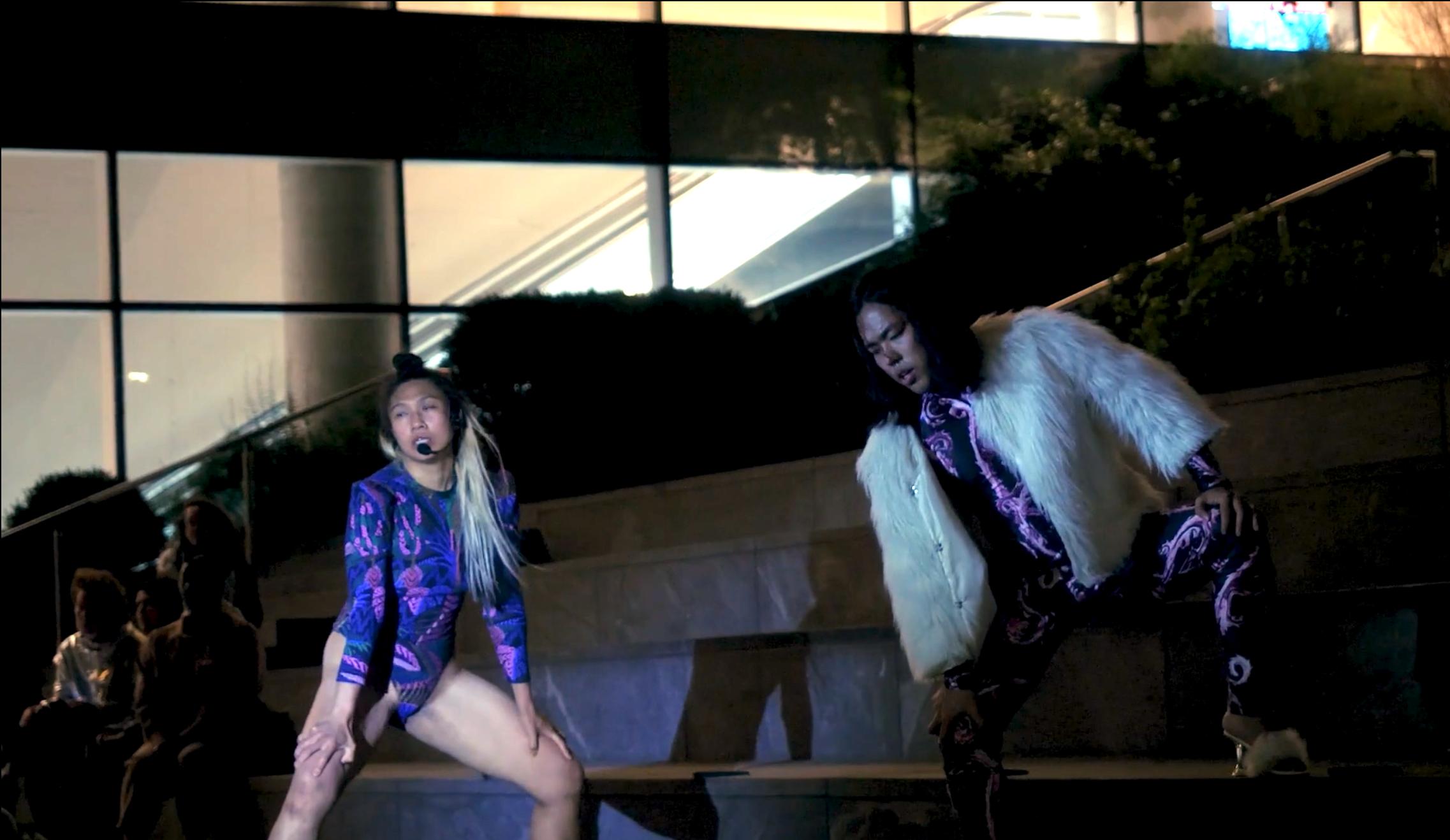
Anh Vo and Kristel Baldoz in Possessed by Capital. Video still by Kyle b. co and iki Nakagawa.
On June 14, 2025, I went to see a performance by the dancer/choreographer Anh Vo. The email I’d received told me to be at the plaza across from the Mark Morris Dance Center in downtown Brooklyn, behind Whole Foods and the Apple Store, at 9 pm. I arrived a few minutes early. No sign of anything happening. I sat down and waited on the steps on the east side of the plaza. Gradually people began arriving, although I couldn’t tell who’d come intentionally, who’d chanced by. Porous boundaries, I would come to understand, are central to the work of Anh Vo, who I noticed (I took it to be them, dressed in a Versace bodysuit with a white, faux-fur jacket) at the plaza’s edge. There wasn’t one clear moment when I knew the performance had begun, but soon Vo and their long-time collaborators, Kristel Baldoz and Justin Cabrillos, began whirling in the center of the plaza. While a viola and violin played a dissonant duet, the dancers shouted out phrases, creating an interpolation of repeated movements and sentences. A zone of trance.
Vo, when discussing their work, more often speaks of possession than trance. The performance that night was titled Possessed by Capital. Central to my grasp of dance is a process/project in which the body moves in a state of full somatic consciousness, in which logical and analytical processes largely recede. This trance of corporeal awareness includes and responds to the presence of other dancing bodies. And of the environment in which the dance occurs. And, for Vo, the environment is always multi-dimensional, including not only the other dancers, but also the presence of the audience, the psychological, the socio-political, the traffic on Flatbush, the spirit world, the Apple Store, the night sky.
The whirling continued for forty minutes. The plaza, it seemed to me, had become an entirely different space. (Can dance change space? It can certainly change our sense of it). Then Vo and their dancers ceased their whirling, began running through the audience, handing out slips of paper that read “Follow Us to the Apple Store.”
And then everyone did, running around the block, past Whole Foods, to the front of the Apple Store.
Where the performance continued.
*
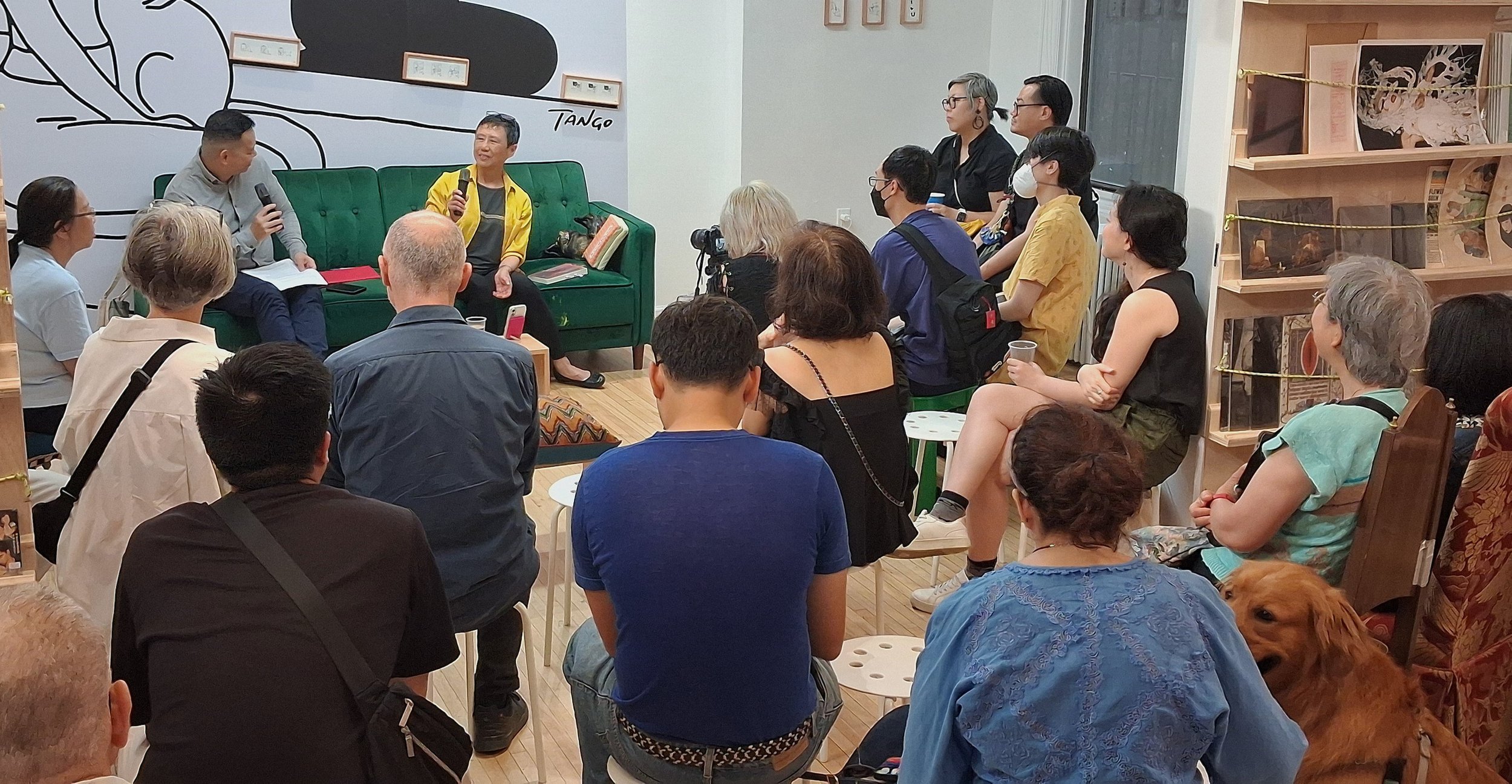
Subsequently, I saw Vo perform twice more. In one of those performances, at the Performa Space in Manhattan, they intoned phrases from Gertrude Stein. I watched videos of their performances from the last ten years. Vo is from Hanoi, and it was my good fortune that we were both there in January 2026. And that I was able to attend a talk they gave at Hanoi’s a queer museum (the living room of the curator/artist Nhung Dinh), and to interview them the following day, at a café on Nguyen Gia Thieu Street.
***
Ru Marshall: I want to start by asking how you arrive at the words and phrases and allusions which you employ in your performances. And how they’re woven in with the movement.
Anh Vo: You could say I have a spoken language fetish—an oral fixation if you will. My father’s parents were illiterate, so they had a very different relationship to words and writing. My grandmother ran a convenience store out of her home, and she would remember by heart who owed her what. She didn't have a notebook to write it down in. That’s emblematic of a way of life I try to hold onto. When things get written down, I associate that with a kind of confinement and containment. Poetry breaks us out of that. Gertrude Stein breaks us out of that.
RM: You could also say she breaks language, or comes close to doing so.
AV: It’s her use of rhythm. Another thing that’s important, in terms of my relationship to language, is that I grew up with communist propaganda everywhere. Which is, on the one hand, very rigid. On the other, propagandistic language also tends to be quite rhythmic. They want you to remember. In rehearsals, I don't write anything down. That's been clear from day one. Most choreographers keep rehearsal notes. I don't.
RM: How do the phrases you’re incanting arise?
AV: One reason I love dance is that it has so much structure. You come in, everyone warms up for an hour. You stretch, do conditioning. We do qigong. During that hour, I gauge the energy. Then I'll say, "Okay, let's try this. " Of course, I come in with ideas, certain themes I want to deepen, explore, figure out. But I never have a written plan. Instead, I’ll set up structures. For Possessed by Capital, we put on Roísín Murphy, this avant-garde, Irish disco queen (who’s gone astray in her transphobia, unfortunately). I put that on and we started improvising phrases. There’s this back and forth. Over time we develop a grammar that we don't need to spell out.
RM: You’ve worked with the same dancers quite often. I imagine there’s a wavelength you’re all on.
AV: Exactly. You don't have to explain much. It's a nice way of working.
RM: Let’s talk about your warehouse performance, Common Fetish.
AV: That was in a hosiery warehouse. Owned by Taiwanese immigrants. Their daughter is an artist, she let us use it. She has her studio in a corner.
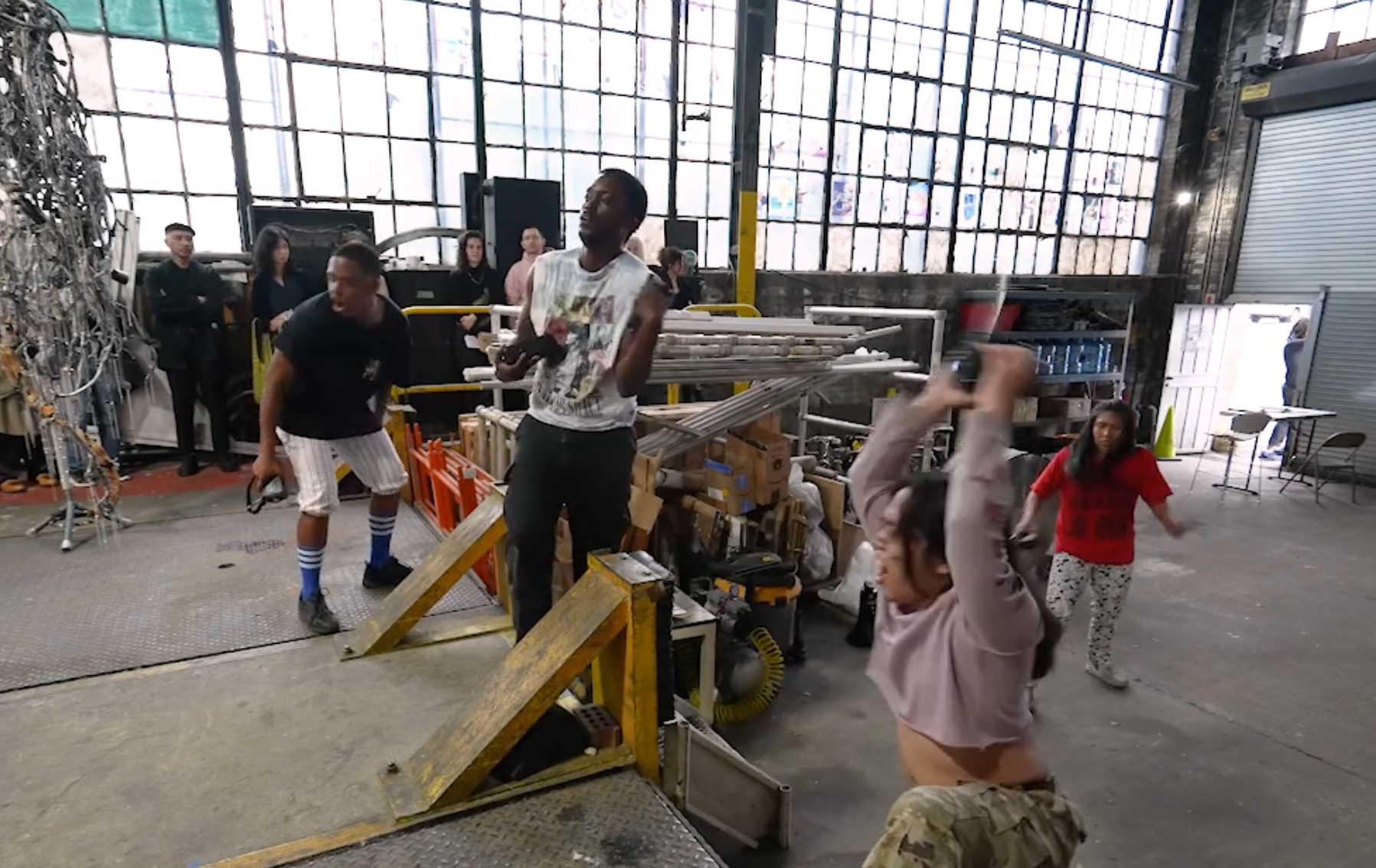
Kris Lee, Nile Harris, Anh Vo, and Kristel Baldoz in Common Fetish. Video Still by iki Nakagawa.
RM: In this piece, several Zen-adjacent phrases were among those incanted: “I am empty but I am not dead.” “Being is nothingness and nothingness is everything.” Ontological paradoxes seem to be among your preoccupations.
AV: We had to work on that so fast. Very few of the texts were anchored in writing.
RM: It was mostly improvised?
AV: Ninety percent of it.
RM: I would never have known.
AV: That's good to hear. It was such a fast and furious process. I want to add something about language. I never want to completely divorce it from meaning. The way I use language isn’t nonsense, but I am playing at the edges of meaning.
RM: It’s not unakin to baby talk. Is that okay to say?
AV: It’s OK to say.
RM: In your talk at a queer museum, someone asked, “why do you speak English in the US and Vietnamese in Vietnam?”
AV: Because I actually do insist on communicating. I’m not trying to get away from meaning. I want to say something. I really do, but the existing language doesn't quite lend itself to that. I want to get at something more subliminal.
RM: Something underneath language?
AV: Yes. In the rehearsal for the warehouse performance, for example, we started playing with speaking in tongues. You need a lot of structure to not lose yourself in that sort of improvisational practice. I didn't explain to the dancers what the content should be. But they got the grammar. We were in the same landscape. The process was structured so that we were taking turns, trying things out. I would be the first one, then they’d try to catch on to my syntax.
RM: That doesn’t seem unrelated to the way Stein forefronts the concreteness of language, how it communicates through rhythm.
AV: Yes.
RM: Is speaking in tongues an aspect of Vietnamese shamanism? I’m curious about your experience of that growing up.
AV: Yes, though it’s tricky to explain how this kind of practice lives in me. Shamanism is like the air that I breathe. It is just a part of the metaphysics of Vietnam. It’s everywhere. To me, it’s a practice of contending with the unknown, the unknowable. When I was a child, we would go to temples and pagodas every month. There’s always someone at the pagoda giving divination readings. I’m especially fascinated by the non-consensual readings given by local workers. They have no real stake in your life. They just get possessed by your spirit and talk to you as if they are that spirit. Those experiences can be terrifying. They feel real. You’re not asking for it.
RM: Sounds scary.
AV: It's also profound. Someone is seeing a part of yourself you don’t have access to.
RM: Everyone wants to see behind the veil. And everyone doesn’t want to see behind the veil.
AV: It’s often just a worker at the temple. She doesn’t want your money. She sees something and has to say it. Shamanism isn’t an organized religion. There's no dogma. In Vietnam, artists go to shamans all the time. Last year I was doing studio visits with some local artists in Hanoi. We were all hanging out, and the artist Việt Lê showed up. He’s a full-time shaman now. One of the artists asked him, "Can you go check out this land and perform geomancy for me? Just to gauge what spirits are there.” She’d just bought this property. There was a scary-looking building nearby, which she wanted to turn into a studio. So we all started walking over there. When we arrived, Việt briefly communed with the spirits. He said, "Your land is fine. There's some death happening in the river. Someone got raped, but it's over there. It's not tied to your land. If you perform some rituals, it should be fine.” But when it came to the potential studio space, Việt bluntly said, "No, this is really bad. Don't even think about it. " That kind of thing happens daily.
RM: Do you see yourself in the role of a shaman when you perform?
AV: I'm actively figuring that out. I go to a shaman a few times a year in New York. She’s Korean—Mudang Jenn. She’s connected to the art scene. The Korean artists are always roping her into their projects. She told me from the very first time we met that I might have to get initiated as a shaman. I didn't really know then what that meant. She warned me that if you get initiated, your life doesn’t belong to you anymore. It belongs to the gods.
RM: That sounds scary. In the art world, people talk about the artist being a kind of shaman. The word is used loosely, metaphorically. But you’re talking about practicing shamanism for real. And grappling with the implications of that.
AV: I'm always asking myself: am I making it up? Can my art actually help me to not get initiated? Society is changing so quickly. When it comes to how we inherit these traditions, everyone is improvising. You can't just rigidly hold on to the older models and apply them formulaically. I'm constantly in conversation with Mudang Jenn about this. And she, from day one, suggested that being an artist could be my way of navigating this calling. But there's no guarantee of that.
RM: I see.
AV: People usually get initiated as a shaman because they have to. Nobody casually wants to do it. Illness is often involved. You get so sick you go to the hospital. But the doctors don't know how to treat you. So you have to turn to the spirit world. The illness is an opening. Then you serve the gods. The illness is like God knocking on the door, telling you it's time. That's what happened to Việt Lê. And to me, somewhat. I got very ill in 2021. I developed acute Graves' disease. I had to have a thyroidectomy. There was permanent damage to my parathyroids. Afterwards, Jenn told me that I might not need to get initiated. The spirits seemed satisfied.
RM: Did that mark a change in your work?
AV: I think so. It's still too soon to tell.
RM: Was this when you began more consciously exploring possession?
AV: I’ve always been interested in possession. But I never framed my work that way. I suppose I was scared to. But… why wouldn’t you want to play with the spirits? In terms of presenting my work that way to the public, that wasn’t until 2023, after my thyroidectomy. Somehow, in the wake of the surgery, I felt so at peace. It had to do with letting go of the fantasy of being in charge of my life.
RM: How does that relate to the self-punishing rituals which are also an aspect of your work?
AV: Self-punishment has always been there. Before the surgery, it felt very masochistic. After, it started to feel more like real magic. Which just means a more intimate understanding of why people would watch someone mutilate themselves. When you attend shamanic possession rituals, you watch people do very intense things to themselves for the sake of the collective. I have no need to do such things in my daily life.
RM: You're not sitting at home cutting yourself.
AV: No. But there's something about doing it in front of others that has to do with processing the basic helplessness of being a living being. You’re a really small, tiny, little thing.
RM: A speck of dust.
AV: Yes. But you don’t live as such. We live our lives thinking what we’re doing is really important. It’s an incredible contradiction.
RM: Does self-punishment take you back to that smallness?
AV: I think so.
RM: Sometimes the self-punishment gets pretty intense. I’ll be honest that this aspect of your work can make me pretty uncomfortable. I’m interested in your understanding of what the audience goes through witnessing these rituals.
AV: I don't know for sure, but I do have fantasies of what people are experiencing. That's why I was talking about how my work has shifted from the masochistic, even if that’s how it might look. In one performance, I dance naked out in the cold. Everyone is freezing, even in their jackets. I don't really know what people are going through watching me, but I do know we’re enduring something together. Something is happening between us. It's also a little manipulative.
RM: I think there’s a kind of rupture of the rules of public space. There are countless hidden rules governing how we exist with each other in public. When I saw the performance at the Apple store, I thought: this space just became completely different. I've never actually seen anything like it. Would it be correct to surmise that you’re now increasingly interested in working outside of traditional theater spaces?
AV: Not necessarily. I don’t actually have a desire to transcend theater. I love making work in the theater. It’s a laboratory of spectatorship. In the case of the Apple Store, I was interested in how people gather around a spectacle. I wanted a crowd. This goes back to my upbringing in Vietnam. I didn’t grow up with theaters. Theater was this bourgeois thing nobody went to. I didn't grow up watching dances or plays. My childhood association with people gathering around something together is temples and pagodas.
RM: The first time I came to Vietnam, I was fascinated by the space of the pagodas. It’s not like when you enter a church and there's a clear inside/outside boundary. It's entirely flexible. It’s similar to the sense of the proscenium you created at the Apple store. So this makes a lot of sense to me. You choose your degree of involvement. Or it’s open to negotiation.
AV: The concept of personal space isn’t the same in Vietnam. It honestly drives me crazy.
My family will burst into my room, go through my suitcase to get their gifts. There's something radical about it, but I also can't deal with it. This is so present in my work. I’m always trying to push into people in ways that can feel quite aggressive. Even sadistic.
RM: Let’s talk about sadism. Which performances cross into that zone? In Introjective Exhibition, you wore a shock collar, and recruited an audience member to send you shocks. That seems to me more masochistic.
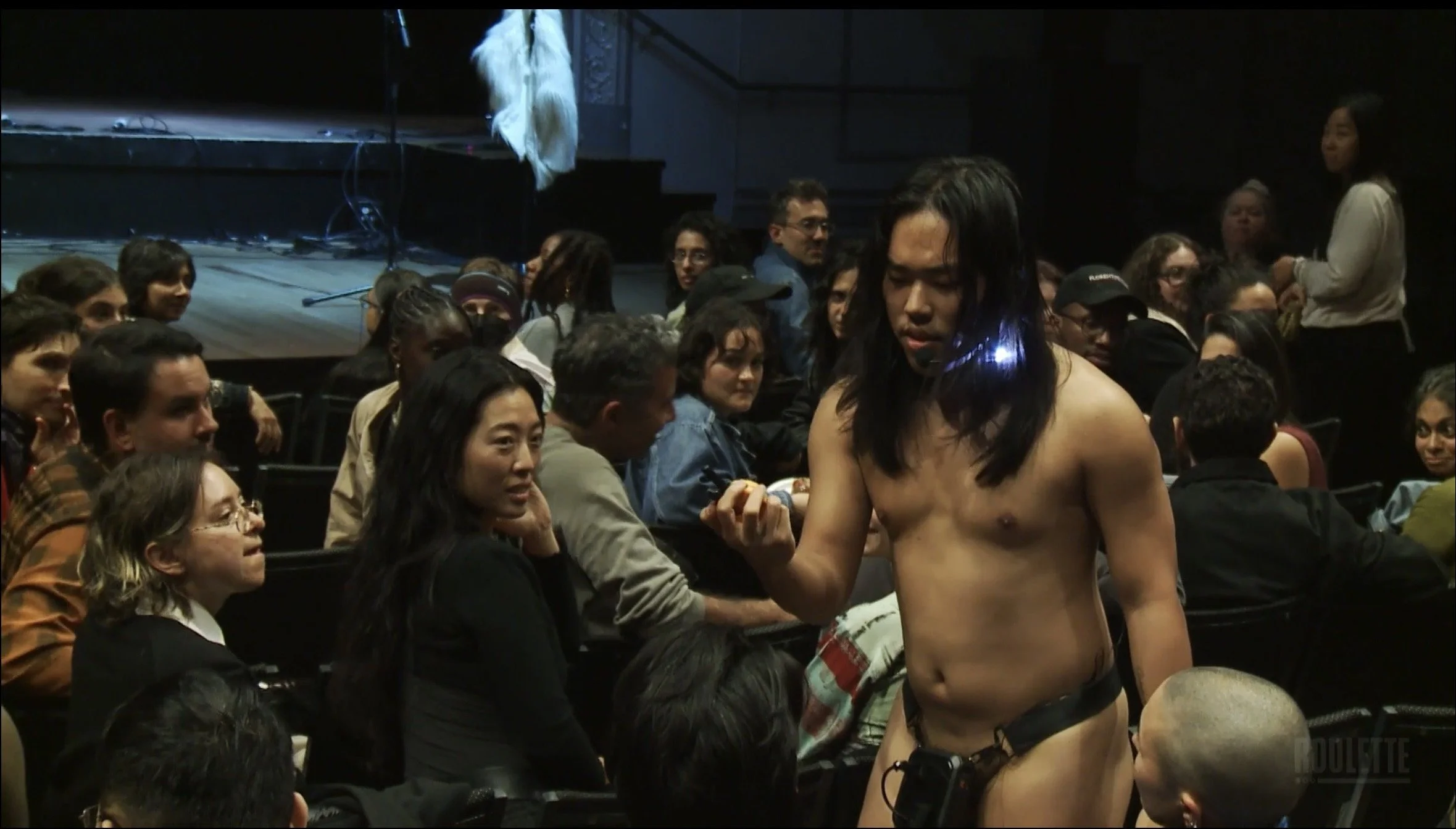
Anh Vo in Introjective Exhibition. Video still courtesy of Roulette Intermedium and Triple Canopy.
AV: That’s how it appears. But to me it feels very sadistic to force someone into their capacity to inflict pain. It’s pretty aggressive to give the remote to a stranger and ask them to keep shocking me continuously so I can go into an intense speaking-in-tongue mode.
RM: Why do you want to do that?
AV: It started when I had a dog. A very unruly dog. I thought, “maybe I need to get a shock collar.” Then I thought, “oh no, that's cruel.” I began thinking about the ways we’re tethered to each other. And my own insecure need to feel tethered to someone. You know, when you have a crush, they text you and you text them. Then they don't text back for an hour…
RM: And you’re a wreck.
AV: Right. I’ve been thinking about that dysfunctional need for connection, that craving for assurance the connection is still there.
RM: How does it feel when you receive the shocks? Intensely painful, I imagine.
AV: Not as painful as you might think. This is where theater comes in. And where I start to diverge from a lot of performance art, from the fetish of the real. I thought, “I don't need to be in pain.” I was careful what setting to use. I need it to produce some involuntary, visible jolt, but I don’t need to be in real, intolerable pain. The level is set to around 27 or 28 out of 100. I experiment. Initially, in rehearsal, I set it very low, at 12 or 13. But after the first performance, I realized that with my adrenaline pumping, I could hardly feel a thing. So I increased it. The optimal setting is where I'm not really in pain, but my body is jolted. I’m interested in the encounter with the people who are watching. And with the person who has the remote, who is watching me and being responsible for the shocks. It becomes more about people’s projection of what my body might be subjected to, rather than what my body is actually going through. It’s pretty manipulative. And sadistic.
RM: I’m still not sure why you want that.
AV: I think people in the US, in the West in general, are too polite. They insist on a facade of civility. They don’t have a reflective relationship to violence. They have this distance from violence. There’s a lot of pretending. I think we need to develop a relationship to our own aggression, our capacity for inflicting pain. That will enhance our kindness. You need both, the yin and the yang. It's never just love or hate. Everyone insists on too much safety. I get so bored. Part of this comes from growing up in Vietnam and its postwar landscape. The presence of violence is so powerful.
RM: How do you feel about the way the shamanistic aspect of your practice is received in New York?
AV: I don’t talk about it much publicly. Not in depth. I talk about it with my friends and in the studio with my collaborators, but within public discourse, people don't understand it. So I hold onto it myself. I feel lucky that Mudang Jenn also has a very unconventional path. She was a strip club manager, before getting initiated in a very traditional way. But she negotiates at the edges of her tradition. Recently, she got involved in a theater production and told me, “Your performance productions aren’t so different from my ritual ceremonies. Your suitcases are full of props and costumes, with two sets of clothes for yourself. That's exactly how I travel to ceremonies. And the way you manage people and musicians—shamans have to do that too.”
RM: But the context is so different. In the New York art world, if you just use the words “faith” or “belief,” you’d better be careful. There's so little that truly supports ego surrender. It's very interesting to see how you're moving in between these different contexts.
AV: It helps that Vietnam has this approach to religion that’s more folk and oral. It has this formless relationships to gods and deities.
RM: It's not so doctrinal.
AV: It addresses what we need as a society. We need myth-making, we need storytelling. To understand who we are, to stay connected to the world, to cope with our smallness. I think I’m able to go into this sort of mythical, religious talk and still get taken seriously because I'm Vietnamese, and working in the US. That's also why I relate to dance and claim it as my lineage. I think dance is one of the most spiritual art forms. It gets at our relationship to God. Because you're not doing it to tell a story. I mean you are, but also you’re not. As a form, it's so abstract—you do it because you have to. Which is not unlike going to pray in the temples.
RM: Does your background as a dancer make your work different than that of, say, Ron Athey or Julie Tolentino?
AV: Julie's a dancer.
RM: I didn’t know that.
AV: I relate to her work so much because of that. Dancers have a real relationship to what it means to be in the body moving in space and time. A lot of Vietnamese performance artists come out of the visual arts. They embody, too. But they place so much importance on concepts, on creating situations to put the body in. I don’t relate to that. I insist on certain dancerly things, such as rehearsals. The way I make work is like a dog following a scent. I can't just generate a container of a concept and put my body in it. For example, with my upcoming exhibition at Participant Inc, I’m planning to do a spectacular bloodletting ritual. This is my first time bloodletting. It’s not a willful decision. I’m actually so scared. The impulse came to me a year ago, and I started having dreams about it. Now I’m just following where the scent takes me.
RM: Tell us what you're going to be doing at Participant.
AV: I'm working with Ca Trù, which is an endangered Northern Vietnamese chamber music tradition. It was hugely popular in the twenties and thirties. These singing houses were places poets would frequent. And the singers, who were exclusively female, became their muses. But the singing houses were also sites of prostitution, opium smoking, and human trafficking. When the communists took over, they banned Ca Trù. It remained banned until the early nineties when Vietnam opened up to the world. The government realized Ca Trù could fit into a nationalistic agenda, since it's a very distinctively Vietnamese form. So they tried reviving it as a cultural heritage project. But in doing so, they took it out of the social fabric. Now it’s dying again because people aren’t interested in it. Or they are, but it's unapproachable. I’m particularly invested in Ca Trù because my great-grandmother on my mom's side was a singer in one of these houses. My great-grandfather bought her out from it to be his second wife.
RM: So it's long been in your consciousness.
AV: For forever. Without that history, I wouldn’t have known Ca Trù was tied to prostitution. The State has elevated it into this sophisticated thing. Which it is— the underlying music theory is quite difficult. And because it’s sung poetry, the singers need to be literate. I initially thought I’d use the Participant exhibition to experiment with prostituting my body. I also knew that I wanted to study with real Ca Trù musicians. I’ve done that for the past month, studying with them almost every day, five hours a day. I then realized I'm not really that interested in the prostitution aspect. I mean, I am, but it's not the thrust of the work. I’m more interested in the oral history transmission and the resilience embedded in the form. The two musicians I’ve been studying with, Vũ Thuỳ Linh and Phạm Đình Hoằng—the way they devote their life to this form feels like sacrificial ritual to me. Sacrifice and resurrection and the violent entanglement with the revolution—that feels more like the core of what’s pushing this project forward.
RM: I'll regret not asking you about the relationship between gender and shamanism. The ritual practitioners seem to be occupying some kind of space between genders. Or beyond genders.
AV: In Vietnamese, one of the words you could translate as “queer” is “bóng”. Which is also the word you would use to describe the practitioners of Hầu Đồng, the ritual in which a medium allows gods and deities to occupy their body. Bóng means weird, eccentric, but with negative connotations. Now, the queer youth are reappropriating “bóng” in the same way “queer” has been reclaimed in the West. I think there's something about folk magic and folk art, where things are a little bit more loose. There's more of a relationship to otherness. Things outside the norm are more tolerated.
RM: It's something you find all over the world. In another lifetime, I want to write a book about people like Jack Smith. I want to write about the tradition of magic and queerness in the United States. And how Orientalism gets mixed up in that, too.
AV: Magic gets at this thing that binaries can't quite tolerate. Gender doesn’t quite get dissolved, but it gets destabilized. There are still codes to follow. These days, I don't actually work so much with identity on a conscious level anymore.
RM: I feel like you work with identity, but not with …
AV: The idea of identity? Yes. In the studio, concepts such as queerness, race, or even “Vietnam” function more as cultural signifiers. They don’t serve me much, though of course they are there. My theory about folk forms is that people do things because they need to do them—how birds sing because that is what they do. Folk practices provide a ritualistic container for people to push against larger social norms. Over time, these activities crystalize into something that can be described from the outside as queerness. So, do I make queer work? Yes, but I’m not trying to do that. It just happens.
RM: You’re like that dog, sniffing around. Also—your work is funny. It's really heavy and it's really intense, but it's also really funny. You're being serious, but there's this quality of self-awareness about it.
AV: One thing I really love about New York with my generation is there are a lot of clowns.
RM: Yeah. Clowning is big. I noticed.
AV: Some of my best friends are clowns. I had a fantasy of going to clown school at one point.
RM: There’s a long line to get in.
AV: Clown school, from what I’ve heard, is a series of humiliation rituals, which I’m very into.
RM: There’s such an interesting political history to the court jester.
AV: The jester is both making fun of and entertaining the king. But I’m also interested in how the clown works their relationship to the people in the audience. It's just you and me. This nothingness is all that we have together. What can we do with it? That's a clown sensibility. It’s also a shamanistic sensibility. When you go to a shaman, all they need is your date and place of birth, and then everything goes from there.
Anh Vo’s work has been presented at Participant Inc., The Kitchen, the Chocolate Factory, Performance Space New York, Roulette, Danspace Project, the Asian Arts Initiative, and numerous other venues. They are the recipient of grants and fellowships from NYSCA/NYFA, the Jerome Hill Artist Fellowship, Franklin Furnace, the Brooklyn Arts Council, and numerous other institutions. They are currently an adjunct instructor at Cooper Union.
Ru Marshall is the author of American Trickster: The Hidden Lives of Carlos Castaneda (OR Books 2026) and the novel A Separate Reality (Carroll & Graf 2006). Their visual work has been exhibited widely in the United States and Europe. Rmarshallstudio.com
Of shamanism, orality, violence, and queerness: an interview with dancer/choreographer Anh Vo, by Ru Marshall.