
A Refusal of Capture
Jhani Randhawa Interviews Khairani Barokka
By Jhani Randhawa
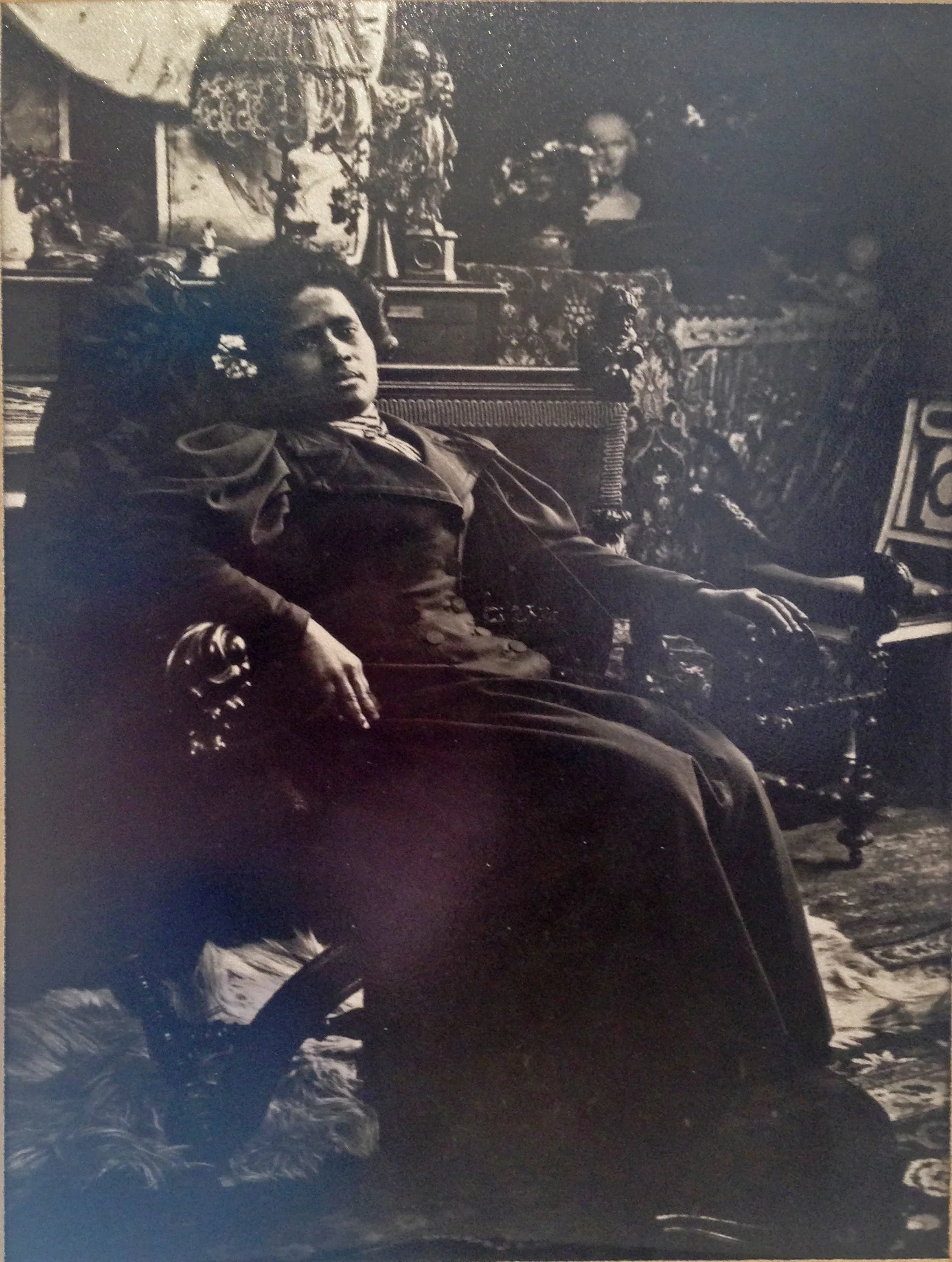
Alphonse Mucha (1860–1939), Portrait of Annah La Javanaise (b.1880), rue de la Grande Chaumiere, Paris,1894. Photograph. (Rephotographed by Davide Mauro, CC BY-SA 4.0; source: Wikimedia Commons).
Image description: Sepia-toned Black and White photograph of a Tahitian woman wearing a dark gown with puffy sleeves, seated on an ornate chair in a room filled with art and antiques, her long hair worn up.
Annah, Infinite (Tilted Axis Press, 2025) is a critical, speculative nonfiction by artist, writer, and translator Khairani Barokka, which centers the lives, transtemporal dreams, and non-European individuals painted and “kept” by painter Paul Gauguin (1848-1903) in the late nineteenth century.
Khairani Barokka has described Annah, Infinite as a 300-page image description of Paul Gauguin’s painting Annah la Javanaise. As of publication in 2025, to scholar Barokka’s knowledge, no content warning or in-depth citation existed in others’ presentations or writings on Annah la Javanaise, the painting or the figure depicted. “If,” Barokka writes, “Annah a Javanaise is a colonial depiction of a supposedly Javanese child, it is a typical denial of their right to be perceived as a fully human child in need of care. It is in the colonial interest for them to be denied the possibility of being a pained body—not only because Gaugin was a citizen of France as colonial power, as well as being coded white, male and abled […] but because Annah was turned into a commodity […] through the mythos surrounding their supposed consensual sexual relationship with Gaugin” (Barokka 188-89) which cannot be proved.
Book cover: Annah, Infinite, by Khairani Barokka (Tilted Axis Press 2025).
Image description: Dark serifed typface against a monochromatic lilac background.
For over fourteen years, Khairani Barokka has built a body of work spanning performance, visual media, poetry, fiction, and critical theory to unpack and find healing in her life and the lives of Annah(s) despite the interlocking expressions of disability/debility, sexual abuse, systematic medical neglect, and legacies of colonial capitalism.
Annah, Infinite is tender, trusting, unapologetically clear, and for me as a reader, often devastating. Through its pages, I was invited to bear witness to, and thereby find myself witnessed as part of, peoples currently and formerly living through colonization who are disabled, or who are being systematically disabled and traumatized by international, state, or settler violence. While reading Annah, Infinite, I felt in my bodymind waves of intergenerational exhaustion. Between the nadirs in reading and navigating my own entangled illnesses, in the wake of insurance coverage denials and inaccessible psychological care, I kept Annah, Infinite close. Through the prayers, anecdotes of freedom at varying scales, and speculative transit woven throughout the book, I also found relief and joy. All told, it took me over a year to read the book from cover to cover.
Formally, Annah, Infinite moves permeably between memoir, critical essay, manifesto, poetry, speculative nonfiction, epistolary, and prayer. Between dense yet approachable analytic chapters, interludes of queer and crip time. There are interludes wherein Annah(s) lie awake beside a sleeping Paul Gauguin, envisioning their escape from domestic servitude during an eczema flareup, or Annah(s) attend the first Indonesian Women’s Congress in 1928, telling us: “We carry the sensememory of having been many different genders […] They can never claim, as slavers, that they invented what it feels like for a woman to feel.” Annah(s) haunt then rewrite the western-backed Indonesian genocide from an invented past and the present, unburying those erased: “In 1965, I will be in my eighties, and live to see the flourishing of my sisters, my daughters” (241).
The book-as-citation is itself an unfinished reclamation journey full of potential. Beyond being an exquisite piece of intertextual and intersectional art history, Annah, Infinite is a formative work in postcolonial disability studies. It is a fully embodied restorative event inviting each of us to heal from the debilitating legacy of heteropatriarchal, capitalist, ableist suffering for which white supremacist racism is a centuries-long smokescreen. To me, Annah, Infinite embodies and envisions a framework outlined by the late director of The Lotus Institute, Dr. Larry Ward, for healing cycles of racial karma: Annah, Infinite invites us to learn and breathe and wail and unlearn and advocate; it demonstrates “active recognition, vulnerable acceptance, fierce naming, and the selective cultivation of the energies to which we give our life force” (Ward 87).
Annah, Infinite cuts “close to the bone,” to bring in Black feminist scholar Jennifer Nash’s concept—that is, to enter a state of mourning and affective resonance that is so raw it cannot be inhabited for long. Khairani Barokka acknowledges this early in the text, recommending that readers “[g]ift yourself as many breaks as you need” (4). The breaks, which are responses to pain, may also be opportunities to delve “into worlds where none of these modes of violence exist, when time is no object, time becoming an enveloping warmth” (Barokka 4). And so, what honesty it is to witness the bone, the mortal framework that connects each of us. What a pleasure it is to deeply feel our shared vulnerability, and to acknowledge how our vulnerabilities emerge discrete, unique, and infinitely variable.
Revising this, I am in my diasporic family home, in bed after losing consciousness and fainting at the top of the stairs. Earlier this week, Okka and I caught up virtually, and we made plans to meet for bubble tea. Okka responded to my interview questions through voice note. I transcribed her responses, and returned them for Okka to review and revise. This sharing and collaborative process, through our joy and camaraderie, through our low-energy days is a wonder, is a prayer, is presence.
[Editor’s note: The following are a few of the enlightening questions Jhani asked Okka; for a full version of the interview, keep your eyes peeled!]
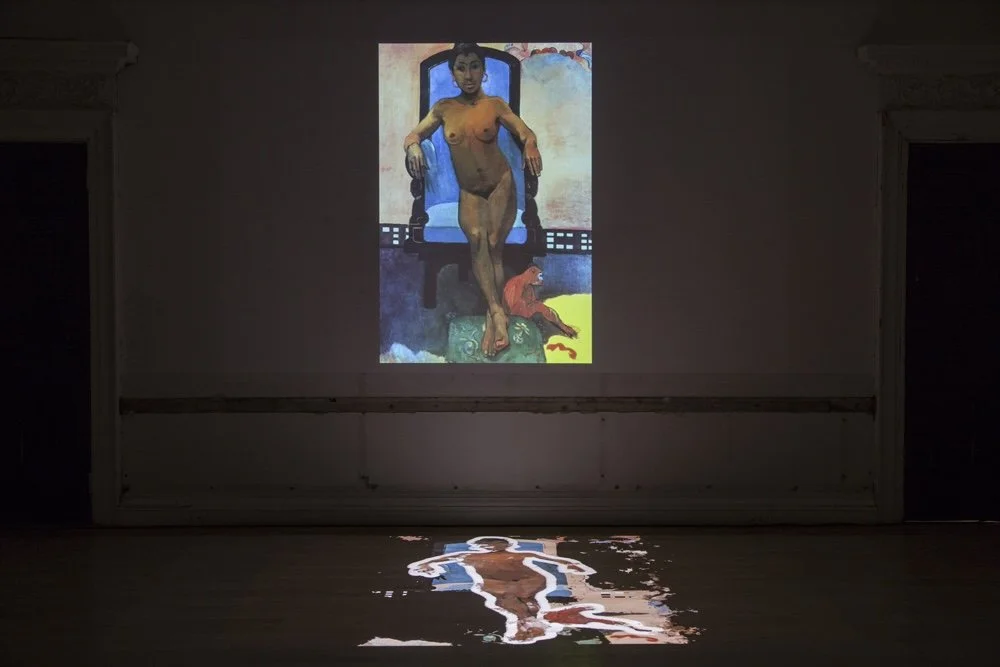
Khairani Barokka, Annah: Nomenclature. Still photograph from performance & installation, Institute of Contemporary Arts (ICA), London, 2018.
Image description: Wall projection of the painting Annah la Javanaise by Paul Gauguin, juxtaposed with a floor projection by Barokka. Photo: Christa Holka.
JR: I’d love to begin with ancestors. Annah(s) is an ancestor, and calls forward their own to rekindle their senses and ways of knowing, protective energy, and connection across great distances. Who else would you like to call in, who else is banging down the door, who has been an ancestral co-writer with you during your journey with Annah, Infinite?
KB: Hello dear Jhani...I’ve been dealing with a lot of health stuff today, but I thought I would have a go at answering the questions. And will probably do one voice note clip per set of questions.
My entire journey with the Annah(s) has been a calling in, without necessarily knowing to whom. Although for certain, my late grandmothers, especially my Javanese grandmother who kept a photo in her room—until she passed—of her and her schoolmates when they were at the age of around thirteen, because I believe, she was the very first generation of native women allowed to go to secondary school. And it was very important for her to have that cohort, and that was very meaningful for me to see that—to see friendship and learning and togetherness as Javanese girlhood. And I think of that photo as being in direct contrast to Paul Gauguin’s so-called depiction of Javanese girlhood and childhoods. And I think in terms of calling in, then, it’s also the other many, many Javanese women and children and people who have their art and their lives snuffed out by Western-backed genocide. And also not just Javanese people, but people of many other Indonesian and global south cultures. And then also people in living souls who are here in the present. I was trying to call them in somehow so that I could survive being in intense emergency for pretty much a decade, during which I was writing this book as a way to try and live and be with people, despite despite despite. And it was an escape. One of the first sentences of the book is “This is an escape story.” And I want it to be an escape for as many people as possible in terms of understanding that blueprints for escape have been laid everywhere by our ancestors, and also to help us find each other as we try to escape this world of traps, and to go into a world of ease and subterfuge and generativity and abundance.
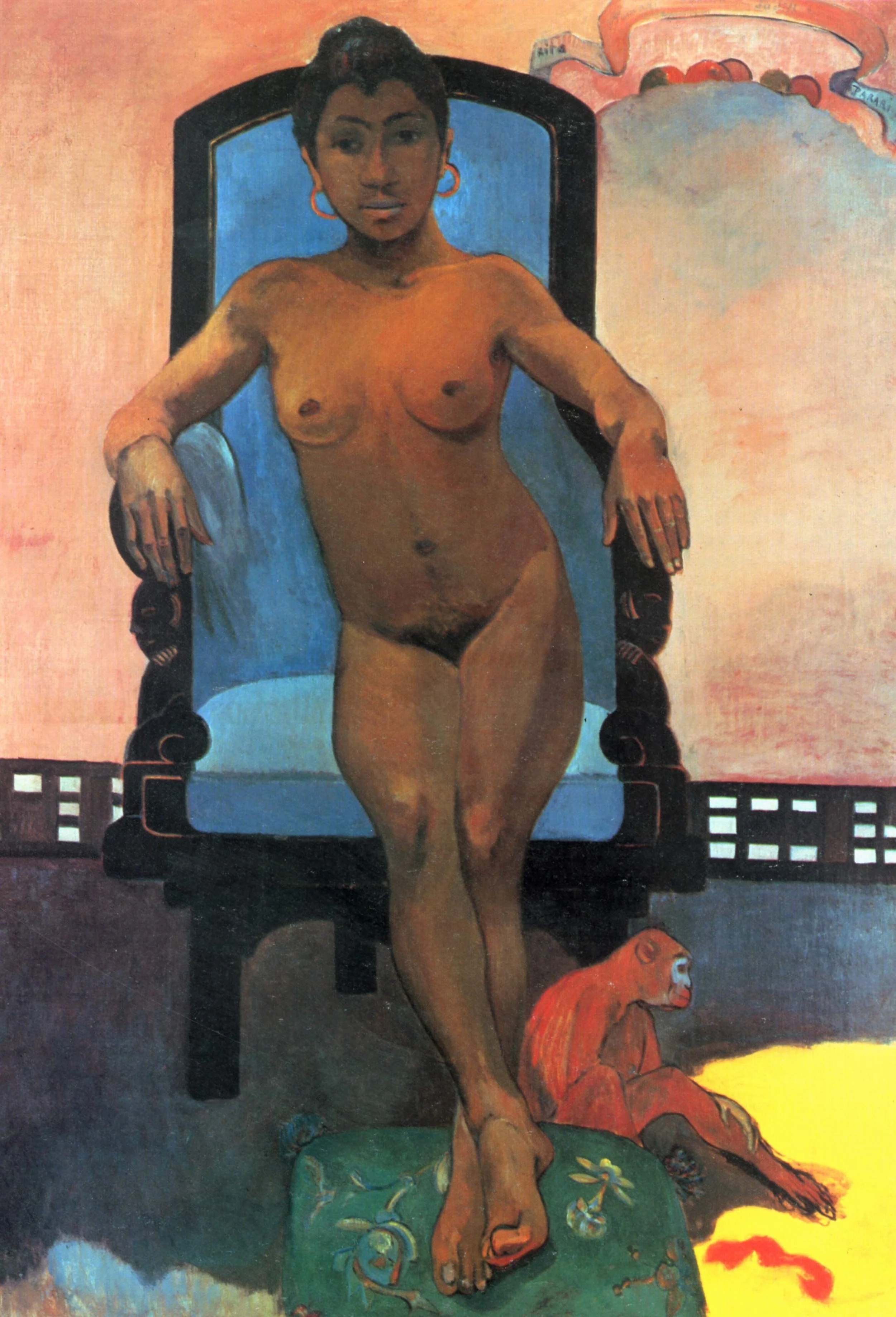
Paul Gauguin (1848-1903), Aita tamari vahine Judith te parari (Annah the Javanese, or the Child-woman Judith is Not Yet Breached), 1893-94. Oil on canvas, 45.6 x 31.8 inches. Private collection, Winterthur, Switzerland.
Image description: Portrait of a nude Tahitian woman seated in a blue upholstered chair with a small orange monkey at her feet. Her arms rest casually on the arms of the chair as she gazes directly at the viewer. Her ankles are crossed, her feet resting on a green cushion on the floor. Painted in warm, vibrant earth tones.
JR: The narrator of Annah, Infinite—who is Okka and sometimes not Okka, and then again sometimes somewhere someone in-between––shares with readers:
“I wrote and researched this book in scraps of time, jagged runs of compulsion,
non-linear, non-continual. For writing about Annah is a fundamental revisitation of
such gargantuan scales of trauma, and by gargantuan, I mean so all-pervasive that
it invades your very mitochondria; by overwhelmingly large, I also mean minute,
subatomic.”
This to me feels definitive of what we mean when we say, “crip time.” It feels so
very resonant to me, as a worker and artist who identifies as living with invisible
disabilities.
What/how else is crip time? What does crip time ask of us? What does crip time offer us?
KB: I never want to be prescriptive or determine with any kind of precision the bounties that crip time can offer any of us. I think that is the glory of it, and it is specific to our own individual situations of life, in terms of what it asks of us and how else it manifests, and the kinds of succor it can give us. I want to note also that I recently performed alongside the poet Ren Liu who is another disabled poet based in the States, who is from California I believe. And they said that they no longer use the word “crip” because of how it is racialized in the context of police violence and state violence for Black people in California. And so, I’m thinking also about how the word crip itself is a very North American term that is useful to a lot of people, but I understand that’s not necessarily a term that everyone wants to use.
So I can use “disabled time,” I can use “ancestral time,” I can use “bodymind time,” or “soulbody time”—jiwa raga time—and I believe that it is the timescale of ourselves working in concert to make sure we are alive, and us leaning into that. I believe it is time that is not focused on the ticking of a clock as much as on feeling and connecting, experiencing and thinking through life outside of strictures of Western timescales. The minute, the hour, the day, the year, q1, q2 [laughs]—and how very very difficult it is not to be beholden to Western capitalist time in order to survive. It is a realization that all of us go through or are experiencing, and I think crip time—or disabled time—offers us a sense of opposition that is meaningful, and that is grounded, and that is rooted in the experiential. And one that offers possibility, specifically the possibility of relief, of escape. And perhaps ideally, a form of community.
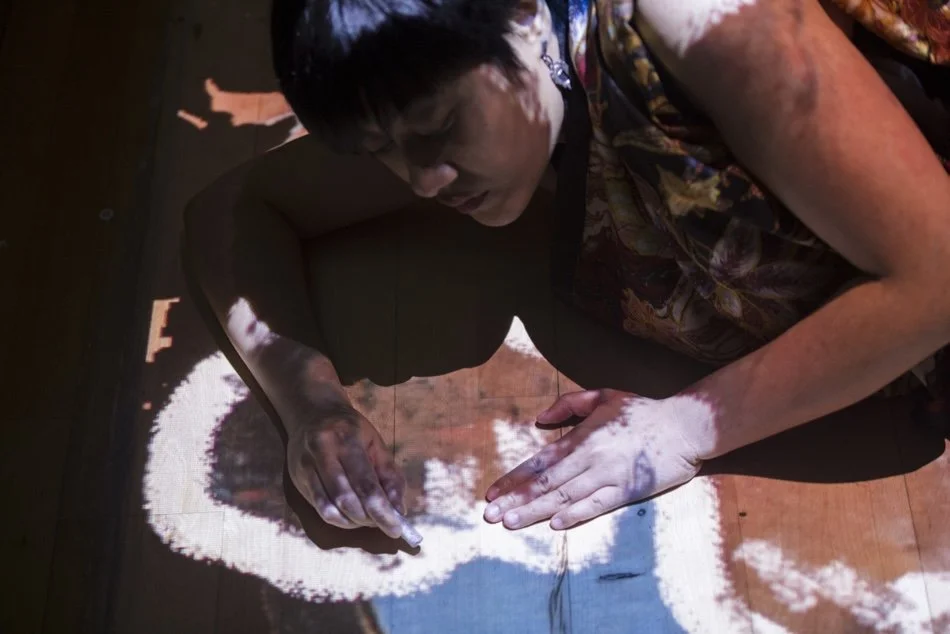
Khairani Barokka, Annah: Nomenclature. Still photograph from performance & installation, Institute of Contemporary Arts (ICA), London, 2018.
Image description: Barokka is shown on the floor, performing while inscribing the outline of a figure in white chalk. Photo: Christa Holka.
JR: Annah, Infinite is an epic and intimate text of historical reclamation and community building across temporalities, beyond time (the Western linear and capitalist construct of time), beyond even the “infinite”—you’ve spoken and written about how this works in ways that I love. For example, you’ve shared that certain/your Indonesian cosmologies of time cannot be translated into the English language, given that in Indonesian, Malay, and hundreds upon hundreds of indigenous languages, there is not a time tense:
“And so when I say saya hidup, I live, it’s also, I lived…I will live. And when I say
Annah hidup, it means Annah lives, Annah will live, Annah lived.” You’ve shared
that these linguistic constructs, which are fundamental to how you perceive the
world as an artist who identifies as disabled, are also “the wisdom of the
ancestors.”
This reminds me of Alexis Pauline Gumbs’ passage in M Archive:
“soon she was shaped like a ghost. had it always been so?…
or
wherever she was there was space and ancestors came through.” (80)
It also reminds me of what Jennifer Nash has argued to be one of Black feminist theory’s greatest interventions, that is the insistence on a “palimpsestic conception of time” (17). Could you speak to the relationship between intimacy and time? I’d love to hear you speak more on any of the ideas above, whatever direction you’d like to take them in.
KB: So Alexis Pauline Gumbs is a huge influence, and someone whose writings and feeling I deeply deeply admire, so thank you for quoting them. And also Jennifer Nash. We learn from and are so indebted to Black feminist theory and Black feminist writing. And of course, Annah was described as quote-unquote “a little negro girl” in the account by Gauguin’s associate of how Annah(s) potentially came to be in Paris. In that Madame Nina Pack asked for “a little negro girl” quote-unquote. And that of course is a very tragically fruitful way into solidarities between Black and Asian bodies, especially femme bodyminds.
So the relationship between intimacy and time is, I think: giving time a true intimacy is also a rebuttal to the impersonal, the corporatized, to the institutionalization of time. I think imbuing time with an intimate hue in our bodyminds, imbuing time with gratitude and purpose and a sense of being one of a gigantic collective of people of the global south, or of your specific community, is resistance. And I believe taking time for intimacy is resistance. Understanding that the time we have on earth must include time spent delving into intimacies with ourselves, with our loved ones, with seeking out loved ones, with seeking out collectivity—is all resistance. And I believe that is further facilitated by being deeply in tune with the sensorial of not hating one’s bodymind [laugh and inhale], but really acknowledging what it feels and being as gentle and as kind as possible to it. When you are immersed in that depth of feeling of intimacy with self and other, time feels elastic. Time feels expansive. Time feels full of possibility. And time feels like rest. And within that rest, we can imagine how people who came before us and people who came after us will also hopefully experience their own versions of rest and gathering and true self-love that we should hold onto as our true anchor of the temporal. Which again is very very difficult to do when survival is bound us in divorcing ourselves from embodied time and space.
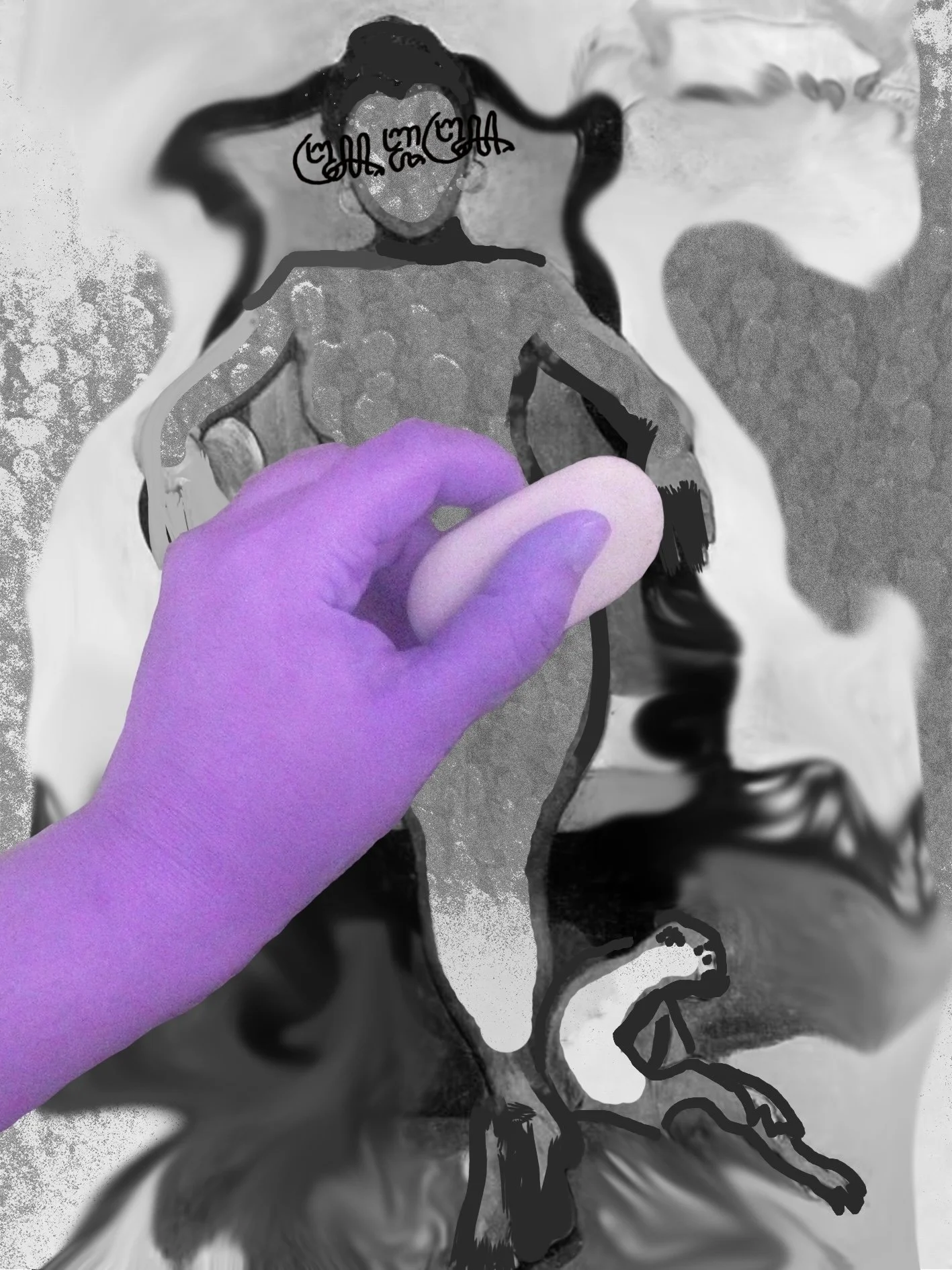
Khairani Barokka, Annah #67, Greyscale. Digital image, part of the performance installation Annah: Nomenclature, Institute of Contemporary Arts (ICA), London, 2018.
Image description: A large, purple hand holds an eraser to a black-and-white abstract outline of a female body seated on a chair with a monkey at her feet. Purwapada in Javanese script (the traditional symbol-cluster used to mark the beginning of a poem or song) covers the face of the figure against a textured black-and-white background. Courtesy of the artist.
JR: In your conversation with Dr. Anandi Rao at SOAS, you read from page 54 in Annah, Infinite, a poem “about measure and pain:”
“Is it squares on a board you were born into that began with spices and trading
ships, and men in peaked headgear who terrorized your ancestors' chickens, and
worse? So much worse, you feel the sickening of history like a plague in all your
parts? And this came from my friend in school, miss, caught it from him, hysterical
disease. Are you saying colonialism didn't give you the flu, or are you just trying to
get him into detention?”
Could you say more about measure here, and its relationship to pain? The threads in these passages weave together other relationships and themes of measure/scale that I’d love to hear you speak more on, if any of these topics stir something for you:
(the relationship between) euphemism, hyperbole, and humor;
(the relationships between) mapping and illness;
(the relationship between) educational institutions and “exotic” trade
(the relationships between) isolation and colonialism;
(the relationships between) mapping and crip time;
(the relationship between) time travel and carework;
(the relationship between) crip time and captions;
KB: Thank you for bringing up that poem which is entitled “Sliding Scale,” and is a poem that I wrote circa 2011–12, and is very meaningful to me because it was the first instance of art I can recall where I was trying to convey what it felt like inside my bodymind and that it was an emergency, and to come out in a way that connected how I felt the echoes of intergenerational violence within this as well, and all of that stuff. [The poem] ended up being part of the show that first brought me to the UK, at Edinburgh Fringe in 2014, entitled “Eve and Mary are Having Coffee,” in which I performed the show in various countries as a one-woman show that was hearing-impaired accessible, about how I was being disbelieved. Throughout the course of the one-hour show I paint the parts of my body that have nerve damage blue, but it was easier for me to get funding to tour a show internationally about not being believed than it was for me to actually be believed [laughs], and to get emergency healthcare. So there’s a lot in there that is related to this poem and why it is something I still enjoy performing.
And the poem begins with a question that I think many of us have been asked, which is, “What is it, on a scale of 1 to 10?” And it is often used to measure a so-called pain-scale. But one person’s 3 may be another person’s 7, etcetera, and why are we trying to quantify something that is deeply fundamentally immeasurable? And that has led to a lot of suffering for people who are pained, especially chronically pained, I think. But those are the tools that we are given, that we have. And so it is a way to kind of—the poem is the answer I would Ideally give to that question.
And so you asked really perceptively and beautifully how the threads in the poem “Sliding Scale” weave together, in your words, “other relationships and themes of measure/scale.” And you wanted to know if those topics stirred something for me. So I am going to do a rapid-fire response to these:
(the relationship between) euphemism, hyperbole, and humor;
I think so many of us who are pained and have been pained have been accused of hyperbole, and actually what another person might think of as bombast, such as intergenerational trauma and pain pathways, for instance, is just sometimes a matter of them being too numb to understand or feel it. Humor I think is really—people still say sometimes that my work confuses them because I’m in pain but I use humor. It’s like well, I don’t know if [laughs] you’re aware that a lot of people use humor as a way to deal with painful topics. A lot of standup comics do this, a lot of acting does this, a lot of screenwriting and writing for the stage does this. I think we should reserve to retain our own definitions of what constitutes hyperbole if we are pained people, and how we choose to employ humor.
(the relationships between) mapping and illness;
The relationships between mapping and illness—you know, I mean, I think that the Western colonial medical industrial complex is inherently tied up with the project of colonial expansion and the mapping of colonial bodyminds and subjects, alongside mapping the land that those bodyminds are in relationship with. It’s shocking to me how many people still don’t understand that a lot of what we know about people who are assigned female at birth, about our anatomies, comes from experiments on slaves. This is not a controversial statement at all, this is fact. And yet so many people, especially women in the Western world, are unaware of this. And it certainly took me until adulthood to know about it, you know, because it is not taught to us.
(the relationship between) educational institutions and “exotic” trade;
Ooh, I love that you pinpointed this. I think with the current gutting of educational institutions particularly with departments of arts and humanities in Western countries, international students are seen as kind of institutions’ cash-cows. But also institutions in the UK and elsewhere have been propped up by money derived from slavery and colonialism and an interpretation, and crude translation, of many things that are so-called “exotic.”
(the relationships between) isolation and colonialism;
Colonialism is an isolating project. And in times of extreme physical and emotional discomfort, it can be so tempting to divorce ourselves from even our own bodyminds. And so hopefully everything in Annah, Infinite is a counter to that.
(the relationships between) mapping and crip time;
I love all these pairings that you’ve come up with. I think they’re so incisive and attuned and understanding. So, I think that a lot of what we know of as contemporary capitalism was only able to come to pass because of the work of Southeast Asian translators who were translating and mapping under duress under the Dutch East Indies Company, which is the first proto-corporation. And part of that mapping process came alongside the universalization quote-unquote, or the globalization, of Western time-scales and time-keeping techniques, and calendars, and clocks, in order to facilitate the exchanges that would be smoothed along by this mapping. And crip time is a refusal of that. I think in an age where AI can manipulate maps, and so much of AI translation and AI data-sets are about capture, I think crip time is sort of a refusal of that capture. [A refusal of] that attempt for untrustworthy entities to map our selves, our bodyminds, and our lands, as previously mentioned in my response to your pairing of mapping and illness. So knowing and expressing ourselves becomes a form of countermapping.
(the relationship between) time travel and carework;
I think that holistic care for a population or a community involves understanding the ways in which ancestral wisdoms can save us. And different understandings of time and traveling throughout time can save us, and an understanding that we’re not the first people to experience something ever. And that we, sadly, probably, won’t be the last. But then how do we have a continuity of care in the sense of frameworks for survival?
(the relationship between) crip time and captions;
I love this, thank you. I deliberately make weird caption books. So amuk and Annah, Infinite are both captions. And both are translations because captions are a form of translation, a form of intermedial translation. And I refuse the understanding that captions can only be what even fits inside a social media alt-text bracket, right? I want to play with elasticity and space, in terms of how long we give for captions and how long it takes for us to formulate captions, and to allow us to formulate captions in our own time.
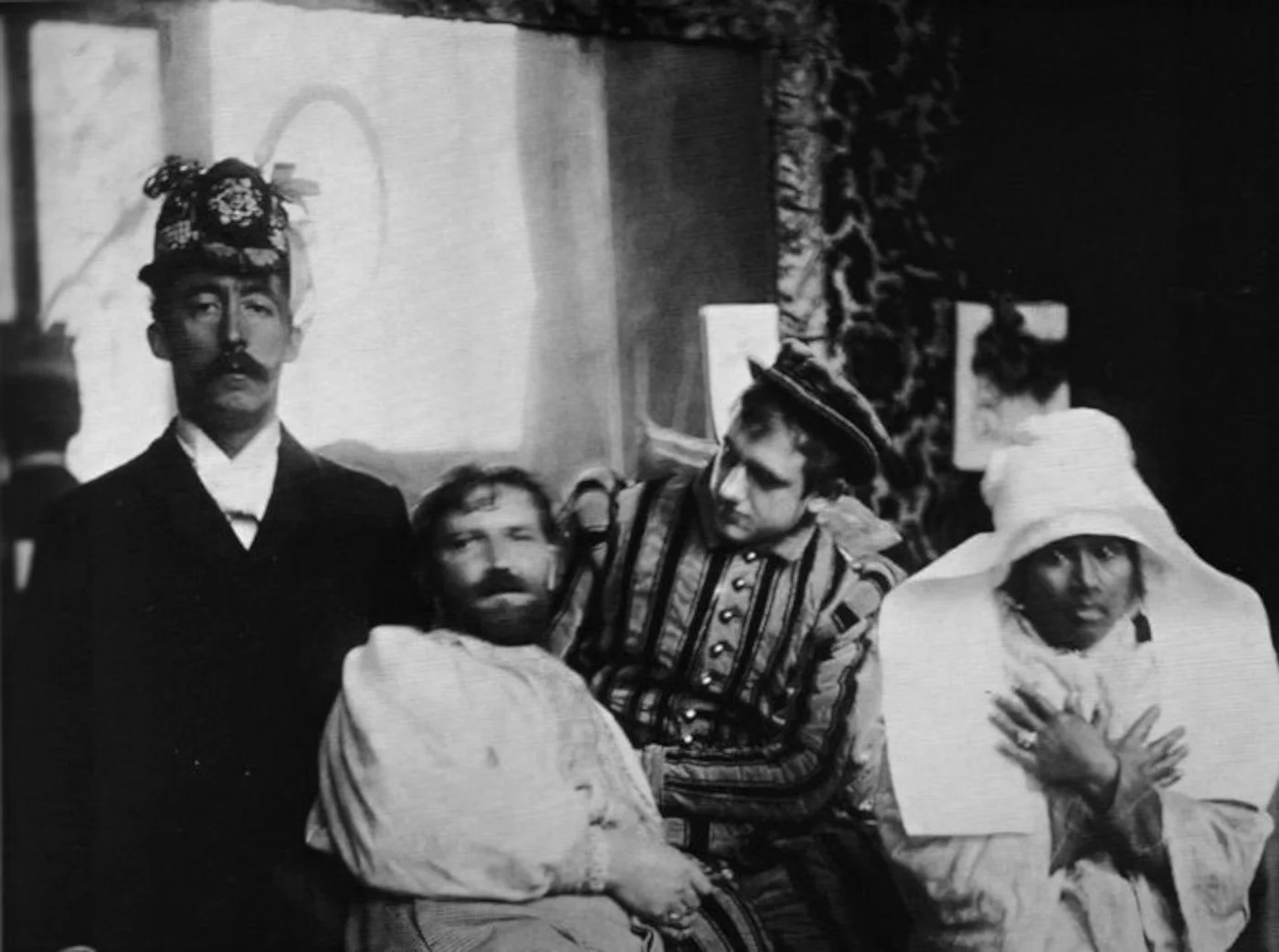
Alphonse Mucha (1860–1939), Mucha with his friends in the studio, rue de la Grande Chaumière, Paris, c.1893-1894. Photograph, public domain (source: Wikimedia Commons).
Image description: Black-and-white photograph of studio interior with group in costume. L to R: Paul Gauguin in an ornately festooned helmet; Alfonse Mucha in a billowing white smock; Luděk Marold in a striped jacket; and Annah la Javanese in traditional Breton costume with a large white coiffe bigoudène (bonnet), her hands crossed on her chest, her expression exaggerated as in a performance.
JR: What, if anything, has shifted for you since the book’s publication? What is next for Annah, Infinite? What is next for you?
KB: Since the book’s publication, I have really come to understand the beauty of writing a book that was never intended to be marketed or publicized on the typical publishing timelines. I mean it when I say I hope people read the book in their own time, and respond to it in their own time. And I genuinely feel like I’ll be promoting this book for the rest of my life. And so, you know, I’m happy to receive—like more than happy, always overjoyed to hear from people for whom the book has resonated—from booksellers telling me about readers for whom this book has resonated—and I think it also has given me time for rest. Because it’s the first time in almost fourteen years that I haven’t been working on—I have ideas for next projects—but this is the first time I haven’t been working on such a huge project or a named book project, and so I think it’s given me time to think about “Who am I?” without working on [laughs] Infinite. And what and who are my true supporters and collaborators and community members who understand what the book is about and what it took. And I just hope that more and more people will continue to discover it, and continue to respond to it, and that it helps them in some way on their own journey.
And I think I’m grateful that I’ve been given the opportunity to stick with something so long and to have it save me and save my life, and then help usher me into this relatively very new stage in my life in which I’m not just surviving but trying to thrive as well, creatively, in community, in terms of my health and wellbeing. And just, it’s also given me the chance to look back and think about the ways in which I was forced to participate in artistic community in conditions of duress, discomfort, and distress, and how I refuse to do that any longer. At all. A true joy and benefit of growing older. I want to continue to explore notions around environmental justice and disability justice that are brought up in Annah, Infinite, which is probably going to be the next book project through a very specific lens in particular. But really it’s about creating out of joy, rather than fear; and creating not out of the burning need to escape, but from a position of restedness and that is something new that Annah, Infinite has given me, alongside being able to part of other peoples’ lives in some small way. And to hopefully do justice to the spirits of the Annah(s).
[...] Thank you so much again. [...]
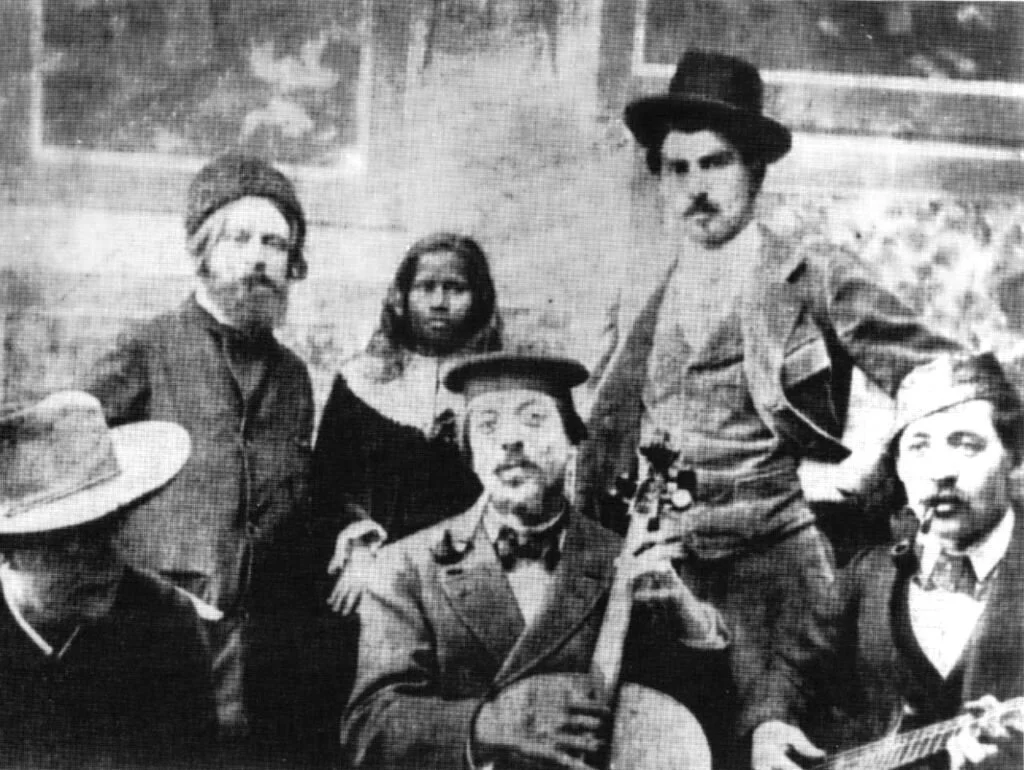
Paul Gauguin (1848-1903), Gauguin’s Studio at 6 rue Vercingétorix. Photograph, public domain. Collection of Te Fare Iamanaha Museum, Tahiti.
Image description: Black-and-white photograph of studio interior. Front row seated: unknown man in in white hat (left); Swedish cellist Fritz Schnedklud playing cello and smoking a long pipe (center); musician Larrivel with guitar, smoking a short pipe (right). Back row standing: bearded painter Paul Sérusier in a toque (left); Annah la Javanaise in black dress with broad white collar, her hair worn down, her expression intense (center); painter Georges Lacombe in a vest, jacket, and brimmed hat, hands on waist (right).
Works Cited
Barokka, Khairani. Annah, Infinite. Tilted Axis Press, 2025.
Gumbs, Alexis Pauline. M Archive. Duke University Press, 2018.
Nash, Jennifer. How We Write Now. Duke University Press, 2024.
Ward, Larry. America’s Racial Karma. Parallax Press, 2020.
Jhani Randhawa is an interdisciplinary teaching artist, editor, and cultural programming facilitator whose research, performance, and video work have been presented around the world. A contributing co-editor of Beautiful Zameen: Jagdeep Raina in the Green Revolution Archive (PS Guelph, 2026), Jhani’s debut poetry collection Time Regime (Gaudy Boy, 2022) won the 2023 California Book Award. They received their M.A. from SOAS, University of London.
Khairani Barokka (b. 1985) is a writer and artist from Jakarta, based in London, whose work centres disability justice as anticolonial praxis. She has been a UNFPA Indonesian Young Leader Driving Social Change, Associate Artist at the UK’s National Centre for Writing, Editor of Modern Poetry in Translation, an Artforum Must-See, and a shortlistee for the 2023 Asian Women of Achievement Awards. Okka’s most recent exhibition was 2025’s Kerokan Pol, four short films shot in Jakarta, on sick-disabled intimacies. Her latest books are 2021’s Ultimatum Orangutan (shortlisted for the Barbellion Prize); 2024’s amuk (longlisted for the Jhalak Poetry Prize); and her 2025 prose debut, Annah, Infinite, an Expert Pick in the Bookseller.
For Suspect’s ‘Crip Time’ themed folio, an excerpt of Jhani Randhawa interviewing Khairani Barokka on her speculative nonfiction book Annah, Infinite.