
#YISHREADS November 2026
By Ng Yi-Sheng / @yishkabob
In line with SUSPECT’s special CRIP TIME portfolio, this column covers works about disability, authored by disabled writers from Asia and the diaspora. Consider it a cool little reading list for the International Day of Persons with Disabilities, which approaches on 3 December!
Curating this list wasn’t easy. So much of critical writing about disability comes from the developed Western world, rather than our own continent. Furthermore, I was determined to include works beyond the world of non-fiction—as Alice Wong wryly comments in Year of the Tiger, disabled writers appear only allowed to do memoirs rather than romance or crime thrillers—only to realise that many disabled writers of fiction, like Ovidia Yu or Jane Vejjajiva, don’t actually write much about disability.
Ultimately, I decided to break my informal rule about including multiple works from the same country: after reading the essays in the Singaporean collection Not Without Us, I grew curious about the work of pioneer Singaporean activist for the blind, Ron Chandran-Dudley, and knew I had to dig my copy of his memoir out of my TBR pile. It’s to my regret, however, that I haven’t featured any works centred on mental disability or neurodivergence—I read Naoki Higashida’s The Reason I Jump, but felt I couldn’t bring a critical perspective to the writings of a literal child. (Danielle Lim’s The Sound of SCH, a memoir of schizophrenia, is on my reading list.)
My final selections include works of poetry, fiction, memoir and social commentary from Singapore, China, Japan and the USA. Drop a comment if you know of further titles I ought to explore—this is my first disability-themed column, but it doesn’t have to be my last!
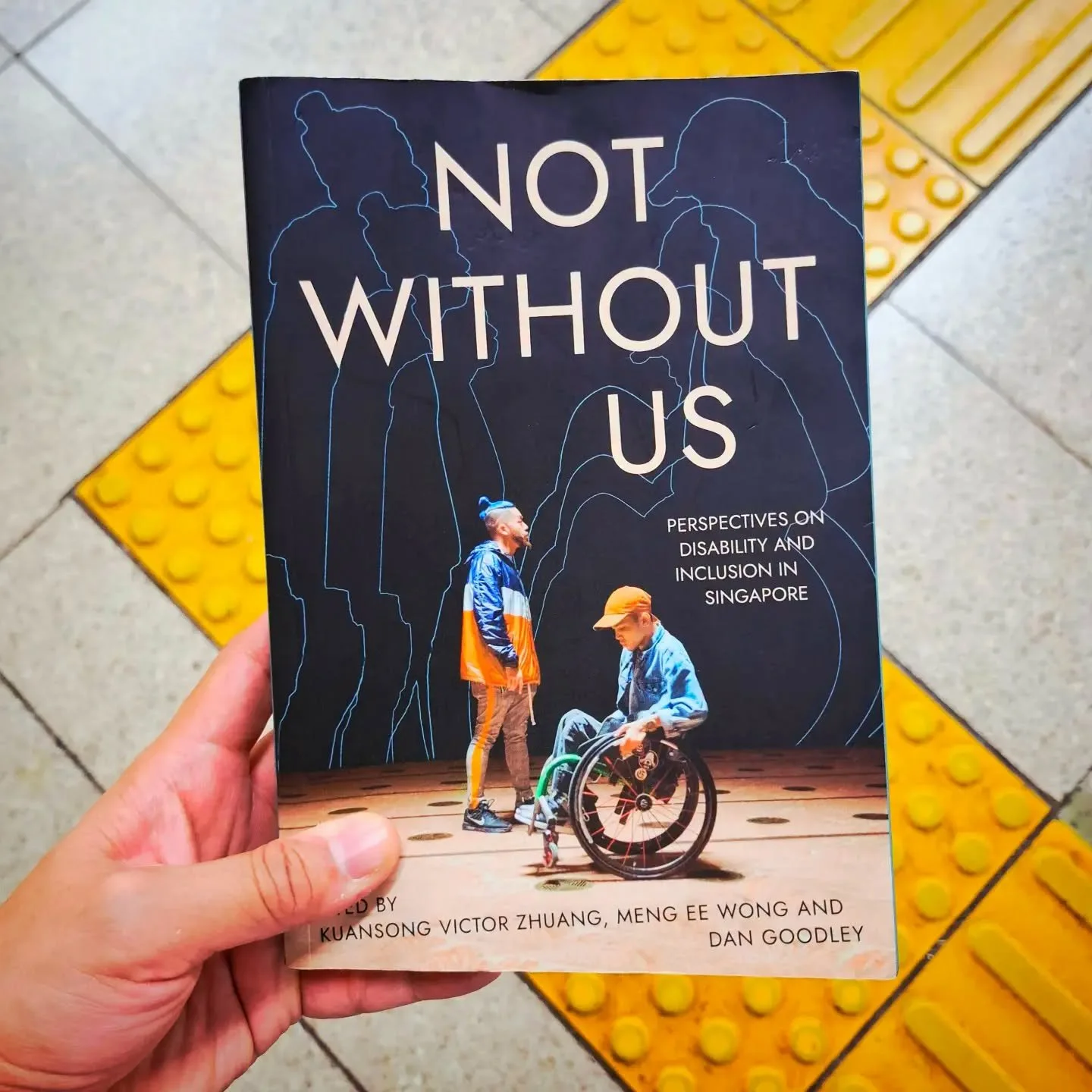
Not Without Us: Perspectives on Disability and Inclusion in Singapore, eds. Kuansong Victor Zhuang, Meng Ee Wong and Dan Goodley
Ethos Books, 2023
I remember the buzz around this 2023 essay collection, perhaps the most comprehensive work about critical disability studies in the country. The Singapore Writers Festival actually had a panel to celebrate it before it was even off the presses!
As it turns out, however, these twenty essays are kinda tonally discordant—some are emotionally charged insider perspectives, others academic pieces, though a handful strike a good balance of both—I thoroughly recommend Sherry “Elisa” Toh’s “Virtual Progress: A Disabled Journalist’s Thoughts on the Video Games Industry” and Nurul Fadiah Johar’'s “A Manifesto for Change: Challenging Psychiatric Authoritarianism” (which actually takes on institutional racism in Singaporean psychiatry!).
What’s consistent, however, is a frustration with Singapore’s much-vaunted system of meritocracy, which ends up marginalising and entrenching discrimination against the disabled—even though it’s sometimes hijacked in the form of cripnationalism, i.e. arguing that without inclusion, we’re wasting valuable contributors to the workforce. Also, more subtly, the fact that we'’e got a conformist culture, coupled with a lack of education on disability, which manifests in bullying and intolerance (Bella Choo’s “Being thick-skinned is the only way to survive” positions public disapproval as the main obstacle to mothers bringing autistic kids outdoors). And the fact that we actually do have a disabled history, as explored in Timothy Y Loh’s “The ‘Right’ Way to Sign”, which traces Singapore Sign Language and deaf education, plus the recurring mentions of the legacy of blind activist Ron Chandran-Dudley and others. (I’m rather impressed by Aaron KH Ho’s “He’s not normal: Representations of Disabilities on Singapore Television”—he watched a whole lot of obscure Mediacorp to trace both good and bad rep!)
What’s a little curious to me is how the editors are clearly intent on exploring the world of disability in the arts—there’s all these essays about disabled theatre and media—yet feature only one patently literary essay: poet Cat Chong's “—I'm writing my way out—and this is a place of refuge—: A Poetics of Illness and Disability”, which illuminates both the agony of chronic pain and the limitations of a Singaporean academic and legal system for accommodating this, especially during Covid lockdown, when it was written. Also feel like there’s a tension between the inclusion of extremely unimpressive artworks, when essayists are urging us not to infantilise the disabled. (Mind you, I’ve done plenty of affirmative action as an editor myself.)
Final shout-out to Daryl WJ Yang’s “Realising a Radical Suggestion: Disability Rights and Self-Representation in Singapore”, because it confronts the fact that disability activism here is so weak partially because the government's made it clear that human rights-based activism isn’t welcome—even a mention of the Disabled People’s Association moving away from a recommendation in a report because of the controversy over the execution of intellectually disabled convict Nagaenthran K. Dharmalingam. It’s all bloody connected, isn't it?
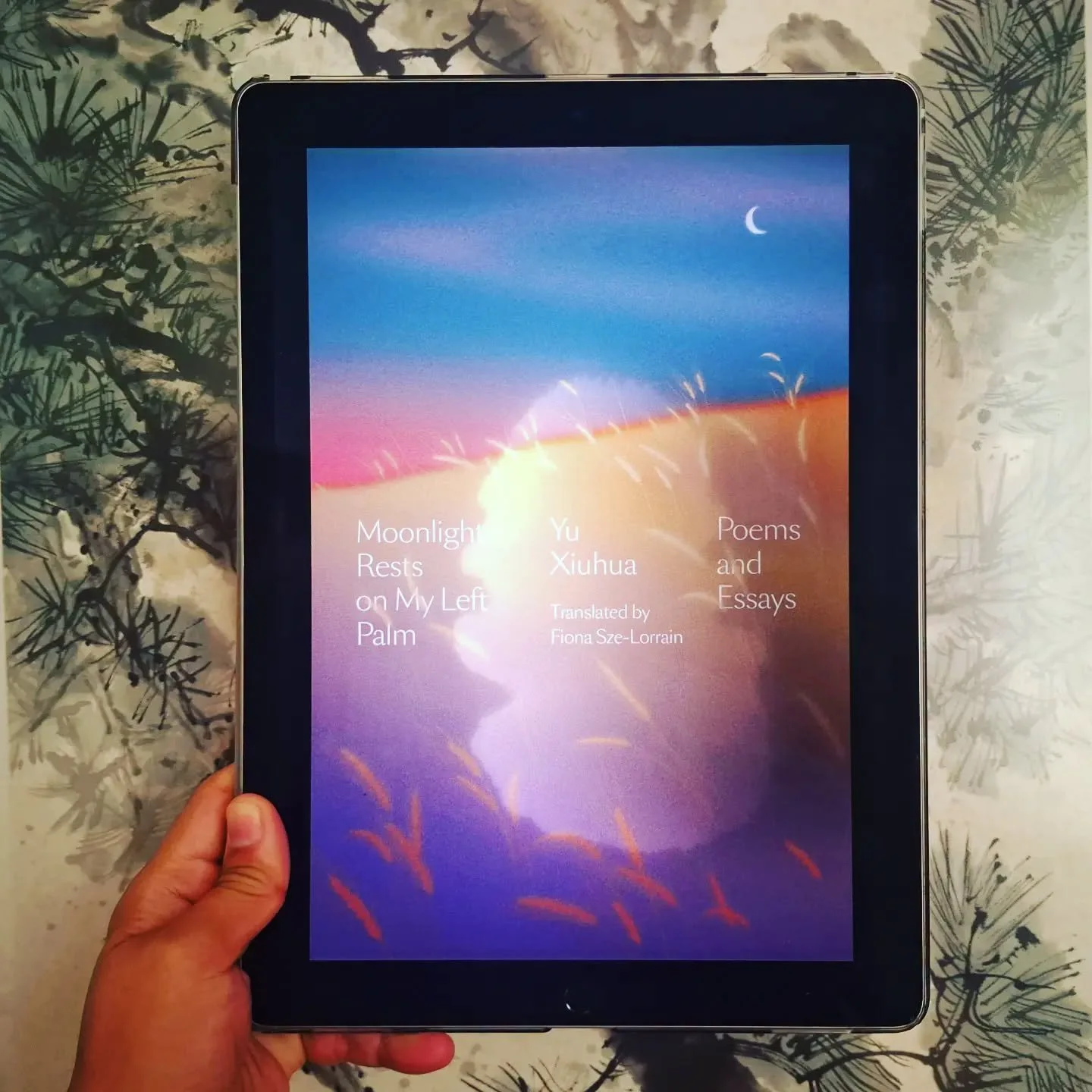
Moonlight Rests on My Left Palm, by Yu Xiuhua
Translated by Fiona Sze-Lorrain
Astra House, 2021
Yu’s disability, cerebral palsy, isn’t actually the focus of this book, but it does inform her writing. Prevented from going to university or pursuing a career, she’s lived her whole life in the farming village of Hengdian in Hubei, enduring an arranged marriage (which doesn’t seem to have ended well) and worrying about her aging parents and grandma. This lack of mobility explains her fixation on rural life and nature in her poems—not from the idyllic perspective of a city slicker, but from an insider’s POV, who understands that the beauty of changing seasons comes with brutal work and squalor. Yet it’s also bred a searing sense of longing for love, which is why she went megaviral in 2014 with a poem titled “Crossing Half of China to Fuck You”.
Throughout the work, we get that sense of loneliness and frustrated desire (her lover, she says, is imaginary), and also a good deal about family, e.g. the essay “Bright Full Moon, Towering Tree Shadows”, reflecting on her grandma’s last years of dementia and strange conversion to Christianity (she’d hoped it would cure Yu’s disability, but became a believer cos it cured a toothache). She also reflects on the ironies of a poet’s life, e.g. “My Crazy Love Feels More Like Despair” and “I Live to Reject Lofty Words”, which also challenges the idea that she’s a role model, an inspiration in any way.
Yet she’s also consistently ambiguous, refusing to directly politicise herself—I find myself hunting for opinions in her poems’ throwaway lines and images—while also being clearly a voice of protest, of hunger, of longing for liberty—quite different from the more overtly politicised crip lit I’m reading as part of this project. These verses feel less like polished polemic than fragments from a disintegrated manuscript, fleeting and enigmatic... but they also feel all the more precious for it.
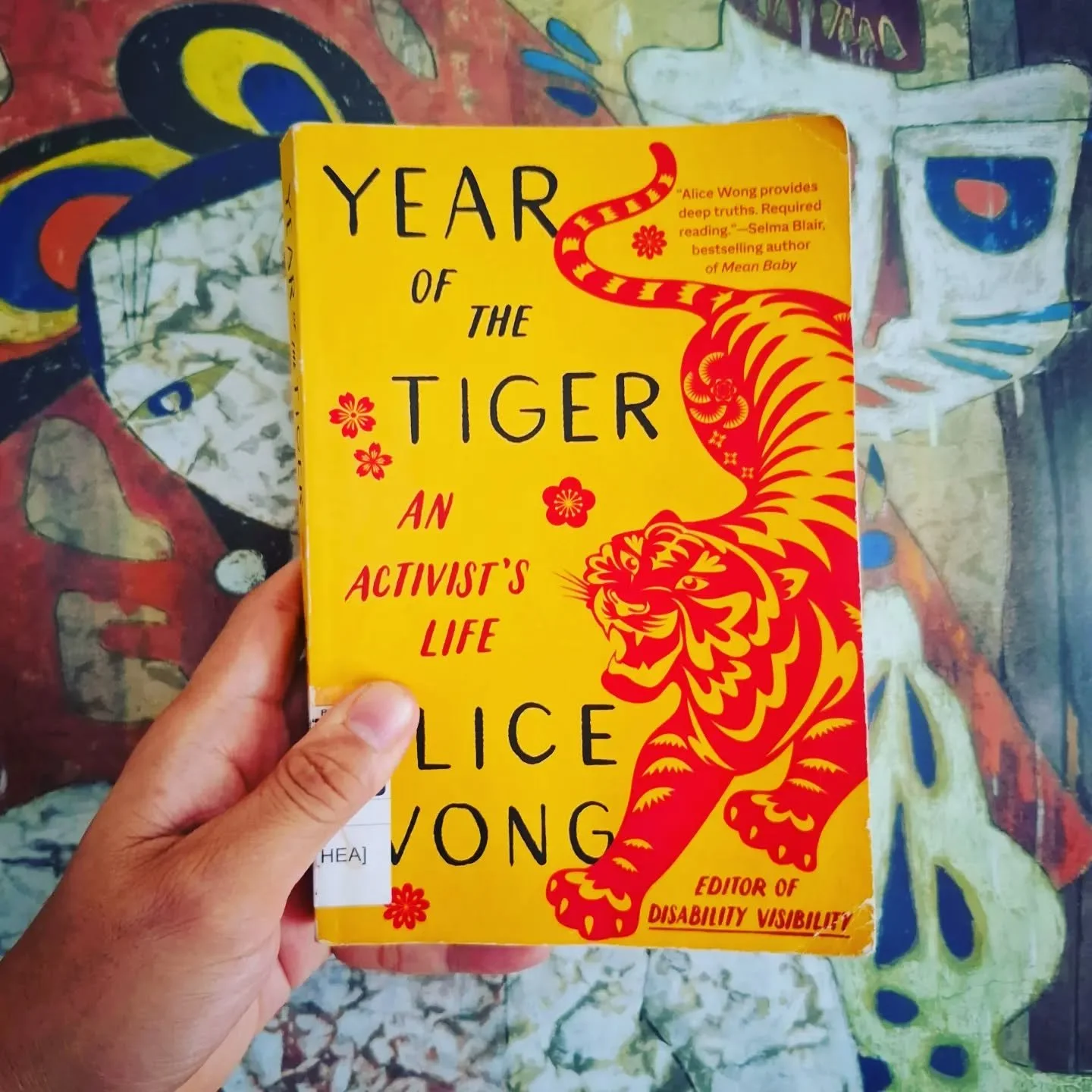
Year of the Tiger: An Activist's Life, by Alice Wong
Vintage Books, 2022
Time for our token American! This is one of those books that gets consistently promoted when you search for books on disability, possibly because it’s recent, and because the author only just passed away, on 14 November 2025.
What’s under-publicised is how fun the book is. It’s structured almost like a scrapbook, including drawings, recipes, photos, tweets, transcripts from radio and podcasts, even a crossword puzzle. The author draws heavily on pop culture and nerd culture—she takes pride in her status as a mutant (the cause of her muscular dystrophy) and a cyborg (her BiPAP machine and other tech devices as an extension of her body), discusses disabled rep in action films like Denzel Washington’s The Bone Collector and imagines crip sci-fi futures for herself (living to the age of 96 and moving to a zero-G capsule on the moon).
The contents, however, come from a real place of rage and injustice. She talks about how she had to drop out of university due to cutbacks on Medicaid, the way she was treated as expendable during the Covid pandemic (not only was she deprioritised for vaccines after Governor Gavin Newsom said only seniors would get first dibs, but policies said doctors had the right to take her ventilator to give it to someone with a better chance), as well as all the small failures of educators and family and the public she’s had to live with (being bussed to school before sunrise because the shortbus was needed elsewhere; being denied the chance to take a second class of drama because the teacher said there was no way she could do the mime segment).
I was initially going to add pain to the list of motivations, because that figures significantly in her biography: gradually losing motor control over the course of childhood, the agony of her teenage spinal surgery and its complications, the sheer difficulty of breathing as an adult. But on reflection, this isn’t a testimony of grief (though it does contain an in memoriam for a fellow activist); it’s a celebration of agency. Over and over, she talks about the possibility and history of disabled people making change, from her uni days appealing for accessible elevators to her #CriptheVote campaign. She refuses pity and demands dignity instead, and she rejects disgust, celebrating her spit cup (useful for clearing her throat) and her habit of chewing delicious foods which she can’t swallow.
Some caveats, though. Despite Wong claiming she’s going to resist tired Asian American tropes in this book, she does go on a little long about her Shandong-Hong Kong heritage and Chinese New Year dumplings and Mandarin classes... though she bucks stereotypes by having a very positive relationship with her parents, understanding that they did their best for her as new immigrants. Also, the scrapbook nature of the book (i.e. how it compiles previously published essays) means there’s a bunch of repetition of anecdotes. And for fellow Gen-Xers, it’s also a little sobering to realise that though she was of our generation, she was already considered an elder activist. May we lead lives as legendary!
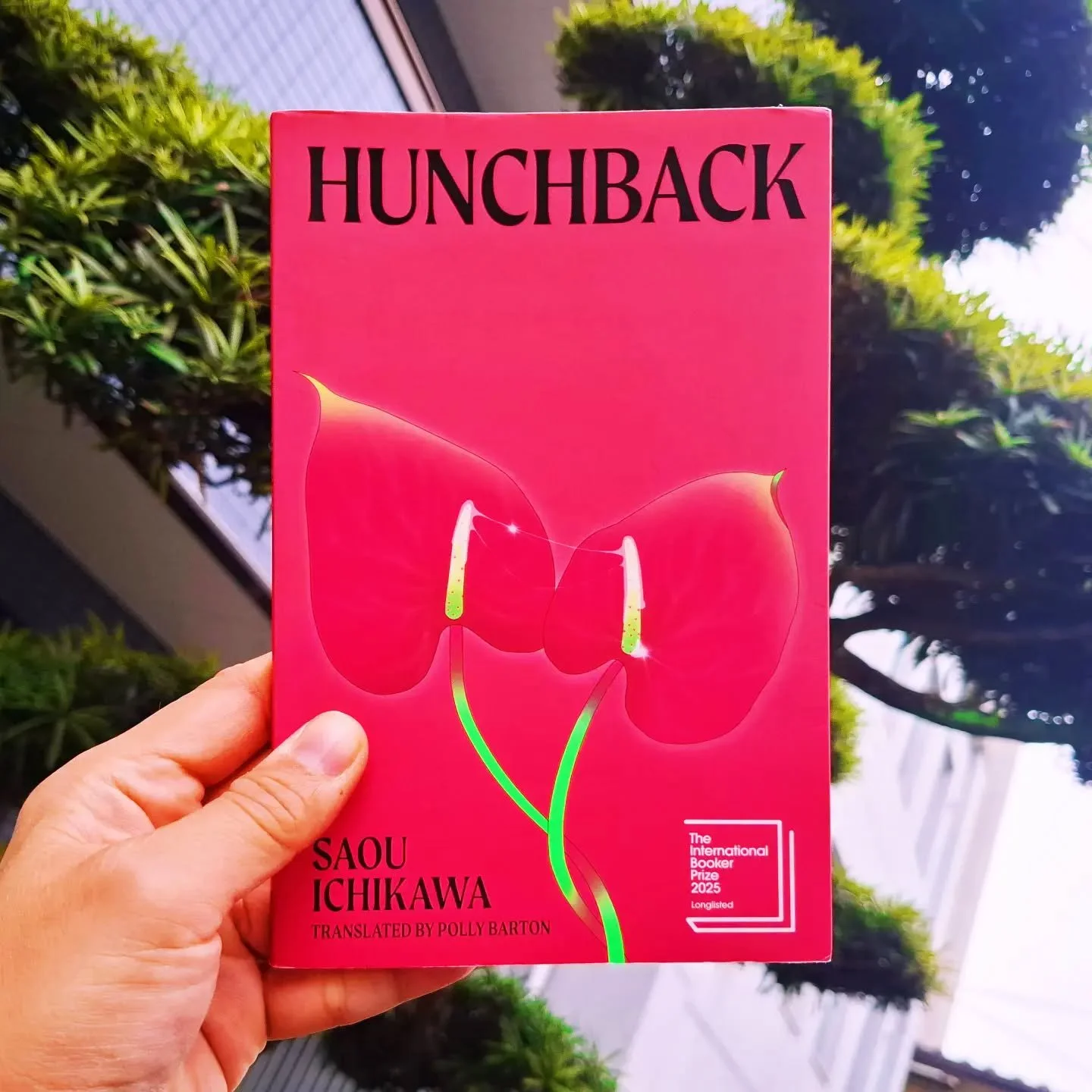
Hunchback, by Saou Ichikawa
Translated by Polly Barton
Viking, 2025
An award-winning novella about a woman with a severe spinal disability, confined to a care home in the midst of Covid, yet living a raunchy life of the mind as a professional erotica writer and tweeting about how she longs to get knocked up and have an abortion... plus, actually acting on this desire once a male care worker reveals he knows about her double life.
It’s fascinating to read this after Year of the Tiger, because there’s a whole bunch of parallels between her experience and that of the protagonist Shaka (whom I believe is pretty demographically similar to the author herself). Both have severe mobility issues that go beyond wheelchairs; both have respiratory conditions that require the use of ventilators (Shaka actually has a tracheosotomy, which becomes a plot point during the blowjob scene); both are also sensitive to the politics and economics of disability, though Shaka’s actually super-privileged and aware of it, outright owning the care home she lives in and having money to throw around to charities and on her indecent proposal. Oh, and both are also funny: Shaka imagines over-the-top stories about college girls with E-cups in swinger clubs and imagines covering her lover’s dick with nori, to make it look like censorship bars in porn.
While a lot of the hype around this book is based on minority representation and shock value, I’ve also gotta note that Ichikawa is writing genuine literature, using her protagonist’s wandering mind to explore disconnected themes (e.g. the anti-semitism of Wagner, the Japanese feminists who threw red paint on the Mona Lisa) and delivering a conclusion that both accentuates the class dynamics and blurs the line between fictive realities. Really cool, and really freaky.
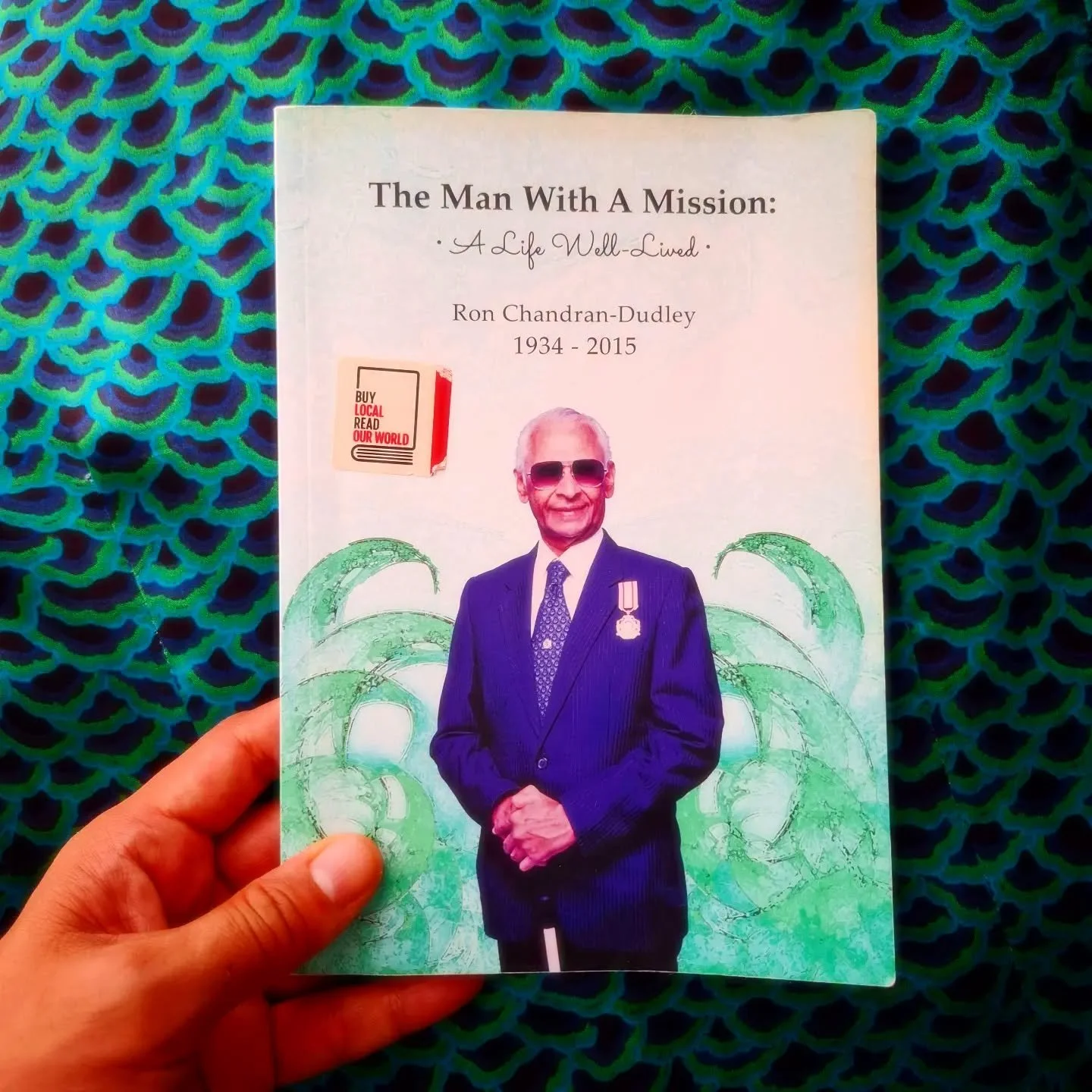
The Man With A Mission: A Life Well-Lived, by Ron Chandran-Dudley
Pagesetters, 2017
Let’s close things off with a memoir authored by one of Singapore’s greatest disability activists... sort of. You see, Ron Chandran-Dudley only wrote half of it before he passed away in 2015, leaving his widow Rena to complete it, which means that most of the chapters which are actually about activism (the juiciest bits of the book, IMHO) aren’t by him at all.
The prose, alas, is nothing special—I’d kind of expected it to be, given that Ron’s got other texts to his name: a collection of retold folktales, a 1955 play called The Reminder and a 1972 play called Trace the Rainbow Through the Rain. The early chapters about growing up on Race Course Road in a middle-class Jaffna Tamil family and lying low under the Japanese Occupation are interesting enough, but unremarkable in the corpus of local autobiographies.
What’s rather more interesting is his account of the onset of his blindness in 1951: not only because of how it dashes his dreams of becoming a neurosurgeon but also because of how this plays out in Singapore in the midst of the Merdeka era. He ends up flying to the UK for treatment, attempting to look fashionable in his winter clothes but shocked by the bitter cold, and when efforts to save his sight fail, ends up clashing with British administrators who think the best job he can do is physiotherapy, gets furious when he hears beggars are being cleared from the Sri Lankan streets so they won’t offend the visiting Queen Elizabeth, pisses off Lee Kuan Yew at a London talk on merger with Malaysia (Lee later apologises cos he didn’t realise he was blind; Ron says no thanks; he wants to talk about politics, not blindness) and agitates for the Singapore Association of the Blind to be run by the blind themselves.
Basically, Ron intends for us to understand his disability activism in the context of decolonisation. Rena extends this in her continuation of her story: how she (a Polish Jew, and thus a fellow outsider) met and married him during his studies in London, how they attended Ban the Bomb protests in the UK and worked with traumatised Vietnam War veterans in the USA, and how he had to be screened by the government as a Socialist upon returning to Singapore. He even advocates for more disabled people to participate in Singapore politics! (Sadly, Rena doesn't write from her own perspective, and the little personal info she reveals indicates that adapting to life here was very hard for her.)
Then there’s the fact that Ron was elected the first Chairperson of Disabled People's International (DPI) in 1981. I’ll confess that when I read about this in Not Without Us, I figured it was Third World tokenism. Not so: he was involved in international activism from the seventies onwards, co-founded DPI, and headed the eight-month effort to having the first Congress in Singapore that year, choosing the Hyatt as the most accessible hotel, then fitting it with Braille touchpads and even flying in an iron lung machine from Australia. Incredibly, this marked the first official diplomatic visit from the People's Republic of China to Singapore. (Cute moment when Taiwan’s delegates decided to leave, went to Ron’s room and discovered his nine-year-old daughter was fluent in Mandarin.)
So while I do think this biography could’ve been written better (and there’s plenty of archives available for another writer to work with), I’m also left with this frustration over how Ron is such an obscure figure in Singapore history, when he should be praised as an inspirational national hero like Elizabeth Choy. Ah, but I suppose the powers that be aren’t that interested in inspiring kids to be activists!
Ng Yi-Sheng (he/him) is a Singaporean writer, researcher and LGBT+ activist. His books include the short story collection Lion City and the poetry collection last boy (both winners of the Singapore Literature Prize), the non-fiction work SQ21: Singapore Queers in the 21st Century, the spoken word collection Loud Poems for a Very Obliging Audience, and the performance lecture compilation Black Waters, Pink Sands. He recently edited A Mosque in the Jungle: Classic Ghost Stories by Othman Wok and EXHALE: an Anthology of Queer Singapore Voices. Check out his website at ngyisheng.com.
We close off our CRIP TIME portfolio with the first disability-themed #YISHREADS column—read Ng Yi-Sheng’s selections of the month here.