A Half-Gold Mongoose
By Jeyamohan
Interviewers often ask me: why do I write?. Generally, writers don’t know the exact answer, which is why they are always eager to respond, often finding new answers each time. Sometimes I answer boldly, "To structure Tamil culture!" and add, with a hint of confusion, "and to demolish it immediately...."
Being an heir to a great fortune is not an easy thing to deal with. Our destiny is defined forever, our present is confined by traditional customs and rules, and our past makes us feel small everywhere. For this reason, writing in Tamil is both a blessing and a curse. We have a classical language with a glorious history spanning three thousand years and more than four distinct layers. We can read two-thousand-year-old epics in our language, and we possess a rich collection of vocabulary and metaphors. Additionally, we have unique classical forms of art, such as architecture, sculpture, dance, and music, to support us. There are three unique schools of philosophy that emerged in our land: Advaita, Vishishtadvaita, and Shaiva Siddhanta. Great indeed!
But our modern works are always compared to the classics of the past, and the reading habits of contemporary Tamil society are bound to traditional literature, resisting any new aesthetics and visions. We can only worship tradition without doing anything new—as the anthem of the Tamil Nadu government narrates it, “spellbound by its magnificence”—and of course secretly cursing, "Magnificence, my foot".
Anyway, we have to redefine our culture according to modern ethics and philosophy; it is the mission of modern literature. But Tamil society usually considers it blasphemy or useless, petty talk. Modern Tamil literature has very few readers—less than a thousand. This makes modern Tamil writers practically invisible, given that the global Tamil population exceeds one hundred million. Only the writers know that we exist.
Yet we write and publish modern literature in little magazines with circulation never more than two hundred copies. We are never honored by any institution. We write with great passion and engage in discussions with a vigor typically found only in small groups of minorities. We have created excellent literature and thus proved that readers are not necessary for creating real art (and they could be a burden too). The pioneers of modern Tamil writing took inspiration from American little magazines like Partisan Review and Encounter. Their models were European and American modernist writers who expressed their strong dissent through writing.
Modern Tamil literature deals with the major question that every indigenous culture, like Tamil, faces throughout the world: ‘the inheritance.' I used to refer it with a pun: 'To inherit or not—that is the question.'
The dichotomy in modern Tamil writing emerged from its very inception. C. Subramanya Bharati, our preeminent poet of the modern era, passionately embraced European ideals of democracy and equality, yet he retained a strong commitment to tradition. As a Romanticist, he envisioned an enlightened period for India that would harmoniously blend the democratic influences of the West with the enlightened traditions of the East. He identified himself as both a disciple of Shelley and a worshipper of the Tamil poet Kamban.
But Pudumaipithan, the pioneer of modern Tamil prose fiction, was totally against Bharati. He was an early modernist; he dismissed the Indian tradition completely through his bitter satire and direct criticism. He evaluated Indian or Tamil tradition as sheer exploitation and foolish faiths and, at the same time, mocked the European tradition as war-mongering, lust-driven ‘motor culture.'
Sundara Ramasami, one of our masters, once categorized Tamil writers as belonging to either the Bharati tradition or the Pudumaipithan tradition. We cannot easily bifurcate our writers like that, but this classification is useful to understand our writers and the themes they deal with. Everyone has some element of Bharati and Pudumaipithan in their writing; the ratio is the scale to evaluate them.
In the last fifty years, modern Tamil writing has attempted every kind of fiction, including magic realism and metafiction. We have six generations of modern writers. Ku.Pa. Rajagopalan, Mauni, and Na. Pichamurthy were contemporaries of Pudumaiputhan. K. Azhagirisami, La. Sa. Ramamirtham, K.N. Subramanyam, and Chellappa belong to the second generation. T. Janakiraman, Jeyakanthan, Ki. Rajanarayanan, Indira Parthasarathy, Asokamitran, and Sundara Ramasami belong to the third generation. Nanjil Nadan, Vanna Dasan, and Gandharvan belong to the fourth generation, and my generation is the fifth one. We have a new young generation now.
The major challenge in Tamil writing lies in balancing the adoption of global ideological and aesthetic advancements with our tradition. This tradition is not monolithic; it encompasses both a Vedic tradition and a more influential anti-Vedic tradition, each with its own extensive history. Additionally, there are folk and tribal traditions that vary by region. India has experienced periods of cultural redundancy for over eight hundred years, resulting in numerous meaningless customs, inhumane practices, and outdated beliefs. However, this redundancy has also shielded traditions from the effects of time, enabling a significant amount of art and philosophy to persist. Particularly the archetypes and metaphors provided by the tradition are a priceless source of insight for any creative writer.
For an Indian writer, living within the Indian language and culture is like losing himself in a timeless dream. We love it but are impatient with it. We hate it but can’t abandon it. That is why we are always confused, and our works are always searching for something. We are different because we have an entirely new task to deal with.
If a particular piece of creative Indian fiction matches perfectly the taste of a Western reader, it is not originally Indian; it is manufactured for Western taste. If an Indian work is very easy to grasp for a Western reader, it is not a literary piece; it is a flat propaganda with predefined political and social ideas. In every genuine Indian work there is an element of Western aesthetics and values, which a Western reader easily connects with, but there will be an element that a Western reader finds odd. The Indian work could be overly emotional or rude, like tribal art. It could be outspoken and uncontrollable, like a folktale. It could be filled with "too much" cultural and sociological detail and nuances of expression, like an ancient classical epic. A Western reader may occasionally find it repulsive too. This twofold nature presents the major challenge in reading genuine Indian fiction, yet it also represents the true essence of Indian culture.
I would like to tell an allegory from the Mahabharata. After completing his grand Vedic sacrifice ceremony and feast, Yudhishtra sees a half-gold mongoose. The mongoose said that it had turned part of its body to gold by attending a simple meal given by a saint to a dying beggar, and it had come to Yudhishtra's palace hoping to convert the rest of its body, only to find that its hope was in vain. Hearing the mongoose, Yudhishtra realizes the meaningless vanity of being an emperor. One part of our culture and literature is gold, and the other is alive. I think this duality is the ideal form for creative fiction. The gold in a nugget is more precious than any artwork made up of pure gold because it has soil in it.
But presenting this strange idea to Western readers and Western-minded Indian readers who rule our institutions is not very easy. Always two kinds of fiction works are celebrated by the West and the Western-minded. Simple propaganda works containing political ideas influenced by the West, and works that imitate Western forms and styles. Most Western readers do not appreciate the works highly valued by Indians in their own land. Reading an original work needs extra attention and particular aesthetic training. The outside world fails to recognize our aesthetics, emotions, and visions. Even in India, the very essence of Indian writing is still largely unknown.
This is why we are trying to present ourselves as ourselves in the heart of the Western world through our Living Tamil Literature Festival, which we are holding in New York City on April 3 and 4, 2026. This could be a naive attempt, but we feel this is the right thing to do. We are presenting ourselves to Western readers and the children of the Tamil diaspora without any intermediation or institutional support.
We know that commercial factors and power centers control the cultural scene today, leading to a global decline in the importance of serious literature. I don’t know who is going to be patient and studious enough to listen to a different writing from a distant third-world country, but I believe in the secret power of literature. Our voice may be odd, but someone will always listen and connect with the soul of it.
Editor’s Note: Check out the website (https://livingtamillitfest.org/) of Living Tamil Literature Festival. It will be held in New York City, on April 3 and 4, 2026.
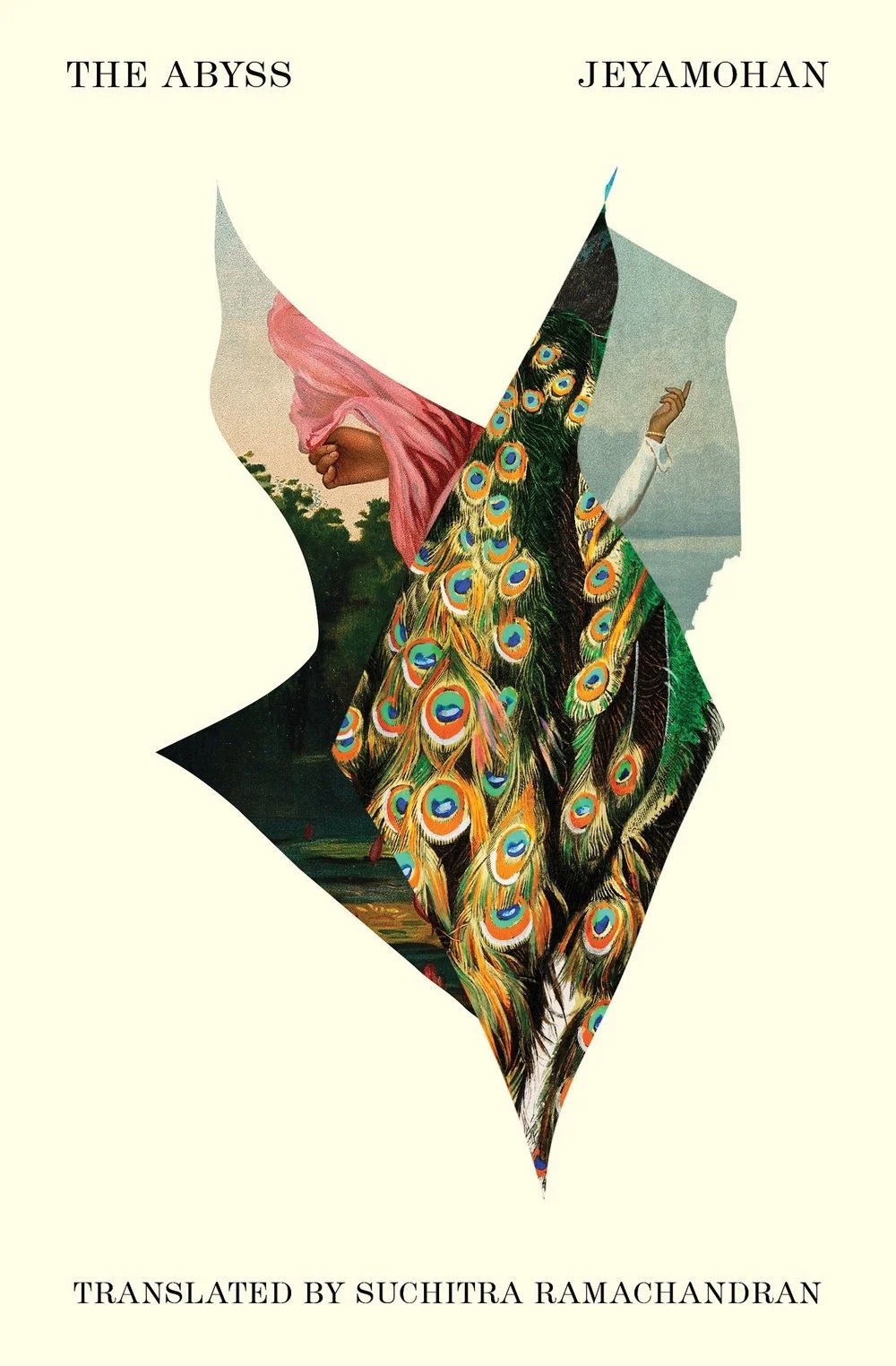
Jeyamohan lives in the southernmost part of India, near Kanyakumari. He is the author of nearly 350 books, including novels, short story collections, literary criticism, and works on Indian philosophy. He is also the author of one of the longest novels in the world, Venmurasu, a modern reinterpretation of the Mahabharata. His works of fiction that have been translated into English include Stories of the True, The Abyss, The Daughter of Kumari, A Fine Thread and Other Stories, and One Million Footsteps. Additionally, he has published a collection of autobiographical notes titled Of Men, Women, and Witches. The first two books were published in the USA. Jeyamohan has a global readership, and his readers' forum, the Vishnupuram Literary Circle named after his famous novel, organizes festivals and literary seminars worldwide.
“Last names come first in Japanese, you racist piece of—” a brawl, a funeral, and a stolen father in a short story by Jay Lindstrom.