
Visitation Day: The Cork Street Odyssey
By Celestine Woo
As a teen, I sat in far more living rooms belonging to strangers than to people I knew. Once a year, our church would hold a Visitation Day, during which we called upon Chinese families across Orange County, California and invited them to check out our church.
I would volunteer because:
a. I felt pressured and guilt-tripped into doing so;
b. Some of my friends would do it too;
c. It got me out of the house and away from my parents on a Saturday, which was always a positive thing.
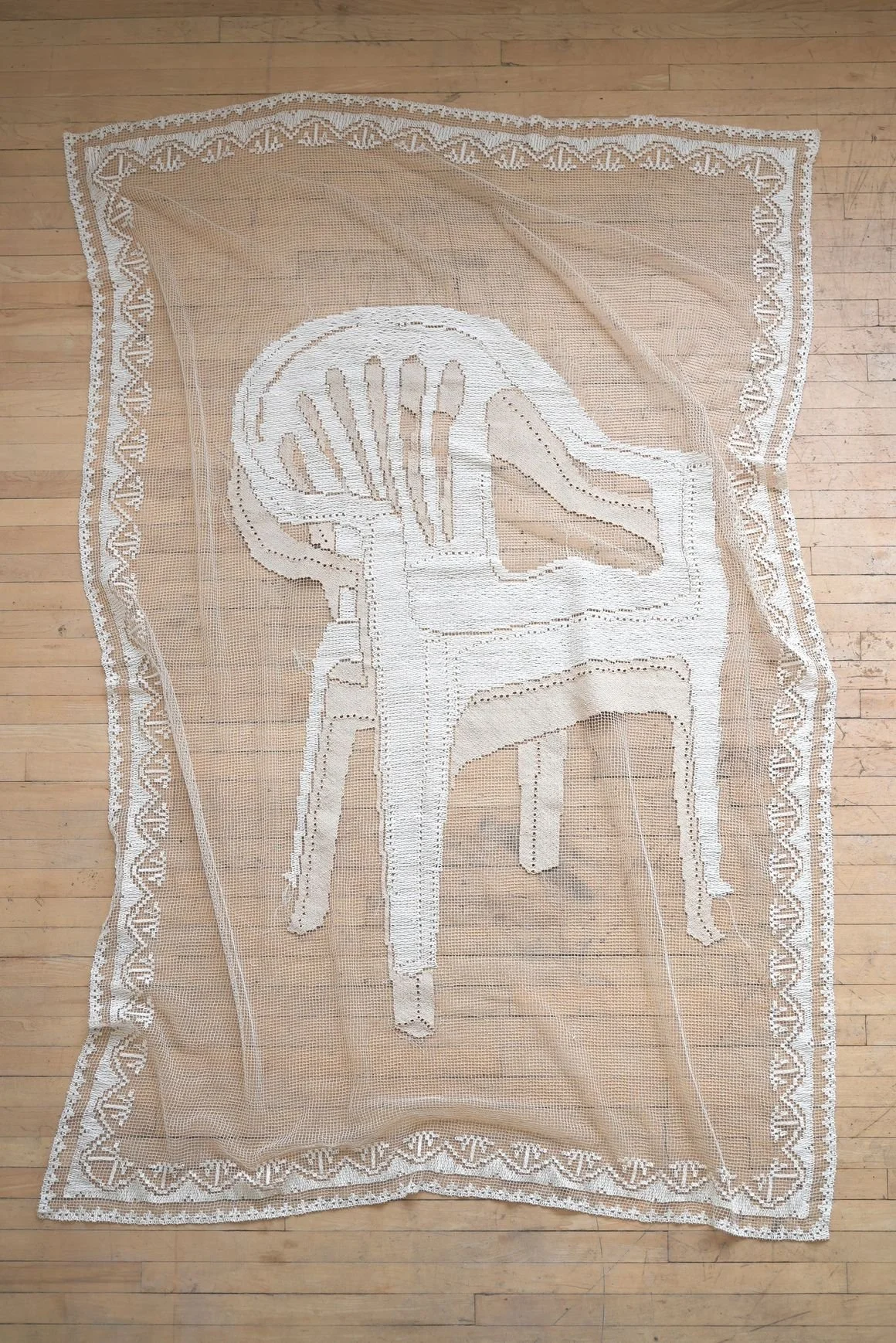
Jingyi Li, Lean on Me, Lean on Me 01 / 两相依 01, 2025. Filet lace in cotton thread,190x120cm.
Image description: Image of a plastic bucket chair rendered in white lace surrounded by an intricate border.
The organizers were always thrilled when we “AOKers” (short for our youth group, Alpha Omega Koinonia) would agree to go, since as teenagers, we were walking advertisements that our church had kids of various ages and corresponding activities, a major draw.
When the designated Saturday rolled around each year, the volunteers would arrive by 8:30 am. We’d be divided into groups of four ideally—two adults and two kids, if there were enough kids to go around (there often weren’t). Families we visited were far more likely to open the door to a pseudo-family. An effort was made to have some gender balance on each team, which meant that I would be stuck with either a boy or no other kid to talk to; I would never get assigned with my girl friends. They also tried to pair a Cantonese- and a Mandarin-speaking adult in each team.
Each team would appoint a navigator, who was given a folder with the list of addresses we were to call on, pen and paper for notes, pamphlets advertising our church, and a Thomas Guide. It was the 1980s, and everyone relied heavily on these beautiful inch-thick atlases; they were spiral-bound with flexible yet sturdy plastic covers, and contained copious cross-references and indices. They were pricey, but if you didn’t own one yourself, it was easy enough to find someone who did. I assumed they were universal; when I grew up and moved away, I was aghast at the abysmal quality of the Hagstrom's atlases that I was reduced to using in New Jersey, with their sloppy lines, inaccurate or missing details, and labels in Comic Sans misaligned with the roads. I used to pray that the Thomas Guide company would open up franchises nationwide.
This is how Thomas Guides worked: let’s say you had to find Wilson Street in the city of Cypress. You would consult the index, discover that there were, say, five Wilson Streets, and choose the one in the correct city. It would refer you to the macro-view pages, where you could see the map of all of Cypress, and see that Wilson Street was in square B-3. You could then look at a more micro-view map—what we now do on Google Maps when we click the + sign or use our fingers to zoom in. You flipped back and forth between the broader and the more detailed maps to determine your travel path.
If you had a good team, working together to figure out directions and the most efficient path to hit all your assigned addresses was fun and could build camaraderie. Our church drew its members from all over Orange County, so chances were that all four team members resided in different cities and were familiar with a variety of geographic areas. I was always a bit nervous working with my team members, but the overall task was low-stakes and free of any moral imperative, so there was nothing I could get in trouble for. In fact, being one of the kids exempted me from responsibility! As someone accustomed to being blamed for everything, sitting back and letting the adults take charge and bear any heat took some getting used to. If there were awkward silences during the day, it didn’t matter, because we had a mission, we had boxes to check off, and by focusing on said mission and boxes, I could indulge in the luxury of rebuffing one too many attempts at getting to know me, from either the strangers we met or my fellow team members.
Here’s what typically would happen during our outings. Let’s say we were visiting the Huang family on Wilson Street. We would get to the house and let the Mandarin speaker, whom I’ll call Rebekah, do the talking, since Huang is a Mandarin name. The kids rarely had to say a word. Rebekah would explain to whoever opened the door that we were visiting from First Chinese Baptist Church, or FCBC. The Huangs would invite us in; the presence of teenagers usually helped. A wholly adult team sometimes didn’t get invited in, and if we’d had little kids, the families might not have wanted to deal with them, but teens were perfect: we were young and appealing enough to catch the interest and goodwill of the families, but old enough to behave properly.
We would all take off our shoes and have a seat in their living room, and Mrs. Huang would go make tea. Rebekah would give a brief spiel about our church, inquire if they had any kids, and discuss any appropriate kids’ programs. At this point, Mrs. Huang would return to serve us tea and snacks. Maybe those ubiquitous butter cookies that all Chinese families seemed obsessed with. If Mrs. Huang was one of those moms we’d encounter in our visits who would lament about the pernicious influence of American culture among our youth, Rebekah would respond with empathetic clucks and the gentle suggestion that FCBC’s teen fellowship group would be just the thing—after all, look at our well-adjusted, respectful teens right here today! In silence, I would grab a Norwegian cookie from the proffered platter, since those were the only ones not coated with sugar, and munch slowly as I peered about the room, curious how Chinese-y this family was.
It was fascinating to see inside other Chinese homes, to be welcomed into a familiar yet foreign space. At church, it wasn’t our habit to invite friends over. Virtually none of my friends got to see inside my house, nor I theirs. I appreciated these visits for the rare window they offered into the ordinary lives of other families. In non-Chinese homes, I expected things to look different from my own life, so souvenirs from Europe or Africa, cuckoo clocks, baseball posters, or other paraphernalia didn’t surprise me. But in Chinese homes, I could compare how Americanized they were with my own family. Were their dining table, lampshades, and sofas covered with plastic? Were all their knick-knacks made of jade, teak, and ivory, brought over or imported from China? I was especially intrigued by Buddhist homes, since both my parents were of the firm belief that anything reeking of Buddhism was satanic. If I spotted incense sticks in front of a photograph or a little Buddha figurine next to a plate of oranges, I would try to check them out without staring. Buddhist objects, like a family altar, were negative signs from our Visitation perspective: that meant the family was less inclined to come to our church. So the team leaders would remain friendly but hurry through their spiels, and then in the car, one of us would note down that they were Buddhists.
Sometimes we would meet families who attended another church. They might have bible verses framed on the wall or stitched on sofa pillows. We would smile at our shared faith, uttering a few Praise-the-Lords, although just how cozily the bonding went depended heavily upon which church they attended. We wouldn’t try to poach them, so our team leader would again shorten the spiel, maybe ask if they had comparable kids’ programs, and then we would politely bid them goodbye. In the car, I would find out what the adults really thought of that family’s church. “Presbyterian! They baptize babies!” someone might harrumph as they filled out the follow-up form.
We got our list of names from a variety of methods, all coded neatly on the chart. Several were found in the phone book by one of the myriad church committees scanning the pages for common Chinese surnames. Sometimes we got referrals, like when Mr. Chan recommended we visit his colleague Mr. Lee who lived in Fountain Valley. Some families had visited our church long ago but had never come back, so we would go to see how they were doing. With phone book finds, we never bothered explaining how we got their name. Nobody ever seemed surprised. With referrals, we would name-drop if that seemed helpful. I say “we,” but like I said, the kids never had to do a thing except look polite, sip tea, and eat butter cookies. No one ever bothered asking us what grade we were in, or what school we attended. It was enough to see Chinese teenagers spending a Saturday doing a church thing.
I was hugely embarrassed by the whole enterprise of inviting people to church, and thus, always felt sheepish at seeing how nice people were about it. It was an odd sort of culture clash: the American part of me kept bracing for folks to yell at us, kick us off their doorsteps, get offended, or rail against church or religious people. But it was ethnicity that bridged the gap: people were amused, surprised, curious, and even appreciative at being singled out for their Chinese-ness. Some even accepted our invitation, which never failed to stun me.
By the time I was 16, I had long since grown exasperated with church: everything had to be spiritualized, everything had a chapter-and-verse justification. The checklists were endless. Does dancing fulfill the principle of edification? No, therefore, it is sinful. Does listening to rock music, or attending football games, or having women in leadership fulfill the tenet of necessity for spiritual growth? Obviously not, huffed our male leaders, expecting us to nod and overlook the convenient selectiveness of their chosen examples. The version of Christianity we practiced was also culturally inflected, but no one ever acknowledged this. Anything American or Westernized, considered too pleasurable or hedonistic, was suspected of luring us ABC (American-Born Chinese) kids away from a proper sense of duty and humility toward the elder OBC (Overseas-Born Chinese) generation. Any misstep on our part was ascribed to our excessive Americanness: “You don’t feel like volunteering your Saturday to help clean the church, or repaint the sanctuary, or visit families who need to find Christ? You should honor your elders and be grateful for the chance to serve them. You kids. You spoiled Americans, with no appreciation of your culture.” My parents too shared a fondness for culture as a bugaboo: “How dare you talk back to us? How dare you look away when your mother is talking to you? So arrogant and ungrateful. No respect for your culture.”
Culture. This curse word and source of shame in my upbringing, was apparently a powerful lure for other families. For many years, it flummoxed me.
Occasionally, our efforts at cultural connection misfired. Once, my Visitation team were assigned the Huey family. We had a Huey family in church, and Huey is a reasonably common Chinese name, if not as well-known. So we were embarrassed when a white couple opened the door. They’d been a phone book pick—oops. The team leader apologetically explained that we intended to visit Chinese families, and did not mean to bother them—but Mr. Huey amiably chatted with us awhile, telling us that this was not the first time they’d gotten mail or a visit from someone who assumed they were Chinese. They were quite amused by it all, and gamely took our church flyer.
The most memorable Visitation Day I experienced was the year my team had to find a house on Cork Street. The team included a quiet bespectacled man named Jay Liang, a kind fluffy-haired woman named Henny Wong, and a teenage boy named Derek Chen. Our fake family that day–dad-figure, mom-figure, kids—would feel far closer to what I see as a functional, healthy family than mine ever did.
We mapped out our route to Cork Street, drove there, and were a bit perplexed. I will make up the house numbers to illustrate. Let’s say we needed house number 6371. We drove to Cork Street in the correct city, and the numbers only went up to 4819. We checked the printout, rechecked the street, scrutinized the map, and hypothesized typos or other errors. There was a way of locating the approximate numbers on a given block (they were printed in light italic type underneath a street name), so we checked those. Finally, Derek spotted another Cork Street, just a couple inches away on the map. It looked like a continuation of where we were. “Aha!” we smiled at each other. “The freeway interrupts this street, so they just called it Cork Street on either side of the overpass, and we’re on the wrong side. No problemo.” We rerouted and ended up on the opposite side.
But that second Cork only had house numbers up to 5311. We repeated the above steps, from perplexity through permutations to enlightenment: Henny spotted a third Cork Street a little ways away on the map. “I’ve got it,” Jay said. “The city planners took one straight line and named the whole thing Cork Street even though it gets interrupted by both the freeway and this park.” Feeling smug that we had figured it out, we proceeded to the third Cork.
The same thing happened. This Cork was tiny, only having half a dozen houses on either side of the block, and then dead-ending. By now we had gotten wise, so we looked much farther along the map, extrapolating the same line and exclaiming when we spotted three additional segments of Cork Street! There were six in all! We proceeded to the farthest one, only to discover that the house numbers here had five digits, not four. We had gone too far.
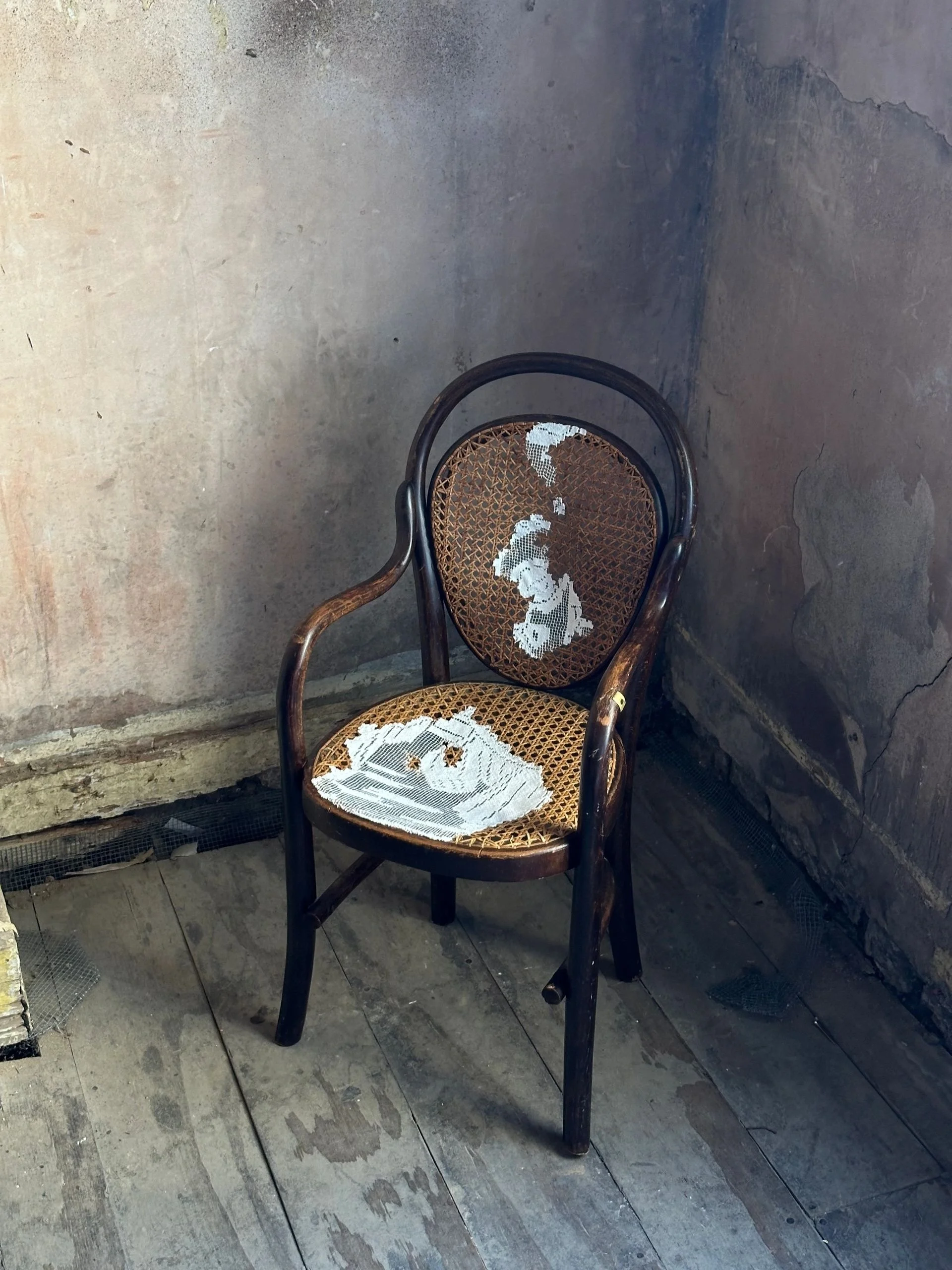
Jingyi Li, Obedient Objects - Chair, 2024. Handmade filet lace, vintage chair.
Image description: Classic wood and rattan cafe chair placed in a darkened corner with white lace piece-work draped on its back and seat.
We finally made it to the correct segment, and did our dog and pony show at the house. I have no memory of what happened next. For me, the best part of the whole experience was now over. We had bonded as a team, led by a patient man who didn’t lose his cool. We had all taken turns poring over the map, which all of us were blessedly able to do (I can’t stand people who don’t know how to read maps). We had been on the verge of giving up and just skipping that confounded address, but we had persevered, passing around soda and snacks during the stop-and-start car ride, joking with each other, and cheerily stopping for lunch at Carl’s Jr.
My own family could never have managed all this. My dad would’ve done the driving, I would’ve done the navigating, and my mom would’ve complained in a querulous, perpetually terrified tone from the back seat that he was going the wrong way, even though she never had any clue how to get from one place to another. About an hour in, I would’ve yelled something rude, and then my mom would’ve broken down in tears, my dad would’ve lectured me on respecting my mother, and my sister would’ve tried unsuccessfully to play peacemaker. We would have given up on our mission, returned home ignominiously, and spent the rest of the day sulking and missing out on the potluck and fellowshipping.
Happily, I was not with my family, so upon returning to the church by late afternoon, we all got to sit around, eat, and debrief. We swapped stories over bowls of jook and paper plates loaded with the usual stuff that the cadre of moms had been cooking in the church kitchen for hours: noodles with strips of pork, peas, and carrots; beef and broccoli; fried chicken from Churchs (the favored fried chicken place, with the ironically appropriate name and the annoyingly absent apostrophe). I was proud of the number of houses my team managed to visit, unlike another team who got so lost they only managed to track down three addresses in total. We topped our jook with scallions and peanuts, and balanced our plates on our laps as we sat around the courtyard on the planters or on the concrete, letting the adults have the folding chairs and the shady spots.
As always, Auntie Millie presided over the food with an iron hand, trying to seem unimpressed with us all when she was really covertly affectionate. “Hey!” she barked, slapping away Derek’s attempt at a third helping of noodles. “Have some respect! Jiao See Mo hasn’t even had any yet, you greedy boy!” Derek retreated, abashed, as the elderly Mrs. Jiao inched forward. Millie rolled her eyes at me. “You better get some more families here who know how to cook! Somebody gotta feed all you fat Americans!” I made a face, and her mouth quirked up.
The next day was Lord’s Day (a.k.a. Sunday, but our pastor had taken to calling it Lord’s Day, which I found rather pretentious), and some of these unwitting souls invited just the prior day showed up to church. At the appropriate welcoming moment during service, visitors were invited to stand up. I cringed. I hated this moment. Someone would stand up and introduce themselves. If they didn’t, some usher would politely come to their row and inquire whether they would like to stand up—since we all knew who the visitors were, duh. If that didn’t work, the pastor might come right out and say, “I see our new brother and sister in the row back there, next to John and Ellen Louie …” They were never allowed to sit through the service unnoticed. They may have innocently believed that sitting in a crowd of 500 Chinese faces would make them anonymous, but guess again.
After a friendly welcome, the pastor would inquire whether they were our brother and sister in the Lord. If they’d been brought by a church member, the church member might say, “I’d like to introduce my good friend Mary Lee from Irvine. She’s a sister in the Lord,” at which we would all smile and mercifully move on. But woe to those who did not claim to be our Lordly siblings. To these heathen, the pastor would unctuously explain that after the service, Usher Gary (indicated with a gesture) would be happy to take a few minutes to speak to them about accepting Christ.
If I had ever been remotely tempted to invite a friend to church, this stopped me cold. If coming to an evangelical congregation run by unintelligent men was not already unappetizing, having to run the gauntlet of proselytization in front of 500 people emphasized that we were Southern Baptists first, and Chinese a distant second. Yet it must have worked, or else we wouldn’t have done this year after year, I suppose. Decades later, I remember one of the elders fondly recalling that the Hsieh family first came to us through Visitation. For some of those families, then, it was worth it: perhaps they had the ability to amiably nod at the prayers and dogma, take some comfort in the bashing of mainstream American culture, source a sense of control from policing their women and children, and revel in a ready-made group of friends to have dim sum with afterward. For these folks, that was all church was.
They’re the ones still there. The rest of us who tried so ardently to swallow what we were fed have long since departed, abandoned ideas like hairballs littering the path, long-dry dust shaken off our soles.
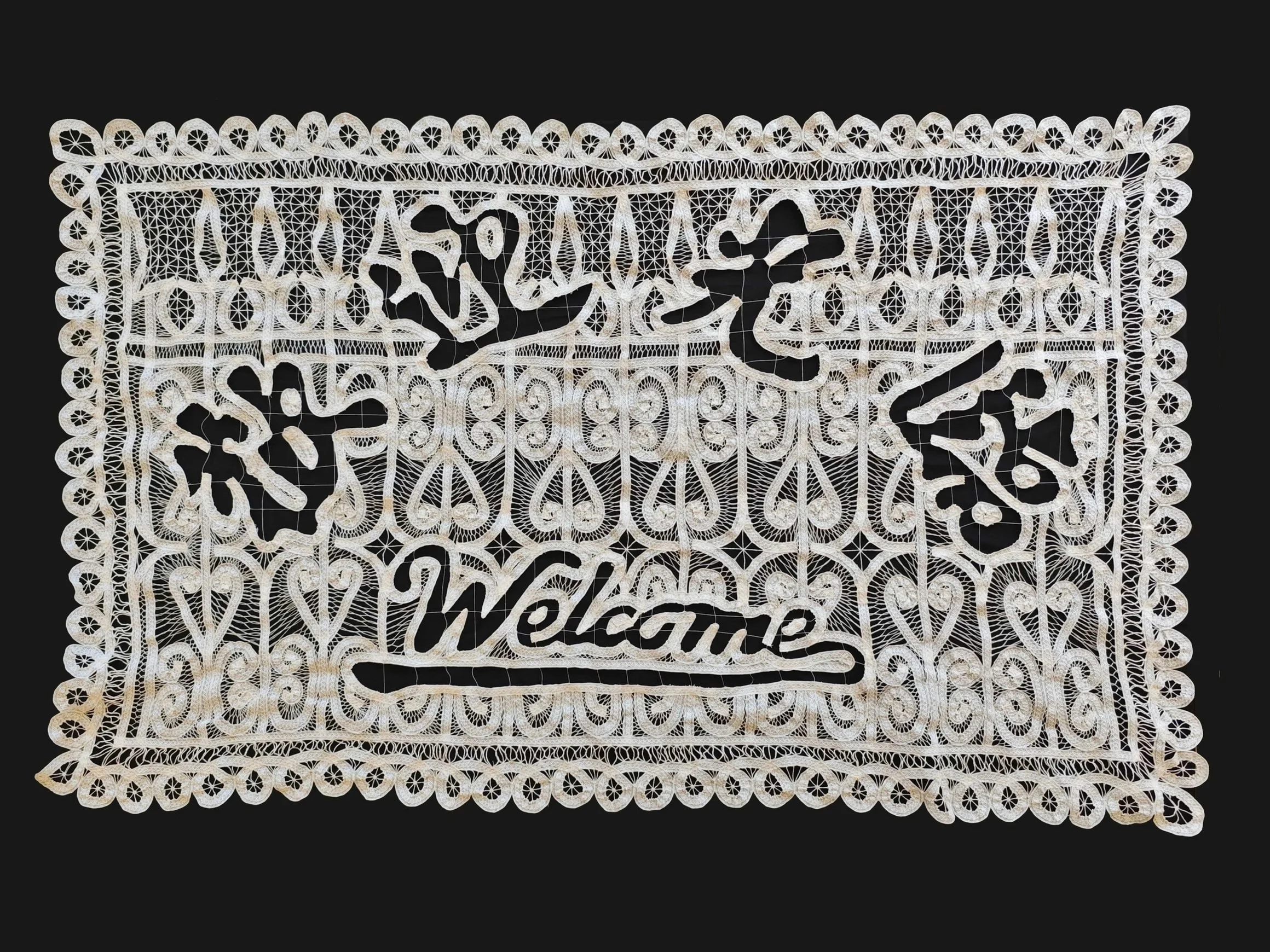
Jingyi Li, Welcome / 欢迎光临, 2024. Battenburg lace.
Image description: A welcome mat rendered in white lace against a black background with intricate patterns and the word “Welcome” in English and Mandarin.
Celestine Woo is Chinese American, raised in California. She has been an English professor at various colleges in New York and Colorado, and now teaches high school in New York City, at Trevor Day School. She has published two books of poetry, as well as scholarly work, and is nearing completion of a book-length memoir, which discusses religion and race, much as this essay does. She loves dance (she has been a modern dancer for over 30 years) and languages (she speaks French, Spanish, Cantonese, and a smattering of Mandarin and German).
*
Jingyi Li (b.1999 Beijing) is a Chinese artist based in London. With a focus on Asian women, she uses atypical materials and techniques to explore intense emotions while building a feminist space. Jingyi received a Bachelor of Art (Crafts Arts, Fibre) from Tsinghua University, Beijing, completed her Master of Fine Arts (Jewellery and Metal) at the Royal College of Art, London, and is currently pursuing a PhD in Anthropology with a focus on craft theory at Goldsmiths, University of London. More info: https://jingyili.co.uk

'Yet a declaration had been made on my behalf, and I did not know how to take it back.'—deconstructing desire in an essay by Amanda Juico Dela Cruz.