
#YISHREADS March 2026
By Ng Yi-Sheng / @yishkabob
For years, I’ve been wanting to devote one of these columns to transgender authors, celebrating the likes of Gretchen Felker-Martin, Daniel Ortberg and Kyle Lukoff, who’ve radically expanded the field of queer literature beyond the focus of sexuality, to include the traumas and joys of discovering a gender that’s truly one’s own.
The problem was, I couldn’t seem to find the right titles to feature. I knew I wanted to shine a spotlight on the trans writers of Asia, but a lot of them weren’t actually working the identity politics angle of writing about the trans experience—especially in the case of nonbinary authors, who’d often come to this identity only after immersion in gay and/or lesbian communities. Plus, a number of these books felt flawed, imperfect, not exactly the masterpieces I could honestly rave about in reviews.
But you know what? These are mere excuses. Trans writers have the right to talk about anything they want to; likewise, I have a right to take them seriously by critiquing them as best I can. So here are five works by trans women, bigender and otherwise nonbinary authors, hailing from India, the Philippines, Thailand, Malaysia and Singapore, writing in the genres of nonfiction, fantasy, magical realism, horror and confessional poetry.
And yeah, I know it’s a little weird doing this in March, Women’s History Month, instead of November, which contains Transgender Awareness Week. But we’re living an age when trans rights are under attack, in the USA, in Malaysia, in India, and in too many other places to mention.[1] Better now than later, I say.
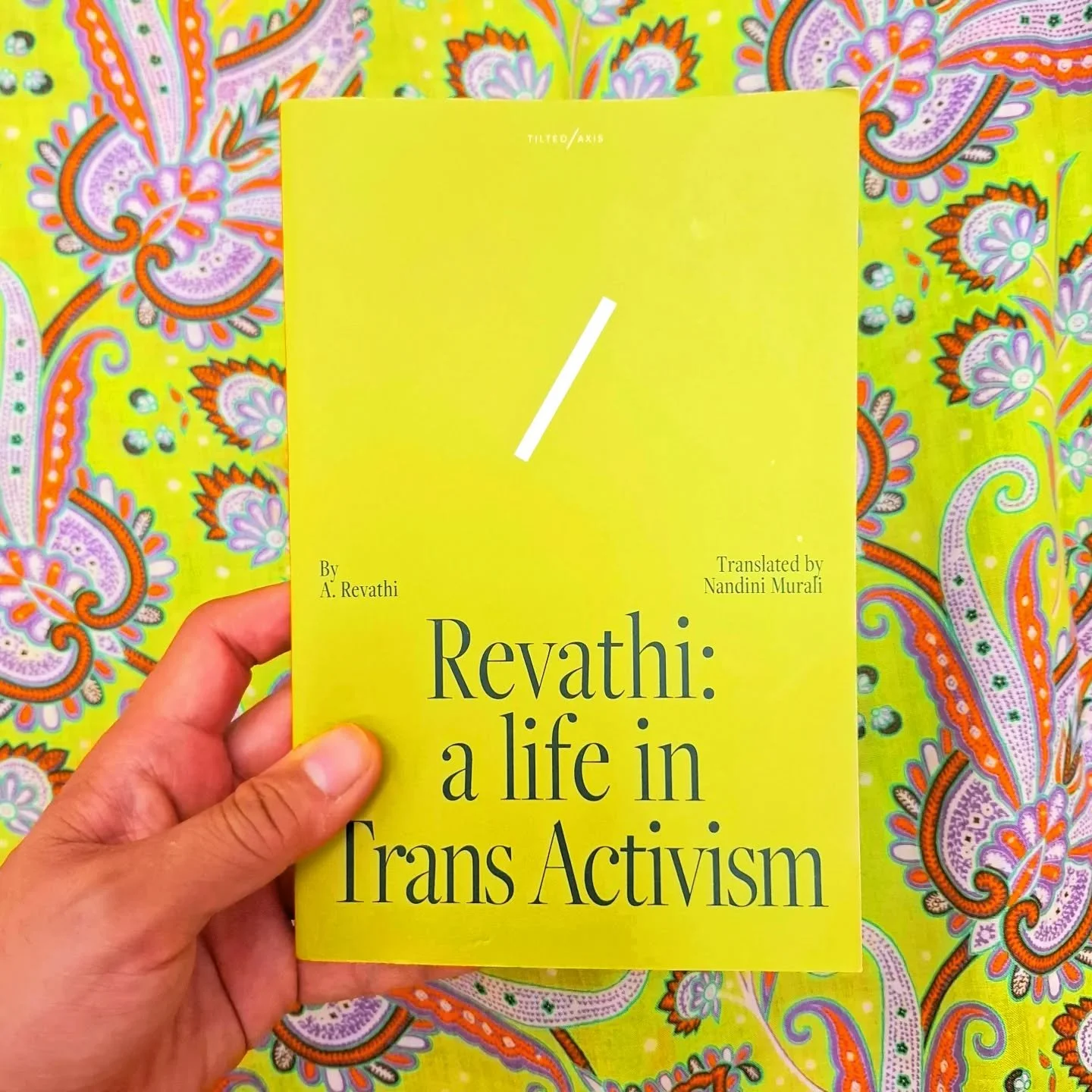
Revathi: A Life in Trans Activism, by A. Revathi
Translated by Nandini Murali
Tilted Axis Press, 2024
I’ve been curious about this author ever since I heard her name appear in 2019 on a banner at Columbia University, advocating for an alternative literary canon entirely made of women of colour![2]
First published in 2016, it’s based on Revathi’s conversations in Tamil with translator Nandini Murali, whom she describes as a co-author. Unexpectedly, it’s not framed as a coming-of-age story—that’s probably more present in her 2010 memoir The Truth About Me—and the standard narrative about childhood trauma, finding community and getting gender affirmation surgery is all packed into just Chapter 1.
What’s fascinating, however, is how in the 1990s she seems to have been a bridge between the traditional culture of the hijras, living communally in the hammams, to the activist world dominated by Westernised gay men and feminists. This wasn’t easy for her: much of the book details her tumultuous relationship with the queer organisation Sangama, which first gave her refuge when she started working there (a much lower-paying but less dangerous alternative to sex work), but which eventually turned into a site of bigotry and petty office politics when she was promoted to director, driving her eventually to quit.
The world that unfolds from these pages is jaw-droppingly violent, definitely not the kind of positive publicity India’s hungry for today. Revathi recounts not just sexual violence, domestic violence (her younger brother beat her till she could hear her skull crack) and police corruption, but also casteism and the arrogance of English speakers (she’s further marginalised as a speaker only of Tamil and Kannada) and random mob violence as randos believe they have the right to beat up any activist with stones and chappals.
There’s even toxicity within the trans community: the economic exploitation of elder hijras to their chelas (protégées), as well as their rejection of non-conformity (it’s a big deal when someone wears pants and cuts her hair short!), their bigotry towards trans men (a full 80 pages are later devoted to stories of trans men she interviewed!), the opportunism of incompetent surgeons. Also a little shocking how casually Revathi talks about stealing money from her family and dousing herself with petroleum to emotionally blackmail them!
As a whole, the book feels a little unfocussed and unstructured, less bound to a forward progression in life than returns to old grievances and sorrows, e.g. the suicide of Famila, her chela, who was incredibly charismatic and progressive, but who couldn’t take the pressures of the activist world and ended it at the age of 24. Sure, the Indian government struck down 377 and now formally recognises trans people (previously documentation was such a mess Revathi became the first Indian trans woman to get a passport!). But that doesn’t solve the fundamental problem of how trans people can become economically equal members of society. Even if they get handouts, it can be hell to survive when everyone denies them services.
Also, a bit of a reminder of the flaws of the “appeal to tradition” argument for trans rights. Sure, India has had hijras and stories of Shikandin for centuries, and Revathi invokes that past with pride. But this heritage doesn't mean trans people are gonna get dignity or justice.
(By the way, my recent Tamil lessons paid off a little here! The translator left some bits of dialogue in the original language... as well as the slurs. Yikes.)
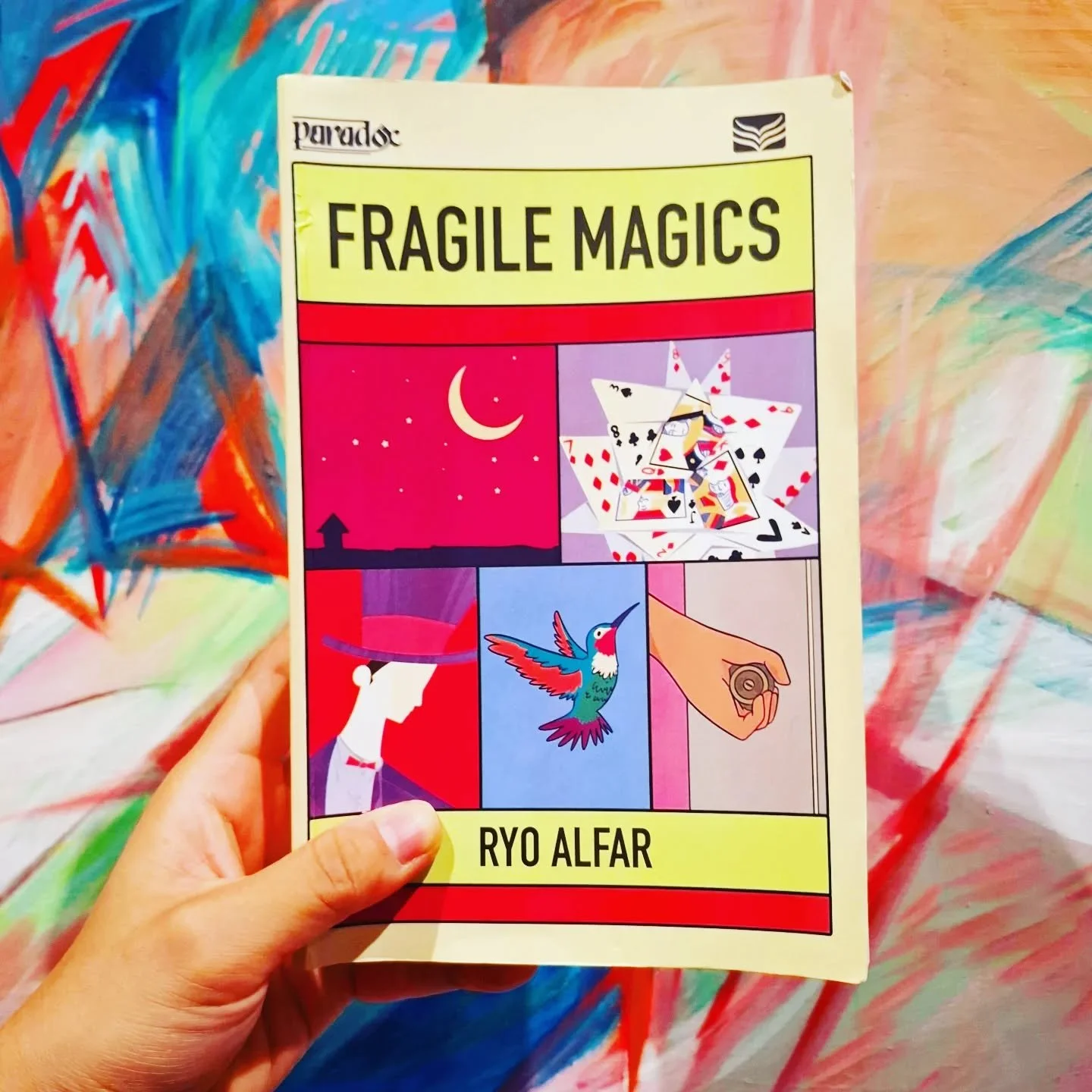
Fragile Magics, by Ryo Alfar
Paradox, 2025
I’ve read some of this author’s stuff before: back in 2017 he co-authored the collection Stars in Jars with his dad Dean Francis Alfar, who’s more or less the big daddy of contemporary Philippine speculative fiction.[3]
This, however, is his first novel: a fantasy adventure about a gang of young queer magicians—Rialli, Yoshiko and Xiaoji—hurtling through cities inspired by Philippine, Chinese and Japanese culture, pursued by a horde of mysteriously zombified citizens in masks. A lot of their magic stems from paper, which means loads of tricks and fight sequences involving paper stars, origami animals and playing cards... and also some body horror as they realise the mask magic depends on the corollary to paper: ink, flowing through the flesh and blood of their antagonists.
Sounds cool, huh? Unfortunately, this manuscript is pretty damn raw, and it made a lot of sense when Alfar explained in the acknowledgments that he’d written this in high school and college. There’s no exposition—which isn’t terrible for worldbuilding, since a bunch of that is revealed through flashbacks and epigraphs, but is bad for the reader’s understanding of the characters. Almost everyone’s a young, androgynous queer magic user in a society apparently free of racial bias, gender roles and homophobia, who talks in snarky teenspeak full of exclamation marks. How do you keep track of who’s who, let alone feel for them or understand relationship dynamics? (Also strange: recurring shifts in format, with random chapters written as script dialogues... but that’s less a flaw than a marker of eccentric style.)
It’s possible that I’m just not the right reader for this: a younger reader who's used to One Piece-style shenanigans might find this more digestible and relatable, and it’s certainly true that the story gets more gripping as the mission and antagonists become more evident. Still, I do think this would’ve been a stronger work if we had just one or two protagonists, if someone had edited out more of the Tom Swifities, and if Alfar had leant a little more towards the literary in his descriptive prose.
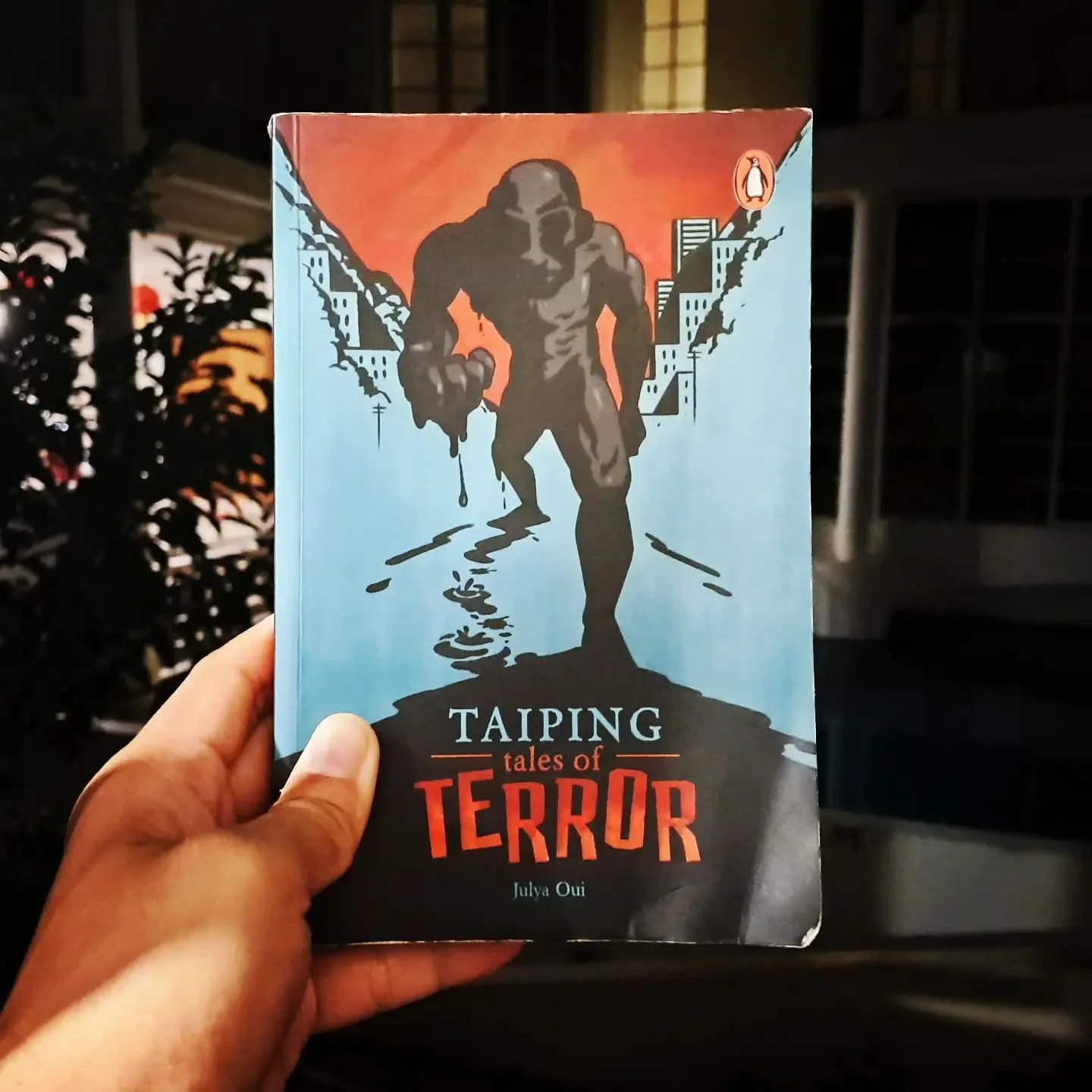
Taiping Tales of Terror, by Julya Oui
Penguin Southeast Asia, 2020
A collection of scary stories by one of Malaysia’s foremost horror writers, all set in and around the town of Taiping, all told in a frame story by a bunch of schoolboys around a campfire.
Should be good, no? Well, not at first! Quite aside from the author’s stilted style (she doesn’t quite know how to modulate her language, throwing around five-dollar words like “transmogrify”, “expectorate”, into the mouths of babes), she kicks off the volume with her two weakest tales: “The Haunting of the Headless Trishaw Man” (where neither the ghost, nor the headlessness, nor the trishaw have any real bearing on the shaky plot of a mother and daughter-in-law thrown together) and “Siloban aka the Jamban Incident” (two kids face off a penanggalan by trapping her in their outdoor toilet, with the main horrific element being scatological disgust).
The rest of the stories are, however, pretty decent, whether because of their genuinely disturbing images (a pitch-dark room flooded by the blood of girls’ wombs in “In a Locked Room in Maxwell Hill”) or satisfying plots (an old man takes his supernatural revenge on his ungrateful family in “Curse of the Papaya Tree”), or tender humanity (a ghostly security guard comforts a sexually abused boy in “Jaga Jaga”). Mind you, there’s a lot of depictions of sexual and gender-based violence (and merciless vengeance thereof), as well as some rewritings of national traumas that are in dubious taste (“Hunt for the Were Tiger” makes the racial riots of 1969 about a former sex worker, an animal trapper and mass hysteria rather than race; “The Old Man Who Wouldn't Die” turns the Japanese invasion of 1942 into a Western vampire-cum-jiangshi fantasy). But all that's creative, and the big twist at the end of the book was quite unexpected, and gave me some delightful shivers.
I do also appreciate the grounded specificity of the stories—makes me wanna visit Taiping itself and see if there are phantoms haunting the Burmese Pool, and half-rotten bodies floating in the Lake Gardens. No queer or trans perspectives here, alas. Oui tells me she’s published only one trans-themed short story ever, “Comes the Beast.”
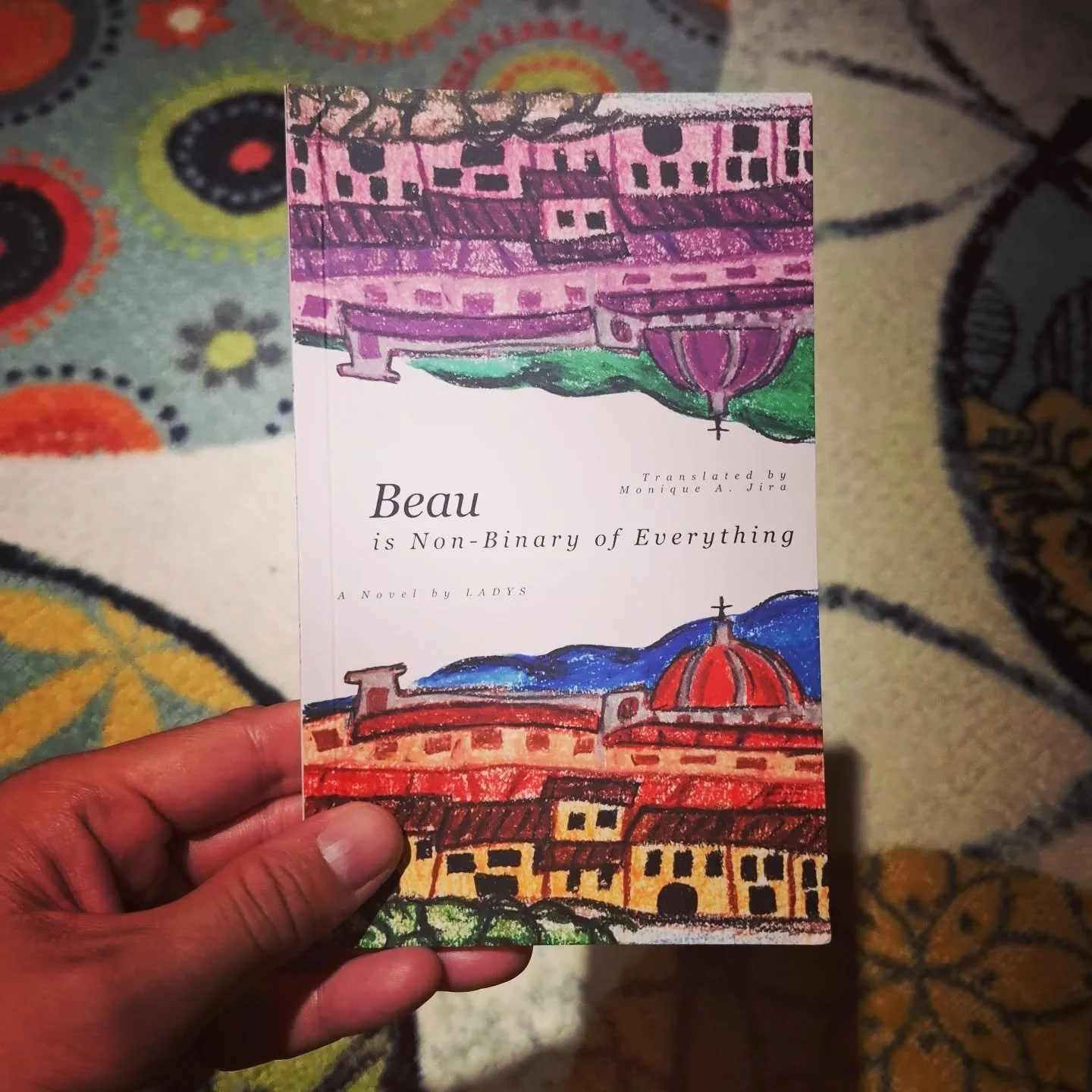
Beau is Non-Binary of Everything, by LADYS
Translated by Monique A. Jira
Ladys and Moonscape, 2024
A strange novella, written in Thai and first self-published in 2021, telling the tale of a stunningly beautiful black-winged nonbinary angel named Bella Beau, who serves as the muse of a Korean woman artist named Kwon Cho. Not much of a plot: instead, we get strange dreamlike exchanges over Tutti Frutti sweets (it’s hinted that they’re analogues for antidepressant medication), oil paints, charcoals and sculpture material; wanderings between Jeju Island and the Ponte Vecchio in Florence.
I wouldn’t call this an essential read—it’s definitely not a great resource for educating oneself on Thai queer culture, having no apparent intention of representing Thai-ness, depending instead on old tropes of doomed lesbian longing. Still, it’s a fascinating artefact of emergent NB identity in the nation, quite different from the gay and kathoey cultures it’s famous for.[4]
What does it mean when LADYS chooses not to ground her story in Southeast Asia or the hegemonic USA, instead locating it in the idylls of Korea and the classical Mediterranean, her lovers’ lips invoking Caravaggio and the myth of Pygmalion and Galatea? Nonbinary sapphic culture is imagined as cosmopolitan, multipolar, divine and antique, utterly disconnected from more familiar dynamics of butch/femme and tom/dee. Curious to see if that persists in her upcoming novel Karunya, coming out this June with Penguin Southeast Asia, telling the tale of a trans man who gives birth to a daughter.
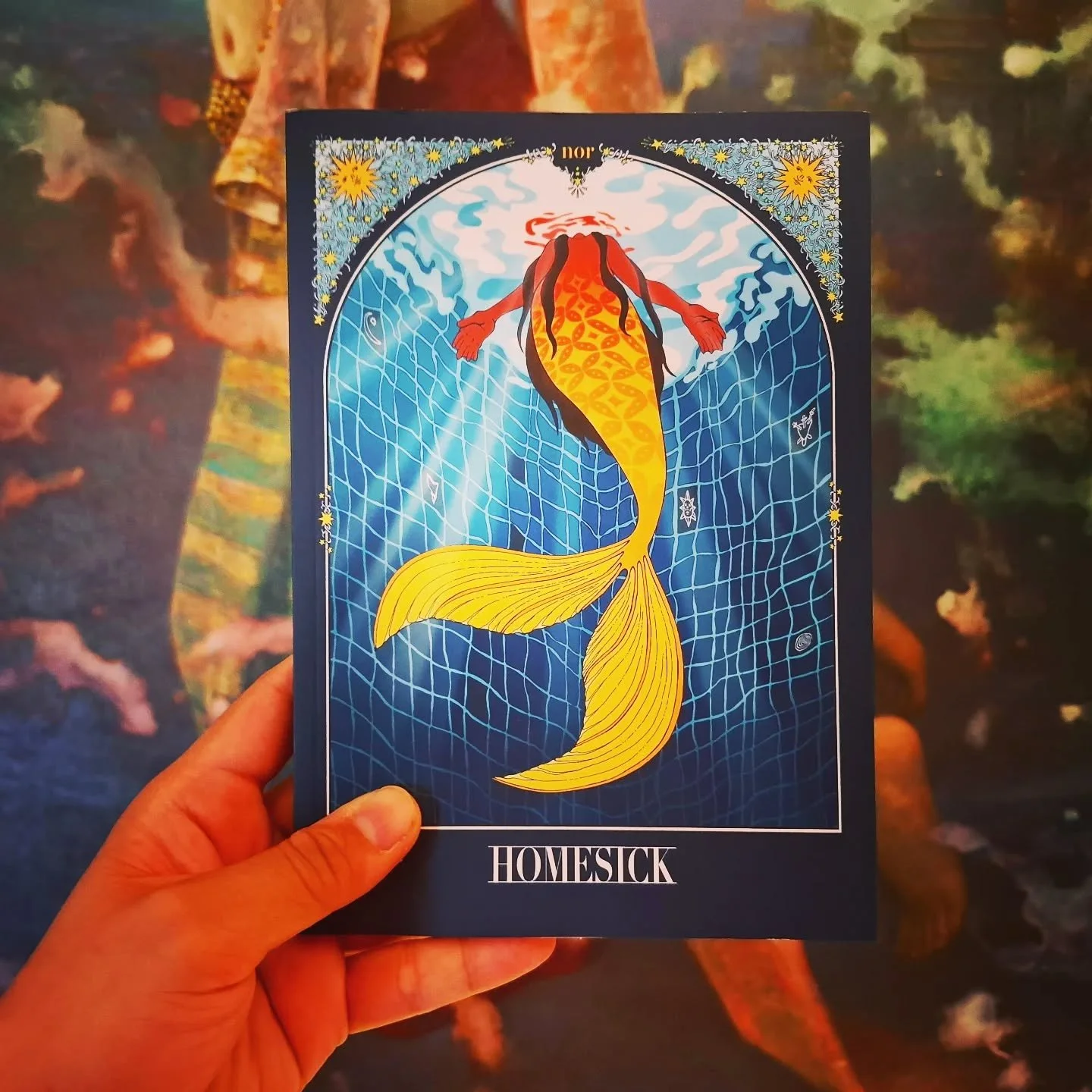
Homesick, by nor
Ethos Books, 2025
I’ve seen a bunch of nor's visual art and read their speculative fiction—short stories like “The Beginning” and “The End”, published in Singa Pura-Pura, as well as “Operasi: Merdeka”, published in EXHALE. Somehow along the way I got the impression that this was gonna be a volume of speculative poetry.
Turns out it’s more complicated than that. Sure, they do reference mysticism, Malay magical traditions and fantastical futures—see “an ocean” and “towards a wilderness”. But the principal genre here is the queer confessional: heartbreaks, dancefloors, bathhouse sex, abusive lovers, Fellini’s Death in Venice, even platitudes on love and lovers that read as oddly banal. (Shout-outs to older queer poets like Alfian Sa’at, Cyril Wong, Tania De Rozario and myself in the credits!)
I’d assumed the cover art represented the Javanese sea goddess Nyi Roro Kidul, who’s indeed referenced in this book, as well as in some of nor’s art. In fact, it’s an illustration of “swim good”, their memoir about being eight years old in a swimming class and the trauma that follows in the wake of that memory. As if to mock my preconceptions about genre, they use “fantasy” here to describe their normcore goal of having a great job and a stable loving partner (echoed in the long poem “wedding”)—hence the line, “Desire. Perhaps, I desire to be free of fantasy.”
But genre’s a tricky word, because there's all kinds of texts here: free verse, concrete verse, lyric essays, a bizarre screenplay imagining nor and their friends on a talkshow (titled “ride”), even a handwritten letter. The credits and acknowledgments are illuminating: they reveal that different bits of this were written for art projects, essay collections, aural compositions, and that it was gradually formed under the guidance of a series of mentors, workshops and editors.
Basically, this is an unconventional collection reflecting the complex, multifaceted career and identity of its creator: trans, nonbinary, interdisciplinary, indigenous, magical, ecofeminist, inspired by works of the past but uninterested in slavish imitation. The operative word may indeed be queer, cos it breaks rules and defies expectations just by being—because it’s also true that there’s no try-hard edginess here; more earnestness and sardonic pain. Shades of Attack of the Man-Eating Lotus Blossoms, the performance text collection from the late great Justin Chin!
Kudos to Ethos Books for taking a risk on something so strange. There’s a structured chaos here that feels reflective of a shift in Singapore poetics of the 2020s, and I wanna see more.
Endnotes
[1] Anti-trans legislation in the US, including Kansas’ invalidation of driver’s licences and Idaho’s bathroom bans, can be found at Rachel Cohen Booth. “The fight over transgender rights in America has entered a new phase.” Vox. 17 March 2026. https://www.vox.com/policy/482762/transgender-lgbtq-trans-rights-kansas-health-care-bathroom-bans-sports
The arrest of a trans woman in Kelantan in Malaysia for undergoing gender affirmation surgery is summarised in “Trans Woman in Malaysia to be taken to court for undergoing Gender Reassignment Surgery.” Asia Pacific Transgender Network. 11 February, 2026. https://www.weareaptn.org/2026/02/11/trans-woman-in-malaysia-to-be-taken-to-court-for-undergoing-gender-reassignment-surgery/
The proposed Transgender Persons (Protection of Rights) Amendment Bill, 2026 in India is explained in Siddharth Kumar Singh. “Law must recognise dignity, not verify identity: Hyderabad’s LGBTQIA+ community opposes Transgender Amendment Bill.” The Hindu. 18 March 2026. https://www.thehindu.com/news/cities/Hyderabad/law-must-recognise-dignity-not-verify-identity-hyderabads-lgbtqia-community-opposes-transgender-amendment-bill/article70753602.ece
[2] Clay Anderson and Katriel Tolin. “3 decades, 3 banners: Students adorn Butler facade with names of female authors amid Core’s 100th anniversary.” The Spectator. 3 October 2019. https://www.columbiaspectator.com/news/2019/10/03/3-decades-3-banners-students-adorn-butler-facade-with-names-of-female-authors-amid-cores-100th-anniversary/
[3] Alfar is bigender and uses he/she/they pronouns, but the book’s bio uses exclusively he/him. For the sake of clarity, I’m following suit. Also check out my review of Stars in Jars: Ng Yi-Sheng. “Stars in Jars, by Dean Francis Alfar & Sage Alfar…” Facebook. 14 March 2022. https://www.facebook.com/ng.yisheng.9/posts/pfbid02hS9Y1YfSq4krLu7TwQj5G5ojaMbuSUPRvjRbpuXMdjLkiPoJ8Me3VeuWcqH6fccil
[4] See my review of Richard Totman’s The Third Sex: Kathoey—Thailand’s Ladyboys, in Ng Yi-Sheng. “#YISHREADS June 2023.” 30 June, 2023. https://singaporeunbound.org/suspect-journal/2023/6/30/yishreads-june-2023
Ng Yi-Sheng (he/him) is a Singaporean writer, researcher and LGBT+ activist. His books include the short-story collection Lion City and the poetry collection last boy (both winners of the Singapore Literature Prize), the non-fiction work SQ21: Singapore Queers in the 21st Century, the spoken word collection Loud Poems for a Very Obliging Audience, and the performance lecture compilation Black Waters, Pink Sands. He recently edited A Mosque in the Jungle: Classic Ghost Stories by Othman Wok and EXHALE: an Anthology of Queer Singapore Voices. Check out his website at ngyisheng.com.

‘A snapshot of our planet, filled with souls dead and living, crying out that they matter, that their stories must be told.’—this September, Ng Yi-Sheng reviews writers exploring their own pasts.