
A Diet of Rays and Radishes
By Yap Hao Yang
Review of “A Field Guide to Supermarkets in Singapore” by Samuel Lee (Singapore: Afterimage, 2026)
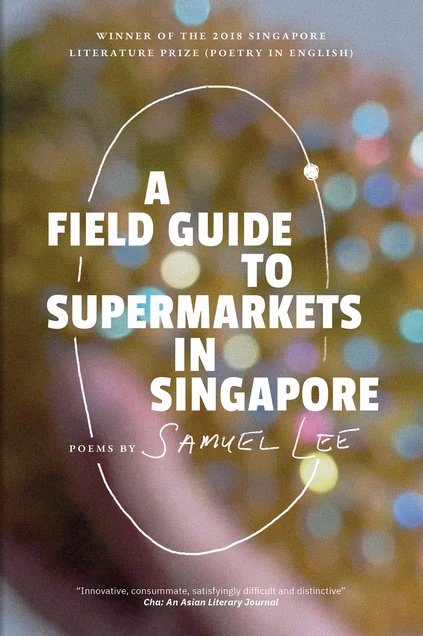
The first thing one realises upon flipping through A Field Guide to Supermarkets in Singapore (Supermarkets) is that the title is something of a misnomer. In this collection of poems by Singaporean poet Samuel Lee, one is not instructed in the authoritative manner of a field guide to wander through Singaporean markets and find best buys of produce and products. Instead, the collection perplexes. Its poetic logic—subjective and associative—takes us beyond the supermarket to unexpected places and cultures, histories and futures. It meanders from a kitchen to a lecture hall, from New Haven to Penang, from 19th-century European art to contemporary haute couture, from absurd food-writing to sincere confessionals. That is to say, readers expecting a literal field guide to Singapore’s NTUCs and Cold Storages may leave empty-handed—but nonetheless intrigued by the shelves of curiosities. The charm of Supermarkets begins with its conceit.
Inspired by the space and the very idea of a supermarket, Lee’s book charts an idiosyncratic path through a particular literary terrain. It is, as Lee quotes in the self-reflexive epigraph—an excerpt from Allen Ginsberg’s A Supermarket in California—a ‘dream of [an] odyssey in the supermarket’. Just as Ginsberg dreams of Walt Whitman’s 19th-century I-am-large-I-contain-multitudes romanticism amidst 20th-century I-saw-the-best-minds-of-my-generation-destroyed socio-political decay, so does Lee transfigure his 21st-century consumerist reality into a fantastical world of aesthetics. There is something self-consciously absurd about aestheticising a place as humdrum as the supermarket—if one can wax lyrical about the supermarket, what can one not? Already from the title and epigraph can we foresee the poet’s devotion to a thoroughly aesthetic way of experiencing life—it sees the ‘transfiguration of flesh to something gleaming’ (‘Charlotte Farquhar remarks on Her Souvenirs’).
—
In Supermarkets, reality ends and fantasy begins with light. In the first poem, ‘Argument’, Lee writes:
[…] Overnight the door
became a blank page humming in the moonlight, and then
you were gone.
I spilled a measure of flour and thought of you
in the dust-storm.
Although cold moonlight first illuminates the loved one’s sudden and total absence, the emptiness is later re-filled by a translucent cloud of dust that inspires the ‘thought of you’. Harbouring hope, the persona then ‘wait[s] stubbornly by the stove for you to appear as a blue ghost’, a flame. Light, here, has the effect of evoking visions of the immaterial, but it also fundamentally enables vision and thereby imagination. In the following poem ‘Still, Life’, light even animates the inanimate. As the title suggests, the poem first describes a supermarket scene as though it were a still life (nature morte, or ‘dead nature’ in French) using the technical language of formal analysis:
Gradations of flesh reclining on the artificial grass [...]
We gaze at the pinks and reds behind the frosted glass.
However, the dead seem to come alive later as ‘a silvery thread flows from skin to blood, from oysters to ashen wall’. What is interesting is the ambiguity here. It is unclear whether the oysters and the ashen wall are found in the supermarket or in a Chardin painting. For, in the second stanza, we find ourselves in an Art History lecture where ‘[light from] a projection of Chardin’s grimacing ray [...] swim[s] beyond [the professor’s] arms’, a luminous image reminiscent of the earlier dust-storm. The light from the projector is at once seemingly alive (‘flickers a thousand times a second’) and dead (‘a sliding scale of inanimacy’), just like the Chardin still life it conjures up. The still life and the flesh display; the lecture theatre and the supermarket. Fantasy and reality coexist under the same light and the same transfiguring gaze of the aesthete: the dead body of the fish can also ‘ru[n], like water, over the metal’.
The language of art transmutes not just the supermarket, but also the everyday world outside. Besides the few poems fashioned as still lifes or self-portraits, many others aestheticise ordinary phenomena through parodic titles and artful metaphors. For example, the poems ‘Rupture of Fruit Through a Plastic Bag’ (‘Rupture’) and ‘Prophetic Vision of Next Week’s Grain Consumption Patterns’ (‘Prophetic’), which elevate the mundane (e.g. oranges tumbling from a plastic bag) to the mock-monumental (e.g. ‘a minor crisis on the moving bus’), are titled (and framed) like serious works of art. On the level of metaphor, Lee compares ‘the sky[,] dark and uncertain’ to ‘early experiments in the moving image’ (‘Prophetic’) and friends to ‘a pair of earthenware figures’ (‘Apartment Therapy in the Age of Discovery’). Art is the reference for life.
It is also worth noting how Supermarkets takes inspiration from not just any kind of art, but specifically that of historical Europe. It imprints a subjective interpretation of a foreign and bygone world, one unfamiliar to the average Singaporean reader, onto an otherwise local and contemporary reality. The result is dislocatingly fascinating—like seeing one’s face ‘reflected [in Parmigianino’s] convex mirror’ (‘Apartment Therapy’). We are transported back in time, to the age of Chardin and Boucher, and even further back to the Middle Ages, when people still believed in the Vegetable Lamb of Tartary, alluded to in ‘Today’s Specials’ (‘fruit with heart of a lamb’). We travel also to the West through the mentions of Breton sweaters and California oranges. If such flights of fancy seem far-fetched, one needs only to visit a local supermarket to discover that one can indeed travel around the world by traversing a few aisles.
However, Supermarkets does not completely replace reality with art; instead, it reproduces a hybrid, uncanny dimension in which a ‘pink mop [...] with fabulous white dreads’ could be ‘Donatella Versace / standing in a broom’ (‘Tanka For Found Fashion’) at the same time. Such a surreal world is implied by the subtle appearance of ‘artificial grass’ in ‘Still, Life’; later, Lee also draws our attention to one Madam Chia’s ‘black wig’ (‘First-World Grocery Shopping’) and ‘fictive landscapes hanging from the fabric / walls of a hundred hotel rooms’ (‘Still Life with Radishes’). These images collapse the difference between reality and representation. A well-read poet (who knows his Adorno and Benjamin), Lee is seemingly responding, playfully, to a 21st-century reality described by Baudrillard several decades earlier, one in which the relationship between reality and representation becomes increasingly confused and even subverted. We see this in ‘Rupture’, wherein ‘orange’ takes on three different forms of varying ‘realness’: the fruit, the colour, and ‘a smiling cartoon orange’.
Such multivalent—and absurd—imagery repeats itself throughout the collection through the personification of inanimate objects, from ‘lemons blinking in your hands’ (‘First-World’) to ‘dinner tables [that] parade down the road’ (‘Birthday Dinner’). In ‘Outstanding’, one of the highlights of the collection, lettuces behave in anthropomorphic ways, anticipating the absurdity of AI-generated ‘fruit brain rot’ TikTok videos:
I am congratulated on all sides by heads of lettuce
[…]
and being new to the country they
are generous with their admiration
and have spread their leaves forward as if to embrace
Likewise, ‘Today’s Specials’ personifies fruits serially and ad absurdum (‘a fruit that paused in the tree’, ‘a fruit that started a minor religion’, etc.) to the point of defamiliarising the word ‘fruit’ itself.
Besides questioning reality and its representation, Supermarkets also pokes fun at contemporary bourgeois lifestyles. The characters in the collection, including the persona himself, belong to the same socio-economic milieu, namely one that enjoys ‘bespoke cocktails’ (‘First-World’), subscribes to ‘Alice Waters and her message of slow foods’ (‘Eating Organic in New Haven’) and owns a ‘self-cleaning espresso machine’ (‘Apartment Therapy’). Although Lee seems to make sport of the inane behaviours of middle-class Singaporeans, he also paints a sympathetic portrait of them, especially in the poem, ‘On Winning the Award For Most Outstanding Shopper’ (‘Outstanding’). Despite its ludicrous title, the poem poignantly portrays a shopper who earnestly—and even naively—commits to being a Good Citizen through such Samaritan acts as ‘[giving] a Thank You / card to a salesman with a limp’ and ‘pick[ing] up a bottle of shampoo / that fell on the floor and restor[ing] it to its best position’. Instead of mocking this anonymous shopper, however, the poem rewards them with a heartwrenchingly beautiful image of divine inspiration: ‘Brilliantly the light shines upon the freshly mopped floor / and rewards, even the children, with tiny coins.’ Fantasy, here, attempts to atone—with radiant grace—for the inadequacies of reality.
—
A collection like Supermarkets is rife with things (from sundry foods to miscellaneous items), and these things are invested with personal emotion—primarily grief. In ‘Argument’, for instance, ‘handwritten recipes’ are associated with the loss of a loved one: ‘Once there were handwritten recipes / on the fridge, and then there were none […] and then you were gone.’ The loved one, now existing in a state of absence, then takes ghostly shape, as the persona’s grief wills them to appear in ‘the trees, the rain, etc.’. Eventually, however, the poem ends with a distinctly tactile image unlike the preceding immaterial visions:
[…] I press down into cookie dough like
I’m burying the dead. I press down into wet earth like I only have my
fingers left.
With its tangibility, the kneading of dough seems to offer a return to presence and even resurrection. Yet the dough is likened to a grave. There is presence, but it is that of a virtually palpable yet ultimately intangible grief. The ritualistic motion of kneading brings solace as much as it gives form to the process of grief. The same movement across immaterial and material imagery—reflecting the persona’s negotiation of the loved one’s absence and persistent presence—is reprised in ‘Breakfast at the Materials Recovery Center’ (‘Breakfast’), wherein the persona shifts his attention from ‘holograms of beige objects’ to ‘weisswurst and cold beer’, from ‘your laugh’ to ‘a dandelion flower’. It ends with a tender plea for ‘you’ to stay:
There is already so little
of you in the clouds,
it cannot afford to rain.
Material objects—even tentative clouds—offer comfort, making tangible that which is otherwise intangible. For instance, the persona ‘see[s] glyphs of wounded animals in [his] pancakes / and press[es] you close to [his] ear’ (‘Breakfast’), or he ‘cradle[s] the vegetables and think[s] of [his] nephew’ (‘Self Portrait with Swiss Chard’). Things, warmed by hands, bring the poet closer to loved ones afar, bridging distances and filling absences. Additionally, the material roots the persona to the real world. As contemporary philosopher Byung-Chul Han writes in Non-things, ‘still, inconspicuous things, what is common, the incidental and the customary [...] ground us in being’. Thus, in ‘Eating Organic’, simply watching the leaves of an organic cabbage ‘fall off as slowly as [he can]’ assuages his fears of ‘hunger’, and the ‘concept of hunger’—cabbage-watching—here staves off two different kinds of absences.
At times, the persona seeks consolation in materiality through self-abnegation. In such impressionistic poems as ‘First-World’, ‘Ideology’, and ‘Learning to Eavesdrop’, the poet-persona recedes into the background as a passive observer, witnessing ‘things [...] shuffling themselves into view’ (‘Learning’) without intervening. Later, in the unsettling ‘Fever Dream’, he goes a step further to objectify and de-humanise himself. First, he substitutes himself for a fish that ‘hang[s] from the ceiling / in a bloated way’, and then, after that perverse taxidermic act, he further divests himself of life by instructing a ‘you’ to ‘find the knots / in [his] back and / turn them into a scarf’. A dark current runs under this poem. There is bitterness, it seems, beneath the apparent frivolity of radishes and lettuces. ‘Curse the days,’ the poem hisses.
—
The previous sections should have implied this sufficiently: dark and complex emotions underlie the poems in Supermarkets. Although the collection is undoubtedly intellectually and aesthetically rich, exploring compelling themes of fantasy and materiality, it is also a highly personal one that navigates an admixture of joy and grief, denial and acceptance. This much is clear from the start as ‘Argument’ alludes to an interpersonal conflict, perhaps related to the loved one’s leaving. Its sincere, confessional register sounds again in subsequent poems, such as ‘Breakfast’, ‘Advice’, and ‘Addendum’. All three poems deal with the grief that follows the loss of the loved one; ‘Breakfast’ remembers laughter, ‘Advice’ reels from the ‘wound’ of love, and ‘Addendum’ looks forward to the curative rinse of water, which ‘will wash what needs to come off’. Mortality, in fact, figures throughout much of the collection, particularly in the two still-life poems, ‘Still, Life’ and ‘Still Life with Radishes’; the former meditates on the image of a dead animal’s heart, whereas the latter directly invokes ‘the finality of death’.
The persona’s sorrows, however, are situated within a larger social landscape of latent melancholy. On the collective level, there is a civilisational anxiety that urges the apocalyptic visions in ‘First-World’ (‘babies are eating flies in the heat’) and ‘Noah’ (‘I walk the waterlogged earth / with a PVC purse and platform shoes’). In this decaying and decadent world, ‘oranges brow[n]’ and ‘pears are half price’ (‘Learning’). A similar angst is detected in the individual psyche as well. Even though the writing appears playful, at times it betrays a profound discontent. In ‘First-World’, for instance, one remembers that disturbing image of Miss Chia ‘holding a loaf of white bread / and weeping by the cake display’; or, in ‘Apartment Therapy’, the young, middle-class couple ‘waiting anxiously on a hill for sunrise.’ Ennui, perhaps, is what Lee suggests when he declares, ‘everyone / is a minor character / within their own lives angry and bored’. The disappointing nature of reality is best symbolised in ‘Charlotte Farquhar Remarks on her Souvenirs’ by the ‘empty space [in the boar’s head] / where nature would have intended a brain’, a disillusioning experience that leaves Charlotte ‘sit[ting] in front of its stupid grin’.
Read in this emotional context, the fantasies of Supermarkets are attempts at ameliorating the deficiencies of reality. In ‘Outstanding’, the lone, unnamed shopper parades through a fantastical section of lettuce, biscuits and noodles, then confesses her inner unhappiness (‘the entire mall is celebrating something / small and lonely’), and finally returns to the fantasy of light-coins on the floor. The poem is cynical enough to recognise the sorrows of a Most Outstanding Shopper, and yet, it sees through that reality to demand the redemption of fantasy. There is, simultaneously, jadedness and hope. Likewise, this complex combination of sentiment is found in poems such as ‘Ideology’ and ‘Self Portrait on the Eve of My Birthday’ (‘Birthday’). In the former, the persona asserts:
We pronounce the names of things
vainly anticipating the slightest possibility
that we can slide our fingers down their contours,
understand their shape, manage desire.
we fill them with desecration, colouring them,
making them whole.
The act of naming is interpreted as an act of futility and profanation, but also one of embellishment and consummation. It is this persistent romantic inclination that later moves the poet, in ‘Birthday’, to declare, ‘I intend to be rosy-cheeked forever [and] I will only sit in rooms with flowers’, although he also describes himself as ‘at least two hundred years old / given the nature and quantity of loss’. Despite the poet’s wry cynicism, there is yet faith in Stendhal’s formulation that beauty is the promise of happiness.
In the last three poems of Supermarkets, an acceptance of reality is reached through stoic humour and disenchantment. In the post-apocalyptic ‘Noah’, the persona surveys the ‘waterlogged earth’ alone, only to surmise that ‘things have more or less / remained unchanged’. The realisation of a permanent impermanence comes across as remarkably wise, and the underlying philosophical wisdom of detachment informs the conclusion of the following poem, ‘A List of Illustrations’:
[n]othing in the pictures /
were ever as complicated as they seemed.
Upon reaching the final poem ‘Hands’, written in stolid prose, we find ourselves back on the surface of a ‘scanned document’. The meaning of the text is reduced to its medium of representation, just as the depth of the world can be flattened into a two-dimensional picture. There is a disenchanting effect here that seemingly reverses the enchantments of the entire collection. On the scanned document, a pair of hands appears, then ‘disappears again, back into the shadows, where perhaps a mug of coffee [or] another pair of hands wait for their turn’. Human mortality is accepted as a natural outcome in the order of things. As Lee describes ‘the light distribut[ing] its attention equally again’ in a gesture of cosmic indifference, we return to that very first image of moonlight in ‘Argument’ illuminating the loved one’s absence, this time with newfound serenity.
‘The hands are gone. Blank pages, printed grain, a barcode—that’s it.’
That’s it. The item is reduced to its barcode, at once a statement of individual existence and inevitable consumption. The persona’s romance and cynicism converge towards a stoic conclusion, the itinerary of an emotional odyssey outlined in ‘Argument’: ‘after laughter, darkness, / then light.’
—
Ten years after its initial publication, Supermarkets remains fresh and even prescient in parts, arguably prefiguring such recent collections as Daryl Lim’s Anything But Human (2021), with its similar theme of 21st-century ennui and absurdity under late-capitalism, and Tse Hao Guang’s The International Left-Hand Calligraphy Association (2023), with its surreal and impressionistic renderings of everyday scenes and characters.
However, for all its inventiveness and thoughtfulness, Supermarkets is not without its shortcomings. For one, its conceit could have worked more effectively had the selection of poems been more stringent. Even loosely interpreted, several poems do not provide meaningful inspiration or immersion, instead detracting from the collection’s compelling emotional, aesthetic, and intellectual thrusts. Specifically, much of Part II falls flat, dense with irrelevant subject-matter (e.g. ‘Poem Machines’, ‘Logistics for a Garden Show’, ‘Haiku from the Heaney’, ‘Penang ‘98’). As though sensing that as well, Lee offers a reset in Part III by returning to the genre of self-portraits.
Additionally, although changes in tone to the sincere and confessional offer more direct access to the emotional heart of Supermarkets, they undermine the collection’s overall tonal coherence and even come across as simplistic in comparison to its other more compelling and distinctive voice. The more serious poems do not, as it turns out, convey more nuance as the more seemingly frivolous ones.
Nonetheless, these shortcomings are more than compensated for by the collection’s conceptual originality and complexity as well as its poetic precision and suggestiveness. One cannot walk through supermarkets in Singapore quite the same way again.
Yap Hao Yang (he/him) is a writer based in Singapore.

‘A snapshot of our planet, filled with souls dead and living, crying out that they matter, that their stories must be told.’—this September, Ng Yi-Sheng reviews writers exploring their own pasts.