
Indigenous Realities: Perspectives from Borneo
By Sharmini Aphrodite
What does it mean to be Indigenous? This is a question that has long troubled Southeast Asia, where competing ideas of indigeneity and what it means to be ‘native’ has led to decades of postcolonial strife. There are those who argue that ‘Indigeneity’—the question of who came first—is a colonial demarcation, conjuring up romantic figures of untouched ‘natives’. In the context of Asia, scholars have argued that the term ‘Indigenous’ is anachronistic, an outside imposition.[1] The ‘salt water thesis’, which posits that settler-colonialism can occur only when settlers come from over the ocean, also muddies the waters—this thesis has come under critique for its limited understanding of colonialism and settlers, being founded on Anglosphere histories and theorising.[2] To make things more complicated, ethnonationalists have cottoned on to the vocabularies of Indigenous activists, appropriating the concept of Indigeneity for their own causes. Malaysia, where I write from, is replete with such examples: Malay-Muslim supremacists grandstanding as land activists,[3] talking about having ‘custodianship’ over the land to justify their xenophobia,[4] and insisting that any political movement—even leftist and progressive ones—must foreground them as they are the ‘indigenous’ peoples of the country.[5] All while the voices of the Orang Asli—the Indigenous Peoples of Malaya—have been left out of the conversation, even deliberately erased.[6]
Yet all this scholarly and political debate misses a key point: Indigenous Peoples have been, and continue to be, fundamental forces in refining the language of Indigenous activism. It is true that the term ‘Indigenous Peoples’ is relatively recent, arising out of global conversations[7]—but these global movements, themselves, are driven Indigenous Peoples,[8] in conversation with Indigenous communities worldwide, other actors, and contemporary realities. The term signals a form of international solidarity forged in relation to history and in engagement with the past from the present.
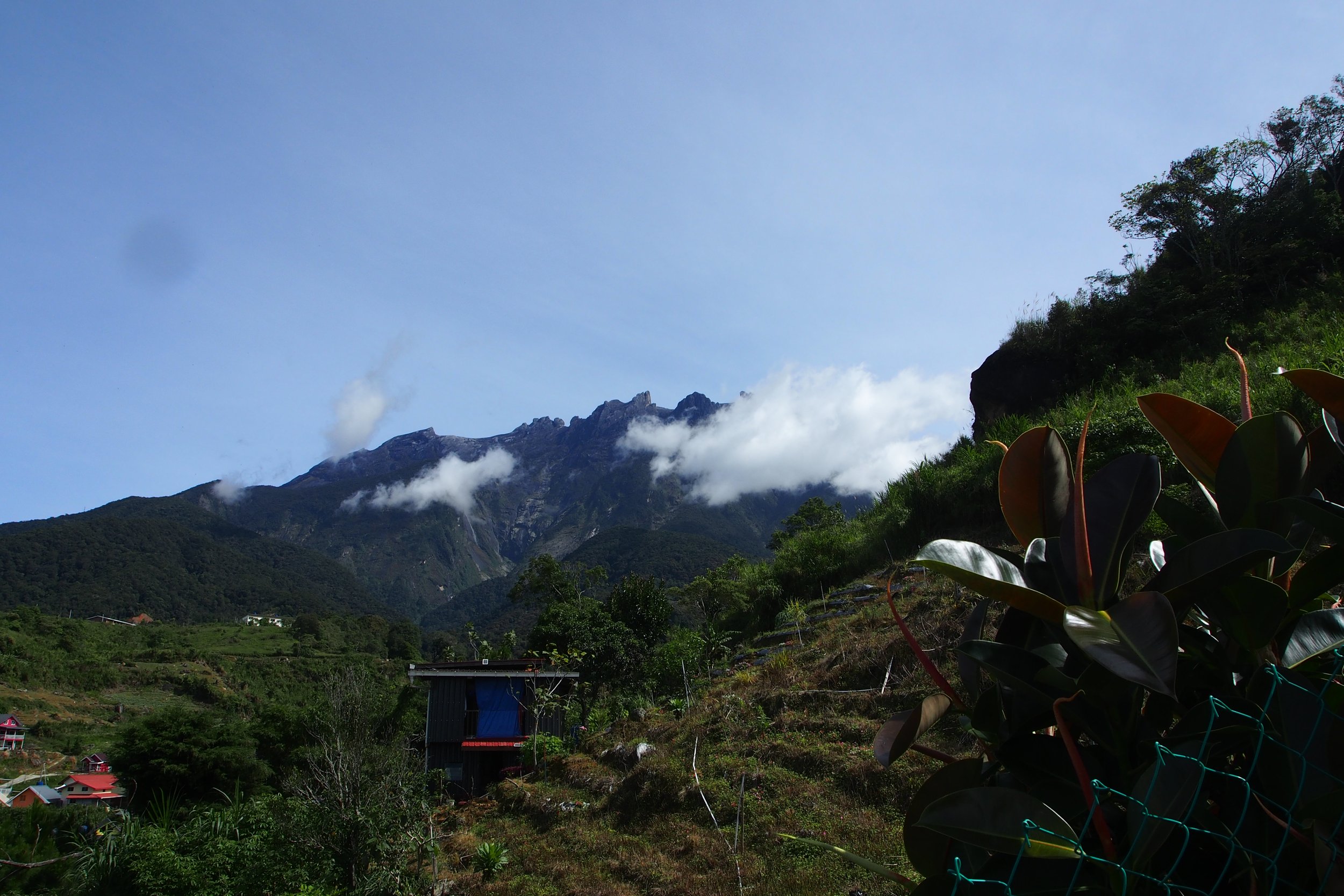
Aki Nabalu, the mountain sacred to Kadazan-Dusun communities, wreathed in clouds. 2026. Author’s photo.
Over the past couple months, I’ve been back in Sabah for fieldwork. I did not set out to focus on Indigeneity per se, but I found that it could not be extricated from my larger research. My focus is on Kadazan-Dusun communities on the west coast of Sabah and their relation to the Malaysian state. ‘Kadazan-Dusun’ itself is a very broad, potentially contentious umbrella label: in short, it encompasses over forty ethnic groups aligned on a language chain; these groups share an overlapping ancestral cosmology and agricultural practices, but they see themselves as distinct. That said, the formation of Malaysia in 1963 led to them uniting politically, sharpening their identity against the Malaysian state. My original focus was on Christianity: how it blended—and continues to dialogue—with ancestral practices and became a ‘rallying point’ in the face of state Islamisation.[9] When Malay(an) politicians dreamt of a Malaysian nation in the days of decolonisation, the worry of the political elite was that the Malay population would be overwhelmed by the greater-number Chinese, who were racialised as communist and inherently exploitative of the Malay populace.[10] The Indigenous Peoples of Sabah (and Sarawak) thus provided them with a neat solution: the Malay(an) politicians thought that these peoples were all serumpun—stemming from a single root: sharing a history, language, and culture, in other words, adat. They thought that Sabah and Sarawak’s inclusion in Malaysia would balance out the Chinese they were so afraid of. They thought that the Indigenous inhabitants of Sabah and Sarawak were essentially ‘like Malays’, which would result in a Malay-majority Malaysia.[11]
They were wrong. Simply because the Indigenous Peoples in Sabah and Sarawak are not Malay. This seems pretty simple to grasp, but for some reason, some people just cannot. In Sabah, what happened after the formation of Malaysia in 1963 was state-backed mass-Islamisation—with support from Kuala Lumpur to Libya—and the erosion of non-Malay languages from the media and in education, for the Malayisation of these communities: forcing them to abide by one adat, one language and one history.
As I’ve written elsewhere, the truth is a tricky thing to handle for a postcolonial narrative that confines injustice to the colonial period. The truth is that the Indigenous Peoples in Sabah did not want the British to leave so hastily to facilitate Malaysia’s formation; they were wary of Islamisation and Malayisation since the beginning of the Malaysia talks.[12] They were worried that their own adat would be wiped out for a neat Malay(sian) story. This fear was also based on a centuries-long history of being enslaved and exploited by the Bruneian and Sulu sultanates.[13]
I’ve written about how this discriminatory history persists in the contemporary era for Indigenous Peoples in Malaysia—Sabah, Sarawak and Malaya. Not only do I read these stories in archival files, I also hear them from family and community members. For example, anecdotes about how non-Muslim students were marginalised by education programmes supposed to uplift them. The students were subject to discriminatory and predatory behaviour, knowing that unless they converted to Islam, they would never get the benefits that were supposedly promised for Malaysia’s ‘indigenous’ peoples. Take Malaysia’s National Economic Policy: passed in 1971 in the wake of the violence of 13 May 1969, it was supposed to balance the economic scales between the Chinese and the Malays—to uplift the ‘indigenous’ peoples of the country. Yet, by a large margin, only the Malay community sees this benefit. The Orang Asli surely do not.[14]

In the middle of the sea separating mainland Sabah from the Federal Territory of Labuan (2026): Author’s photo. Labuan was formerly part of Sabah before being handed over to the Malaysian Federal Government in 1984 without consultation of the populace. See more on Labuan’s history here.
When I speak out about such issues in Sabah, I’ve been told by supposed Malay progressives that I’m still trapped in a colonial mindset by emphasising difference; they insist we were all serumpun, as we were before the British came. I’d argue that the serumpun mindset is also a colonial one. Aside from the assimilation of Indigenous Peoples in Malaysia, there is Indonesia. Sukarno, still romanticised for Bandung and the Indonesian revolution, used the serumpun ideal to justify Indonesia’s colonisation of West Papua, which continues to this day.[15] ‘Decolonisation’ appears a cheap word, then: it simply looks like a handover of power from Western powers to nationalist elites.
That’s why the international language of Indigeneity became appealing: because the forging of this language, in conversation with Indigenous Peoples worldwide, did what the postcolonial state—and those on the right and left who support it—failed to do. Confer dignity, recognise sovereignty, and provide a platform. This international language is not perfect and it is constantly being negotiated, but it’s a beginning. And it frustrates the state because it provides an alternative imaginary; and because it airs dirty laundry that people would prefer stashed away. Malaysia, for an instance of state failure, signed the United Nations Declaration on the Rights of Indigenous Peoples in 2007, but implementation is lagging. Self-determination, for Indigenous communities here, is still only a phrase. Malaysia has not recognised the International Labour Organisation’s Indigenous and Tribal Peoples Convention, 1989 (ILO 169), probably because the Malay community—with their regional political dominance—would not be recognised as Indigenous Peoples under this convention. The convention would, however, recognise the Indigenous Peoples of Sabah and Sarawak, and the Orang Asli of Malaysia.
To this day the Malay(sian) state exerts its powers to make its Indigenous Peoples Malay through the Malay ‘civilising’ project. Not only has Islamic education been forced onto Orang Asli children, in Kelantan and Terengganu there have been cases of Orang Asli children being ‘fostered’ by Malay families to ‘civilise’ them.[16] In Kelantan, too, incentives have been offered to Muslim preachers who marry Orang Asli women to convert them[17], and the same state aimed to convert all its Orang Asli peoples to Islam within 30 years of 2019.[18] Why is this ‘civilising’ project necessary for the state? Because the history of Indigenous communities, and their continued refusal to assimilate, frays so many of the myths it builds itself on. When I hear the phrase ‘Tanah Melayu’,[19] often denoting an imagined precolonial ideal, I feel no revolutionary nostalgia. I think of a subjugating force whose reach preceded and proceeded from the British.
But the state and how it attempts to exert power over Indigenous Peoples in a Malaysian context is just one facet of my research. My real interest—what I see play out in the day-to-day—is resistance, a refusal to accept being silenced.
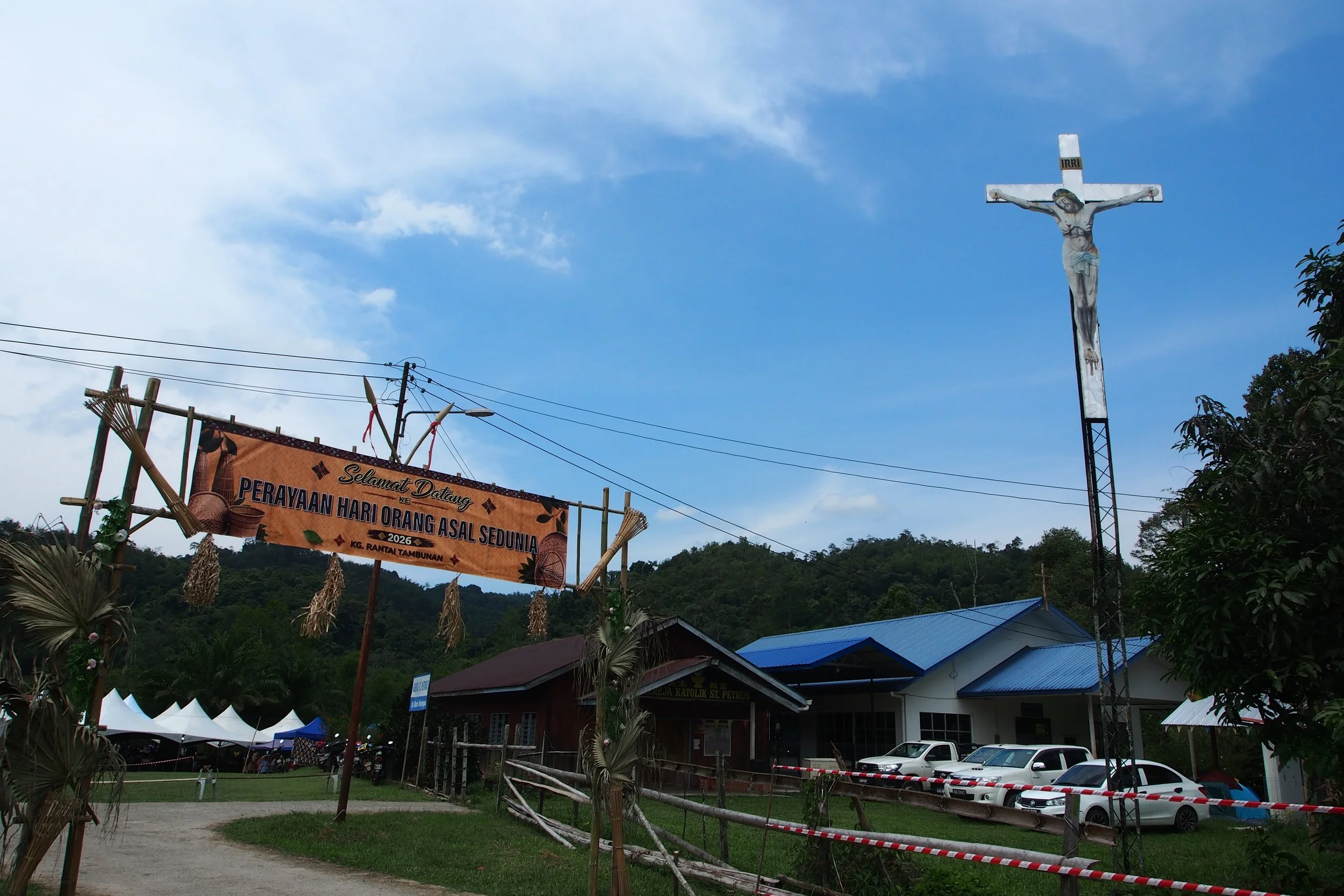
International Day of World Indigenous Peoples celebrations, Kampung Rantai (2026): entrance to the venue. Author’s photo.
9 August is International Day of the World’s Indigenous Peoples. This year it was celebrated in the Sabahan interior. Delegates, community members, activists, and observers came from Sabah, Sarawak and Malaya. We were Kadazan and from various Dusun communities; Iban, Temiar, and many more besides. We were all different, and that difference was the point of the celebration. No single adat, language or history. The first two days of the festival were taken up with community-based discussions, where issues integral to the day-to-day were discussed: dealing with a lack of infrastructure; gender issues within our communities; health and sanitation; recording histories and culture; and involving the youth in advocacy. The issues were grounded in local realities instead of abstract theorising. On Sunday morning, still half-asleep, I attended Mass at the adjoining church. I sang a hymn I knew well in English, but for the first time in a variant of Dusun adjacent to my own heritage language, Tatana. In that Mass, we used ‘Kinoingan’ to refer to the Holy Father; this was the name of the ancestral Creator, repeated again in that church across generations and faiths. That evening the closing celebrations were held, with dancing and singing.
With drumbeats in my ears, our chairs shunted to a corner to hear each other better, I spoke that evening to an activist who had been involved in land rights for about as long as I have been alive. The night was chilly; we were in the embrace of mountains. The grass skimmed our ankles, dogs laced through the clumps of people: I remember stroking one as it stayed behind me. We talked about where we both came from. He told me about the gains of advocacy but also continuing frustrations: for all that I’ve written here about the Malaysian state, it is not the sole source of our problems. Local actors also sell Indigenous land illegally, and foreign capital extracts resources such as timber and palm oil from Indigenous territories. There is much to be done. The fight is generational. He was pleased to hear the topic of my research, but he was adamant that there was more to be done today, and he reminded me what else I could do to not forget where I came from.
History is one way of establishing customary land tenure. History in the form of grave sites, folk tales, lineages, a knowledge of rivers and fruit trees. To know how the land gives but is also taken away. Knowing our diverse history helps cultivate a respect for other people’s sovereignty. My roots stem from a particular place—in my case, one in the southwestern coast of Sabah, facing the wide spread of the sea. I would not claim Indigeneity to the same place that this activist was from, hemmed in by mountains, with different—even if similar—words for pig and dog, both integral to our lifeways. Solidarity is built and shared: not assumed as birthright. Not taken for granted, but worked on and sculpted. Indigeneity is a relational concept—where you are from, yes; but also where you go, what you continue to do.
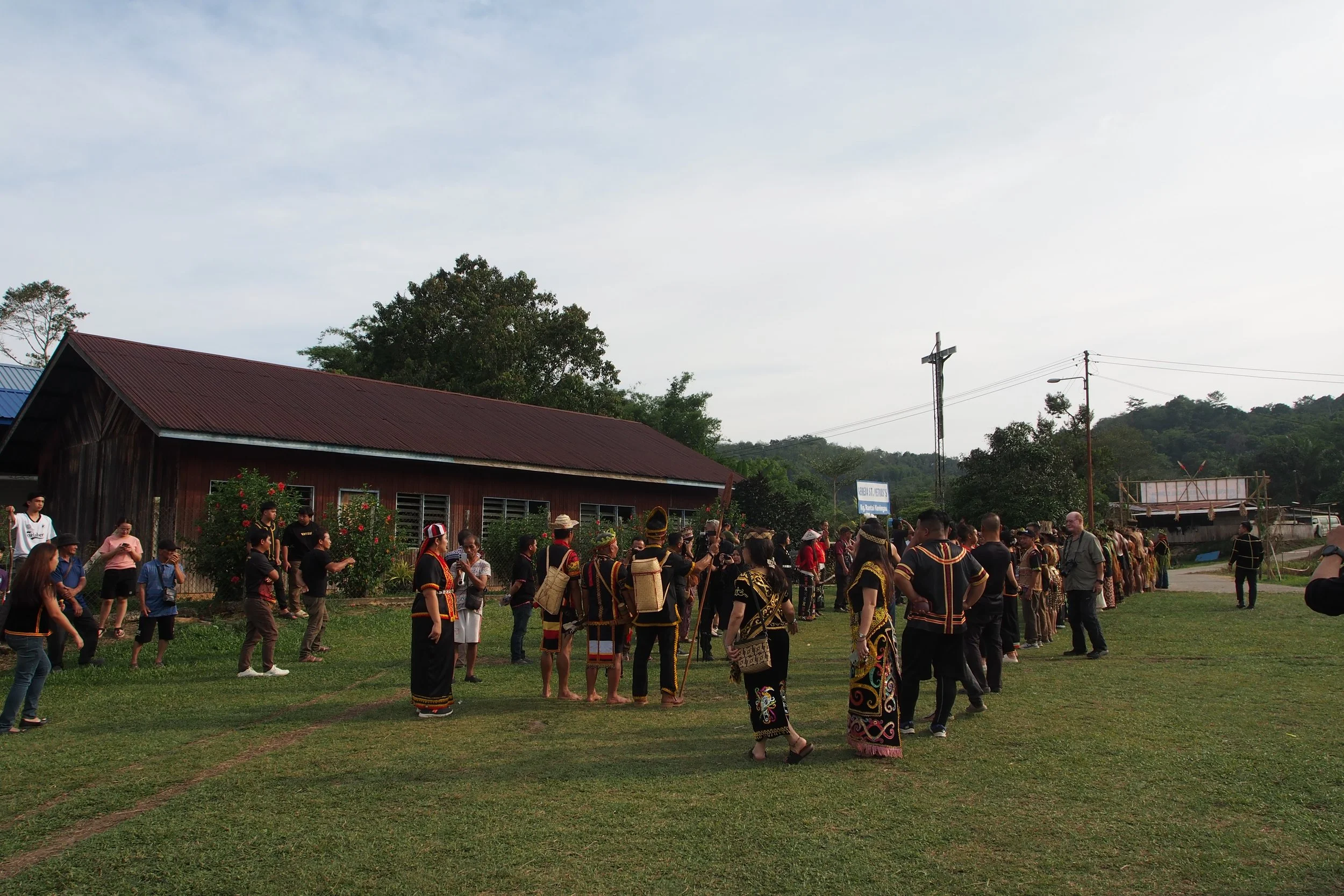
International Day of the World’s Indigenous Peoples, Kampung Rantai (2026): the delegation relaxes. Author’s photo.
With that said, it’s time to start building solidarity here at SUSPECT. This essay kicks off what will be not just a single portfolio, but a sustained engagement with Indigenous communities from across our Southeast Asian archipelago and eventually through the rest of Asia. We have writers, artists, and collectives in mind, hoping to provide a space to generate discussion on what it means to be Indigenous in Asia today. If you are a writer or artist of Indigenous heritage, we invite you to submit your work to us, to reach out and get in touch with your ideas. What kind of a world can we build together? What have we always wanted to say, but have been told is inconvenient and embarrassing, by people both outside our communities and inside them? Our stories are a way of remembering the past, and creating something to remember for the future. So let’s go back to the drawing board, and see what happens next.
This running series will be back with another essay in the beginning of 2027. Until then, take care. We’ll see you around the bend.
Notes
[1] See the introduction to Lau Hui Ting’s Decolonial Endurance: Lisu Worldmaking Against Settler Colonialism (Stanford University Press: 2026), where she discusses the pushback she received for delineating Indigeneity and settler-colonial bodies within an Asian context.
[2] See Jessica Namakkal’s essay ‘Decolonization and the Third World’ in Lateral: Journal of the Cultural Studies Association 12:2 (2023).
[3] See this article on Malaysiakini.
[4] Wan Ahmad Fayshal, Minister of Parliament for Machang, Kelantan, used the term ‘custodianship’ to characterise Malay-Muslim hegemony in a BBC debate in 2025. A former member of BERSATU (The Malaysian United ‘Indigenous’ Party), he gave his comments in defence of the right-wing Parti Islam Se-Malaysia (PAS). His precise statement was ‘I would reconfigure the word “hegemony” and would rather use “custodianship”’.
[5] An article by Audi Ali discusses the evolution of Malay nationalism, which includes key left-wing figures such as Burhannuddin Al-Helmy, who considers the Malaccan Sultanate as fundamental to Malay(an) nationalism. It also analyses the work of Rustam Sani as an articulation of progressive Malay nationalism, repeating the idea of Malay ‘indigeneity’ as the fulcrum of ostensibly progressive milestones such as the Melayu citizenship provision in the 1947 People’s Constitution. More on that in the next footnote.
[6] Presented in 1947 and produced by the anti-colonial coalition PUTERA-AMCJA, the Constitution proposals provided a blueprint for a progressive state buttressed by strong labour protections. Although the proposals marked a significant stride forward for the labour movement, which saw unity on that front among Tamil labourers, the Chinese working class, and Malay representatives, there were aspects of the proposals that caused friction between the Malay nationalists and non-Malay members of the coalition. One such aspect was the proposal of a ‘Melayu’ nationality as a common citizenship. This included the granting of citizenship as ‘Melayu’ (Malay) nationals to Indian and Chinese communites—described as ‘aliens’ and given conditions to prove their loyalty to Malaya—and emphasised the primacy of the Malay language. The ‘Melayu’ nationality was ‘insisted upon’ by the Malay nationalists, who ‘accepted a common citizenship’ upon this condition. (See Yeo Kim Wah’s ‘The Anti-Federation Movement in Malaya, 1946-48’ in The Journal of Southeast Asian Studies 4:1 (1973)).
While ostensibly shearing the term ‘Melayu’ of its ethnoreligious baggage, this provision also premised Malays as the indigenes of Malaya, erasing the Orang Asli. This was part of a wider trend in ‘Melayu nationalism’ during that period, which Charles Brophy describes as giving ‘particular focus to… the Malays—as a way of building anti-colonial unity between the people, thereby sacrificing equality in the present for its realization in the future’ (‘The “theory of the unity of all classes and races against foreign capital” in Malaya: Socialism, communalism and uneven development in the thought of James Puthucheary’ in Modern Asia Studies 56:6 (2022)).
[7] See Michael Dove’s ‘Indigenous Peoples and Environmental Politics’ in the Annual Review of Anthropology (2006), which gives a brief introduction to the rise of Indigenous politics in the 1980s and includes common critiques against it.
[8] See Jonathan Crossen’s ‘Another Wave of Anti-Colonial Internationalism: The Origins of Indigenous Internationalism’ in the Canadian Journal of History 52:3 (2017), and George Manuel’s treatise on the ‘Fourth World’.
[9] Fausto Barlocco, Identity and the State in Malaysia (London: Routledge, 2017), 119.
[10] Ngoei Wen Qing. Arc of Containment: Britain, the United States, and Anticommunism in Southeast Asia (2004). Cornell University Press: 114-115. [10]
[11] See James Ongkili’s ‘The Problems of Kadazandusun Bumiputeraism: Promises, Privileges and Politics’ in Kajian Malaysia 21, no. 1 & 2 (2003): 198-201.
[12] David Saunders. ‘The Scramble for Sabah: The extension of foreign influence and the creation of Malaysia, 1900s-1960s.’ PhD diss. (The University of Hong Kong, 2020). Writing by Saunders on the Pasok Momogun political movement and the Gunsanad brothers in 1960s Sabah illustrates how Islamisation was a concern even in the early days of the Malaysia discussions. The 20 Points—a memorandum drafted on the cusp of Malaysia’s formation—outlines safeguards that Sabah stressed should be upheld if they agreed to be part of the formation, thus also clarifying their concerns about what might happen if the safeguards were not upheld. The 20 Points stresses freedom of religion and protections surrounding cultural practices and languages.
[13] Files related to the Cobbold Commission also discussed how fear of the Malaysia proposals amongst Indigenous communities in Sabah stemmed from being ‘preyed upon’ by the Brunei and Sulu sultanates (FCO 141/1279). Beyond the archives, folk tales recall the fear of slave-raiding and conquest, particularly in the southwest of Sabah, nearer to the border with Brunei. One folk tale explaining the origin of the ‘Tatana’ name tells of a people who had to constantly hide underground when Bisaya raiders came into villages.
[14] See Wan Zawawi Ibrahim’s 2021 policy paper on the NEP, which discusses not only how it failed Indigenous communities in Malaysia but also terraformed the nation’s cultural and political landscape in favour of Malay hegemony.
[15] See Douglas Gerrard’s essay on how triumphalist narratives of Indonesia’s revolution simultaneously excise Indonesia’s colonisation of West Papua and the exclusion of the latter’s history. To Sukarno, West Papua was an essential part of the Indonesian state; in calling for its conquest, he likened its separation from Indonesia to an amputation.
[16] See Robert Knox Dentan’s Overwhelming Terror: Love, Peace and Violence Among Semai of Malaysia (Rowan & Littlefield Publishers: 2008): 186 and 197-198.
[17] See this article on The Star.
[18] See this article on Free Malaysia Today. This official body behind this is the Majlis Agama Islam Kelantan dan Adat Istiadat Melayu (MAIK: Council for Religion [Islam] and Malay Custom in Kelantan).
[19] SUSPECT’s practice is to not italicise non-English words: this is to counter the Anglophone assumption that English is a default, and other languages are always in relation to and outside of the English vocabulary. That said, I am italicising the Malay words in this particular essay to emphasise Malay is also a language imposed on Malaysia’s Indigenous Peoples. In the course of my research and community work, I’ve heard laments of how Indigenous Peoples with no understanding of Malay had their agreement for political agendas or religious conversions manipulated on the basis of this lack of fluency. It reminds me that this language—despite being one I speak myself, mainly use in Sabah, and am even fond of—also has an assimilative legacy.
Sharmini Aphrodite was born in Sabah. Her short fiction and writings on art, literature, and history have appeared online, in print, and as part of art exhibitions. She is the Editor-in-Chief of SUSPECT, a journal of Asian literary writing. Her short-story collection The Unrepentant was published with Gaudy Boy in 2025. She is currently working on a novel titled The Prodigal that explores forced conversions of Indigenous Peoples in Sabah to Islam by the Malaysian state during the 20th century.
'Yet a declaration had been made on my behalf, and I did not know how to take it back.'—deconstructing desire in an essay by Amanda Juico Dela Cruz.