
The Ruins
By Amrita De
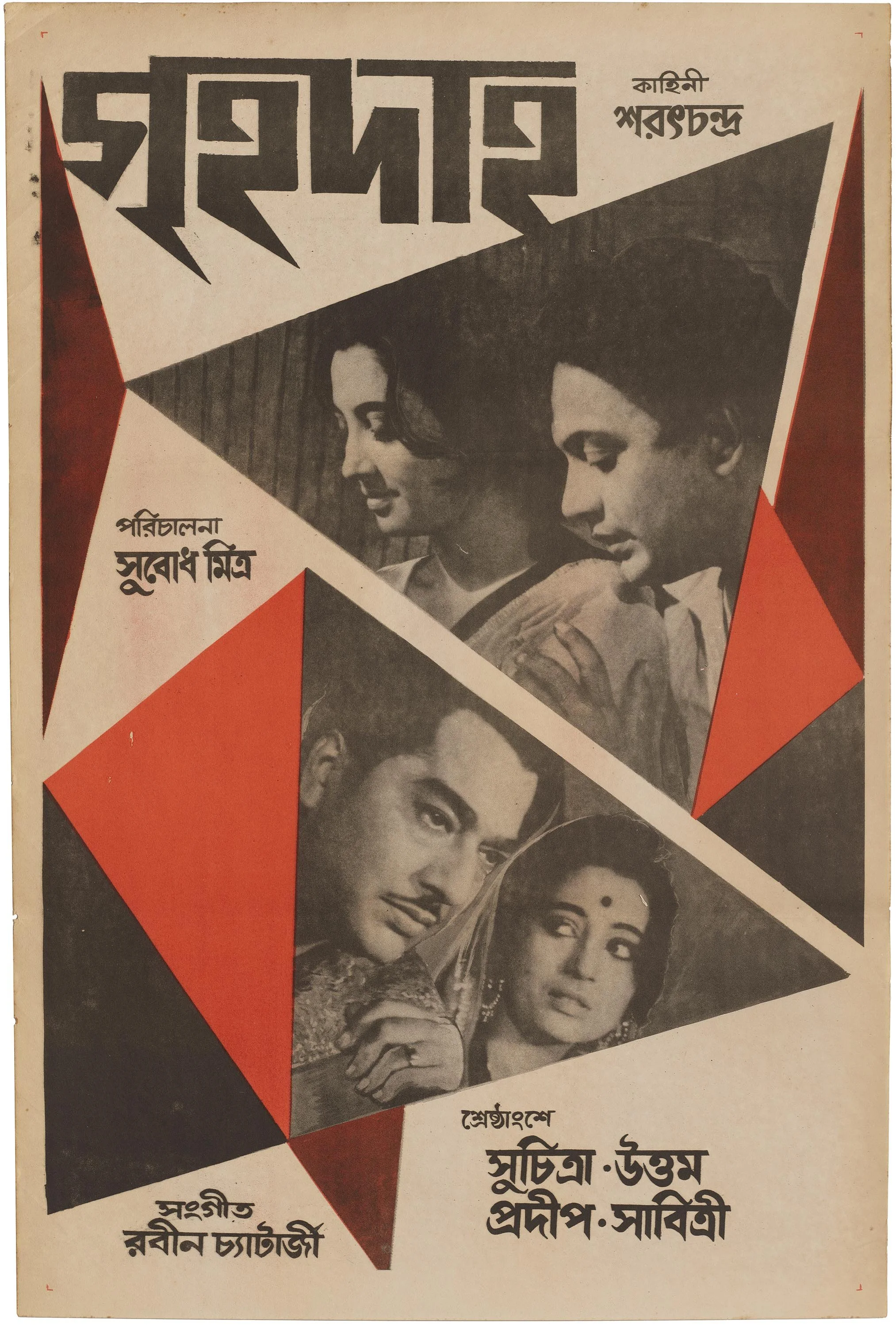
Movie poster for the Bengali film Grihadaha (গৃহদাহ), ca. 1967. Photo-lithography; designer and print studio unknown.
Image description: The vertical composition is divided top-to-bottom by a broad diagonal on either side of which are two triangular black and white photograph portraits of the four protagonists, some of whom are caught in (yet another) love triangle. They are framed by two more fiery red triangles, as well as three maroon triangles along the composition’s outer edges. The title above is large,and the credits (center and below) are in black ink on a pale ground in Bengali script.
The ruins changed colour in the setting sun, warm ochre turning midnight blue. I held a silver box inlaid with coloured glass diamonds. Three red and two blue stones fell on my lap when I turned the box upside down. A wind picked up, dispelling the stillness of regular summer evenings, ramming against the corrugated steel of the makeshift restroom at the back of the watchman’s quarters. Nobody knew what the wind left in its wake: sometimes it swallowed up empty holes, filling them with grains of sand, dust, and empty cola cans; and sometimes it took away rooftops, and with it, fortunes and livelihood, like it was nothing—just a coin toss midair.
“Today was a flat day.” D’s voice expressionless, his eyes fixed on a snail shell glimmering in the dark.
“Why? Didn’t you find anything at all?” I asked.
“Did find some junk—mostly inconsequential stuff.”
“I want you to have this.” I bent down to pick up the five stones collected in the hollow of my plaid skirt, where my stockinged legs spread outwards in a reverse V.
“You hurt her, then hurt yourself in the process.” He rebuked.
“I was jealous! I shouldn’t have.” I pleaded.
“You owe her an apology. She’ll understand.” His voice was conciliatory.
“And you? Will you ever understand?”
I couldn’t bear to look into his eyes.
*
Even before I met D, I knew what loneliness was like, how compulsive it was, how it stuck to you like grains of sand, so maddeningly impossible to shed.
My family moved to Rajasthan circa 1993, at a time when everyone was jiving to the tune of the great Indian liberalization. Fizzier Coca-Cola replaced Campa cola, and television sets invaded middle-class homes. I belonged to the MTV generation: full-throttled, jet-setting, future global citizens nostalgic for an imagined home, coasting on the watered-down donations of American capitalism. But even as its shinier urban cousins rolled out welcome mats, jockeying it up on the turntable at hipsterish discotheques, Jaipur pulsated to its beat, impervious to the surround sound. I liked to think of myself in the same way—calm, composed, and self-sufficient like the city—but having grown up in five different places by the age of thirteen, I was stripped of anything concrete. Ice queen, middling hobbit, recluse, all rolled in one.
My father was a senior officer at the Indian Revenue Service. Miles away from our native home in Bengal, we arrived in Jaipur, out of step with the city’s language and culture. My mother started regulating my life more; she insisted I be conscious of my privilege, which meant only curated attire and pre-ordained leisure activities. Ma made it seem that decades of my father’s reputation as a high-ranking administrator depended on the sanctity of my choices.
We lived a kilometre from the ruins, three kilometres from Jal Mahal on the south side. In the morning, when my father left for his office in an off-white ambassador with a red beacon, a specialty of government vehicles, I was dropped off at school. Through the tinted windows of the ambassador, I watched tourists in colourful sun hats train tripod-mounted cameras to the half-submerged palace. At school, I barely talked to anyone—I didn’t want attachment to any person or thing. I knew a time would come when I’d have to move, and moving would entail jettisoning everything at airline baggage limit.
I don’t know if I found the ruins, or if the ruins found me, or if it was the only way I could trick loneliness by placing myself in a more expansive and lonelier space.
One day, after yet another altercation with a nagging mother over a failed Math grade, I left the house threatening to never return. I wasn’t a bad student, but nobody in my family understood that it was difficult to repeatedly pick up from where I left off in the previous academic iteration. Though Math was supposed to be objective, the constant beginning yet never quite arriving anywhere left a physical impression too intense to focus and regurgitate in assessment rituals. Numbers, geographies, archaic facts, writers, poets were all blurred.
The first time I met the ruins, or the ruins met me—I overstayed my welcome without invitation. I don’t know what pulled me inside for they looked terribly unkempt from outside. Only the lower part of the main structure was visible from the iron grille gate. A straggly glorious mess standing on bird-shit-stained legs. It was perfect! I could disappear here. I could scream into a void, and nobody would care. Who could tell, soon after, the ornate designs and the dome-shaped ceiling with twelve pillars would become a daily refuge. And I’d come to spend long summer evenings hugging the pillars, my fingers scratching the cool surface looking for blemishes, not knowing when the sight of Badri limping towards me at six, his right hand on the bamboo staff clanging the marble floor impatiently would start feeling like a ritual.
The evening I met D, I was sifting through a Graham Greene novel, my mind abuzz with the sound of the ruins like the clamour of different instruments in an orchestra—the chirping of crickets, the sound of lizards plopping onto the marble floor, rodents scurrying away, and Badri’s staff scratching the ground as he waited for the six o’clock gong. Blood trickled down my legs, staining the white marble floor. My period had just started. It didn’t feel like anything memorable, and in any case, I couldn’t have shared it with anyone, for I didn’t have friends in my new school, and my mother and I didn’t share that kind of intimacy.
A dark-haired boy in an elephant block print kurta sauntered in, lugging a hefty knapsack to the watchman’s quarters. I tracked his movement till he disappeared inside. A few minutes later, the bamboo staff exchanged hands and the watchman left. I next saw the boy atop the water tank, his scrap collection spread out in front of him. I knew scrap collectors existed, but they had never occasioned interest. But that day, from my vantage point on the raised marbled platform, I observed D meticulously sorting through discarded electronics, fabrics, an assortment of buckles, and miniature vessels (which could have been toy teacups) and then neatly arranging them in separate piles. When he finally noticed me, it was way past closing time, but he didn’t look annoyed to see me there. His expressionless acquiescence of my presence momentarily disarmed me. It was unnerving how he went about his sorting business like it was the most natural thing in the world.
I liked that he kept to himself in the initial weeks of our meeting. He let me stay on long after closing hours for we had entered a wordless pact where neither encroached on the other’s territory. One day, after another fight with my mother over a trivial matter, which ended with me slamming a jug of milk on the table, I ran away from home again. Nobody followed me outside. My mother knew I’d return when I calmed down. I reached the gates at a quarter to six. Badri was still in his shed. I could sense from the impatient thwack of his staff that he was waiting for D to arrive. I don’t know why I waited for him too. D brought with him a sense of calm that was impossible to describe. It was the kind meant to be felt, like the moment when a huge surfing wave briefly lowers you onto the ocean floor, when you can see everything swimming past you, clear as crystal, and even though you are battling the possibility of death, everything is serene and filled with a peaceful quiet: He was that quiet from the ocean floor. Even though on most days we barely spoke, it felt nice to share this space with him, sit in silence together as if it was the most natural arrangement in the world. Or maybe, unconsciously I had already begun staking him out, wrapping myself in his aura like one did while casting a protective spell against the world. Or maybe, this is what first everything felt like. Everything was just energy.
Soon after Badri left, I approached him, catching him in the middle of his daily inspection. Startled, he looked up, registering my tear-stained face, then beckoning me towards him. No questions asked. No explanations needed.
We sat side-by-side in silence, our hands barely touching, my eyes resting on his cracked feet. His spindly fingers splitting the straggly stems off dried grass, twisting them into a braid.
He asked me if I wanted to see his day’s stash, hoping that would cheer me up. “You can select anything you want from today’s collection,” he added, opening his steel trunk to reveal stained glass paintings, attar bottles, a music box, candle holders, a carved wooden owl, and a handheld mirror. I had never felt this giddy about antique objects as I did that day.
I opened the music box, wiping the dust off the surface with the hem of my kurta. An uncanny sound filled the ruins, a cross between a screech and a wail. My eyes welled with tears. I felt a numbing feeling of desolateness. Little made sense, for sense was too congealed in the objective to account for the immediacy of the moment, the tenderness of it, the fragility of it.
D plucked some wildflowers growing inside crevices, tied them together with the braided grass rope he had wrapped around his wrist, and gifted me a bouquet. Nobody had performed such an exclusive act of kindness towards me before. Our hands briefly touched for a second. I felt my chest heave, my insides clamping up, and then a quick release as I regained my natural breathing. We sat together in silence, staring into the starless sky from the edge of our ruins. That night, like a heroine in a Bollywood film, I pressed the wildflowers into a poetry book, holding the book close to my heart till I fell asleep.
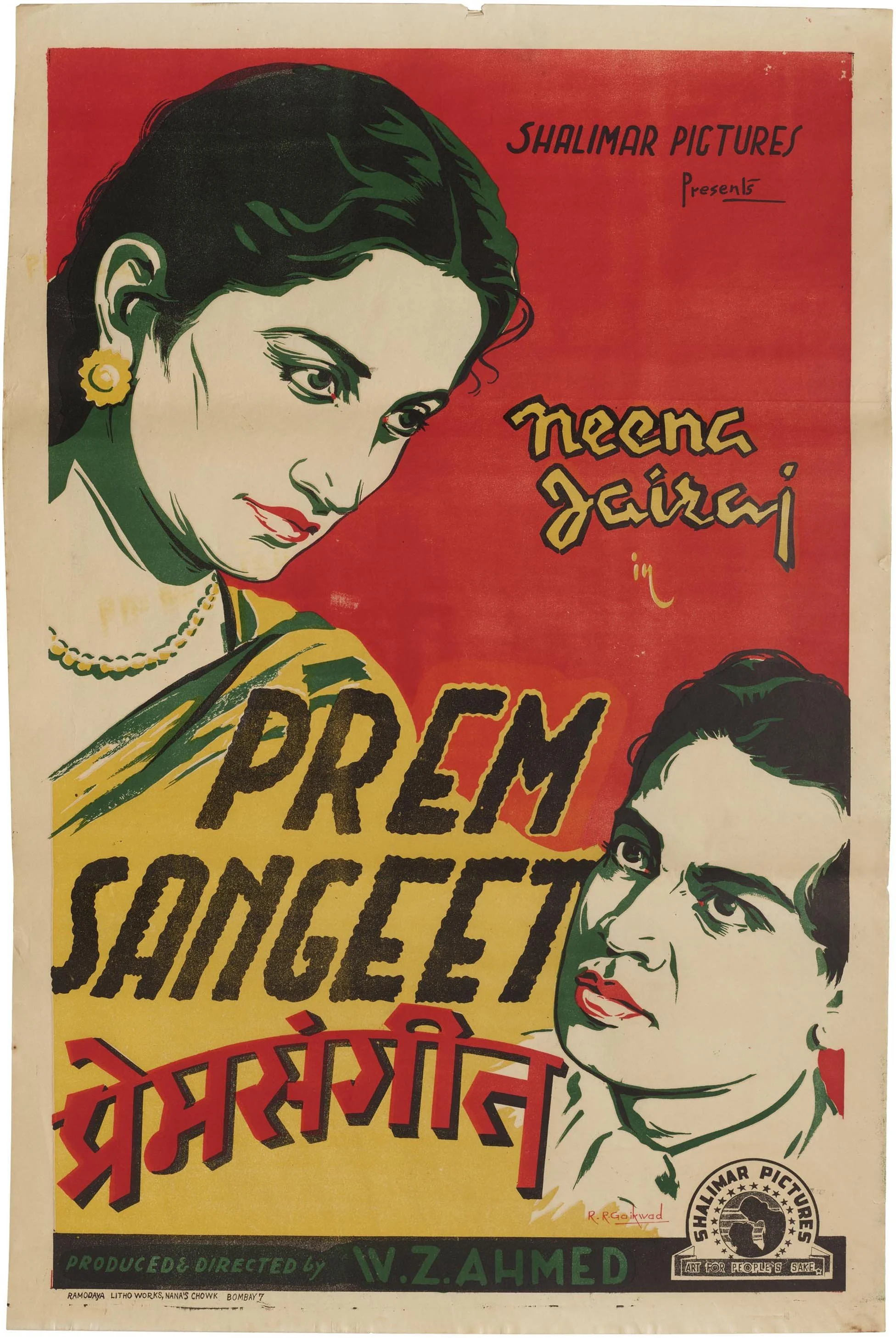
Movie poster for Hindi film Prem Sangeet (प्रेम संगीत) “Music of Love,” Bombay (now Mumbai), ca. 1943. Lithography, R.R Gaikwad (illustration), Ramodaya Lithoworks (printing),
Image description: The vertical composition is divided diagonally: the top right half is bright red, the bottom left half is bright yellow. Illustrated portraits in black, red, and dark green show the protagonists gazing (or glaring) at one another from their respective top-left and bottom-right corners: the woman looks down at the man below her, and he returns her look. The title in Hindi is writ large and placed centrally in black, forward-leaning Latin letters, repeated below in chunky red Devanagari script with black shadowing; the smaller credits are in English above and below: “Shalimar Pictures presents…”
*
After that day, D started inviting me to his scrap excursions. He’d survey houses dotting the narrow alleys, collecting fabrics, floral patterns, empty glass bottles, rusted copper lamps, broken mirrors, and chopped locks of hair. Over the weekend, he’d sell these items by weight to junkyards. On our first excursion, he took me to Johri market, a thirty-minute auto ride from the ruins. I had escaped the latter half of school hours, feigning a stomach ailment. D showed me where to get the cheapest clothes. I remember a large stall with unfurled pleated saris adorning the outside and a man juggling coloured dupattas rolled into tight balls, small enough to contain in the palm of my hand. Everything at the stall was on sale at a fifty per cent discount. On the other side of the road, a middle-aged man dispensed different flavoured ice lollies from a pull cart. I watched D cross the street, a swing in his steps. He wore his dimpled smile, engaging in animated conversation with the vendor ladling coloured syrups on the shaved ice. I noticed the fall of his shoulders, the sweat dripping down his forehead, and the thin cotton shirt clinging to his back, accentuating his muscled torso.
Next, he took me to a bright shop with seashell curtains, where we were greeted by smiling attendants seated on floor mattresses displaying colourful saris to potential customers. A middle-aged woman, perhaps a potential buyer, was engaged in a detailed appraisal: she laid out delicate fronds of Balochi silk on her extended hand, carefully parsing through the layers as the light rippled through the fabric, before settling on a minor defect. She then asked for more colours and prints, making her displeasure apparent. The attendant, unruffled, spread more saris one after the other. I didn’t understand why D brought me here. I didn’t wear saris.
It became clear that he wanted me to meet someone.
We climbed a wobbly collapsible staircase attached to a hole in the wall. A small tailor’s room on the upper-level corner jutted outwards. I saw a low-ceilinged room with a large red plastic table. There was barely enough space for two people, so I remained on the top step while he went inside. On the other side of the table, a girl around my age was working on a sewing machine, her nimble fingers stitching a zardozi fabric on a purple drape. I hadn’t seen her before, but I immediately sensed a change in D. The girl greeted him animatedly, her tired frame brightening after his presence, while a flicker of happiness flashed across his face. He later told me that he collected fabric scraps from her.
“And that look?” I demanded an answer. I had witnessed their secret glance; it felt like a rush of emotion I couldn’t pinpoint, something indeterminate—I still can’t label it exactly, but it was an exclusive body language that I wasn’t privy to.
“You think so?” D almost looked pleased, as if it was a compliment. “Aisha has a special place in my heart. We came here together after the riots broke out in Gujarat,” he added.
I had difficulty processing this. They knew each other and shared a special connection, one borne out of hardships and flight that I wouldn’t ever be able to share with him.
I don’t know why he took me to see her that day, but soon afterwards, Aisha became a regular part of our meetings at the ruins. One day, I arrived later than usual to find her with her arms around D. Thereafter, something inexplicably changed in our dynamic. I couldn’t accept it. What could I tell myself, that I saw them kissing or that I saw them urgently seek out each other’s bodies, lit up by a manic internal entropy that outsiders like me had no business knowing?
*
On my sixteenth birthday, a month after my last meeting with D, I impulsively dragged my mother to the sari shop where Aisha worked. My mother immediately busied herself, running the texture of the drapes through her long narrow fingers and then letting the embroidered ends fall on one side of her box-like frame. I couldn’t help noticing how grey her hair was, how thin her lips looked pursed in concentration, and how her eyes narrowed while studying the price tag. After the assessment, she belligerently shouted that all the saris were overpriced, the handiwork not intricate enough, and the colours too garish for her taste.
“Village women make them. All proceeds from the sales will go to them,” the shopkeeper stated.
I moved away from my mother, determined not to be correlated with her. How embarrassing it was. I shouted at her, “Pay the full price. We have enough!” I was conscious the entire time of Aisha’s presence. It was part vanity and a desperate attempt to translate myself into a bigger person, bigger than my mother’s pathetic attempt at bargaining. But then, I abandoned this performative script. I don’t know how or why. Suddenly ignited by a sense of betrayal at the remembrance of their embrace, I found myself climbing the stairs past the glass-t with the flattened saris lined up in progressive shades of warm to cold, like the old vinyl records in Baba’s room I was forbidden to touch.
I hovered on the edge of the last stair for a few seconds as if to summon extra courage from the pit of my stomach. I peremptorily rapped the red plastic desk, saying, “I want my measurement taken for a new Kameez.” And then, as if the undisguised cruelty in my voice wasn’t enough, I added, “This is for my birthday. I want sophisticated patterns, not the kind people of your class wear.” My mother’s voice tunnelled through mine, a phantom self wheezing through rusty pipes and broken lever. My years of loneliness and want for affection finally bundled up into momentous energy. The words took a geometric shape of their own, ricocheting off the plastic table, changing the temperature of the room, erecting a metal wall between us—and at that moment, between D and me.
Wordlessly, Aisha unspooled a measuring tape and signalled for me to stand atop a low stool. I shook with embarrassment, looking away as her blank gaze levelled mine. She was five inches taller than me. I felt her scabbed fingers, perhaps from where the sewing needle scraped the surface skin, as she took exact measurements of my chest and upper navel. I noticed her small waist inches from mine, how it curved in the right places, not like the downward slope of my stomach rolls. I wondered if this was why D kissed her. Aisha was sexy like Hindi film actresses, with their slender figure-eight waists, and tattooed wrists. My eyes settled on her arms, searching for some confirmation of D’s love. I noticed an inky bluebell imprint, like the one I had hidden in my novel to preserve the memory of that moment at the ruins when D’s skin had almost touched mine, his body warm and intimate next to mine—so close that not even a thin disc could fall through the cracks in-between.
“It is done,” she replied, jotting down numbers in a yellowed notebook. I wanted her to express some insult, some aggression to offset my previous imperious assertion. But she behaved like she would behave with any other customer, denying me any satisfaction that my attitude had hurt her. I felt invisible, like we didn’t ever share any space or history; like there was never any man between us. At that moment, she clarified that there was never any competition between us. How could I ever compete with what they shared? They had crossed borders, fled the same village—perhaps slept together in strangers’ houses, or underneath the same starlit sky. I was the outsider—a passing rumble in their intertwined world.
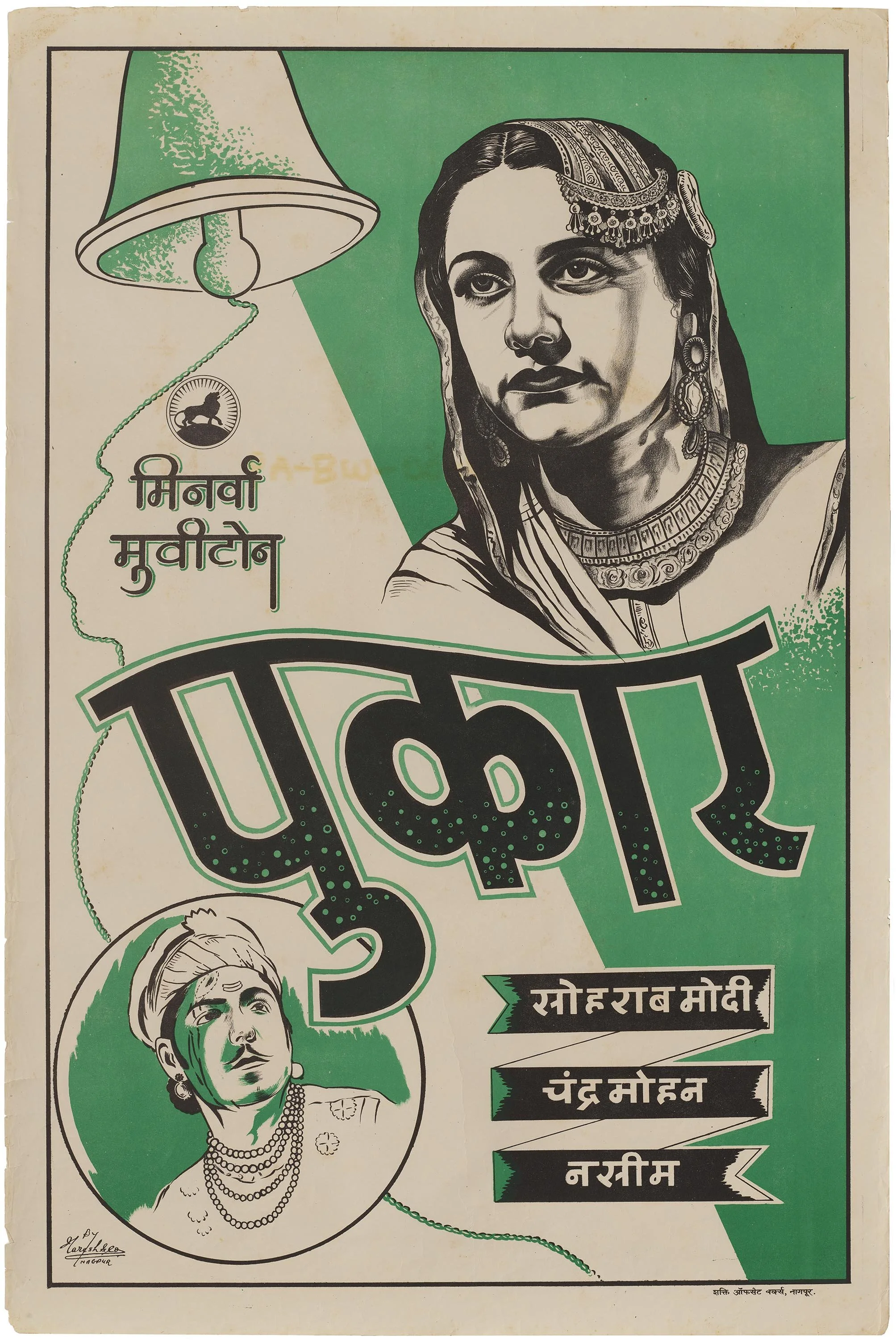
Movie poster for Hindi film Pukaar (पुकार), Nagpur, ca. 1939. Two-color offset printing, Naresh & Co. (illustration), Shanti Offset Works (printing). A love story à la Romeo and Juliet is set in the court of 17th-century Mughal ruler Jehangir.
Image description: Black and prairie green ink on pale ground, a detailed and complex illustrated portrait of the female protagonist with a wistful expression dominates the upper right quadrant, while a small portrait of the male protagonist is set in a circle in the lower left corner. A large bell is “ringing” in the top left corner, its pull-cord winding down through the credits to the bottom edge of the poster. The title, in chunky, curving, black Devanagari script dotted with green stipling, splays out across the center of the composition.
*
Once, at the ruins, when it was just the two of us, D asked me about cities I had visited. I rattled names of foreign countries and the many restaurants I had been to, describing prawn cocktails and strange flavours of ice creams in bustling European marketplaces. I described the air-conditioned interiors in the five-star hotels I had stayed in, majestic buildings with dome-shaped hallways and stained-glass panels. D had been a silent listener, adequately enthralled by my elaborate descriptions. It took me many years to realize that a gulf separated us—segregated geographies and splintered childhoods marked by unequal geometries of capital.
He later told me he had grown up in a one-tenement mud-walled hut in Gujarat. Even as his home withstood a massive earthquake, it had been razed to the ground by an angry Hindu mob in the 1992 riots. Overnight, the thirteen-year-old boy had transformed into a hearse driver. Their village headman entrusted him with the responsibility of transporting the dead bodies to unmarked graves in neighbouring villages—places these bodies had never travelled to when alive. D collected all their belongings, rifling through their pockets to find crumpled love letters, wallets filled with notes, and sometimes imitation gold wedding rings. He stored these items in glass jars, labelling them with whatever identifying markers he found on their bodies.
I remember the evening when D finally opened up like it was yesterday. The crescent moon poured onto the marble slabs at the ruins, magnifying our shadows in the gleaming dark. The rustle of cicadas in the thicket offset my voice, hoarse from crying, while D looked on—not a tear in his eye, luminous under the moonlit sky. I nudged him to say more, willing my heart to turn into stone in preparation for Aisha’s entry. I knew they were connected in a way I couldn’t access—her presence in his life and now in mine an inevitable movement in this trajectory. D recoiled from my insistence to attach myself to his story, like a fly on the wall impervious to gravity but hungry for the spoils.
We were seated cross-legged on the mausoleum floor, our backs to the round white centre pillar, sharing a packet of sliced Britannia fruit cake. D didn’t eat much of my packaged stuff. Initially, I thought I could tempt him with cardboard pizzas, fizzy colas, and packaged fruit cakes, but he always preferred his rolled-up parathas in his rectangular steel tiffin box. Most days, he just consumed that without any accompanying side. Sometimes, there were curried potatoes and pickled mangoes. Sometimes, he ate my food to stop me from bugging him too much.
“What was it like? Archiving dead people’s things?” I inquired.
“It makes you conscious of being alive,” he said, lost in thought. His eyes furrowed, concentrating on something far away, his cheeks flushed in remembrance of a particular memory I couldn’t physically access.
“I don’t think I could have lived if I didn’t meet her. At times, the glass bottles got too much. It was like I was carrying all this excess weight, these inanimate objects making all these sounds as the truck hit one potholed road after another.”
He had found Aisha on the floor of a burnt hut. Wrapped in dust, curled up in a fetal position, her tear-stained kohl bloodshot eyes stared into his face with a look he said reminded him of someone dangling at the edge of a precipice.
“But she also possessed this uncanny vitality, injecting life into everything she touched,” he said, suddenly animated, as if whipped up by unexpected force emanating from an elsewhere beyond the ruins. His words rippled through the dark, making me conscious of my inadequacy. What I felt then was not longing for an object beyond my reach but for something more profound—the coiled gravity of a presence that could discharge the loneliness from my body, cutting into my flesh like a blade on my exposed skin.
I knew all this about him after he first introduced me to Aisha. He had revealed himself to me, peeling away the layers, trimming the fat from the bones until only his abject form was visible. Yet, I had hoped I would be the life force in his veins. It didn’t take me long to comprehend the reality of my situation, my knowledge a beating heart on the palm of my hand—that I had lost all possibility of any story with him when I disrespected Aisha. What was there to say after that?
*
Some days, I crept into the ruins after dark, slinking in the shadows, watching him and Aisha from a distance, desperate to be seen by him the way he saw Aisha. Sometimes, I was aware of my voyeuristic third presence, aware of how a propulsive nameless being had taken hold of me with a burning sensation in the pit of my stomach, in the back of my throat—a feeling that left me wrought and rooted in its grasp.
D was a different man in her presence. They sang and danced amidst the ruins, their laughter bouncing off the dome-shaped canopy of the abandoned shrine. Once, D turned on an antique radio with protruding dials and an antenna. Shamshad Begum’s lyrical melody filled the air lighting everything in its presence with a joyful verve, detonating the otherwise calm with a singular energy that hovered over their frames like an aura of everything beautiful and glorious in this world. Aisha ran down the marble stairs, gathering her voluminous skirt around her, going round and round, increasing her pace, till everything was a blur, her long hair wrapped around her face, her mirror-worked skirt glinting in the dark. He watched her from the top of the stairs, fixated on her frame with unadulterated happiness. All I ever wanted was to experience a fraction of that in the coming years—to find myself in a frame filled with that kind of light.
One day, I got into another altercation with my mother over a major affront: I had stolen five hundred rupees from her purse. I also removed a silver box from my father’s study. This was supposed to be my peace offering. I hoped I could win Aisha over by buying her a gift and then worm my way back into D’s heart. In the evening, I ran towards the ruins as if by muscle memory, my tired feet dragging a cloud of dust behind me, my tangled hair billowing in the air, and my chubby frame plodding forward with unexpected levity. This time, I was determined to be seen.
I settled myself at my usual place, waiting for D to arrive. Ten minutes after six, a familiar figure trundled in, lugging a heavy steel trunk filled with the day’s findings. He staggered backwards as he saw me like it required effort, like he wanted to pack in space between me and what I presumed was my toxic influence. I ran to him, my eyes pleading, desperate to make amends. As I stood before him rehashing my tired rehearsed speech, I knew that words weren’t enough to mitigate the hurt and disappointment. The bond that previously existed between him and me had been made available to me for friendship, but I had breached the sanctity of that space by hurting the love of his life. Nothing could mitigate the pain I had caused. My own words sounded hollow to my ears as I tendered my apology.
After what felt like an eternity, he softly laid his hand over mine, smiling his open-hearted smile that I had grown to love. My heart broke into a million pieces even as he made it known in our shared language that he had forgiven me and would make space for me again. Soon, darkness gathered, enfolding us in a curtain of silence with crickets gathered atop our heads, flapping their wings in rhythmic motion. Aisha made her way toward us around eight. I saw them exchange glances, talking in a dialect unfamiliar to me. He probably communicated that he pitied me—this lonely, upper-class, arrogant teenager who could have the world at her feet if she wanted, but not the love of the one she desired—this pathetic being!
Aisha sat beside me on the other side, instinctively placing her arms around me, squeezing my shoulders. I remembered the five hundred crumpled note in my dress pocket, feeling disastrously small that I had even considered that I could buy her affection. She was much bigger than that. She was a gorgeous ship, banners unfurled beside my barely afloat makeshift raft. I desperately craved space on her ship.
That moment is frozen in time. I will always remember us three on the brink of a dissipating world, across decades of future fascist regimes, and across my belated arrival at some sense of class consciousness, when I took the much-coveted step across the high seas, climbing over the safety net that separated me and the ruins from everything else. I will never forget that at this moment when we were young, we surrounded ourselves with a band of unconditional love; the fiercest, the most glowing iteration of it. And that in this space, despite my class, privilege, and access to material possibilities, D, Aisha, and I were bound together in a friendship that would be impossible to fathom in the coming years.
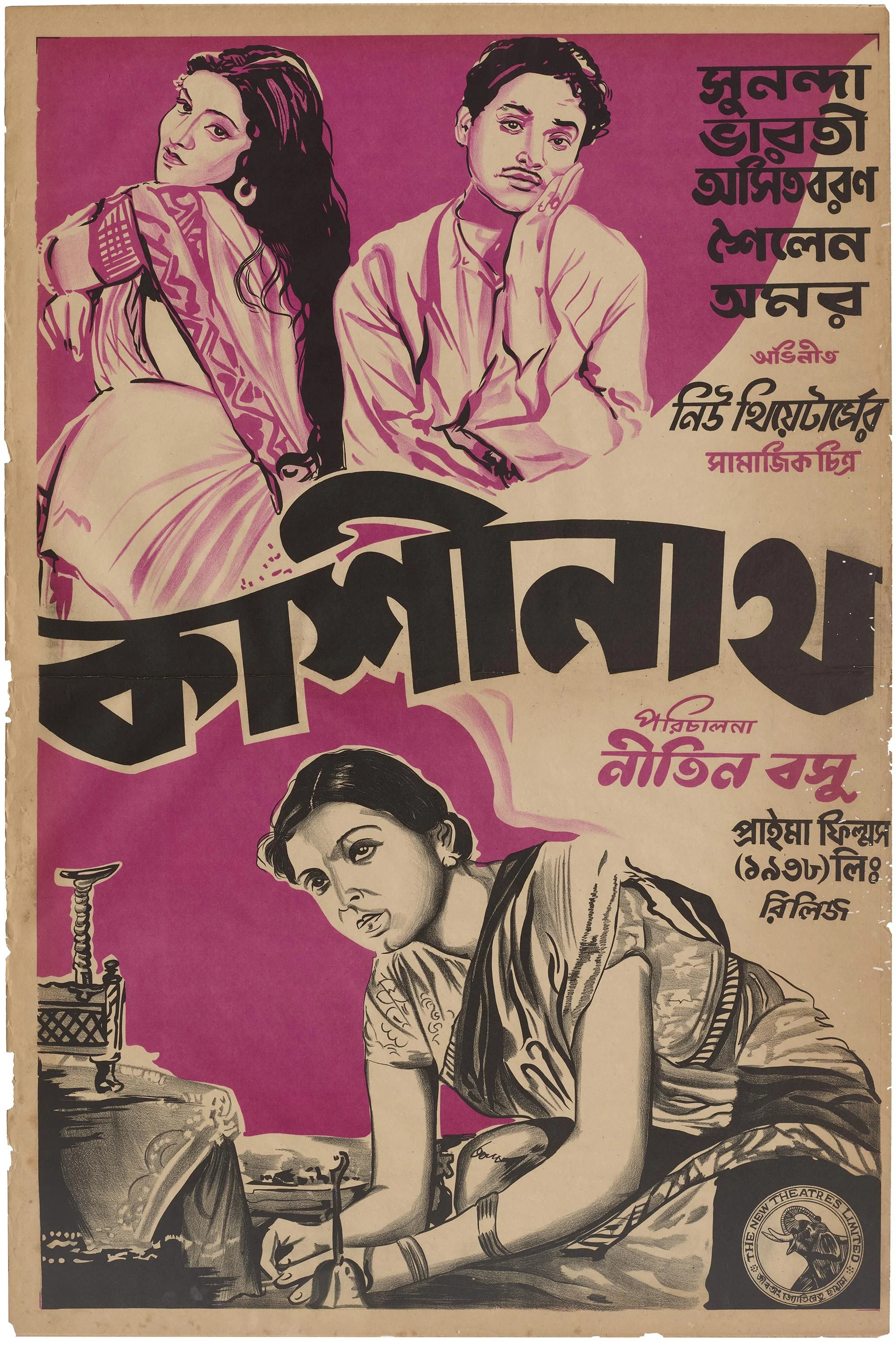
Movie poster for Bengali film Kashinath (কাশীনাথ), ca. 1943. Two-color offset printing, illustrator and print studio unknown.
Image description: Magenta and black ink on pale ground. The title in large, curving, black script, flies across the center of the poster, dividing the composition in two halves. A detailed, complex illustration of a seated woman in a sari and a man (two of the three protagonists), dominates the upper half along with credits in black Bengali script, their expressions relaxed and care-free. Below, a crouching woman in a sari gazes upwards with a look of consternation, or perhaps worry… or longing… or regret…
Amrita De is a Visiting Assistant Professor of English and Comparative Literature at Colorado College. She specializes in masculinity studies and global south literatures. Besides working on her first academic monograph on postcolonial Indian masculinities, she is also wrestling with a novel of ideas and a set of interlinked stories. Her creative works have appeared in Café Dissensus, Aaduna, Muse India, Cerebrations, Snarl, Barricade, Hong Kong Review, J Journal, and are forthcoming in other literary magazines.
*
Indian movie posters displaying graphic design and typography across several decades (1939-1967). For more information, analysis, and images visit: https://letterformarchive.org/news/indian-movie-posters

“Last names come first in Japanese, you racist piece of—” a brawl, a funeral, and a stolen father in a short story by Jay Lindstrom.