
Babli’s Home
By Mayookh Barua
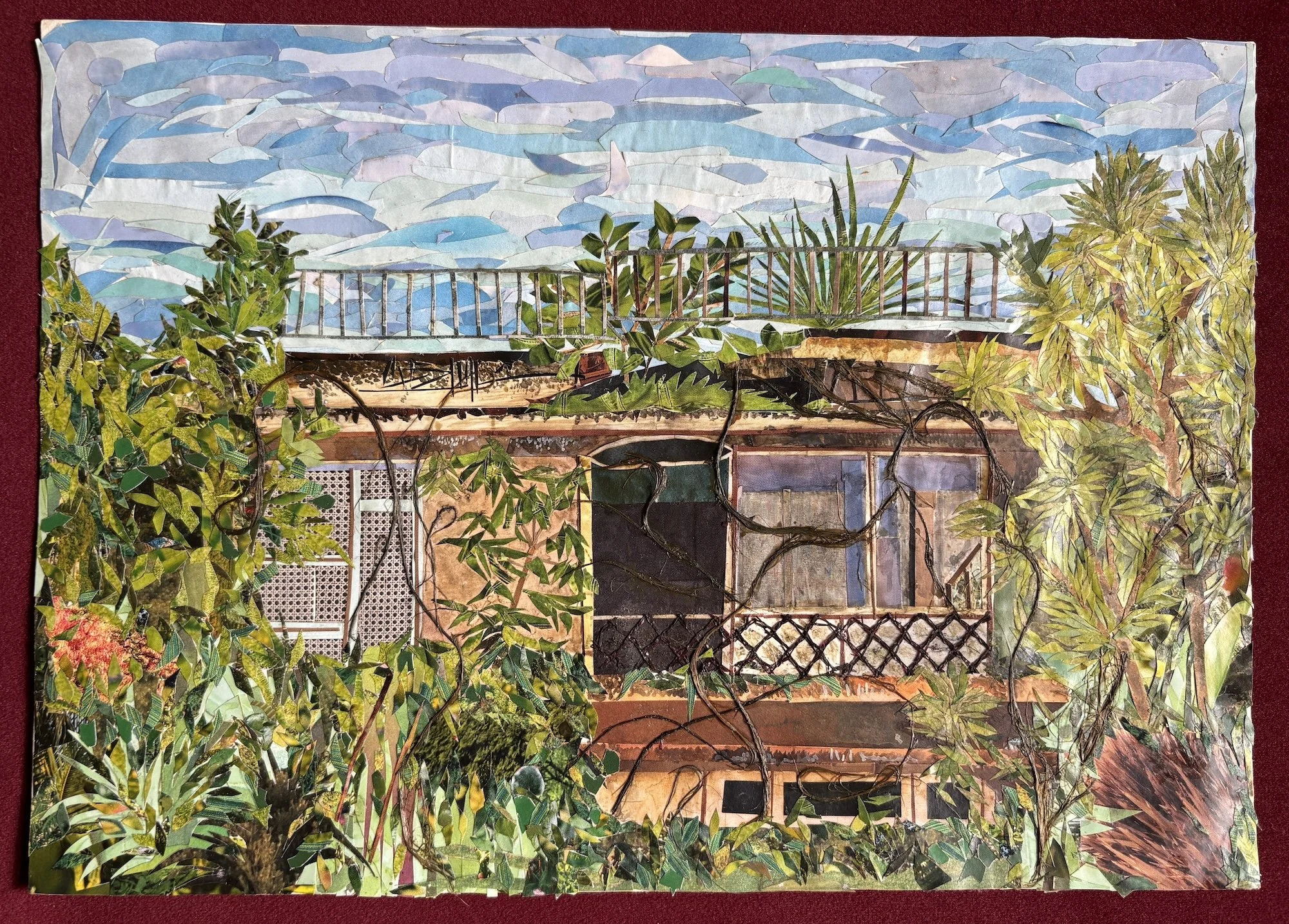
Yushi Chau, Abandoned House: Hauz Khas, 2024. Paper pasted on paper (collage). 21 x 29.5 cm.
Image description: Collage composed with colored papers depicting an abandoned house wildly overgrown with green vegetation, under a pale blue sky.
Five days ago, Babli had landed at the Guwahati Railway Station. She was hungry, browbeaten, disillusioned and mildly nauseous as she lugged her bag forward. The black duffle, which only had three sarees, two blouses and a few letters from Rubina, hit her shins every time she took a step. But she moved on to where the autos were standing. The letters had the address of one of her distant cousins, Rubina. Rubina and Babli were childhood friends. That whole train journey, Babli did not sleep, talk to anyone, or take her face out of the blanket. She was well versed with warnings about how men could claw her out, during a twelve-hour journey, into nothingness. Instead, she tried to imagine Rubina’s face. How excited Rubina would be to see her, and all Babli had to do was wait till then.
On reaching House No. 51, Krishna Prabha Path, Beltola Tiniali, she flung herself onto Rubina, who was sweeping the stone steps of her grilled house. Babli cried on the shoulders of the woman who had, in many letters, expressed enthusiasm to see her in person and show her around Guwahati. The city and its busy people. The noisy Sunday market and the always under-construction Vishnu temple, which Rubina said looked better pink than blue. Babli wanted to see it all.
But on the stone steps, Babli sensed that Rubina’s other shoulder, the one she was not clinging to, did not fold into her body to embrace her.
“You never told me you would be here,” Rubina said. “You could’ve written and warned me.”
Babli stopped crying. She rubbed the snot with the end of her yellowing saree, rancid with her dismay. The red veins in Rubina’s eyes threaded towards the black pupils. Her mouth was agape, empty with words.
“I didn’t know what to say baideow… you wouldn’t believe… I had to leave because Lenu already had…” Babli wiped the tears on her empty wrist.
“Babli, this is outrageous. You can’t just speak about your husband to other people like that. You should’ve worked something out. There is never any reason to leave.” Rubina sat on the wooden dining table.
Babli looked at Rubina’s knuckles, which were moving about under the skin, strumming the air with indecision. “I have nowhere to go,” Babli said, clutching her petticoat and holding back her grief.
“I can’t just have you over, Babli. I have a completely different world here. This is not the village.” Rubina sighed.
“I can work, if you want. Anything you say. Anything.” Babli’s voice quivered. To enter the world of a family woman was like cracking a stone open. A green Maruti 800 grunted into the driveway, and a man waved with two children trying to steer the wheel with him.
“Alright, I don’t think I have time to discuss anything now. And I can’t, at any cost, have the wrath of Krishna on my children. You can stay here as a guest. But you will have to figure something out. And by the way, we don’t have an extra room, so the living room floor has to be it.” Rubina started walking towards the car, out from which came a gaggle of running school shoes.
As months passed by, Rubina became more cordial. The kind of pleasantness that came from knowing a benign cough, albeit uncomfortable, would be gone in time. But it was never like in those letters anymore. Rubina’s words did not have the tenor of ‘Babli you have a place here’, ‘Babli for me you live right here’, ‘Babli your letters are my relief’. Babli recoiled at Rubina’s smile now whenever they came in touch while doing chores.
Of all things, she hated the moon and its fickleness. It bothered her how, despite her disdain, the moon managed to trickle into her eye and steal admiration. Oh, she hated that even more and spat on the floor—thu, thu, thu. Nature, she understood, changed and came back to familiar things all the time. This quick-footed nature of meaning gave her heartburn. How words and gestures changed with time and place. How they accrued different shades of promiscuity. As if there were many kinds of promiscuity. Not all of them were equally painful. But some made one question the world. Rubina’s smile was one of them.
Once, while hanging wet bed sheets under the summer sun, Babli asked, “Baideow, what do you think about me staying here for some more time?” Babli chuckled, just to make sure she had an entry to say she was just joking in case Rubina did not take it well.
“I don’t know if I would prefer it. But there is space in the house. And the kids love you.” Rubina said and beat a towel in the air, spraying the smell of detergent on the front porch where the colorful nylon wires were strung out.
Babli looked at Rubina to see if what she meant was true. Maybe Rubina was so busy putting pink clothespins on the ends of different folds that she forgot to express contempt.
“You have to figure out your life, Babli. I have a home to take care of.” Rubina said, and left with the green plastic bucket on her hip.
A home to take care of. Babli thought about it. She walked into the house and rubbed her fingers across the white plaster of the foyer. They were chalky with dust that smoothened her fingers, wrinkled from washing clothes. She touched the wood of the furniture in the living room, stained the color of coffee with varnish. She noticed the crayoned stick figures made closer to the floor in different parts of the house like raisins in a kheer, waiting to be found. She listened closely to the bolt on doors opening and closing like the click of different joints in the body, ensuring movement. This was all it took for Rubina to do what she wanted. She had a house to fall back on. Something real and concrete that kept other distractions at bay. Maybe people did what they wanted, like shifting between emotions, because they had the arms of a home to hold them together.
So Babli planned for a home. She marked job adverts that came in squares on the last pages of the Assam Tribune with red circles. Tired of being grateful to Rubina, who had in all her silences only wished for her departure, Babli began to draw houses along the two inches of the newspaper while biting her lips. That emotion called gratitude clotted all patience in her. To expend her anger, she washed the dishes, squeezed wet clothes, cooked snacks for the kids, and watered the vegetable garden to keep from feeling like a burden. She enjoyed some of it on some days. For four months, while married to Lenu Saikia, the village accountant, she didn’t have to do anything. At the age of twenty-one, she had a hibiscus garden, udders to steal milk from, silk sarees from guests all the way from fancy towns like Tinsukia, Dibrugarh, and Jorhat, and most of all, sleep. A copious amount of sleep, which she gathered like mangoes in June. Eventually, just as too many mangoes, however sweet, upset the stomach, too much sleep got to Babli. Lenu never slept beside her. Instead, every night, he made his way to Gita’s room, the one introduced as a distant cousin. Gita’s bedroom door creaked the loudest when opened, so all kinds of entries were audible. Before Babli had to change her body to bear a child, she took whatever skin and shame she had and ran. Ran till the lights of the village became those of the city.
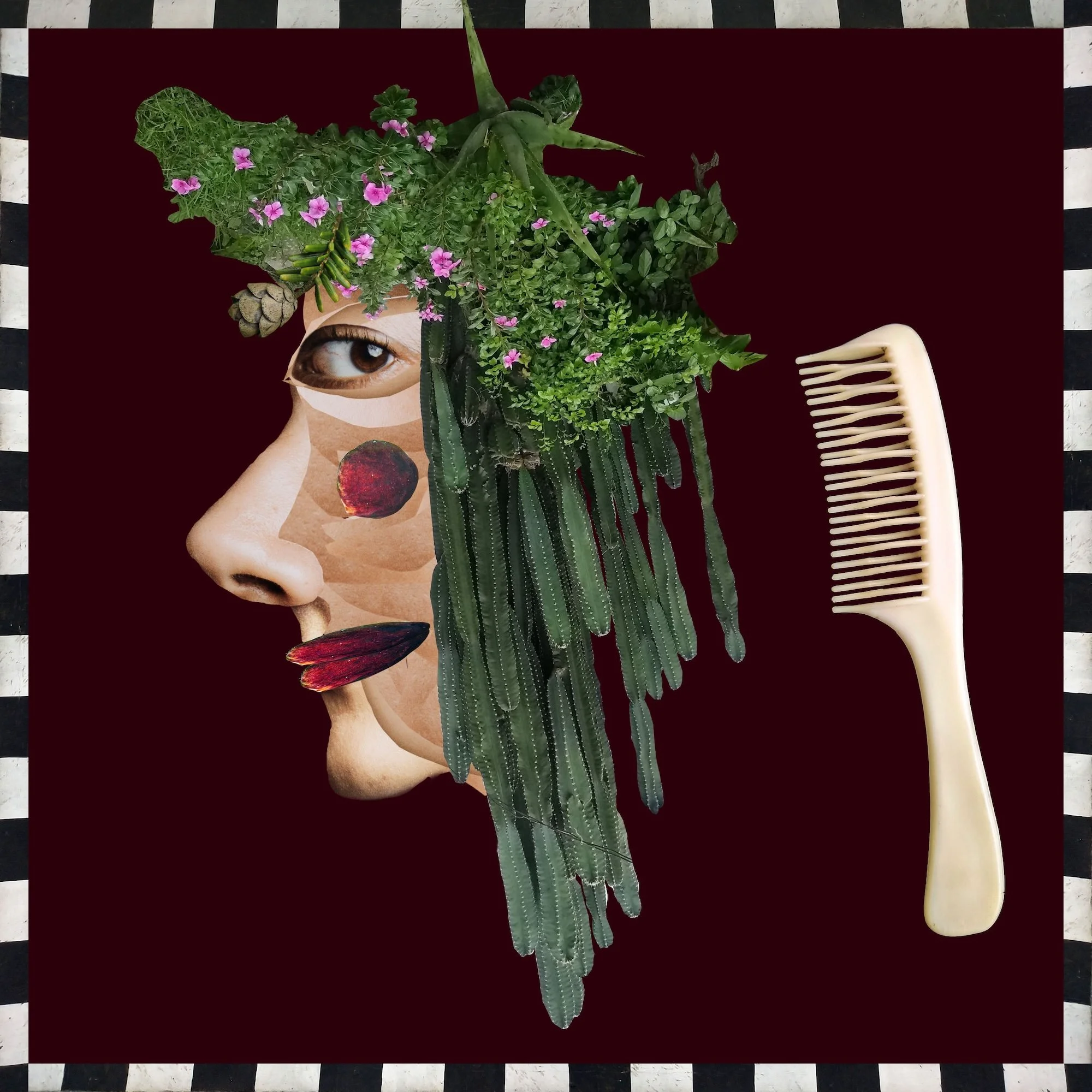
Yushi Chau, Self-portrait from Parallel, 2020. Digital print on archival paper. 30.5 x 30.5 cm.
Image description: Digital collage of a woman’s portrait in profile with cactuses and flowering plants for hair and a comb; her single eye trains on the viewer.
In the city, her blouses grew dark around the pits from the sweat it took to go from one part to another on the bus. She wanted to spend as much time out of Rubina’s house as possible without getting kidnapped. She didn’t feel like an unwelcome guest in the city streets. She found comfort in the familiar smell of hot garbage right before the fishy Dighalipukhuri, the water hole in front of the High Court for secret lovers. She walked along the pond water with her handbag full of money right under her arms, eating buttered corn with a toothpick. She stopped to buy soan papdi from a cotton candy man. As a child, she had begged the cotton candy man to give those delicate cubes for free. But now, after selling much of her wedding jewelry, she paid for them and relished it.
Eventually, a call came from the Assam Housing Board to interview for the position of a Development Liaison Officer. The day of the interview, she wore a blue blouse and an aquamarine saree from her trousseau. Once she reached the Housing Board office, she noticed that all the other female applicants were adorned in pastel sarees. Her stomach groaned when a squeaky-voiced young man called her name. In the future, she would know him as Hiren, the man who would provide her with the reason to have a house of her own. She would feel sorry for him but never apologize. On entering the Director’s room, she took note of the slim man wearing an oversized brown blazer. Director Sir’s fingers were lean from the force with which he flipped papers. His rectangular glasses were so thick that he appeared to have four eyes. He looked at her with all of them and said, “Miss Babli, as you know, the Housing Board is committed to making sure people, real Assamese that is, and not illegal immigrants like Bangladeshis, get housing. We are looking for someone who can speak English fluently. They need to be able to speak with everyone. They have to be very sharp in checking if those applying for subsidized housing meet the application requirements.” He licked his thumb at the turn of each document. He had the countenance of a man who took to morality like a palate cleanser.
She imagined how she would do the job. Maybe she just had to look for people like her. The ones who ran away from their supposed homes for whatever reason but were now scrambling to have a decent night of sleep. Those who were desperate to have a place called home and not have the shadow of an intruder walk behind them.
“I understand Sir. Like I said I was just a teeny bit away from getting a distinction. I am even planning to take English-speaking classes.” She looked at herself in the glass on the bookshelf behind the man’s table while making a promise she hadn’t thought about before.
“What did you do in the year between high school and now?” He finally asked, having found something to complain about.
Babli remained quiet. Sweat pooled between her breasts, “I was trying to find a job I could dedicate to.”
“Doesn’t seem like you have done a good job at that, right?” A silence came between them.
“Alright.” He smiled and slammed her file on his lap. “We will let you know if you are selected. The door is to your left.”
Nobody warned Babli that hard work also resulted in humiliation. She went to Rubina’s place, disheveled in a bright saree. She went to the bathroom and splashed the cold water across her warm flesh. Then she cried, hugging her thighs and making herself into a ball. She cried till a certain kind of hunger pushed deep into the cavity of her body. A week later, Babli was working as the Development Liaison Officer. Through the grapevine, she heard that the job had earlier gone to a woman whose English was possible only after going to Convent School. But then she had to get married and rejected the offer. Even though Babli was twelfth pass, the lowest qualification, she was the only other candidate who could speak English without fumbling at every turn.
The first day at work, Babli opened her Bata chappals and rested her feet on the stretcher. She yawned while Hiren gave her instructions. He was doing the job of the director’s assistant, Makhan, because Hiren just knew the work better, or so people thought. She looked at the first application. There were only meager details. Biometrics like height, weight and eye color. Why would anyone have any other eye color besides black she thought and if not, why ask them? Then there was stuff like jobs held, number of family members and educational qualifications. Sometimes when an application confused her as to if they were illegal or not, she kept it aside. But then that aside-pile grew louder and louder. Soon she started rejecting applications based on language, place of birth, and income. And then she stared and stared and stared at the pile that she rejected for housing.
Three months later, she had enough money to move out. Before she left, she tied a wad of many rupees, that she got from the selling of the last portion of her wedding jewelry, into a gamusa. She made multiple tight knots, so it took Rubina some time to open them.
“What is this?” Rubina asked.
“My debt,” Babli said, and smiled.
Rubina looked confused. “You know Babli, you can always come back here.”
“Baideow, you know you can only come back to places which you lived in once.”
“Don’t be silly Babli. What are you talking about?”
“Nothing, I just want to live closer to work. Besides, the kids are growing, they need more space to cause trouble.”
Rubina kept quiet and stared into Babli's fist, which held her black duffle bag firmly.
“I just want to ask you one last thing before I leave.”
“And that is?” Rubina kept the knotted gamusa on the dining table.
“Why did you let me stay after all?”
“Don’t ask me these things now.”
“But why not? You could’ve asked me to leave.”
Rubina sat on the wooden chair and rested her face on one of her palms. “You will understand later in life what it means to keep a fugitive at home.”
The word rang through Babli’s head again and again till it became an ulcer, fatiguing her. But eventually she understood that if anything, a fugitive had a new chance, different from the life that had been lived. Decades later, when Rubina’s husband died and her kids were in faraway cities with their own families, Babli would whisper fugitive in Rubina’s ear as she slept from a knee replacement surgery. In a delirious bout on painkillers, Rubina would tell Babli that everyone knew about Lenu and Gita. But they thought Babli would tame Lenu. A wife was sour in the milk of a man’s arrogance. That Babli would curdle Lenu and bring him back to earth. And Babli on hearing this, would smile and make a ball out of eggs, butter, and rice to feed Rubina.
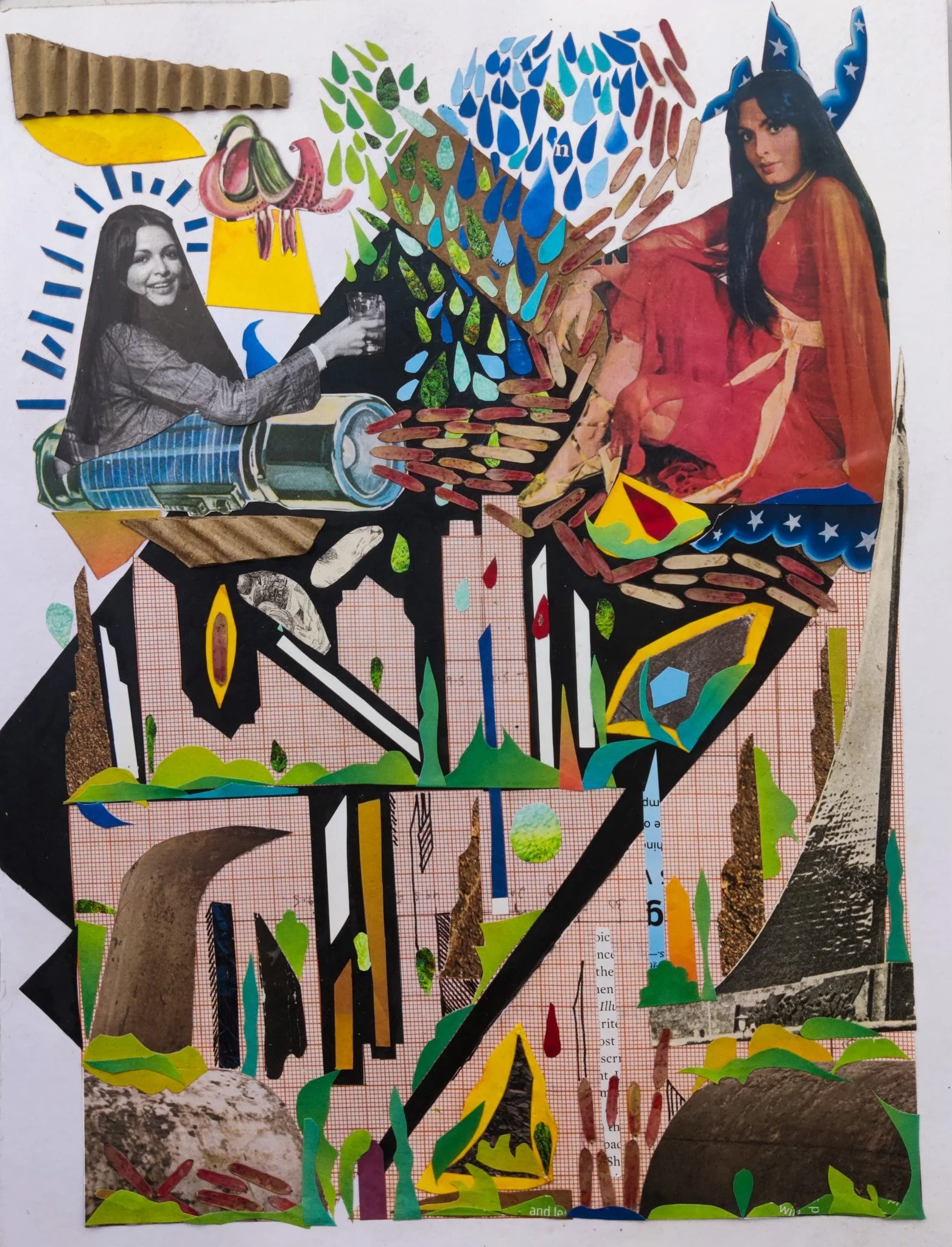
Yushi Chau, Anger and Parveen (1), 2023. Paper and pressed leaves pasted on paper (collage). 30 x 23.7 cm.
Image description: Paper collage depicting two women facing the viewer atop a vertical composition of many shapes and colors.
*
Five years after leaving Rubina’s place, Babli still lived in the hostel, annoyed at the college girls and their boyfriends. A truth had finally caught up to her—there was no way she could own a home. With her meager salary, she would have to kill someone to have a house. She was willing to kill. But then the Housing Board announced a scheme that made some houses available to their employees through a lottery. The caveat was that the nominations had to satisfy a need-based clause; either the nominees had to have dependents, like children and old parents, or they had to be long-term employees who had dedicated enough time and effort at work. Babli did not have any dependents. She had a strong couple of work years under her belt, but nothing compared to those who had toiled for decades on a broken chair.
After that, for lunch breaks, instead of looking at the different forms, Babli thought about how she could grab one of those lottery tickets. There was no way to become a star employee in the course of the next three months when the nominations were due. But she could find a dependent. She was revulsed at the idea of getting married again. Calling her parents back in the village was out of the question. They would either take her back to Lenu or ship her away to another man, not even marry her off this time. They were kind to educate her, but not enough to let a woman do anything she wanted. She could get someone from an old-age home. But which old person would she find roaming freely to do this kind of service? She could adopt a child. But single-parent adoption was not a thing. Maybe she could have a sister or a brother. Someone whom she helped stand on their feet. But where would she find such a sibling?
On their first meeting, the day of the interview, Babli noticed Hiren’s loose cotton shirt and the two spots of paan hanging on his chin. Babli did not take him for much since then. A short, stout man who barely reached the top of the door of the white Maruti van he drove Director Sir in. A man whose whiskey breath catapulted everyone around him. His large, hairy forearms hung out of shirt cuffs, which Babli once saw wrapped around Makhan in the corner of the parking lot. There was something about the way they moved their hands that incited her suspicion of something other than friendship. A nerve sprang from her feet to her thigh when she saw their laughter collide against each other like marbles. She wanted to know the rush of running into something viscous like their bodies against each other. During lunch, she sneaked to the parking lot and watched Hiren and Makhan. The way their fingers went across their shirts without opening too many buttons. The way one painted the other’s lip red with tobacco. Initially, she was disgusted. But she couldn’t stop thinking about it. She couldn’t stop going and hiding behind the red brick wall to lean in and in and in. Maybe this was what Lenu felt with Gita, or Rubina felt having her over—doing the thing that shouldn’t be done.
After the announcement, Babli went to Hiren and asked him, “What do you and Makhan do in the parking lot every lunch?”
“We just get food together. We are very close friends.” Hiren swallowed a ball of spit.
“You know, sometimes his lips are very red like he’s put lipstick.”
“Haha that’s so funny I have never noticed.”
“How would you, Hiren. Your lips are always red from paan too.”
Hiren looked around as if he was holding pee. “What are you trying to say?”
“I am not saying anything, Hiren. I am hoping Director Sir might…”
Hiren split the tobacco out before shouting, “You bloody cunt…” She has heard him swear at women before. The alcohol must’ve helped him with that.
“Look Hiren, don’t try to make it worse than it already is. You are what... twenty? You are the age of one of my sisters. I can help you out.”
“What will you help me with? You are here to blackmail me.”
“No, no you are taking it wrong,” Babli said, looking around. “I don’t think what you and Makhan are doing is wrong. But I am scared it will cause trouble eventually.”
Hiren thought for a bit with his fingers on his chin. “What do you suggest?”
“I can help you keep it a secret if you help me out.” Babli wanted to appeal to that part of Hiren’s body that understood that having someone on your side was better than not.
“I want to get the nomination for the housing apartment…”
“That’s not possible, you are a single woman without a dependent.”
“I know which is why I am asking you to help me with a dependent.”
“A dependent means a family member.”
“I have looked at it carefully. No clause in the conditions says a family member. And besides, what is a family, only something bound by blood?” Babli argued.
“I think so. But what do you want me to do?” Hiren folded his arms around his chest.
“I want you to convince Director Sir that you are my dependent.”
“That’s outrageous. He knows we are no such thing. And besides, his first question would simply be—What have you done to care for me? Huh?” He said, silencing Babli. “Look at her now. Big little missy telling me what I should do and thinking she knows everything. But see, life always wins over hubris.”
Babli’s ears grew red, but the weight of the pink garnet earrings kept her toes from flying into rage. “Fine, I have been thinking about that anyway. Do you cook?”
“What do you think I do to feed myself?”
“I mean, can you cook to sell?”
“No,” Hiren shook his head.
“Then learn how to do it. Because you will run the canteen for the office.” Babli walked away for Hiren to ponder.
A month before the nominations were finalized, Babli decided to get an appointment with Director Sir to tell him about Hiren running the office canteen. She had purchased samosas and pakoras from a place near her hostel, which sold food items that tasted cheap. She reasoned that Director Sir would take it to be from Hiren’s hand because it was tasty enough, but not fantastic. Hiren did not show up. He was in the back, fighting with Makhan after getting drunk. Furious, she opened her shoe to hit Hiren, but stopped. Hiren wobbled on his steps, trying to be Bruce Lee. She took his arm over her shoulder and walked him to a seat. She asked Makhan to get him some sleep. Babli then arranged for another driver to take care of Hiren’s duties for that day. She asked Director Sir for another appointment. He reluctantly did so a week later.
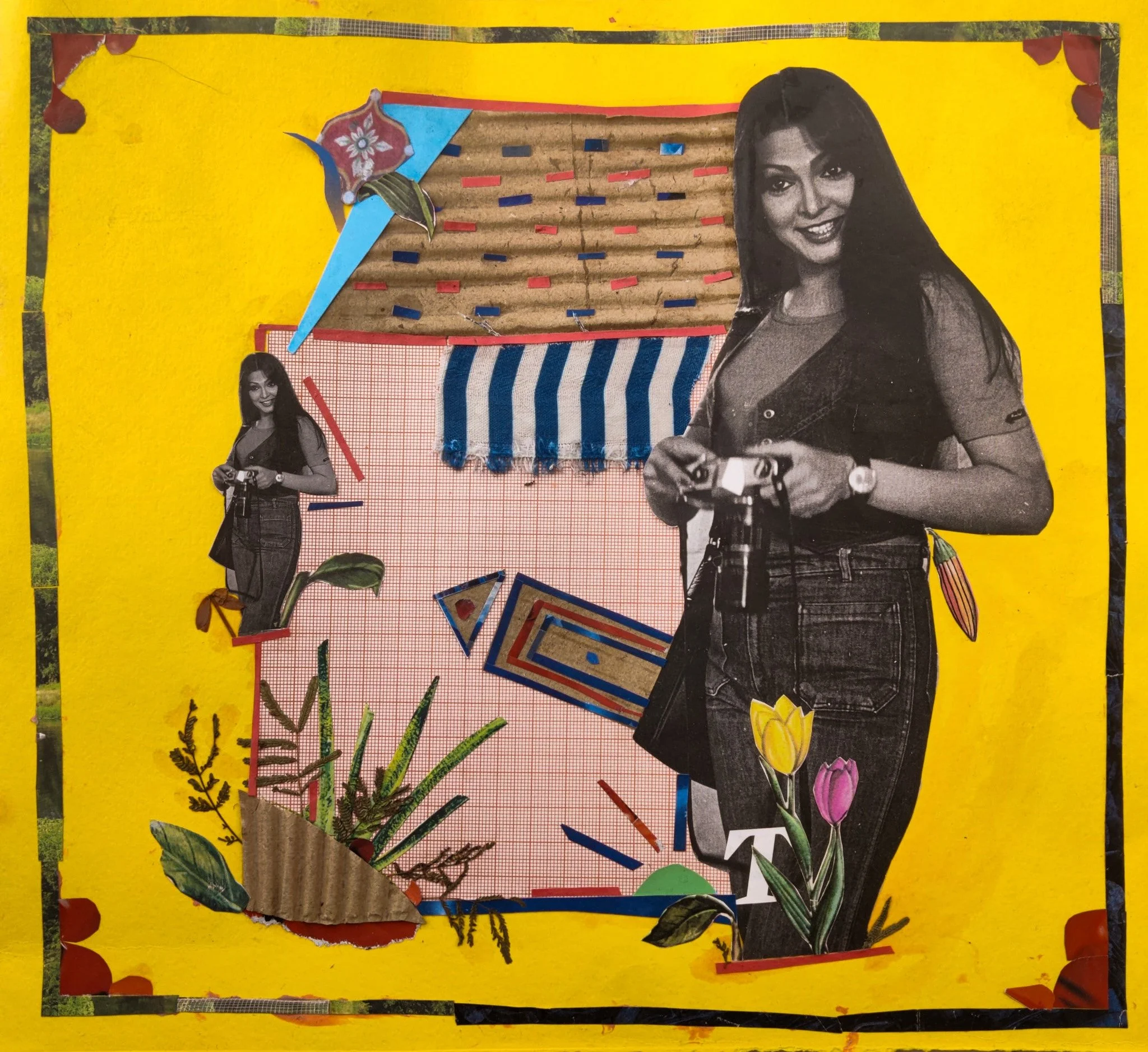
Yushi Chau, Anger and Parveen (12), 2023. Paper, fabric and pressed leaves pasted on paper (collage). 31 x 33.5 cm.
Image description: Paper collage depicting the same woman twice in a square com[position; she holds a camera with a long lense and smiles, while flowers sprout at her feet. A makeshift house stands behind her against a bright yellow ground.
The day of the appointment came. She had arranged for some delicious chai that Hiren would pass around as his doing. Again, Hiren’s eyes were bloodshot with whiskey. Babli could not wait another week.
She dragged Hiren to the storeroom by the collar of his purple shirt and asked, “Do you want a good life for yourself or not?”
He nodded without knowing what the good life meant. Babli opened the fridge, took out the large ice tray, and dropped them into a large steel bowl like pebbles from a riverbank. Then she poured some water into it to submerge the dome of ice.
“Dip your face in it,” she commanded.
“It’s cold,” Hiren put a finger inside it.
“You don’t get to complain. I can’t believe you are doing this again. You know how hard it was to get another appointment? I don’t care what or when you drink. One day. I just asked one day for that not to happen…You bastard.”
“Who do you think you are?” Hiren tried to be angry, but the alcohol confused him.
“Your baideow. Now put that head in.” Babli pointed to the bowl of ice.
“You’re not my baideow.” Hiren looked into the bowl and prayed to God before putting the head in slowly. Then quickly came out. “Alright, it’s done.”
Babli looked at his bloodshot eyes and said, “No, it's not.” She put her hand at the back of his head and pushed it into the bowl.
Hiren pushed her away. “Fuck off, you bitch.”
Babli’s ankle twisted, and she fell on top of the stack of chairs on the corner. Her saree had a gaping tear along the pin that kept the ends attached to the petticoat.
“How dare you,” Babli ran to Hiren and kicked him in his balls. He crouched and cupped his crotch. She pulled his hair and pushed him into the cold bowl. Babli held it in the water for five seconds. The way Babli grabbed Hiren’s hair reminded her of the grip she had on Gita’s hair, the day she had left the village. She had pushed the hair between the crevices of her fingers and then wrapped it around her bones like a snake. She wanted to squeeze all kinds of sugar and turn Gita into chunks of bagasse. Babli wanted to break something inside the woman who ridiculed her by taking away her husband. When Babli finally got hold of Gita’s hair. She turned Gita’s face towards her. She noticed the broken capillaries that made a network of rivers on Gita's cheeks. All of them were carved from toiling in the sun. Gita’s silken hair ran in contrast to the dirt on her feet. A certain admiration appeared inside Babli. It pulled her upright like the folic acid from a red ant. It puckered, swelled, and spread into the lining of her ribs. Babli could never be Gita. She would never have Gita’s eyes, softness, or moans. She left Gita’s hair. Maybe there was a place for both Gita and her to exist. Maybe that’s utopia. A place where enemies existed without killing each other. Babli felt a pain in her stomach where Hiren kept punching. She let go of his head and the bowl of water fell all over Hiren, and some splashed on Babli.
“It is only a matter of this meeting. You do this, I will do anything for you,” Babli said. Her eyes burned with tears. Hiren kept quiet. She wiped the water off his face with her handkerchief. A mop of hair dangled on his forehead. His pink face slowly became the color of skin. The collar of his checkered shirt was wet on one side. She squeezed the water out of it with her fingers and then pushed it inside his pants. “You might have to borrow a shirt from Makhan,” Babli said.
“Right, baideow,” He said without moving his eyes, which were wide awake and looking past Babli. Hiren stood up and left the storeroom, leaving Babli to the sound of wet feet.
She waited in front of the Director’s door and looked at her reflection in the frosted glass. She pulled out two bobby pins from inside her purse to pin her frizzed hair. She pressed the lavender saree with her palm to sharpen the pleat. She put a bindi on her forehead before some Little Pearl lipstick. She wiped the lipstick from the corner of her lips and rubbed it between her two fingers. They were stained with the color of brick.
Hiren came in with a pastel pink shirt. Babli spritzed some Mahogany Apple on him.
“It smells disgusting,” he said and flapped his arms like a bird in flight.
“I know. Just try to put a smile if you can.” She said, pushing his hair behind the fold of his ear.
He nodded and took the plate of chai from Babli’s hand. The chai cups chatted with each other as he moved to the Director’s door.
“Come in Babli, and make it quick. I have lots of papers to sign,” he said with his long nose pinned to the cardboard folders.
“It won’t take a lot. I just wanted to discuss the Hiren thing I had told you about,” she swallowed her spit.
“Yes sir. Babli baideow has been very kind…” Hiren put chai on the plastic saucer.
“This is cold, Hiren. Babli, remind me what this is about,” he handed the chai back to Hiren.
“Make him a new one, will you? Now go,” Babli instructed Hiren with a tilt of her head and eyebrows. She waited for a few seconds for him to leave.
“It’s just that Hiren is a good cook and we could benefit from a canteen.”
“Okay. I will talk to the board of directors to figure this out,” he said coldly.
“That would be great. Hiren has been here for a long time. We all will benefit from it…”
“As I said, Babli, I have lots of work. Just let Makhan know about it and he will keep a memo of it.”
Babli was at the end of the line. Her foot was already on the door. Either she kicked the door or let it snap her feet.
“So Sir… I also wanted to know… if I could put in my name for the nomination… to get one of the houses available for employees?” Her heart skipped a beat.
The man finally looked up from his file. “That is only available for employees who have dependents like children or parents. You have neither, Babli. Besides, aren’t you living with your sister and her husband? That will be better for you anyway,” he looked back into his papers.
Babli pulled her back straight and clasped her bag. “I know Sir. But helping out Hiren has been difficult while living with my sister. He is after all like my brother.”
“But why help him, Babli? Help a woman or something. I have heard about your kinship with him. Find a husband first and then do such social services… I can’t put your name in but I will see what can be done about the canteen,” Director Sir said, looking back into his books.
“Thank you, sir.” Babli bowed and stood up. She looked at her reflection once more in the glass door, but the light was behind her, so she just saw a shadow.
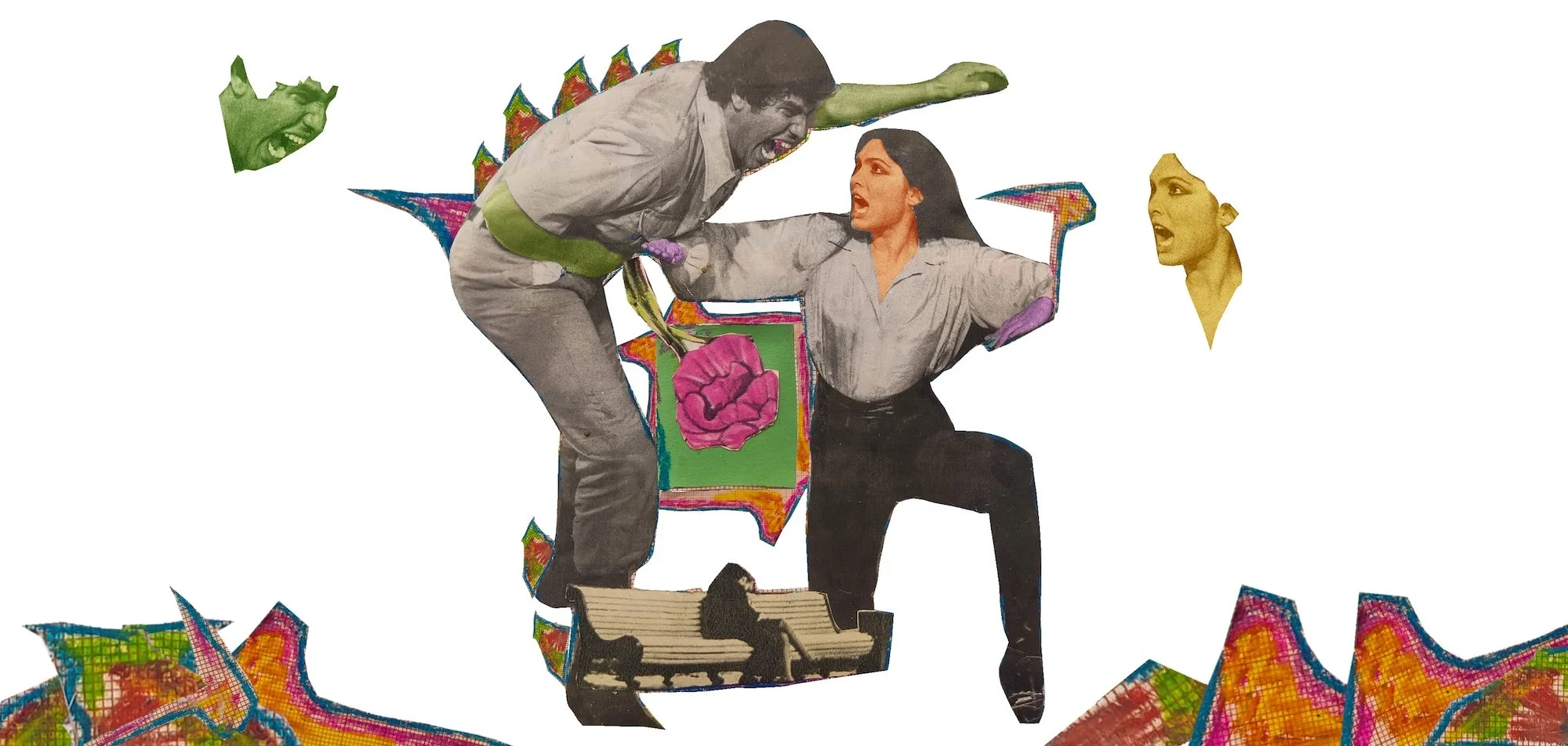
Yushi Chau, Anger and Parveen (123), 2025. Digital print on archival paper. 22 x 46 cm.
Image description: Cinematic wide composition: paper collage depicting a man and woman fighting against a white ground, punctuated by colorful elements.
*
Everyone was shown a floor plan of the house before the names were picked from the lottery bowl. The outline took the shape of the letter E. The living room had four windows and the bedroom six. A beam ran across the living room ceiling, separating the public from the private. Five four-inch bricks separated the kitchen and the bathroom. The bedroom windows looked out into the bright Guwahati skies. When Babli entered the home, she was astounded at the amount of sunlight that came into the third-floor apartment. She switched on the fan, and it blew the end of her pink saree, dousing her in reprieve. Hiren entered her home with her luggage. He decided to take a room in the apartment in exchange for putting in a good word to the Director privately and picking her name from the lottery. That dusk right before the sun squeezed into the hills, Babli opened her braided hair, which had grown to her hip, and combed it in front of the wind from the window.
Two years hence, Babli would find Hiren a wife called Simi. Simi would be closer to his age, adorn a lazy eye, and carry jugs of breasts. She would make him laugh. She would teach preschoolers nursery rhymes. Hiren would keep to his ways. He would get drunker and drunker and drunker. Babli would know he was meeting Makhan when she sniffed Mahogany Apple on him after she stopped using it. And then one day, Simi would get pregnant with oblivion. Babli’s palms would be the first to clasp the child, tight and warm in her arms. Her fingers would dig into the purple flesh. She would whisper in those tiny ears, “Fugitive, you’re home.” The baby would loudly cry, taking in all the oxygen.
Mayookh Barua is a Los Angeles-based writer from Northeast India. He is currently a PhD candidate at USC's Literature Department. His work explores sexuality, art, mythology, education, and family through a queer South-Asian voice. He is an Anthony Veasna So Scholar, Lambda Emerging Writer Fellow, and Roots.Wounds.Words Fellow and his work appears or is forthcoming in Michigan Quarterly Review, The Adroit Journal, The Pedestal Magazine, LunchTicket, The Audacity by Roxane Gay, and elsewhere.
*
Yushi Chau's creative work (https://www.instagram.com/yushichaushop/) begins with wandering aimlessly and ends with practicing playful-misplacement-of-meaning through collage, painting, drawing, animation, and writing. Yushi first started loitering in archives, then in cities, and finally in classrooms, so she could be an archivist, visual artist, and educator individually or all at once. Through her work she observes how societies inhabit, abandon, and transform their built environments. Elements of the past and present combine to become fantastical absurdist narratives (eg: the Indo-Persian dome of Bada Imambada merged with the Baháʼí Lotus Temple becomes a spaceship and quietly propagates a feminine-futuristic aesthetic), while she preaches how recontextualization and re-imagination in this fast-paced, AI-powered era of cultural production might save us yet. Amen. For additional info please visit: https://yushichau.myportfolio.com
“Last names come first in Japanese, you racist piece of—” a brawl, a funeral, and a stolen father in a short story by Jay Lindstrom.