
Blame it on Biscoe
By Kapil Kachru
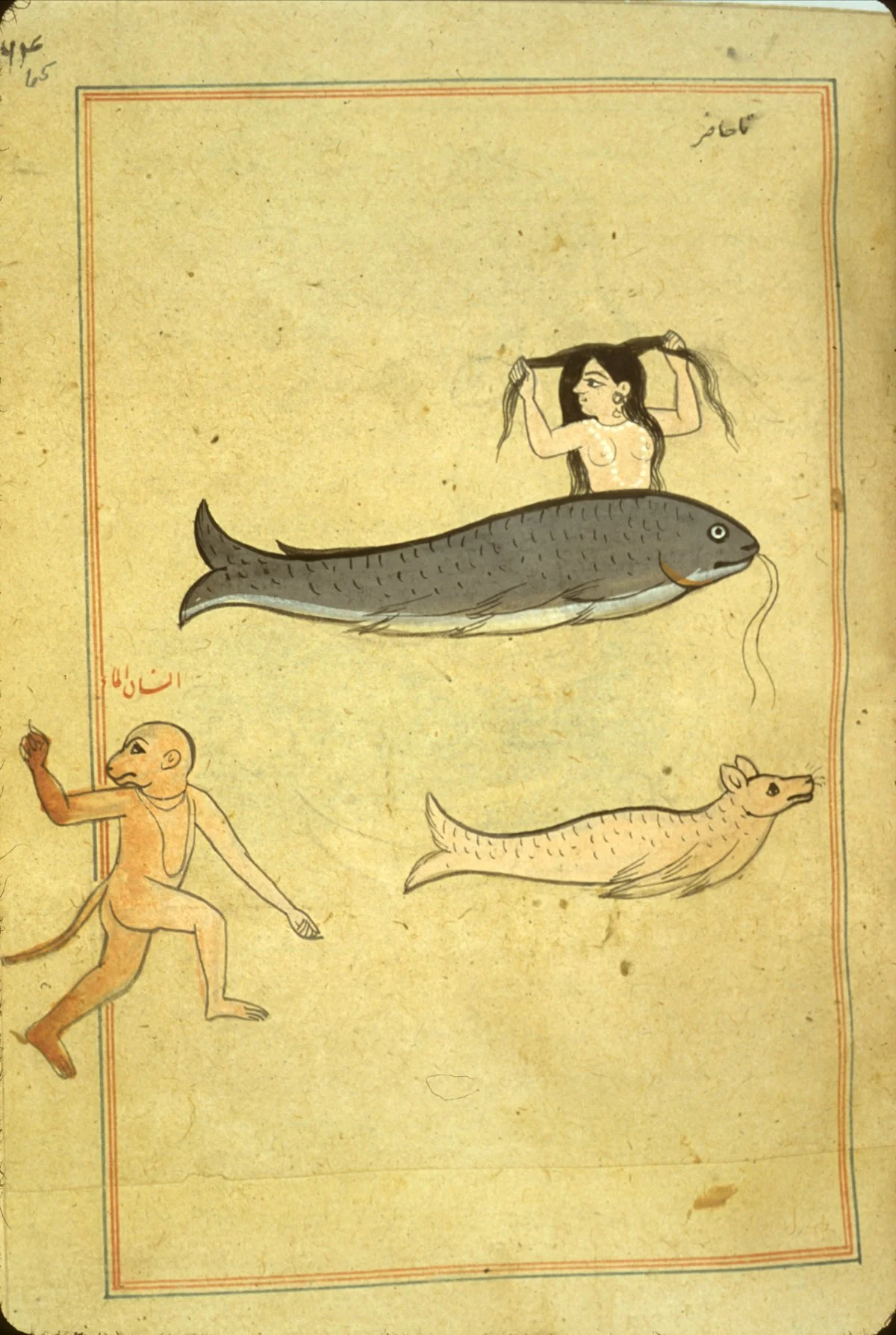
Marvels of Things Created and Miraculous Aspects of Things Existing, by al-Qazwīnī (MS P 2, fol. 65a). Punjab, c. 17th c.
‘Image description: Hovering above, a woman with long hair appears behind a large gray fish. Below her stands a monkey, labeled insan al-ma, (aquatic being) and a pink, dog-headed fish.
Here’s the thing about heavenly bodies. Planets, like people, have personalities, motivations and mood swings, which are beyond the grasp of modern science. One never really knows what keeps them spinning on their axes at any given time. Or when they will turn and reveal their dark side. For turn they shall, when the time is ripe, and the moment opportune. Hold on to your headdress, you’ll find out soon enough.
The average Kashmiri Bhatta may know precious little about astronomy. Still, he or she instinctively trusts it and treats it with decorum. The British, of course, are gullible enough to think of planets as graceful wanderers moving to the predictable harmonies of clockwork. They are such children when it comes to these matters. Kashmiris are more skeptical by nature. For good reason. They’re not on best terms with clocks and generally approach planets with caution, without romance. Let’s just say, nothing good comes from opposing their will. Even though everything has been arranged in careful accordance with planetary agendas, everybody agrees this is the worst possible time for a wedding.
It’s the last day of the usually elaborate five to six-day affair, which has unceremoniously been cut short by recent developments. Calling the situation grim would be optimistic, and yet, reality needs to get a lot grimmer to shut down festivities altogether. Once an astrologically auspicious date has been agreed upon, after months of deliberation, there’s no turning back. The planets don’t care for earthly politics. Down here, everything is taking place in strict accordance with time-honored tradition. Only a select few actually understand what’s happening, what’s being chanted, and why. But that doesn’t stop the show from going on.
*
It’s 1947. The last week of October. Chinars have shed their red-orange-yellow leaves, carpeting the earth with brittle fire. Not far from the ritual altar of arranged matrimony, three of the finest specimens of modern Kashmiri manhood, the cream of the vigilante Bhatta resistance, are walking down a dirt path in the dark.
Bamzai and Raina are side by side, almost in step, heads held high. Bamzai’s clutching an old rifle. Raina’s nursing a half bottle of the cheapest whisky available. Krundu trails behind them with downcast eyes, shoulders drooped, hands clasped behind his back. He’s genuinely dejected. It’s been gloomier than usual since the Qabalis disabled the power station.
“I don’t know why but I feel really happy today,” Bamzai announces, with the sincerity of a schoolboy who is too enthusiastic for his own good.
“You should be,” Raina replies. “That gun must be attached to your arm by now, you’ve been holding it so long.”
They pause for Krundu to pipe in. He has a talent for witty one-liners when he’s in the mood, which he definitely isn’t in now. The world’s bearing down on him with unusual cruelty at present. A wave of unease shivers down his spine. A bad sign. Good energy is supposed to flow the other way.
“Whom can I turn to at a time like this?” Krundu wonders. He looks up reluctantly at his companions. Bamzai pretends to pass Raina the rifle and takes it back at the last moment. Raina stretches to grab it but misses, spilling some whisky in the process. It may be the cheapest available, but it’s all they’ve got. Krundu sighs as he casts his eyes back down and continues in silence.
“Lost in thought as usual,” Bamzai chimes in, “our Bachelor of Philosophy.” The rifle is starting to feel heavy in his hand. He slings it over his shoulder.
“I know what’s eating his mind,” Raina adds.
“Qabalis, of course.”
“No.”
“No?”
“Definitely not,” Raina states with confidence, of which he never has any shortage. Especially when he doesn’t know what he’s talking about.
“Then what?”
“He’s coming to terms with the bitter fact that the schoolmaster’s lice-infested son will soon be making his sister moan with pleasure.”
“That village idiot’s grin will only get bigger,” Bamzai points out with relish. Krundu seethes with anger but doesn’t say a word.
“You got straight to the marrow of the matter, my friend, well done. Just for that I should give you the rifle. But I won’t. For your own safety, of course.”
“To hell with you and your bandook,” Raina responds, visibly irritated. “That rusty relic belongs in a museum. It will be a miracle if it works.”
“Oh, it will. Don’t you worry.”
“How do you know? You haven’t fired a single shot.”
“We have to be careful. Ammunitions are low.”
“What do we have, three bullets? Or is it four?’
“Six,” replies Bamzai, and reaches into his pocket to count. He feels a pang of shame and sticks his chest out to hide it.
“That’s perfect,” intones Krundu, to his companions’ surprise. “You should announce that to the Qabalis. They might die laughing.”
“What an idea,” Raina says, surprised by his imagination. “What if we could turn humor into weapons? We would destroy everybody.”
“Not in this lifetime,” Krundu replies bluntly. “We can launch all the joke bombs we want, but for them to explode our enemy must get the jokes. And I would not count on Pakistanis or Afghans living up to their end of the bargain anytime soon.”
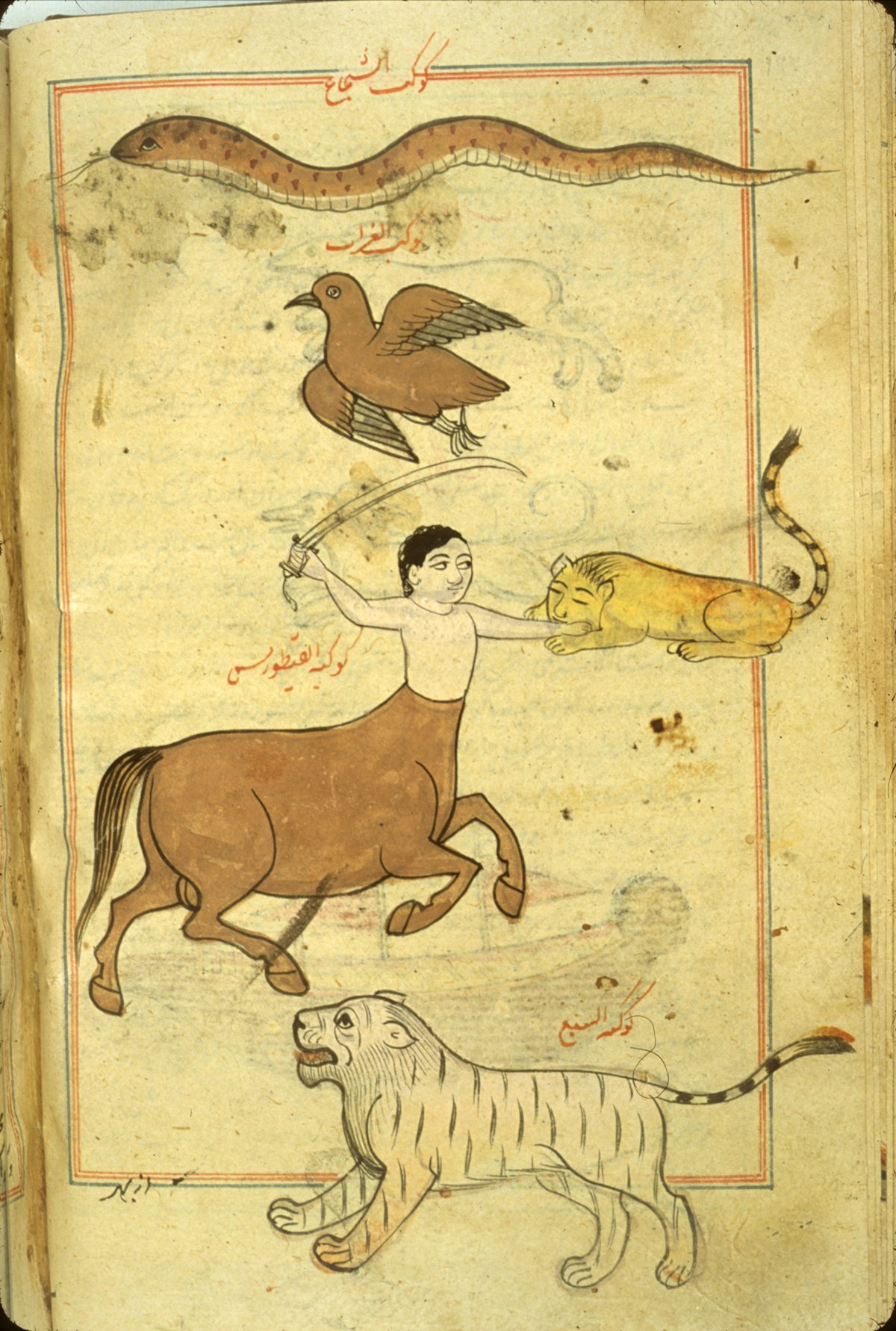
Marvels of Things Created and Miraculous Aspects of Things Existing, by al-Qazwīnī (MS P 2, fol. 24b). Punjab, c. 17th c.
Image description: Five southern constellations: at the top, Hydra, Corvus, Centaurus with Lepus appearing as a yellow, long-tailed cat; at the bottom, Lupus (al-sab‘, a wild beast) appears as a pink tiger.
“Bachelor of Philosophy has a point,” says Bamzai.
“In fact, it might backfire on us,” Krundu continues. “We might be the only ones who get our jokes.”
“Got it, Raina? No joke bombs. Now, pass the bottle.”
“Gladly. Give me the bandook.”
“Don’t be childish,” Bamzai protests.
“No bandook. No bottle.”
“What do you think, Bachelor of Philosophy,” Bamzai asks turning around, “should I accept the scoundrel’s terms?”
Krundu doesn’t reply. He picks up his pace and overtakes the other two. Bamzai slides the rifle off his shoulder and pokes Krundu in the back with the barrel. Krundu ignores him, but this only encourages Bamzai. He takes a few more jabs and prods Krundu in the ribs. Raina giggles uncontrollably. He’s clearly had more than his share of the cheapest whisky available.
Krundu snaps. He swings around wildly, yanks the rifle out of Bamzai’s hands, throws it aside and wrestles him to the ground. Before he knows it, Bamzai is on his back fending off a crazed Krundu who lashes at him like someone who’s been saving his rage for a special occasion. Raina seizes the opportunity and grabs the firearm. He watches with bemusement as his friends roll around in the dirt, though he can’t see in the dark. His bemusement soon turns to boredom, then concern that they might hurt themselves. Raina raises his voice to get their attention.
“Bamzai, Krundu, what the hell?”
The boys are too busy boxing each other’s ears to pay any heed. Raina raises the rifle and accidentally pulls the trigger. The first shot of the Kashmiri Bhatta resistance rings unsolicited in the still night sky. Raina gets out of the way quickly in case it comes back down on his unlucky head. Stunned, Bamzai and Krundu stop pretending to fight and untangle themselves from each other.
“Have you lost your mind?” Bamzai yells. He snatches the rifle back. Raina tightens his grip on the bottle.
“You know why the Qabalis did not celebrate Eid in Srinagar yesterday?” Krundu asks his companions and continues without waiting for an answer. “You know why the Pakistani flag is not fluttering above Jama Masjid right now? I’ll tell you. Because they’re too busy raping our sisters in the provinces. That’s why. The beauty of Kashmiri women is saving our skins once again, and what are we doing? Behaving like buffoons.”
“Take a sip,” Raina offers Krundu the half full bottle, “sounds like you need it.”
Krundu pushes it away right into Bamzai’s hand. He does what any reasonable man would, under the circumstances, and quickly takes a big swig. Who knows when he’ll get the chance again? Raina is ruthless. A damp blanket of silence settles over the company and holds them in its uncomfortable embrace.
A leaf crackles gently in the distance. Then another, crisper this time. Bamzai swings the rifle around and aims at the dark.
“Stop right there. Or I’ll shoot.”
“Don’t shoot! It’s me, Mushtaq, the gardener’s boy.”
“What are you doing here?”
“They sent me to get you.”
“Time for dinner already?”
“The cooks must be in a hurry to get home.”
“Best news I’ve heard all day.”
“I’m starving.”
“Tell them we’re on our way,” Krundu says.
“Wait. There is still some whisky left.”
“You know how I hate to waste.”
“It’s a sin.”
Bamzai and Raina dutifully drain the last of the whisky down their eager throats. Bamzai unloads the rifle and hides the casing in his pocket. Ammunitions are down sixteen point six seven percent. He sighs.
“Don’t worry, brother,” Raina reassures him, “Nehru will come to our rescue. He has to. After all, he is one of us.”
Bamzai’s anxiety is not unfounded. The recent salt rationing has been traumatic for his taste buds. He shudders to think how it will affect the wedding feast.
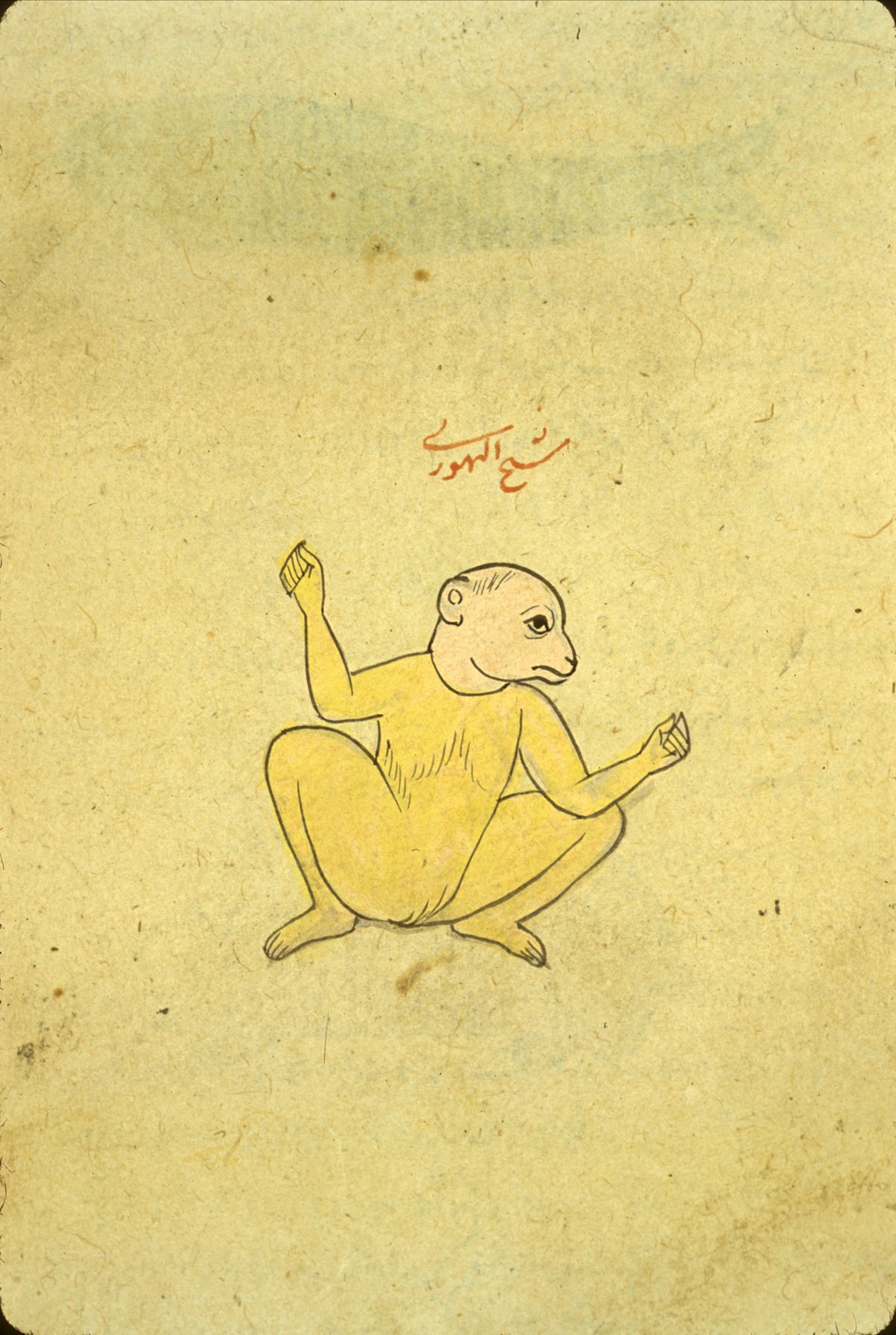
Marvels of Things Created and Miraculous Aspects of Things Existing, by al-Qazwīnī (MS P 2, fol. 63a; chapter on strange creatures of the sea). Punjab, c. 17th c.
Image description: A yellow monkey, labeled shaykh al-huri (master of the fishing-boat), gestures from a squatting position.
*
Back home, mothers, aunts and grandmothers are seated on a carpet in a hall on the second floor, below the attic, where the makeshift wedding feast is in progress. Illuminated by the gentle, oily glow of the few devangirs in the family’s possession, and the soft light of rented gas lamps, the ladies whisper furiously, amongst themselves.
“They are taking lorries full of women.”
“It’s a fate worse than death.”
“Thank the gods. At least the poison has been procured.”
The venom in question, neelthoth, literally ‘the blue interruption’, is commonly used by cotton and wool cleaners.
“The Qabalis may take our lives. But they will not take our daughters.”
The mothers move on to the next item on their worry list. Their sons have been acting waywardly of late and it’s been cause for grave concern.
“I am telling you. It is all that Biscoe’s fault.”
Say what you will about him, and people don’t hold back these days, Biscoe was anything but idle. A Christian missionary of British extraction, tireless reformer, champion coxswain, and part of that energetic social class of young coaxers who went around calling themselves ‘educationalists’, Cecil Tyndale-Biscoe worked in Kashmir for most of his life. Since his arrival in 1890, he is said to have founded six schools with some eighteen hundred students.
“He put these dangerous ideas in their heads.”
Biscoe realized early on that young Kashmiris were clever enough and already spent too much time stooped over their books at home. What they sorely lacked was physical vigor and civic responsibility. To inspire courage and competitive spirit, he made it compulsory for his boys to swim, play football and compete in boat races. To build character and instill a sense of social involvement, he made them volunteer for street cleaning, firefighting, feeding the homeless and the destitute. That was his main mission. He was far less enthusiastic about converting Kashmiri boys to his faith, unless it was to the cult of physical fitness. But he was accused of doing it anyway.
“I hear he made them shake hands with lepers.”
“How did he get away with it?”
He didn’t. After the British reluctantly renounced their empire in India, Biscoe was forced to leave. A staunch imperialist and supporter of the so-called India Defense League, a pressure group dedicated to protecting Britain’s right to rule, he continued championing the cause from a distance. They say he went to one of the last remaining colonies in Africa to defend the ideals of his dying era.
“Do you need more proof?”
“These are disturbing times.”
“The stories get stranger every day.”
“I hear Danvati’s cousin joined the People’s Militia.”
“Must be on her father’s side.”
“They are not straight in that family.”
“He goes around with a big stick all day for the sake of communal harmony.”
“Encouraging others to join.”
“Next thing you know, they’ll be signing up for the army.”
“Can you imagine?”
“The shame of it.”
“Where are these boys?”
“The food is getting cold.”
“We raised them better than that.”
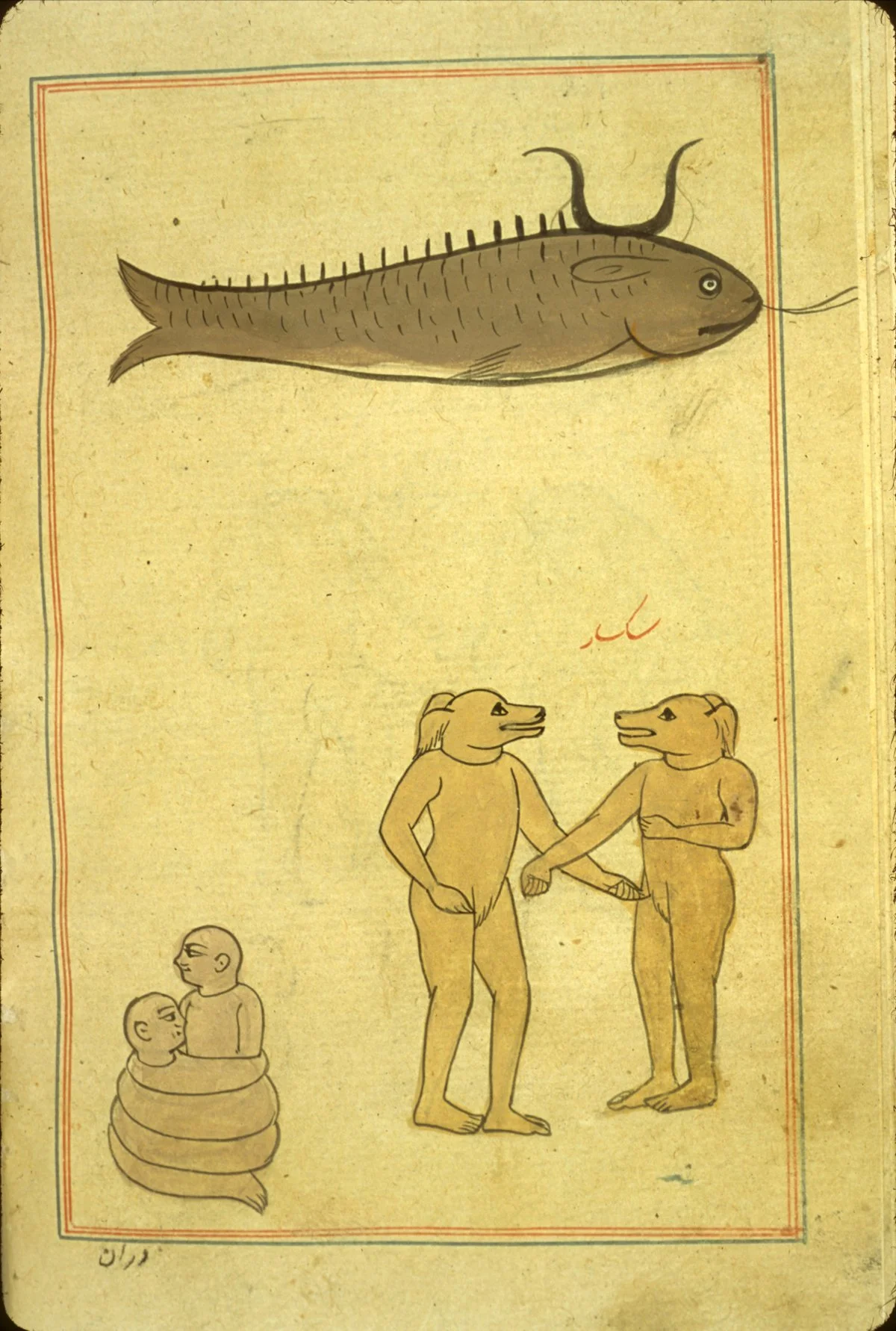
Marvels of Things Created and Miraculous Aspects of Things Existing, by al-Qazwīnī (MS P 2, fol. 59b). Punjab, c. 17th c.
Image description: A horned sea-creature hovers above two dog-headed humans engaged in conversation, while two snake-humans embrace in the left-hand corner. (All are said to be inhabitants of a remote island near the limit of the inhabited world).
*
A respectable distance from his sister’s house, Krundu’s uncle puffs contentedly on an unfiltered Pall Mall under an unlit streetlamp. He could have brought a lalteen for light but didn’t want to draw attention. He intends on enjoying his after-dinner cigarette to the fullest. The way things stand, he may not be able to partake of his preferred brand for a while. He’s down to his last tin, and he’s making an effort to keep unhappy thoughts at bay. They are supposed to be celebrating, after all.
It’s easy to forget when the only news you hear is bad. Or worse. In the absence of an army or police force, one of the political parties took it upon themselves to create a People’s Militia. Volunteers patrol neighborhoods in Srinagar, watching out for miscreants with criminal aspirations, upholding the law and maintaining communal harmony at all costs.
One such volunteer walks the dark street, stretching ahead, with a lalteen and a lathi. Tak. Tak. Tak. The thick wooden stick strikes metaled road at regular intervals, letting residents know somebody is keeping vigil and all is safe. Leaning against the pole, Krundu’s uncle can vaguely make out shapes in the distance emerging from darkness. The knocking stops. Krundu’s uncle doesn’t see Bamzai hand over the unloaded rifle to the volunteer. Or hear him promise to take over the watch after dinner. As far as he can tell, muffled words are exchanged. Somebody coughs. Tak. Tak. Tak. The voices get closer.
“Get a good look,” Krundu’s uncle tells nobody in particular. Because nobody else is around. “Whisky Lal and Soda Ram are here to grace us with their presence.” His nephew and the two louts he calls friends approach into view. He pulls Krundu aside when he’s within pulling distance.
“Show your face to my sister at once,” his instructs his nephew. “She won’t touch her food until she sees you with her own eyes.”
Krundu’s cousin greets him at the door. From a cloth pouch she takes out a pinch of mud colored isband seeds, and touches them to his shoulders, forehead and the crown of his head. She then sprinkles the seeds over hot coals in a kangri. Tik. Tik. Tik. They start crackling and release a pleasing fragrance, like incense, without as much smoke.
“Keeps evil spirits away,” his cousin says.
“And gets rid of body lice,” Bamzai adds, unable to contain himself.
“They should rub the groom down with it,” Raina chimes in.
Krundu’s companions giggle like schoolgirls.
“Have you seen mother?”
“Upstairs.”
Krundu’s mother’s heart almost leaps out of her chest when he steps into the dimly lit hall covered with carpets and sheets. Without wasting words she rushes over, grabs his face in both hands, slaps him on the cheek and sniffs his breath suspiciously for alcohol and cigarettes. She has a sensitive nose for such things. Relieved not to detect their corrupting odor, she kisses him on the forehead.
“Where did you disappear?”
“We didn’t go far. We got lost in the dark.”
“It’s your sister’s wedding. You should be here.”
“I know.”
“You must be hungry. I will have the food warmed. Come, wash your hands. Are those two good for nothings with you?”
“Yes,” Krundu admits, lowering his head in shame.
His mother huffs, hugs him and leaves to organize dinner. Lalteen in hand, she makes her way through the house to the back garden, where the wur, a long platform made with bricks and mud, has been built for the occasion. Wood fires are lit on the platform to cook large pots of food. In the good days there would have been six big brass pots simmering away at all times. Today, there are only three. And none of them have enough salt.
Krundu’s uncle leads Bamzai and Raina upstairs. It’s a rare occasion to see him with both ears free and available. He’s famous in this neighborhood for having one of them firmly attached to the speaker of a transistor radio for as long as the batteries last. He would have been glued to it at this very moment were his niece not getting married. Not that it’s her fault. She didn’t pick the date. The planets decided for her.
“Times are turbulent,” he tells our vigilantes, as they climb the creaking wooden stairs. The lalteen sways in his hand and casts elongated shadows on the freshly plastered, light brown wall. “Two days ago, a village landlord appointed himself the head of government of an independent state.”
“Azad Jammu and Kashmir, he calls it.”
“This time our fearless ruler responded decisively and without hesitation.”
As soon as he heard of the rebellious landlord’s proclamation, the ruler in question fearlessly fled Srinagar for the safety of his palace in Jammu. An act of cowardice so regal and so swift it took his subjects by surprise. When they realized the predicament he had left them in, they renounced all hope. Morale slid into the gutter. Officers abandoned their uniforms and posts. Police stations were emptier than pockets before payday. The air was heavy with a sense of impending doom.
“At least these volunteers are keeping things under check.”
“There would be complete chaos otherwise.”
Bamzai and Raina enter the hall with wolfish grins clinging to their sheepish faces. They see Krundu sitting by himself on the carpet before a sheet of white cloth. A relative pours water for him, from a bronze pitcher, as he washes his hands in a bowl.
Every aspect of this occasion has been compromised. Perhaps none more cruelly than the cooking. The wedding feast, traditionally the pride and joy of Kashmiri Bhatta marriages, has been savagely reduced to three vegetarian dishes and a chutney. That’s all. No meat or fish of any kind. No dairy either. Just thinking about it is enough to make a Kashmiri’s head explode. Krundu’s aunt and her sister bring in the food and serve the boys from brass bowls. Krundu’s aunt avoids eye contact as she scoops up a limp leaf of haq, floating joylessly in a sullen gravy without salt or chili, and deposits it apologetically on his earthenware plate. In addition to monj haq, the beloved kohlrabi dish that’s a regional staple, there is green dal, fried nadru, white rice and horseradish chutney.
Krundu’s aunt looks at her husband with concern. “Hungry already? So soon?”
“Are you trying to kill me? Nobody can stomach this punishment twice.”
“Eat, eat. You need your strength,” Bamzai teases. “Don’t you have to carry the bride tomorrow?”
As per custom, a Kashmiri Bhatta bride did not leave her father’s house through the door after the wedding. If she did, it was believed she could never come back. To avoid this inconvenience, the bride was usually carried out by her maternal uncle through a window, often into a garden. When they came up with this ritual, brides were children and easy to carry. They are almost twice as old these days and considerably heavier. To fulfill their family obligations, this generation of uncles needs to be in much better physical shape than their predecessors. It should have been done tonight, but everybody felt better about leaving it for the light of day.
There won’t be any musical performances either, to the dismay of all present. No instruments to pluck their heart strings. No poetry to praise the follies of youth and passion. The best they can do is swallow their tasteless meal in the dimly lit hall and bless their stars the Qabalis haven’t taken over the city. Yet.
Raina eyes the pitiful pile of food before him with apprehension. “This is no way to live,” he thinks, raising a handful, halfheartedly, to his mouth. Bamzai and Krundu watch with sad eyes but soon follow suit. Three of the finest specimens of modern Kashmiri manhood chew slowly, deliberately, without joy, extracting whatever feeble nutrition one may from this meager excuse for a wedding feast. They wash it down with a healthy volume of water. Nobody says a word. Nothing needs saying. Dark, elongated shadows glide urgently across light brown walls bathed in gentle light. Krundu’s aunt and cousin reappear with second helpings nobody wants.
Exhausted by the demands of holding down dinner, the unholy trinity of vigilante resistance steps out for fresh air. Bamzai and Raina take turns puffing on an unfiltered Pall Mall they scrounged from Krundu’s uncle. He wasn’t gracious about it.
“When are you off to Delhi?” Raina asks absentmindedly.
“As soon as I can,” Krundu replies. “Let the situation settle. Then we’ll see.”
“Meeting prospective in-laws, perhaps?” Bamzai inquires.
“No.”
“Seeing the sights of our young nation’s capital?”
“No.”
“Then what?”
“Higher studies.”
“How much more can you cram into that coconut of yours?”
“Our Bachelor of Philosophy wants to be a master,” Raina chides.
“A suited, booted Master of Philosophy.”
Behind the casual ribbing, the friends realize that the times are changing. And fast. The newly born Republic of India, which emerged a little more than two months ago, promises opportunities on many fronts. Most of them outside Kashmir. For all they know this may well be their last hurrah on home ground. Despite their best intentions, they’re at that precarious age when, at a moment’s notice, a young Kashmiri’s life can swerve away dangerously from happiness. Before they realize it, one or more of them could be hitched to the merciless altar of arranged matrimony for no fault of theirs. The gods forbid. That would put a hard stop to their carefree ways.
“Don’t forget. You promised to take over the watch after dinner.”
“I didn’t. Don’t worry.”
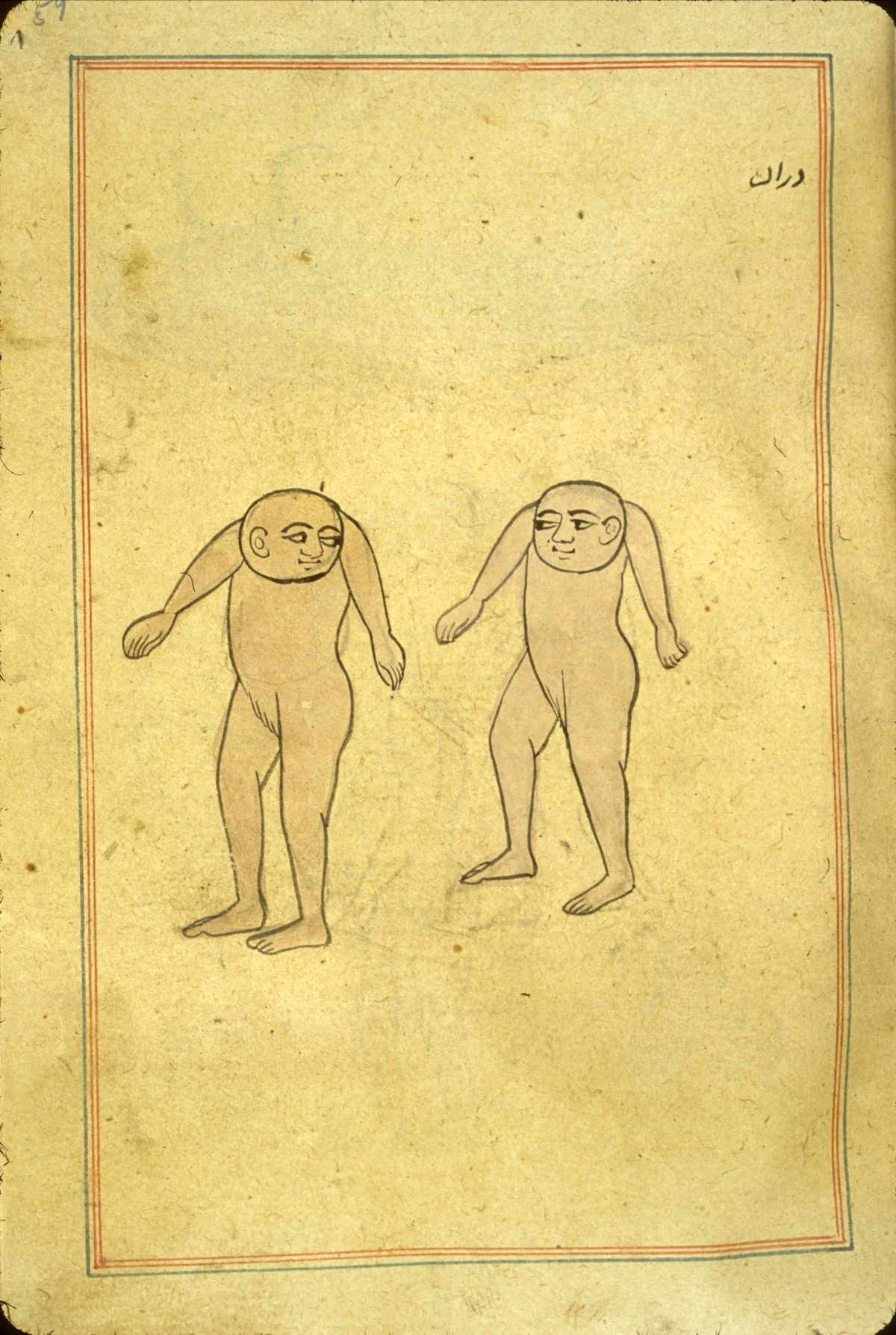
Marvels of Things Created and Miraculous Aspects of Things Existing, by al-Qazwīnī (MS P 2, fol. 59a). Punjab, c. 17th c.
Image description: Two naked figures with their heads on their chests stand looking at each other. They are said to be inhabitants of a remote island near the limit of the inhabited world…
*
Later that night, elsewhere in Kashmir, a young Qabali, of the Afridi clan, spreads his threadbare woolen blanket on hard ground in the dark courtyard of an abandoned house. He kicks off his straw slippers and lowers his rifle with relief. Lying down by his firearm, he takes a deep breath. Six months ago, he was a shepherd in the mountains. One could barely call the meager growth on his face a beard. Now he’s a restless soldier in an invading army of mercenaries. And he’s lucky to be alive. The young Afridi stretches his tired body. He hasn’t been able to sleep since he set foot in this foreign land.
Things made sense when he joined the Qabali militia. They talked about liberating their Muslim brothers and sisters from the oppression of Hindus and Sikhs. The mission, they were told, was to make Kashmir a part of Pakistan, which the Muslim majority wanted. So far, most of the Kashmiris he’s seen don’t look like they have any desire to be liberated. The young Afridi raises an earthen pitcher to quench the fire in his throat.
The invasion started out strong. Too strong, perhaps. He watched in dismay as they relaxed, lost their sense of urgency and squandered their advantage. He can’t understand why they’ve halted their advance on Srinagar. They could have captured it days ago. And celebrated Eid like they were supposed to. After the city was secured they would have had their pick of the spoils. That was the plan.
Hearing of their advance, Hindus and Sikhs fled their villages. As expected, they haven’t faced any resistance from Muslims, either. Except in a few cases. A Kashmiri shepherd was one of the first. When asked for directions, he sent an advance column of Qabalis the wrong way. One look at the hundreds of armed foreigners must have convinced him they hadn’t come to spread good cheer. The misdirection delayed them by several critical hours. When they realized they’d been duped, the Qabalis returned with fury and executed him. As a fellow shepherd, the young Afridi couldn’t help but admire his Kashmiri counterpart’s courage and presence of mind.
In every town and village they’ve been in, some locals have seemed friendly and willing to help. Most looked scared. The Qabalis, however, had been warned not to trust anybody. As a rule, they haven’t accepted food from Kashmiris for fear of poisoning. They prefer taking goats and sheep from villagers, slaughtering the animals and roasting the meat themselves. They were preparing a feast in the forest tonight. Indian planes spotted them and dropped more bombs on their heads than they could count. In the dark, they couldn’t tell how many men they lost. Bodies were scattered throughout the forest.
Unbeknownst to the young Afridi, the ruler of Jammu and Kashmir, after months of royal vacillation, signed an agreement earlier in the day, legally making his once princely state part of the democratic Republic of India. While the ink of his noble signature was still drying, the Indian army and air force sprang into action to defend their new territory. A few hours later, the young Afridi finds himself alone in the courtyard of this village house recently abandoned by a Hindu family. He wishes his companions were with him.
Most of the Qabali army hails from six tribal clans. Getting them to do anything in unison is almost impossible. There’s a very short list of things they agree upon. Looting and pillaging are high on it. Yet again, his tribal brothers have been distracted too easily by greed and short-term gain. They plundered the treasury, robbed shops and burned their empty remains. His fellow fighters have taken sacks of grain and sugar, crates of hair oil, boxes of soap, whatever they can. The young Afridi saw one of his clan carting away cases of alum. Like most Qabalis, the clansman in question was a full bearded fellow. When asked what he was going to do with the aftershave, since he didn’t intend on taking a razor to his face anytime soon, he shrugged.
“Maybe I will sell it.”
They’ve been busy loading up lorries with cows and horses to send back home. And lorries full of women, too many women, weeping and wailing on empty stomachs. His companions think he’s a fool for not securing a good looking wife or two while he has the chance. Each time an enterprising Qabali carries off a helpless Kashmiri woman against her wishes, his brothers in arms shoot the sky to salute his virility. He shakes his weary head. Some people behave like bullets grow on trees.
The young Afridi closes his eyes and begs sleep to hold him, as it once did.
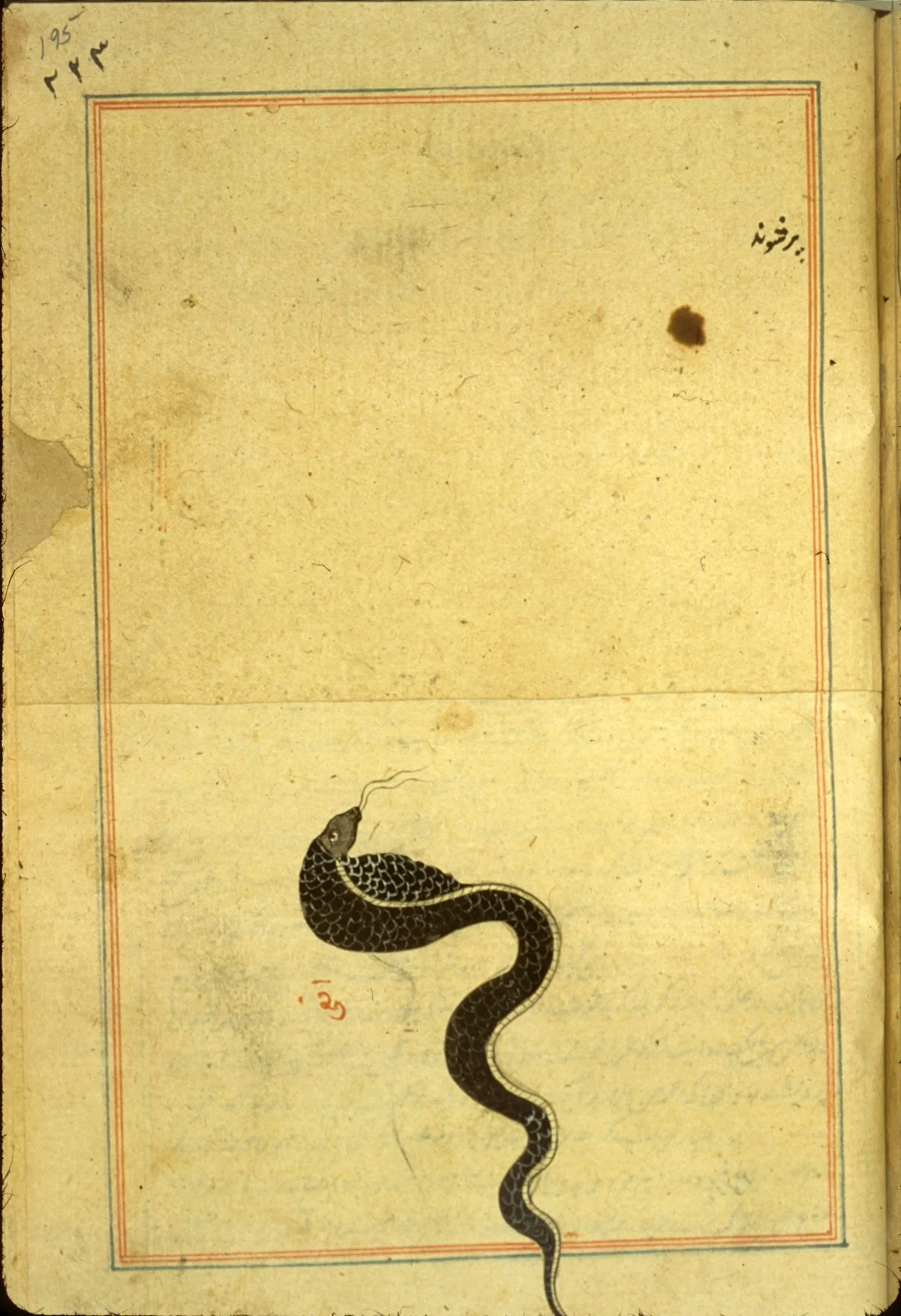
Marvels of Things Created and Miraculous Aspects of Things Existing, by al-Qazwīnī (MS P 2, fol. 195a). Punjab, c. 17th c.
Image description: A cobra, labeled af‘á (viper), lies in the lower half of the page, its tongue flicking upwards while its tail uncoils beyond the bottom border and off the edge of the page.
Born in Lucknow. Based in Boston. Kapil Kachru’s poems and stories have appeared in journals, magazines, chapbooks, and anthologies in India, Japan, the Netherlands, the UK and the US, including Inverse Journal, La Piccioletta Barca, NOON: journal of the short poem, The Bangalore Review, and The Bombay Literary Magazine. Negligible Inertia, his debut collection of poems, was published by Writers Workshop, India.
*
Pages from Ajā’ib al-makhlūqāt wa-gharā’ib al-mawjūdāt (Marvels of Things Created and Miraculous Aspects of Things Existing) (MS P2) by Zakarīyā’ ibn Muḥammad al-Qazwīnī (d. 1283/682). Both the copyist and the illustrator remain unknown and the copy is undated. Likely was produced in provincial Mughal India, possibly in the Punjab, in the 17th century. Collection of Islamic Medical Manuscripts, National Library of Medicine, Bethesda, MD. More info: https://www.nlm.nih.gov/hmd/arabic/natural_hist4.html

“Last names come first in Japanese, you racist piece of—” a brawl, a funeral, and a stolen father in a short story by Jay Lindstrom.